Executive Overview
Transitioning artificial intelligence agents from isolated experimental prototypes to mission-critical production environments has long exposed a fundamental infrastructure gap. While serverless architectures and microVMs excel at short-lived, stateless invocations, complex multi-step agentic workflows routinely span hours, days, or even weeks. These advanced systems demand persistent states, seamless collaboration between specialized agents, shared contexts, direct operating system access, and occasional high-performance GPU acceleration for data-intensive or compute-bound tasks.
Addressing these challenges head-on, Amazon Web Services (AWS) has announced the general availability of runtime instances within the Amazon Bedrock AgentCore Runtime ecosystem. This complementary compute option supplies AWS-managed Amazon Elastic Compute Cloud (EC2) infrastructure purpose-built for enterprise-grade, complex agent workloads. By bridging the gap between lightweight microVMs and heavily customized self-hosted infrastructure, runtime instances allow developers to deploy multiple distinct agents onto a single managed host. These agents can securely share artifact types, dependencies, and a persistent local file system within sessions that can endure for up to 14 days.
The introduction of runtime instances effectively eliminates the heavy operational lifting historically required to maintain long-running agent infrastructure. Rather than manually provisioning EC2 instances, configuring complex VPC routing, establishing custom session-management layers, and stitching together disparate observability platforms, development teams can now leverage managed capacity providers. These seamlessly integrate with existing AgentCore APIs, robust identity controls, and deep observability tooling. Whether orchestrating autonomous software engineering pipelines, running continuous background code reviews, or orchestrating multi-agent collaboration frameworks (such as CrewAI, LangGraph, LlamaIndex, or Strands), runtime instances provide a reliable, scalable foundation for the next generation of generative AI applications.
Detailed Chronology
The evolution of agentic computing infrastructure has accelerated rapidly as enterprises demand systems capable of autonomous, goal-directed reasoning over extended time horizons. The release of Amazon Bedrock AgentCore runtime instances marks a major milestone in this trajectory, born from years of customer feedback regarding the friction of moving prototype agents into production.

The Prototype-to-Production Bottleneck
In the early phases of the generative AI boom, developers relied primarily on lightweight serverless functions and isolated container tasks to execute individual model prompts. As agent architectures evolved from simple prompt-response chains to autonomous reasoning loops—such as ReAct (Reasoning and Acting) paradigms—the limitations of stateless infrastructure became glaringly apparent.
- State Persistence Failures: Workflows lasting longer than a few minutes frequently dropped context when underlying execution nodes spun down.
- Collaboration Overhead: Multi-agent systems attempting to pass data between specialized entities (e.g., a code writer and a code reviewer) were forced to serialize large payloads, make redundant network API calls, or build custom external database layers just to share working files.
- Compute Constraints: Tasks requiring direct file system access, heavy package installations, or GPU acceleration could not be easily accommodated within standard serverless limits.
The Hybrid Architecture Strategy
Recognizing these pain points, AWS engineered AgentCore Runtime with a dual-compute strategy:
- Runtime MicroVMs: Ideal for lightweight, fast-scaling, short-duration invocations (up to 8 hours) with managed session storage. Perfect for orchestrators and API-driven task routers.
- Runtime Instances: Purpose-built for persistent, long-running (up to 14 days), GPU-accelerated, and multi-agent collaborative workloads operating on shared dedicated hosts.
Step-by-Step Implementation Walkthrough
To demonstrate the practical application of runtime instances, developers can configure a multi-agent environment consisting of a Python Code Writer and a strict Code Reviewer operating on a shared file system.
Step 1: Establishing the Capacity Provider
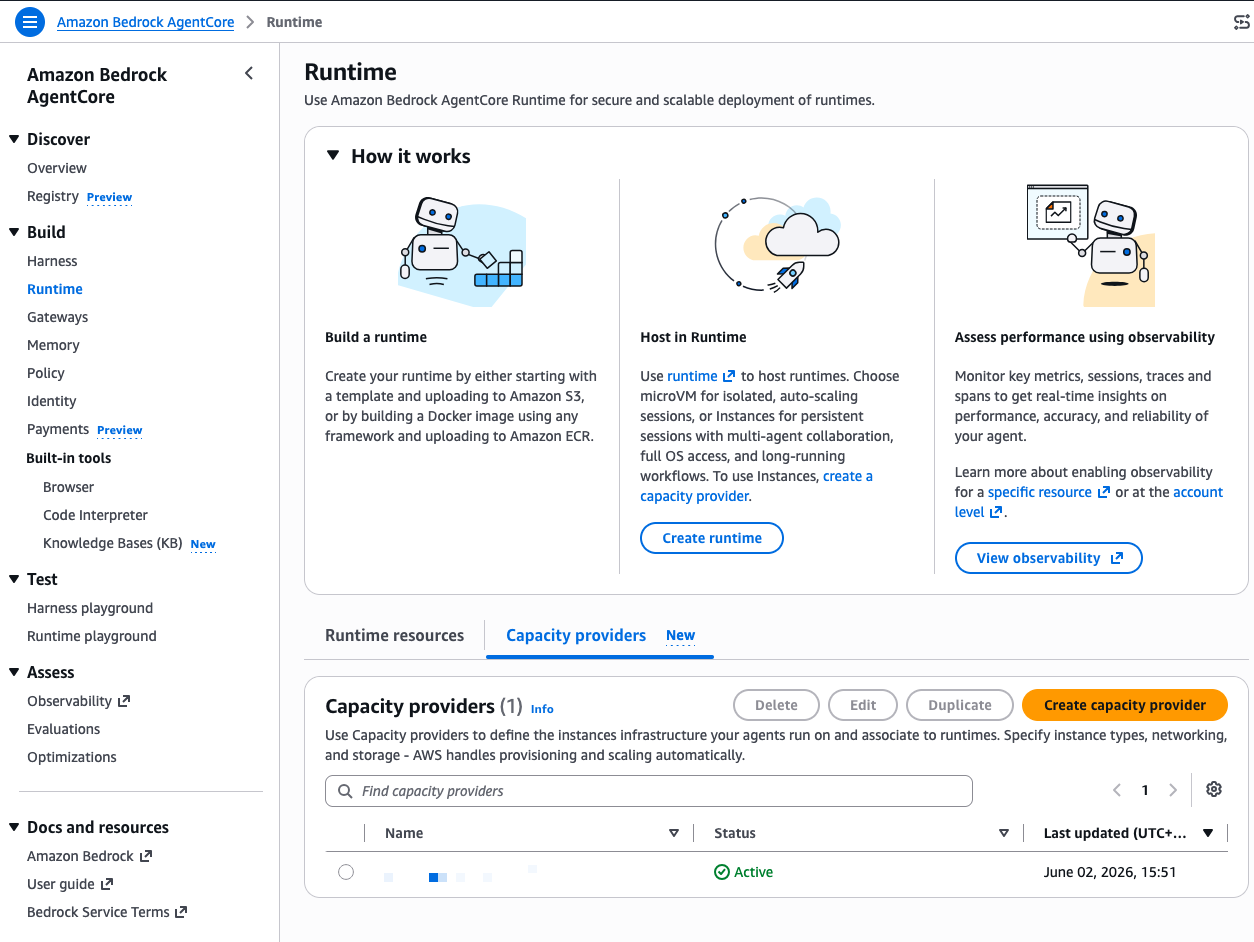
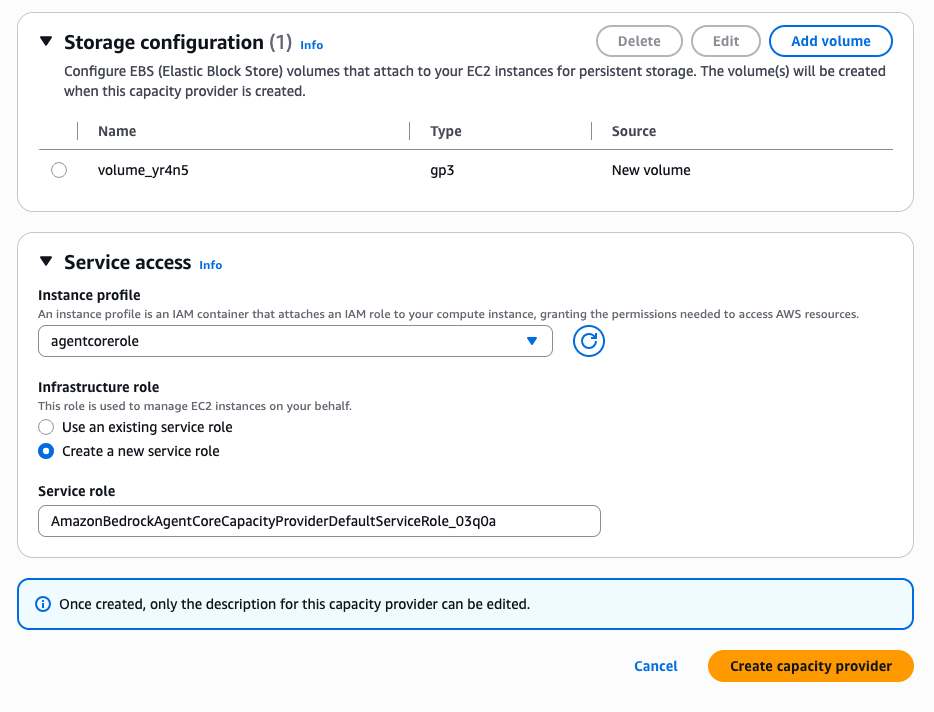
The foundational step involves defining the underlying EC2 compute infrastructure via a capacity provider. Within the Amazon Bedrock console, administrators navigate to the Runtime section, select Capacity providers, and configure the environment:
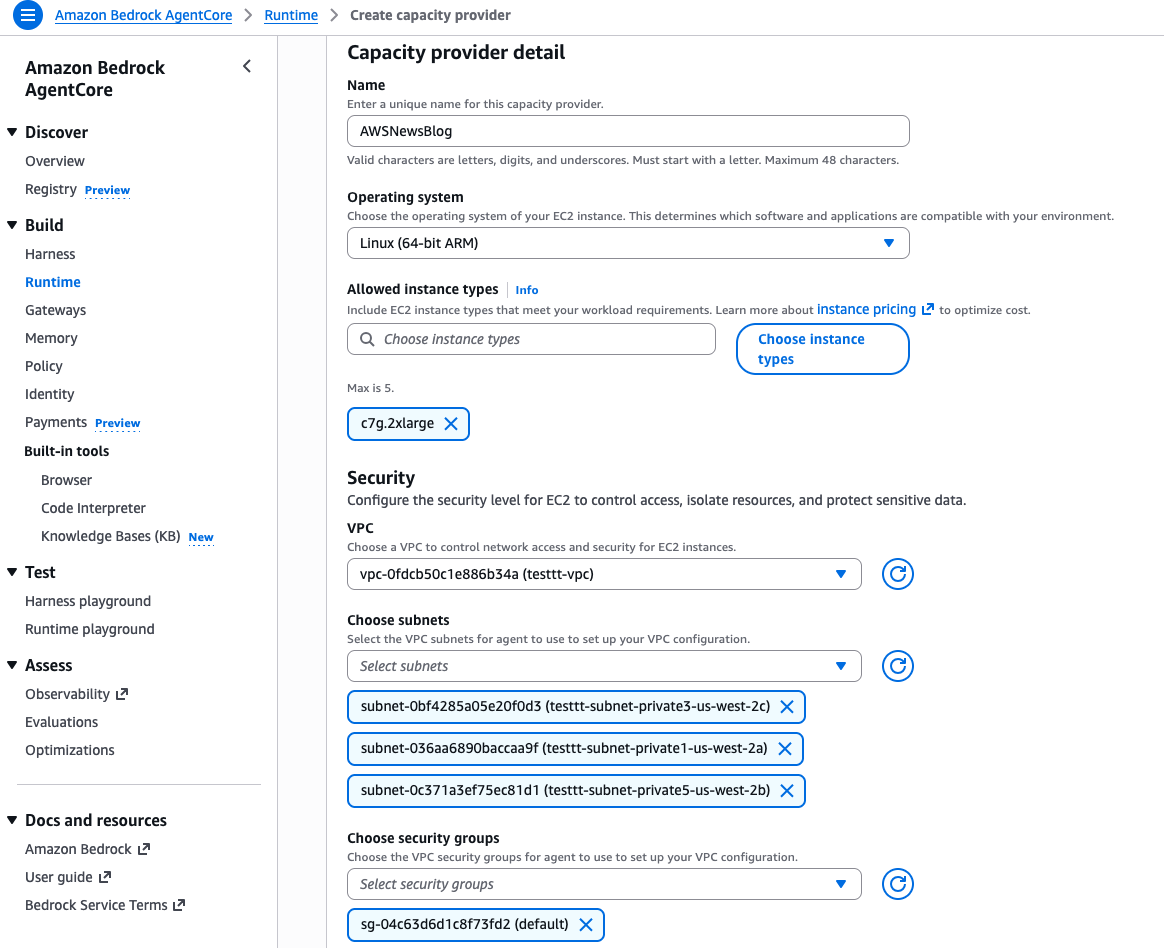
- Operating System: Linux (64-bit ARM)
- Instance Type:
c7g.2xlarge(providing 8 vCPUs and 16 GiB of memory, sufficient for side-by-side agent execution). - Networking & Storage: Configured within a designated Virtual Private Cloud (VPC), utilizing standard gp3 elastic block storage volumes and an auto-provisioned AWS service role to manage instances securely.
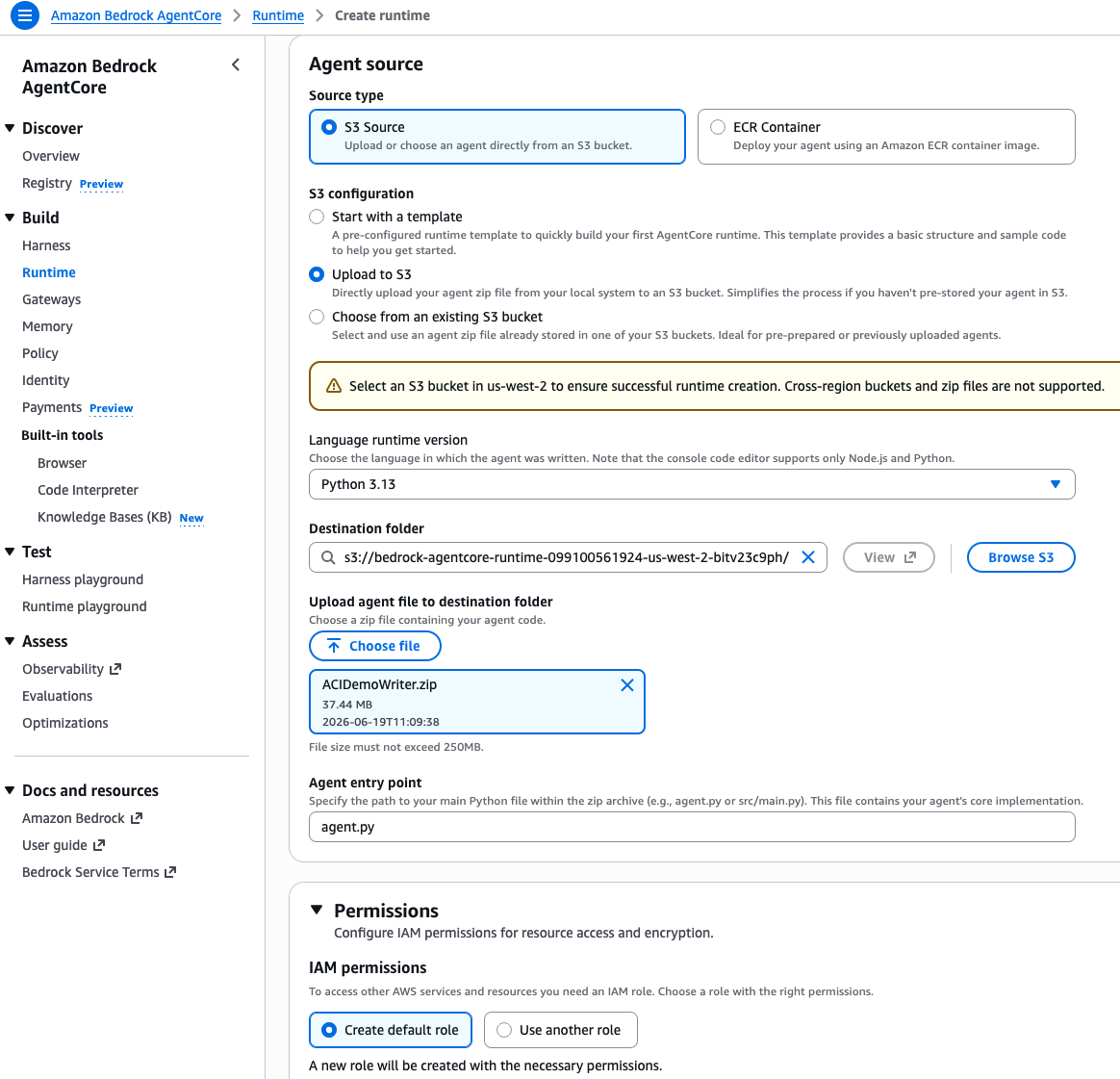
Step 2: Deploying the Agent Runtimes
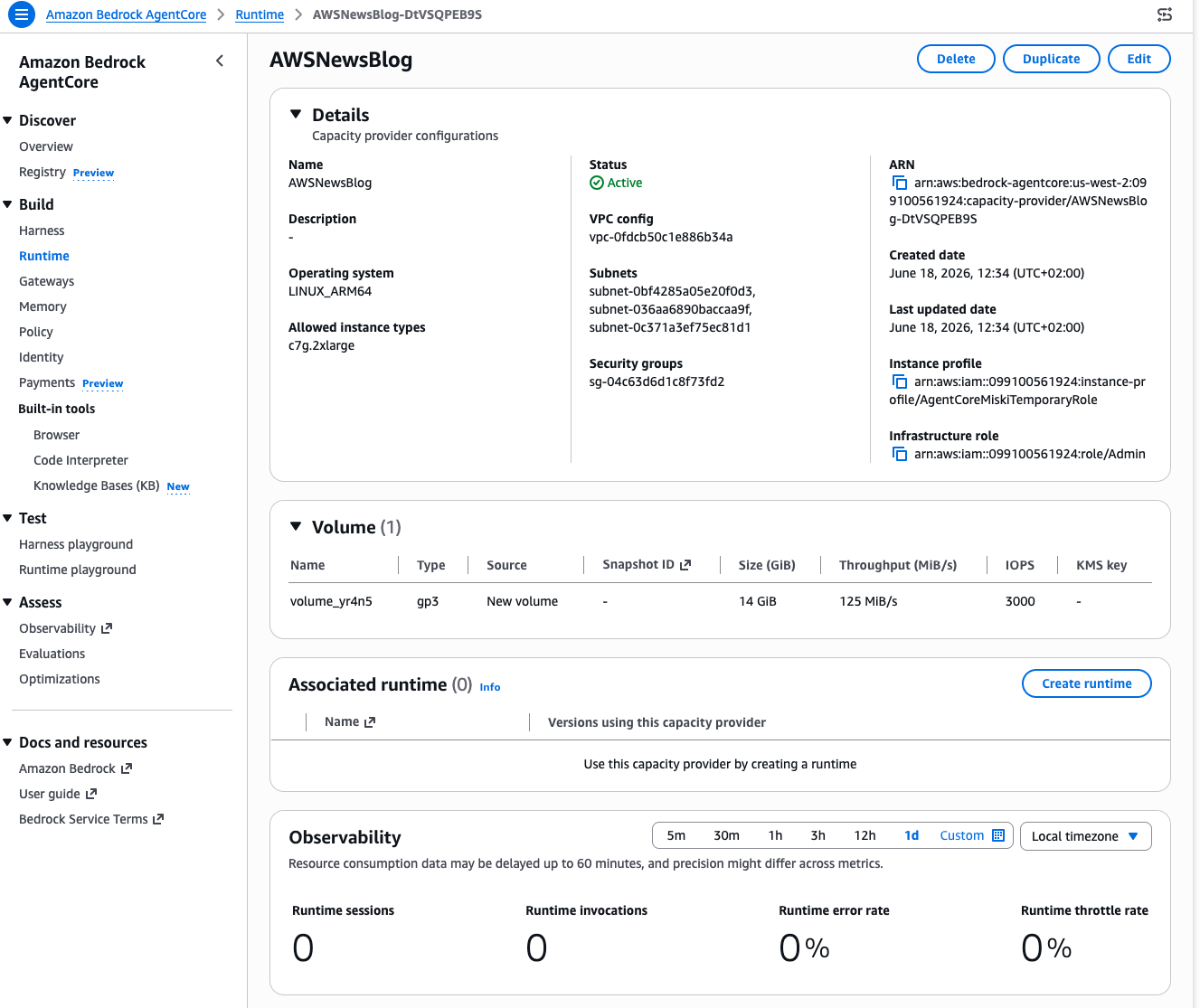
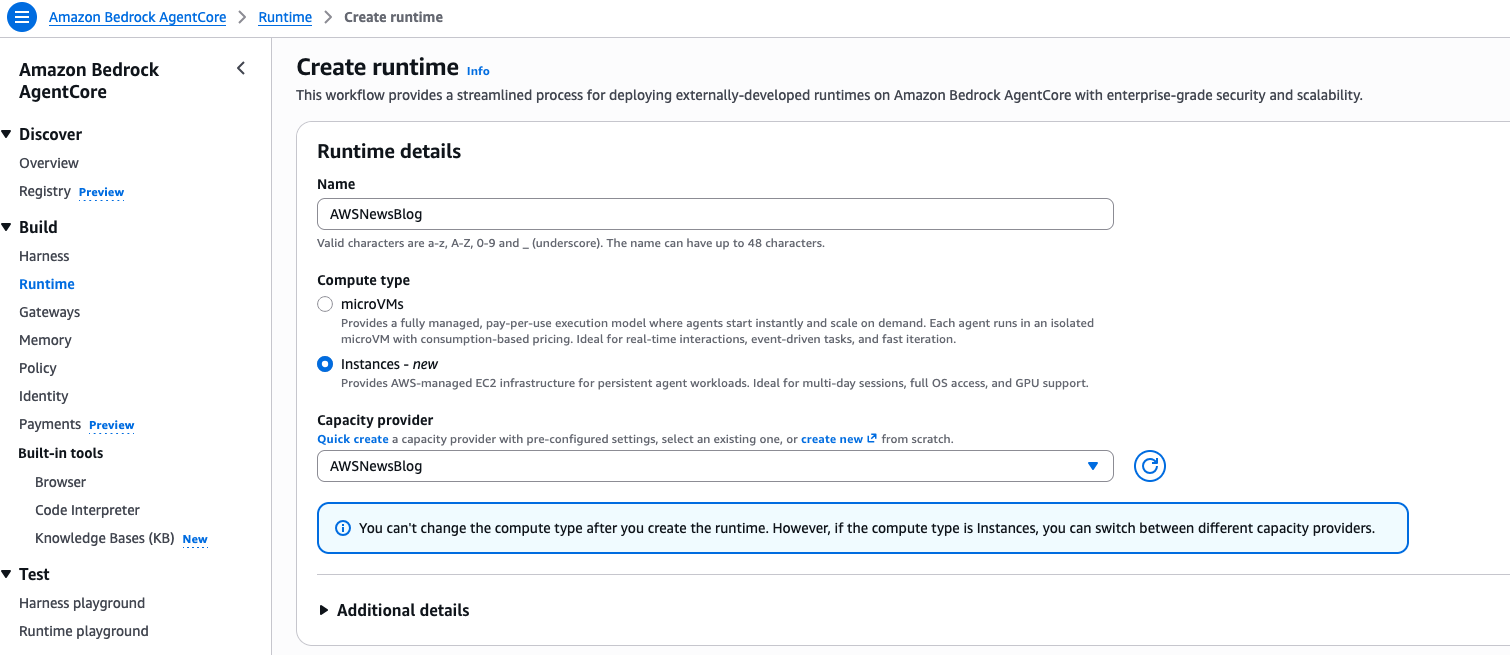
Once the capacity provider achieves an Active status, developers create individual runtimes specifying Instances as the compute type.
- Agent Source: Deployed via S3 source code packages (
.ziparchives containing the agent logic). - Language Runtime: Python 3.13.
- Entry Point: Defined via decorators (
@app.entrypoint) that interface cleanly with frameworks like Strands Agents.
By provisioning separate runtimes for the Code Writer and Code Reviewer while mapping them to the same underlying capacity provider, both agents gain access to the host’s shared local environment.
Step 3: Executing and Observing Collaboration
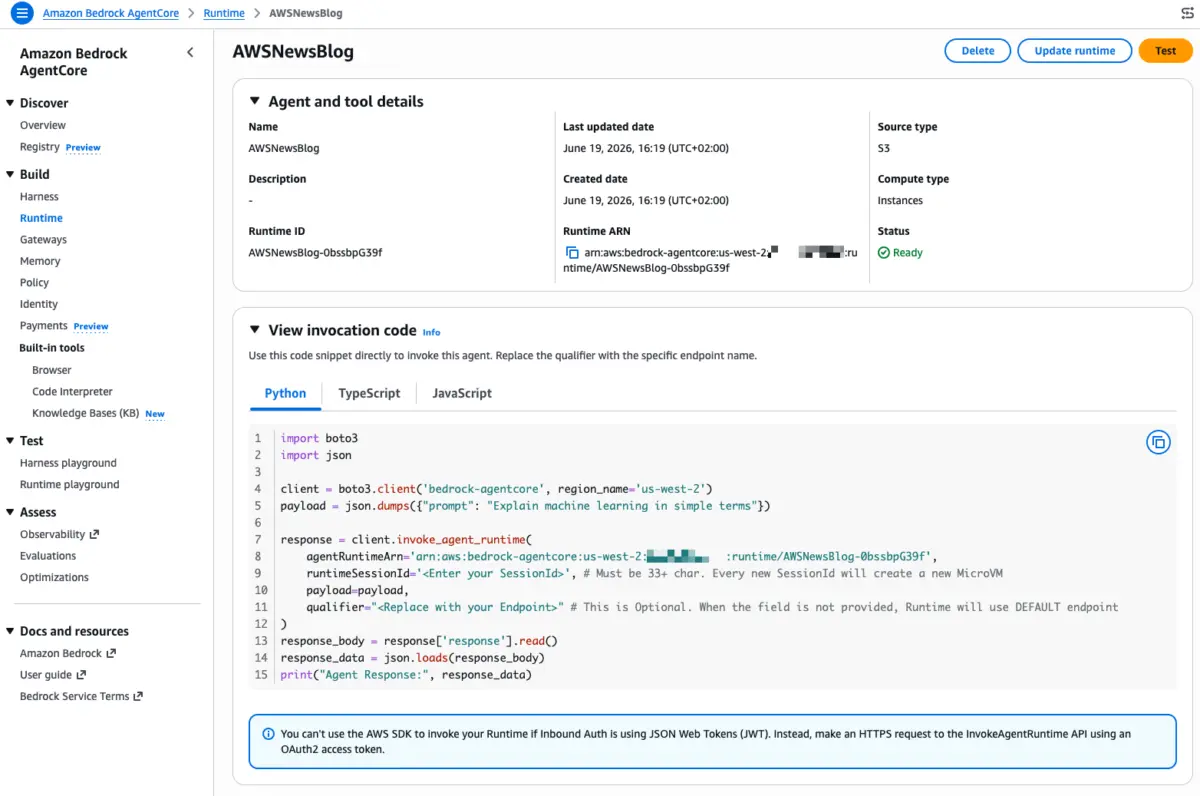
Using the built-in Runtime playground or programmatic API calls, developers initiate a workflow by passing a JSON payload to the writer agent (e.g., "prompt": "write a fibonacci suite").
- The writer agent generates the requested Python module and writes it directly to a local, session-specific directory path (
/tmp/agentcore-session/session_id/code.py). - Because the session ID is preserved, switching the active runtime context to the Code Reviewer while retaining the exact same Session ID allows the reviewer agent to immediately read
code.pyfrom the local file system. - The reviewer agent performs a rigorous static analysis, returning targeted feedback on bugs, style, and syntax improvements without making a single external API call or data transfer to exchange the file.
Supporting Context & Metrics
The architectural shift toward persistent runtime instances is heavily supported by modern enterprise workload requirements. Analyzing the technical specifications and operational metrics reveals why managed EC2-backed agent runtimes are essential for scaling AI infrastructure.
Technical Specification Matrix
| Feature Category | Runtime MicroVMs | Runtime Instances (New) |
|---|---|---|
| Max Invocation / Session Duration | Up to 8 hours | Up to 14 days (with hibernate/resume support) |
| Underlying Infrastructure | AWS-managed microVMs | AWS-managed Amazon EC2 instances |
| Multi-Agent Collaboration | Supported via API routing | Direct shared host / shared file system |
| Hardware Acceleration | Standard CPU environments | Full GPU acceleration support for compute-intensive tasks |
| State Persistence | Managed session storage | Amazon EBS integration & AgentCore Memory |
| Deployment Packaging | Minimal container / zip | Container images or zip files with @app.entrypoint |
Cost Efficiency and Resource Management
Long-running agent workflows frequently encounter idle periods where agents wait for human approval, external webhooks, or asynchronous database queries. Runtime instances incorporate native session stop/restart capabilities, allowing development teams to hibernate complex workflows overnight (e.g., pausing on Monday night and resuming Wednesday morning) without losing in-memory state or session artifacts. This capability drastically reduces unnecessary compute expenditure during non-active operational windows.
Furthermore, the integration with Amazon Elastic Block Store (Amazon EBS) and AgentCore Memory ensures that foundational knowledge survives well beyond individual sessions. While short-term artifacts reside in the shared session directory, long-term recall and institutional knowledge are safely persisted across environment boundaries, giving AI agents reliable long-term memory.
Official Statements
Industry architects and AWS engineering leaders have emphasized the transformative impact of these capabilities on enterprise software development lifecycles.
"When developers attempt to transition autonomous AI agents from experimental sandboxes to production environments, infrastructure complexity expands exponentially," noted senior AWS engineering advocates during the launch. "Agents require robust state management across multi-day workflows, high-speed communication channels for multi-agent collaboration, and direct access to specialized hardware like GPUs. By introducing runtime instances alongside our existing microVM architecture, we are providing developers with the ultimate flexibility—allowing lightweight orchestrators to delegate heavy, persistent compute tasks to dedicated, secure EC2 infrastructure without sacrificing the simplicity of AgentCore APIs."
Architecture teams deploying complex autonomous pipelines have similarly highlighted the reduction in operational overhead. By abstracting the manual configuration of EC2 scaling, security groups, instance profiles, and session orchestration, AWS enables engineering groups to focus entirely on agent prompt engineering, framework selection (such as LangGraph, CrewAI, or LlamaIndex), and core business logic.
Future Outlook
The launch of Amazon Bedrock AgentCore runtime instances signals a broader industry evolution: the maturation of AI agents from reactive text-generators into proactive, autonomous digital workers capable of sustained, multi-day problem solving.
Anticipated Technological Trajectories
- Autonomous Software Engineering Workflows: With agents capable of writing, compiling, testing, and reviewing code continuously over extended periods within secure shared environments, automated software factories will become standard enterprise fixtures. Security scanning, automated patching, and continuous integration pipelines will increasingly be driven by collaborating agent teams operating on dedicated runtime instances.
- Advanced GPU-Accelerated Agentic Tasks: As agents expand into domains requiring localized machine learning fine-tuning, computer vision, and complex GUI automation (such as browser-based testing or desktop navigation), the native GPU acceleration supported by runtime instances will become indispensable.
- Hybrid MicroVM and Instance Topologies: The future of enterprise AI lies in sophisticated hierarchical architectures. Lightweight orchestrator agents running on ultra-fast runtime microVMs will dynamically dispatch complex sub-tasks to specialized worker pools running on persistent runtime instances. This hybrid approach maximizes cost efficiency while delivering maximum compute power precisely where it is needed.
As organizations worldwide embrace autonomous agent technologies, infrastructure solutions like Amazon Bedrock AgentCore runtime instances will serve as the bedrock upon which reliable, scalable, and secure enterprise AI systems are built.