Executive Overview
As federal and state legal scrutiny intensifies around former United States President Donald Trump, the intersection of high-stakes jurisprudence, rapid social media dissemination, and advanced generative artificial intelligence has produced an unprecedented cultural moment. Prosecutors in New York have moved increasingly closer to potentially filing an indictment against the former commander-in-chief in connection with a clandestine hush-money payment made to former adult film actress Stormy Daniels in the final weeks of the 2016 presidential campaign. Should this indictment materialize, it will carve a definitive and turbulent path into American history, marking the very first time a current or former occupant of the Oval Office faces criminal charges.
Yet, even as legal scholars, political pundits, and citizens await the official word from the Manhattan District Attorney’s office, the public imagination has raced far ahead of the courtroom doors. Across the globe, observers are envisioning—some with grave concern, others with gleeful fascination—what the physical apprehension and processing of a former American president might actually look like. Among those leaning into this speculative digital frontier is Eliot Higgins, the 44-year-old founder of Bellingcat, the renowned open-source investigative journalism organization celebrated for its meticulous tracking of global conflicts and covert operations.
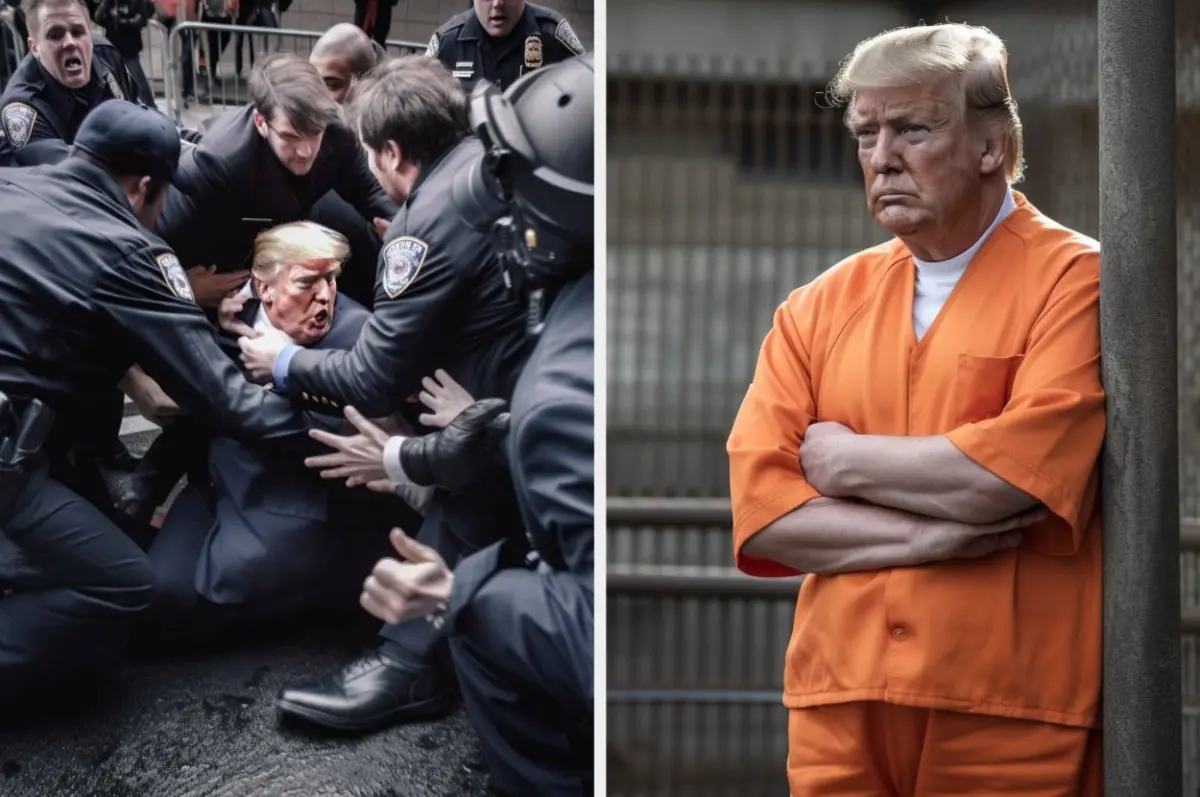
This week, Higgins traded geopolitical forensics for speculative art, utilizing the state-of-the-art AI image generator Midjourney to fabricate a sprawling, highly detailed visual narrative of Donald Trump’s fictional arrest. Publishing a thread of approximately 50 hyper-realistic images on Twitter, Higgins watched in real-time as his synthetic gallery went viral, generating millions of impressions, intense debates, and severe institutional pushback. By Wednesday, Higgins announced that Midjourney had effectively banned him from its service, while the platform quietly blacklisted the keyword “arrested” to stanch the flood of similar political fabrications.
This extensive report examines the anatomy of Higgins’ viral experiment, the technological capabilities and ethical perils of contemporary generative AI platforms, the legal realities of the unfolding New York grand jury proceedings, and the profound, long-term implications that synthetic media poses for the future of truth, democratic governance, and public discourse.
Detailed Chronology: From Grand Jury Rumors to a Viral AI Ban
To understand the sudden collision between artificial intelligence and American political theater, it is necessary to trace the rapid timeline of events that unfolded over a frantic week in March.
The Legal Lead-Up and Speculative Anticipation
The groundwork for the viral images was laid by mounting speculation surrounding the grand jury convened by Manhattan District Attorney Alvin Bragg. For weeks, media outlets reported that law enforcement agencies and security forces in New York City were quietly preparing contingency plans for potential civil unrest or formal legal proceedings involving Donald Trump. The core of the investigation centered on a $130,000 payment made by Trump’s former fixer and attorney, Michael Cohen, to Stormy Daniels (whose legal name is Stephanie Clifford) to prevent her from publicly discussing an alleged affair ahead of the 2008-leaning election cycle.
As journalists camped outside the Manhattan Criminal Court and Trump himself took to social media to predict his imminent arrest on a Tuesday, the public zeitgeist reached a fever pitch of anticipation.
The Experiment and the Twitter Thread
It was within this charged atmosphere that Eliot Higgins decided to test the limits of generative AI. Known globally for debunking state propaganda and war crimes through satellite imagery and geolocation data, Higgins turned his critical eye toward the predictive capabilities of Midjourney v5, one of the most powerful text-to-image synthesis models available to the public.
Beginning with simple conceptual queries, Higgins quickly scaled up the complexity of his prompts. He sought to construct a cohesive, cinematic sequence of events that chronicled an alternate reality:
- The Apprehension: Higgins prompted Midjourney to render the chaotic scene of Donald Trump being physically subdued and swept up by law enforcement officers on the bustling streets of New York City, remarkably positioned just outside a building bearing an eerie, uncanny resemblance to Trump Tower.
- Family Reactions: Expanding the narrative arc, he generated images depicting how members of Trump’s immediate family—including Melania and Donald Trump Jr.—might visually react to the unfolding drama, capturing expressions of shock, defiance, and media bombardment.
- Incarceration and Trial: Pushing the synthetic narrative further into the speculative abyss, Higgins generated bleak, highly textured portraits of what Trump’s theoretical life behind bars might look like, complete with orange jumpsuits, prison yards, and holding cells.
Higgins packaged these creations into a sprawling thread of roughly 50 images and published them to his Twitter account, accompanied by wry commentary acknowledging that he was merely exploring the technological capabilities of the platform.
Viral Velocity and Platform Retaliation
The response was instantaneous and overwhelming. Within hours, the images were retweeted tens of thousands of times, viewed by millions, and picked up by mainstream news aggregators. While many tech-literate users immediately recognized the distinct visual artifacts, lighting quirks, and anatomical deformities characteristic of early 2023 generative AI (such as strangely warped hands, floating uniform badges, and uncanny facial blending), a vast segment of the general public accepted the images at face value.
For hours, these hyper-realistic fakes circulated on social media platforms as genuine documentary photographs of a historic arrest. The sheer speed of the deception alarmed content moderators and platform architects alike.
By Wednesday, the reckoning arrived. Eliot Higgins announced via Twitter that his access to the Midjourney platform had been summarily revoked. Without issuing an immediate public statement to press inquiries, Midjourney administrators updated their internal safety filters and moderation protocols. The platform swiftly banned the word "arrested" from user prompts entirely—a heavy-handed technical barrier designed to prevent further generation of images depicting law enforcement actions against real-world political figures.
Supporting Context & Metrics: The Mechanics and Dangers of Synthetic Media
The incident involving Eliot Higgins and Midjourney is far more than an isolated internet prank; it serves as a watershed moment for the capabilities and perils of generative artificial intelligence. To grasp the gravity of this event, one must examine the underlying technology and the measurable impact of deepfakes on modern information ecosystems.
The Technological Leap: Midjourney v5 and Beyond
Generative adversarial networks (GANs) and diffusion models—the technological backbone behind platforms like Midjourney, OpenAI’s DALL-E 2, and Stability AI’s Stable Diffusion—have evolved at a breakneck pace. Just two years prior, text-to-image models produced blurry, surrealist collages that struggled to render human faces, hands, or legible text with any degree of consistency.
However, the rollout of Midjourney v5 introduced unprecedented photorealism. Capable of simulating complex skin textures, cinematic lighting, accurate reflections, and nuanced emotional expressions, v5 blurred the line between imagination and documentary evidence. When applied to familiar public figures whose faces are plastered across global media every second of the day, the AI model can leverage massive training datasets to synthesize hyper-convincing likenesses in seconds.
The Metrics of Misinformation
The velocity of modern social media ensures that synthetic falsehoods routinely outpace factual corrections. According to digital trust and safety analysts:
- Engagement Disparity: Content featuring sensationalized political narratives—whether true or false—generates an average of 6 times more engagement on major social platforms than dry, nuanced investigative journalism.
- Perceptual Bias: Psychological studies consistently demonstrate the "illusory truth effect," wherein individuals are more likely to believe a false statement—or a fabricated photograph—if they have been exposed to it multiple times, or if it aligns with their pre-existing political biases.
- The Verification Gap: While open-source investigators like Higgins can easily spot synthetic anomalies, the average consumer lacks the training, time, or skepticism required to interrogate the metadata and visual inconsistencies of high-resolution AI art.
The Weaponization of "Plausible Deniability"
Beyond outright deception, the proliferation of hyper-realistic generative images introduces a secondary, highly insidious societal threat: the "liar’s dividend." As deepfakes and AI-generated imagery become ubiquitous, bad actors can dismiss genuine photographic or video evidence of wrongdoing as mere "AI fakes." When the public can no longer trust what they see with their own eyes, authoritarian regimes, corrupt politicians, and white-collar criminals gain an unprecedented shield of plausible deniability.
Official Statements and Industry Response
The fallout from the Midjourney ban and the viral Trump arrest images prompted swift commentary from technology developers, free-speech advocates, and political commentators alike.
Eliot Higgins and the Intent of Open-Source Exploration
Defending his experiment, Eliot Higgins maintained that his intentions were entirely transparent and educational. Speaking to journalists shortly after his account was suspended, Higgins explained:
"I’ve just been playing around with various prompts to see what’s possible and how complex you can make it. The goal wasn’t to deceive people maliciously, but to test the boundaries of what these systems can render regarding high-profile political events that occupy the global consciousness."
Higgins argued that by stress-testing the technology in public view, he was actively demonstrating to the world how easily synthetic media could be weaponized—thereby forcing tech companies to confront their own safety shortcomings before a major crisis forces their hand.
Midjourney’s Silent Enforcement and Policy Shifts
Midjourney, operating as a lean and agile research lab, chose not to issue an immediate public press release addressing Higgins’ specific suspension. However, the platform’s administrative actions spoke volumes. By restricting the service and explicitly banning terms related to the arrest of prominent political figures, Midjourney signaled a defensive pivot toward content moderation.
In its broader terms of service, Midjourney prohibits the generation of misleading or defamatory images intended to deceive the public. Yet, enforcing these guidelines across millions of concurrent users generating millions of images per day remains a Sisyphean task. The blanket ban on specific keywords like "arrested" highlights the blunt-instrument approach currently favored by AI developers—sacrificing creative nuance for rapid risk mitigation.
Legal and Ethical Reactions
Legal experts tracking the intersection of First Amendment rights and AI generation noted that while Higgins’ actions fell under creative expression, they skirted dangerously close to defamation and public disruption laws.
Civil liberties organizations expressed cautious concern over platform censorship. While agreeing that malicious deepfakes targeting political figures pose a severe threat to elections and civil order, digital rights advocates warned against heavy-handed keyword bans that could inadvertently stifle legitimate political satire, artistic expression, and whistleblowing documentation.
Future Outlook: Navigating the Synthetic Horizon
As the legal drama surrounding Donald Trump continues to unfold in New York and beyond, and as generative artificial intelligence cements its place in mainstream software suites, society stands at a critical crossroads. The events of this past week have exposed deep vulnerabilities in our information architecture, offering a stark preview of the challenges that lie ahead.
1. The Need for Advanced Provenance Standards
To combat the rising tide of synthetic misinformation, the technology sector must accelerate the adoption of cryptographic content provenance standards. Initiatives such as the Coalition for Content Provenance and Authenticity (C2PA) are working to embed tamper-evident metadata into digital images at the point of capture or generation. Cameras, smartphones, and AI software would cryptographically sign media files, allowing platforms and users to instantly verify whether an image is a genuine photograph captured by a human lens or a synthetic output synthesized by a neural network.
2. Evolving Platform Governance and Moderation
AI developers can no longer afford to treat safety as an afterthought. Platforms like Midjourney, OpenAI, Stability AI, and Google must invest heavily in proactive safety filters, semantic understanding of context, and real-time abuse detection. Rather than relying on blunt keyword blacklists—which are easily bypassed by creative prompt engineering—future moderation systems must evaluate the intent, context, and potential societal harm of generated assets.
3. Media Literacy and Public Skepticism
Ultimately, technological safeguards alone will never be entirely foolproof. A sustained, global investment in media literacy is paramount. Educational curricula must adapt to the realities of the synthetic age, teaching students, professionals, and citizens how to critically evaluate visual media, recognize common AI artifacts, and demand rigorous source verification before sharing sensational content across social networks.
Conclusion
Eliot Higgins’ playful yet provocative experiment with Midjourney was dismissed by some as a digital stunt, but its reverberations were profoundly serious. It forced a collision between the fragile reality of our political institutions and the boundless, destabilizing potential of generative artificial intelligence. As we step further into an era where seeing is no longer believing, society must collectively build the legal, technological, and cognitive armor required to protect truth from the pixels of illusion.