Executive Overview
To the casual observer, digital payment systems appear deceptively simple. A user initiates a transaction via a web browser or mobile application, a payment gateway processes the transfer of funds, a webhook notification fires asynchronously, and the application updates the corresponding subscription, order, invoice, or digital wallet. In a utopian world of uninterrupted networks and flawless microservices, this happy path forms the bedrock of modern e-commerce.
However, production environments are rarely so forgiving. Servers experience unexpected outages, webhooks arrive hours late or fail entirely due to transient HTTP errors, background workers crash mid-execution, and socket requests time out after capital has already moved across financial rails. When these asynchronous cracks form, a critical divergence occurs: the payment provider holds the accurate, authoritative state of the transaction, while your internal application database remains oblivious, outdated, or persistently stuck in a "pending" state.
This gap between external financial reality and internal application state represents one of the most perilous vulnerabilities in modern software engineering. Left unaddressed, it leads to catastrophic financial leakage, compromised customer trust, and severe accounting discrepancies.
Reconciliation is the architectural countermeasure designed to discover and repair these hidden gaps. Far more than a simple database script, modern payment reconciliation is a rigorous, automated discipline that compares multi-system states, resolves asynchronous race conditions, handles out-of-order events, and enforces strict data idempotency. This comprehensive report explores the systemic fragility of event-driven payment flows, the mathematical and architectural mechanics of multi-system state reconciliation, and the battle-tested engineering patterns required to build self-healing financial systems.
Detailed Chronology: The Anatomy of a Payment Processing Failure
To understand why automated reconciliation is non-negotiable, one must first examine the exact mechanics of how distributed payment workflows break down in production.
Phase 1: The Illusion of the Happy Path
Most payment integrations are born out of rapid prototyping. Developers write code for the happy path: the user clicks "Pay," a checkout session is generated, the provider captures funds, and a webhook fires a payment_intent.succeeded event to an endpoint. The server catches the payload, updates the database, and provisions access.
Phase 2: The Network Partition and Infrastructure Failures
In reality, the moment money moves, you enter the unpredictable domain of distributed systems. Consider a common failure cascade:
- The Webhook Blackout: A user successfully completes a 3D Secure authentication and authorizes a charge. The payment provider immediately dispatches a webhook. However, your application’s ingress controller is restarting during a rolling deployment, or your API gateway experiences a temporary 504 Gateway Timeout. The webhook is dropped or permanently lost.
- The Worker Crash: Your application successfully receives the webhook, verifies its cryptographic signature, and pushes a job onto an internal message queue (such as RabbitMQ, AWS SQS, or Redis). Shortly after accepting the job, the worker node running the consumer process runs out of memory and crashes. The transaction update is never written to the database.
- The Downstream Partial Failure: The database transaction applying the payment succeeds, but a subsequent downstream call—such as updating an enterprise resource planning (ERP) system, provisioning a cloud license, or syncing with a CRM—fails. If the transaction lacks proper saga pattern orchestration or compensation mechanisms, the system enters an inconsistent, half-completed state.
Phase 3: Cascading Consequences
When these failures accumulate, the business consequences are immediate and severe. If a customer paid $500 for an annual software subscription, but their local record remains marked as "unpaid" due to a missed webhook, your automated billing engine may eventually revoke their access or trigger aggressive dunning emails. Conversely, if a customer initiates a chargeback or requests a refund, and your system fails to ingest the corresponding event, your platform may continue servicing a user who has effectively stolen your product or service.
These are not rare edge cases; they are statistical certainties at scale. Once capital is involved, treating distributed system anomalies as anomalies is an architectural failure. The system must assume that messages will be dropped, delayed, or duplicated, and architect its defenses accordingly.
Supporting Context & Metrics: Defining Reconciliation and Mapping Records
What Reconciliation Means in Payment Systems
At its core, reconciliation is the systematic process of comparing the operational state of a financial transaction across disparate system boundaries and dynamically resolving what should be true.
Reconciliation answers fundamental operational questions:
- Did the money that left the customer’s bank account successfully land in our merchant account?
- Does every successful charge at the payment provider have a corresponding, fulfilled order inside our application database?
- Are there pending orders where payment failed at the gateway, but our system is still granting digital access?
- Have any refunds, chargebacks, or disputes been issued externally that our local database has failed to reflect?
The Divergence of System States
Reconciliation inherently involves cross-boundary state comparison. Your internal application maintains its own isolated database domain, typically housing tables and models such as:
-- Internal Application State Schema Example
payment_transactions (id, user_id, amount, status, provider_reference_id)
subscriptions (id, user_id, plan_id, current_period_end, status)
orders (id, customer_id, total_amount, fulfillment_status)
invoices (id, order_id, pdf_url, issued_at, status)
wallets (id, user_id, balance, currency)
processed_webhooks (id, event_id, received_at, signature)
Simultaneously, the third-party payment provider (e.g., Stripe, Adyen, PayPal) maintains an entirely independent, authoritative ledger containing:
// External Provider Ledger Concepts

  "charges": "Collection of authorized and captured funds",
  "transfers": "Payout movements to bank accounts",
  "invoices": "Provider-generated billing statements",
  "events": "Immutable audit log of all system state changes",
  "refunds": "Reversals of captured capital",
  "settlements": "Batched daily financial clearings"
Reconciliation bridges these two realms. If the provider asserts that a charge succeeded, but the local payment_transactions table marks it as pending, reconciliation steps in to bridge the gap, applying the missed business logic safely and idempotently.
The Role, Limits, and Superiority of Hybrid Webhook-Polling Architectures
Why Webhooks Are Not Enough
Webhooks are brilliant for achieving near real-time user experiences, but they are fundamentally flawed as a sole source of truth. A webhook is a network packet sent across the public internet. It can be:
- Delayed: Traffic spikes at the provider can queue webhooks for hours.
- Duplicated: If your server fails to return a
200 OKHTTP status code within a strict timeout window, the provider will aggressively retry the transmission. - Dropped: Misconfigured firewalls, load balancer rules, or DNS outages can swallow payloads entirely.
The Hybrid Model: Active Reconciliation loops
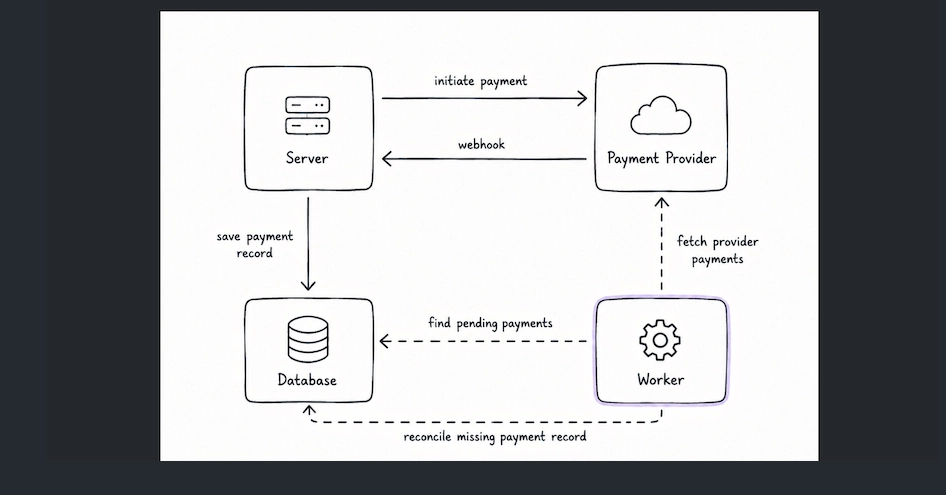
To build bulletproof payment infrastructure, engineering teams must adopt a hybrid model: use webhooks for real-time responsiveness, but pair them with scheduled, authoritative reconciliation polling loops.
A production-grade reconciliation worker operates on a continuous cadence (e.g., executing every hour or triggered during application startup). It queries the payment provider’s API for all financial activity within a specified lookback window, compares those records against unresolved internal transactions, and programmatically applies any missing state transitions through the exact same execution pipeline that processes webhooks.
Architectural Deep Dive: Mapping, Out-of-Order States, and Idempotency
1. Mapping Provider Payments to Internal Records
A successful API response or webhook payload from a payment provider confirms that money has moved, but it rarely contains enough native context to tell your application what product, subscription, or user that capital belongs to.
A provider charge object contains raw primitives: an amount, a currency, a timestamp, and a provider ID. It does not inherently know about your internal database primary keys. Therefore, robust reconciliation requires deterministic identifiers embedded via metadata during the checkout creation phase:
- Idempotency Keys: Passed during API calls to ensure client-side retries do not spawn duplicate charges.
- Metadata Tags: Injecting internal
order_id,user_id, orsubscription_idinto the payment provider’s metadata payload. - Client Reference IDs: Unique business strings that persist across both systems, allowing direct SQL-level indexing and joins.
Without these stable identifiers, reconciliation degrades into dangerous guesswork, forcing engineers to manually parse logs and make assumptions about funds.
2. Handling Out-of-Order Payment States
In distributed systems, message ordering is notoriously fragile. It is entirely common for an application to receive a terminal succeeded event before receiving an older, delayed processing or initiated event.
If an application blindly updates database records based strictly on the timestamp of arrival, a race condition can occur where an older processing event overwrites a completed status, incorrectly demoting a successful transaction back to an active state.
[Arrival Time: T1] --> Event: payment.processing (Created at T-10m)
[Arrival Time: T2] --> Event: payment.succeeded  (Created at T-5m)
If processed out of order without state precedence guards, T1 could overwrite T2.
To prevent this, payment state machines must be built with strict state precedence rules. Terminal states (such as succeeded, refunded, or failed) must take hierarchical precedence over intermediate states (pending, processing, requires_action), regardless of when the message physically arrived at your server. Reconciliation logic must evaluate the semantic weight of the state rather than relying on naive chronological overwrites.
3. Engineering Idempotency in Reconciliation Flows
When a reconciliation worker discovers a missed payment and attempts to apply its resolution, that execution must be strictly idempotent.
Because reconciliation jobs can be retried, overlap with concurrent webhook deliveries, or be executed across multiple worker instances in a cluster, running the recovery logic twice must never result in double-crediting a wallet, provisioning dual subscriptions, or duplicating financial ledgers.
Engineering teams achieve bulletproof idempotency through layered defenses:
- Application-Level Checks: Querying the database to check if the transaction state is already finalized before executing business logic.
- Distributed Locks: Utilizing distributed locking mechanisms (such as Redis Redlock) around specific transaction IDs during processing windows.
- Database-Level Unique Constraints: Enforcing unique database constraints on provider reference IDs and processed event logs. If a worker attempts to insert an already-recorded event or payment reference, the database engine rejects the operation via a constraint violation, halting duplicate execution at the storage layer.
-- Example of Database-Level Idempotency Constraint
ALTER TABLE processed_webhooks
ADD CONSTRAINT unique_provider_event
UNIQUE (provider_name, event_id);
Official Statements and Industry Standards
Financial technology leaders and regulatory bodies increasingly emphasize the necessity of automated reconciliation as a core pillar of cyber-resilience.
Industry standards, including the Payment Card Industry Data Security Standard (PCI-DSS) and various international financial auditing frameworks, mandate rigorous tracking of financial flows and audit trails. According to leading payments architecture whitepapers published by tier-one gateway providers:
"An event-driven architecture without automated periodic reconciliation is fundamentally incomplete. Webhooks optimize for speed, but reconciliation guarantees systemic integrity. Financial engineering requires treating all external inputs as untrusted and asynchronous until verified against a canonical ledger."
Furthermore, engineering post-mortems from major SaaS and fintech platforms consistently reveal that millions of dollars in unclaimed revenue or accidental over-provisioning stem directly from the absence of automated cross-system reconciliation.
Future Outlook: Autonomous Ledgers and AI-Driven Anomaly Detection
As global payment ecosystems evolve toward instant, cross-border, and multi-currency rails (such as real-time payments (RTP) and blockchain-settled transactions), the complexity of financial reconciliation will scale exponentially.
Looking toward the future, the next generation of payment infrastructure is moving away from reactive cron-job reconciliation toward continuous, event-stream reconciliation powered by machine learning and immutable append-only ledgers.
- Immutable Event Sourcing: Modern architectures are increasingly adopting event-sourcing patterns where every state change is stored as an immutable append-only log. This eliminates the risk of destructive database updates and provides a native, tamper-evident audit trail for real-time reconciliation.
- AI-Driven Anomaly Detection: Rather than relying solely on rigid threshold queries, future systems will utilize machine learning models to detect subtle financial discrepancies in real time—identifying micro-leaks, unusual fee structures, latency spikes in gateway settlements, and fraudulent chargeback patterns before they impact enterprise balance sheets.
- Autonomous Self-Healing Rails: Advanced orchestration engines will autonomously negotiate disputes, re-route failed transactions across redundant acquiring banks, and execute self-healing compensation transactions without human intervention.
Conclusion
Payment processing is not merely a software integration; it is a direct conduit for organizational capital and customer trust. While webhooks provide the illusion of seamless real-time automation, the realities of distributed systems dictate that failures, timeouts, and network partitions are inevitable.
By implementing robust, hybrid reconciliation workflows anchored by stable identifiers, strict state precedence rules, and unyielding database-level idempotency, engineering teams can transform their payment pipelines from fragile, error-prone dependencies into resilient, self-healing financial engines capable of scaling securely into the future.