Executive Overview
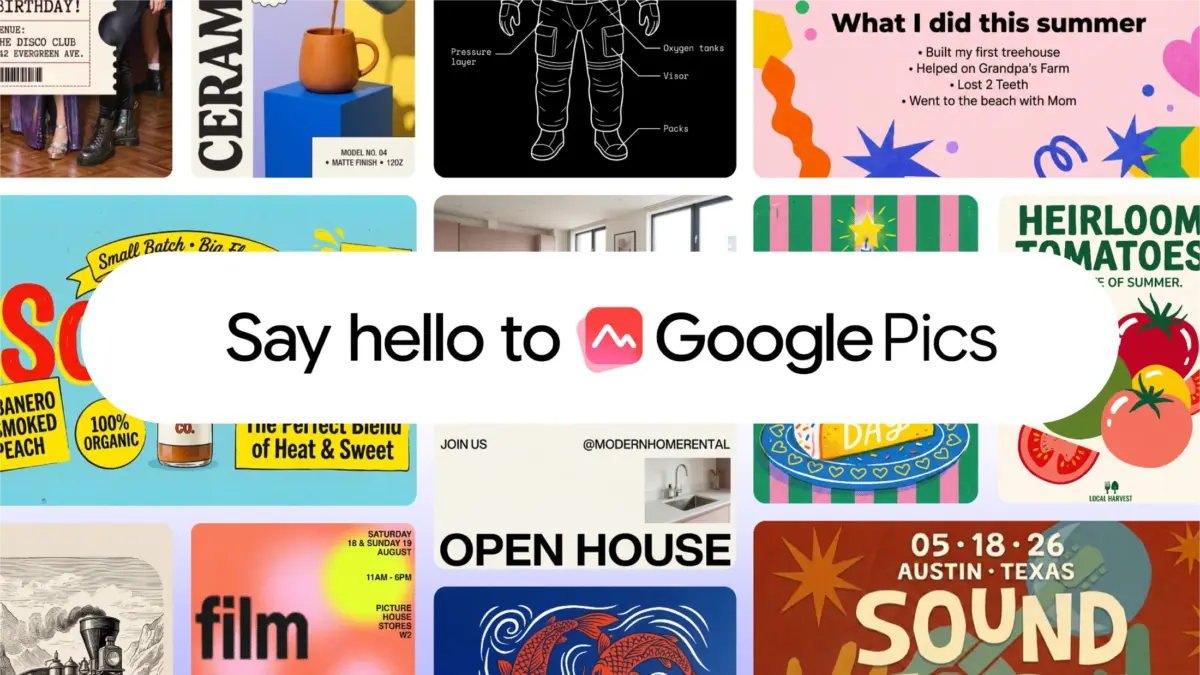
In a direct bid to capture the rapidly growing enterprise visual design market, Google has officially launched Google Pics, a cloud-native image creation and editing application powered by its proprietary "Nano Banana" image-generation model. Integrated directly into the Google Workspace ecosystem and made available to Google AI Pro and Ultra subscribers, the platform signals a decisive shift in how corporate visual assets are created, manipulated, and distributed across global organizations.
By embedding generative visual capabilities into everyday productivity workflows—starting immediately with Google Docs and Google Slides before expanding to Google Drive—Google is positioning itself to disintermediate incumbent creative suites. Rather than relying on traditional graphic creation software or template marketplaces, Google Pics pivots enterprise design toward a prompt-driven paradigm.
However, the product’s release brings long-standing structural tensions to the fore. Unlike established visual design platforms like Canva, which maintain creator marketplaces and royalty structures for human artists, Google Pics operates entirely on an artificial intelligence framework trained on vast repositories of existing digital art. Furthermore, while creative software ecosystems like Adobe Express focus on providing granular canvas controls for visual professionals, Google Pics leverages generative automation to allow non-designer corporate workers to synthesize and modify imagery using natural language prompts. This strategic expansion exposes deep friction between corporate productivity optimization, traditional software subscription models, and the ethics of generative AI training datasets.
Detailed Chronology of the Rollout and Infrastructure Integration
The deployment of Google Pics represents a calculated, phased rollout strategy designed to immediately lock in enterprise end-users while progressively scaling infrastructure demands across Google Cloud data centers.
+-----------------------------------------------------------------------------------+
|                         GOOGLE PICS ROLLOUT TIMELINE                              |
+-----------------------------------------------------------------------------------+
|  PHASE 1: Immediate Launch                                                        |
|  • Deep integration into Google Docs and Google Slides                            |
|  • Initial rollout to select Enterprise Workspace & Google AI Pro/Ultra tiers     |
+-----------------------------------------------------------------------------------+
                                         |
                                         v
+-----------------------------------------------------------------------------------+
|  PHASE 2: Mid-Term Expansion (Next 2–4 Weeks)                                     |
|  • Full platform integration across Google Drive ecosystem                        |
|  • Global availability for standard Google Workspace business tiers               |
+-----------------------------------------------------------------------------------+
                                         |
                                         v
+-----------------------------------------------------------------------------------+
|  PHASE 3: Enterprise-Wide Ubiquity                                                |
|  • Cross-app canvas sync, advanced batch prompt operations, real-time collaboration|
+-----------------------------------------------------------------------------------+
Phase 1: Native Document Integration (Day One)
Effective immediately, Google Pics has begun appearing within the contextual menus and side panels of Google Docs and Google Slides. Users on premium enterprise plans can call upon the "Nano Banana" image engine directly within document layouts, eliminating the need to context-switch between third-party image applications, stock photo repositories, and content presentation tools.
Phase 2: Core Workspace Expansion (Coming Weeks)
Over the coming weeks, the rollout will expand to encompass broader Google Workspace customer bases alongside individual subscribers paying for top-tier consumer AI packages, including Google AI Pro and Google AI Ultra. During this window, Google Pics will be introduced as a standalone and native hub within Google Drive, allowing users to generate, catalog, edit, and organize visual assets outside the confines of a specific document or presentation deck.
Technological Foundation: The ‘Nano Banana’ Engine
Underpinning the deployment is Google’s proprietary "Nano Banana" model architecture. Engineered to balance ultra-low latency with high semantic fidelity, the model operates natively within the Google Cloud TPU (Tensor Processing Unit) infrastructure. Designed specifically for contextual spatial understanding, Nano Banana excels at interpreting enterprise-oriented prompt parameters—such as brand color constraints, typography placement, and layout boundaries—enabling high-resolution image generation and localized pixel-level manipulation without requiring dedicated desktop GPUs.
Supporting Context & Structural Market Analysis
The introduction of Google Pics represents a structural realignment of the enterprise software visual design market, putting direct pressure on long-time market leaders Adobe and Canva.
+-----------------------------------------------------------------------------------------+
|                              CREATIVE TOOL ARCHITECTURE COMPARISON                      |
+-----------------------------------------------------------------------------------------+
|  Feature / Metric     | Google Pics               | Canva                 | Adobe Express|
+-----------------------+---------------------------+-----------------------+--------------+
| Core Paradigm        | Prompt-Driven Generative  | Template/Asset Hybrid | Canvas/Layer |
| Creator Royalty Hub   | No (Model Trained on Art) | Yes (Marketplace)     | No           |
| Enterprise Sync       | Native Workspace Sync     | API / Cloud Sync      | Creative Cloud|
| Text In-Image Editing | Semantic Translation/Edit | Basic Text Overlay    | Vector/Text  |
| Primary Audience      | Corporate Knowledge Worker| Marketers & SMBs      | Creators/Pros|
+-----------------------------------------------------------------------------------------+
Comparative Ecosystem Dynamics: Google Pics vs. Canva and Adobe Express
To understand the industry impact of Google Pics, one must analyze how its underlying product philosophy contrasts with established players:
1. The Monetization & Creator Royalty Disconnect (Google Pics vs. Canva)
Canva’s dominant growth engine relies on a dual-sided marketplace model. Independent graphic designers, illustrators, and photographers publish custom templates, vector elements, and stock photography onto Canva’s platform, earning ongoing royalties based on subscriber usage.
Google Pics bypasses this economic model entirely. Instead of connecting enterprise workers with human-designed templates, Google Pics relies on its synthetic AI engine—trained on massive public datasets composed of human artistic output—to generate visual concepts on demand. For enterprise users, this translates to zero licensing overhead and unlimited visual variations; for the creative community, it underscores growing concerns regarding AI models monetizing stylistic traits without direct creator attribution or financial compensation.
2. Prompt Generation vs. Manual Precision (Google Pics vs. Adobe Express)
Adobe Express serves as a bridge between high-end digital creation suites (Photoshop, Illustrator) and quick-turn corporate publishing. Its user interface prioritizes vector adjustments, precise layer blending, typography hierarchies, and strict canvas-based assembly.
In contrast, Google Pics operates primarily through natural language prompting. It is fundamentally designed for non-designers who prioritize speed and iteration over pixel-perfect vector manipulation. Rather than building a composite design piece-by-piece on a canvas, a user directs the Nano Banana engine to render, transform, or re-contextualize visual elements using descriptive text, drastically lowering the barrier to entry for enterprise asset generation.
Feature Architecture and Enterprise Utility
Beyond raw image generation, Google Pics incorporates specialized semantic editing capabilities explicitly designed for modern corporate workflows:
- Object Isolation and Semantic Transformation: Users can highlight specific elements within a generated or uploaded image to remove, swap, or rescale objects through plain-text commands (e.g., "replace desk with a modern conference table").
- In-Image Text Modification and Localized Translation: Leveraging Google’s multi-modal translation architecture, Google Pics can isolate text rendered inside an image layout and translate or update it directly, preserving the original font style, perspective, lighting, and shadow effects.
- Multi-Generation Selection & Real-Time Collaboration: Following enterprise collaboration patterns established in Docs and Sheets, Google Pics allows multiple team members to concurrently edit prompts, review generated image iterations side-by-side, and finalize visual assets in real time within a shared workspace document.
+-----------------------------------------------------------------------------------+
|                        GOOGLE PICS CORE WORKFLOW ENGINE                           |
+-----------------------------------------------------------------------------------+
|                                                                                   |
|   [ Natural Language Prompt ]                                                     |
|                |                                                                  |
|                v                                                                  |
|   [ "Nano Banana" Model Processing Engine ]                                       |
|                |                                                                  |
|                +-----------------------+-----------------------+                  |
|                |                       |                       |                  |
|                v                       v                       v                  |
|     [ Semantic Isolation ]   [ Text Modification ]   [ Generative Variations ]|
|                |                       |                       |                  |
|                +-----------------------+-----------------------+                  |
|                                        |                                          |
|                                        v                                          |
|         [ Collaborative Canvas Real-Time Sync (Docs / Slides / Drive) ]           |
|                                                                                   |
+-----------------------------------------------------------------------------------+
Market Metrics and Economic Implications
The shift toward AI-generated visual design comes as organizations seek to consolidate software-as-a-service (SaaS) budgets. By bundling Google Pics into standard enterprise tiers and high-margin subscriptions like Google AI Pro and Ultra, Google is applying pricing pressure to point-solution software providers.
For enterprise buyers, maintaining separate corporate licensing agreements for Canva Enterprise or Adobe Creative Cloud alongside Google Workspace now introduces operational redundancies. By offering visual generation natively inside the document stack, Google aims to capture everyday marketing collaterals, internal presentation decks, and social media visuals, systematically re-allocating corporate software spend toward its unified AI tier.
Official Statements and Industry Reactions
Google’s positioning around Google Pics emphasizes seamless operational productivity and democratized visual creation for enterprise teams.
"Google Pics brings generative visual intelligence directly into the tools where enterprise teams already collaborate every day," a company spokesperson noted during the announcement. "By embedding the Nano Banana model into Google Workspace, we are removing the traditional friction between ideation, visual creation, and document publishing."
However, the launch has re-ignited fundamental ethical and legal debates across the creative technology sector regarding the training methodologies powering enterprise generative AI applications.
The Creator Economy and AI Ethics Debate
Unlike traditional creative asset tools that operate on opt-in dataset attribution or creator revenue-sharing models, Google Pics relies on a pre-trained foundational model that synthesizes concepts derived from broader public datasets. Industry analysts point out that while this methodology dramatically accelerates creation timelines for office workers, it further isolates creative professionals from monetizing their visual intellectual property.
Independent design advocates emphasize that tools operating strictly on prompt-based generation risk commoditizing the creative process. Without a platform marketplace or royalty structure—such as the one pioneered by Canva—designers face a landscape where enterprise platforms generate visual content inspired by human art styles without financial distribution mechanisms for the original creators.
Future Outlook & Strategic Implications
The introduction of Google Pics represents a critical milestone in the ongoing integration of generative multi-modal engines into corporate cloud infrastructure. Over the long term, the platform is expected to drive several structural shifts across the enterprise technology landscape:
+-----------------------------------------------------------------------------------+
|                         FUTURE STRATEGIC IMPLICATIONS                             |
+-----------------------------------------------------------------------------------+
|  1. Enterprise Tool Consolidation                                                 |
|     • IT departments merge standalone design app budgets into main AI stack    |
+-----------------------------------------------------------------------------------+
|  2. Evolution of Corporate Design Roles                                           |
|     • Shift from asset creation to brand system curation and AI management        |
+-----------------------------------------------------------------------------------+
|  3. Regulatory Scrutiny on Generative Datasets                                    |
|     • Heightened legal focus on AI training transparency and IP protection        |
+-----------------------------------------------------------------------------------+- Consolidation of the Corporate Tech Stack: As enterprise IT departments look to streamline vendor management, unified solutions like Google Workspace offering natively integrated AI generation will put significant pressure on specialized third-party web design applications.
- Evolution of Corporate Creative Roles: The democratization of quick-turn visual creation means that everyday corporate communications—such as internal newsletters, customer slide decks, and promotional posters—will increasingly be authored by general knowledge workers rather than dedicated visual design teams. Professional designers will likely shift toward brand system management, prompt curation, and high-end artistic production.
- Heightened Regulatory and Intellectual Property Scrutiny: As generative image platforms proliferate throughout enterprise environments, regulatory bodies in the United States and the European Union are expected to increase oversight regarding dataset sourcing, fair use standards, and watermark enforcement for AI-generated enterprise media.
Google Pics is more than a simple photo-editing tool; it represents a major move by one of the world’s largest tech platforms to control the digital creation pipeline. As the "Nano Banana" model rolls out to millions of Workspace users over the coming weeks, the industry will closely watch how traditional software providers respond to this shift in cloud-based design.