Executive Overview
The landscape of artificial intelligence is undergoing a profound structural evolution. For the past few years, the frontier of personalized AI interaction has been dominated by custom wrappers: custom GPTs in OpenAI’s ecosystem and Gems in Google’s Gemini suite. These siloed digital assistants required users to navigate to separate interfaces, effectively acting as distinct applications. However, the paradigm has shifted dramatically. Inspired by the frictionless, slash-command integration of Claude Skills, the industry is pivoting toward an operational model where customized AI capabilities are embedded directly into live conversations.
Simultaneously, the conversation surrounding artificial intelligence in business has graduated from basic experimentation to workforce integration. A massive chasm remains between casual daily chatting and the deployment of autonomous "AI employees"—reusable, highly trained digital systems capable of executing complex multi-step workflows on schedules without continuous human intervention. Industry leaders, such as Callan Faulkner of The Uncommon Business, are establishing rigorous frameworks to bridge this gap, moving organizations away from disorganized prompts and toward centralized operational "business brains."
At the same time, major technology conglomerates are aggressively expanding their ecosystems. Google has unleashed a wave of sweeping updates across the Gemini family—introducing agentic voice delegation via Gemini Live, professional-grade cinematic controls in Gemini Omni 1.1 Flash, agentic video understanding, and the specialized Gemini 3.5 Transcribe model. Meanwhile, Meta has formalized its monetization strategy by rolling out tiered AI subscriptions, integrating advanced generation tools with its core social platforms.
This report provides an investigative, authoritative breakdown of these developments, tracing how custom assistants are transforming into dynamic skills, how businesses are training autonomous digital workforces, and how major industry announcements are reshaping the global market.
Detailed Chronology & Technological Evolution
The Death of the Silo: Converting Custom GPTs and Gems Into Skills
The evolution of custom AI interfaces has been marked by a constant friction: the need to exit general conversation flows to access specialized helper tools. OpenAI’s custom GPTs and Google’s Gemini Gems offered targeted instruction sets and dedicated knowledge bases, but they remained isolated applications.
The turning point arrived with the popularization of native "Skills." Pioneered to maximize efficiency, Skills allow users to simply type a slash command (e.g., /) within an ongoing chat to pull up specialized operational contexts instantly. Recognizing this massive UX and utility advantage, both ChatGPT and Gemini have initiated a gradual phase-out of traditional standalone custom GPTs and Gems, steering users toward the unified Skills framework.
For professionals and enterprises, this requires an immediate asset migration strategy:
- Extraction: Users must harvest existing system instructions, reference files, and knowledge bases from their legacy custom GPTs or Gems.
- Reconstitution: Open the native Skills creation interface in the preferred AI assistant and initiate a new skill via an interactive chat prompt.
- Integration: Upload legacy reference files, define the overarching performance goal, and paste historical instructions. Users then prompt the AI to auto-format these inputs into a clean, modern Skill architecture.
- Iterative Testing: Run operational benchmarks against the newly minted Skill, refining parameters and constraints until the output matches or exceeds legacy performance levels.
The Rise of Agentic Productivity and Multimodal AI
While users streamline their assistants, tech giants are radically expanding what these systems can execute autonomously. Google’s recent product rollouts underscore a massive transition from passive informational retrieval to active, agentic execution.
- Gemini Live Becomes an Agentic Operator: Google has upgraded Gemini Live, turning it from a conversational voice assistant into a multi-step workflow executor. Through deep integrations with tools like Spark, Daily Brief, Gmail, and Personal Intelligence, users can now delegate complex, multi-layered tasks entirely by voice. Gemini Live can autonomously retrieve contextual history from previous chats, summarize sprawling inbox updates, and manage schedules hands-free.
- Cinematic Control with Gemini Omni 1.1 Flash: Content creators and developers have been handed professional-grade video generation controls. Omni 1.1 Flash introduces extended scene lengths, first-to-last-frame interpolation, targeted video references, and blistering low-resolution drafting capabilities scaling up to native 4K output.
- Agentic Video Understanding: Rather than processing long-form video files at a fixed, resource-heavy token rate, Gemini models (3.7 Flash, 3.6 Flash, and 3.5 Flash-Lite) now employ an agentic inspection method. The model autonomously decides which specific frames and timestamps require analysis, slashing token consumption by up to 88% and operational costs by 66% while boosting analytical accuracy.
- Specialized Speech Processing: Google also debuted Gemini 3.5 Transcribe, a speech-to-text powerhouse designed to bypass literal translation in favor of semantic cleaning—automatically stripping out filler words, interpreting mid-sentence verbal corrections, formatting syntax, and adapting dynamically to localized vocabulary across more than 85 languages.
- Workspace Visual Integration via Google Pics: Google Workspace users can now leverage Google Pics—powered by the Nano Banana model—to generate, edit, and collaborate on visual assets directly within Docs and Slides, with Google Drive integration imminent.
Concurrently, Meta has formalized its ecosystem monetization strategy by introducing Meta AI Core and Meta AI Premium subscription tiers. These packages bridge the gap between casual platform browsing and heavy-duty creative generation, bundling enhanced image and video rendering limits alongside cross-platform ecosystem perks for Facebook, Instagram, and WhatsApp.
Supporting Context & Operational Metrics
To understand why the transition from "using AI" to "building AI employees" matters, industry analysts point to a striking disconnect in modern enterprise operations. While studies indicate that the vast majority of business teams interact with generative AI tools daily, fewer than 5% have built repeatable, automated systems that function independently of human prompting.
Bridging the Chat-to-Employee Gap
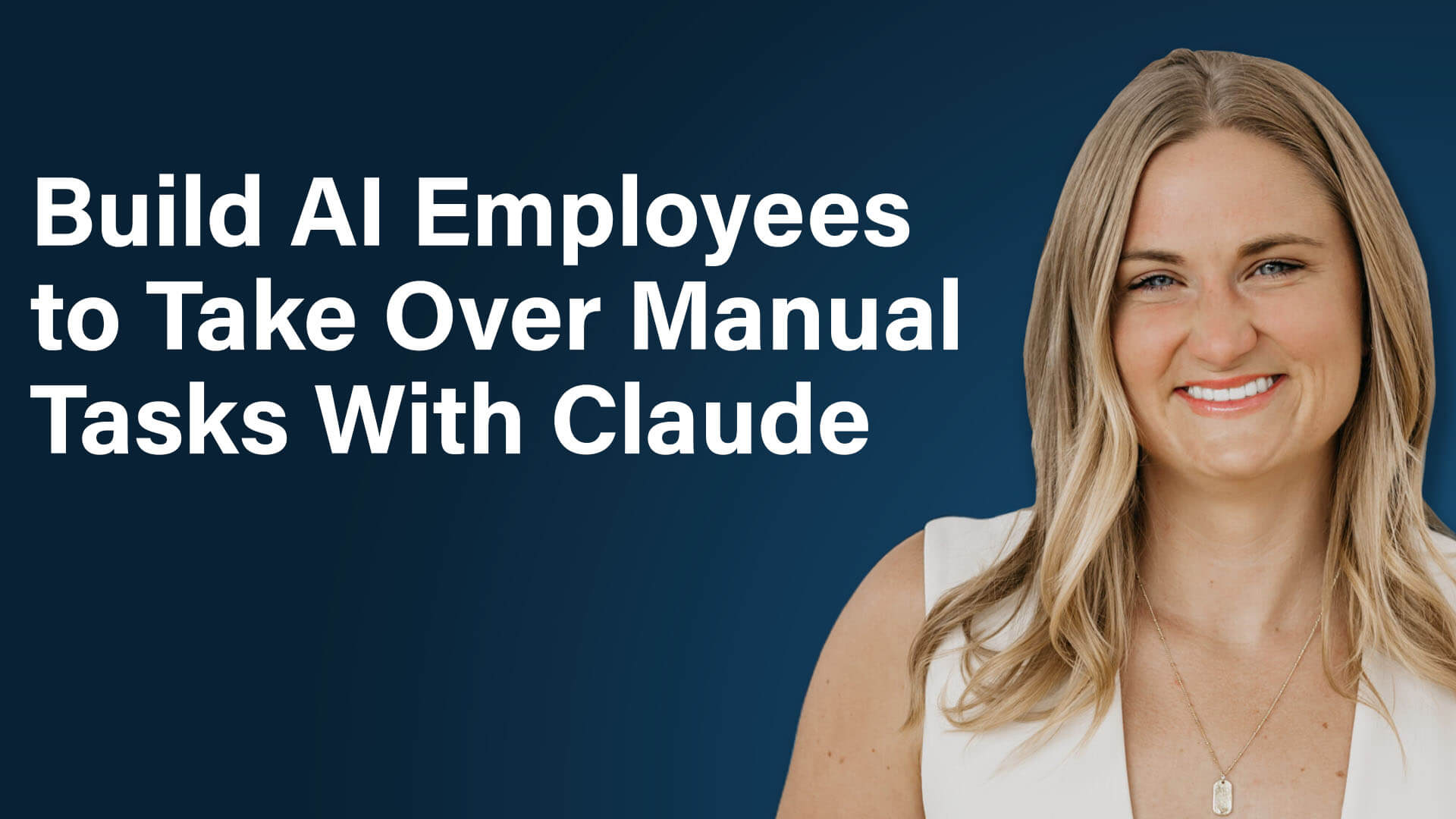
Callan Faulkner, founder of The Uncommon Business and architect of the Automate to Accelerate program, has worked with over 20,000 businesses to diagnose this exact bottleneck. According to Faulkner, organizations fail to scale their AI implementations due to structural and psychological errors:
- The Trap of Ad-Hoc Prompting: Treating AI as a high-tech search engine or an on-demand copywriter results in fragmented, inconsistent outputs. True acceleration requires shifting from reactive single-turn prompts to proactive, multi-turn system designs.
- The "Business Brain" Prerequisite: AI models cannot perform consistently without an institutional foundation. A chaotic, decentralized Google Drive or unorganized Notion workspace guarantees sub-par results. Organizations must construct a centralized, clean repository housing their exact pricing models, standard operating procedures (SOPs), brand voice guidelines, and historical case studies before expecting autonomous reliability.
- The Pipeline Progression: Effective AI deployment follows a strict evolutionary pipeline:
- Phase 1: The Interview. Deconstructing a manual human task via conversational deep-dives with the AI.
- Phase 2: The Skill. Translating the captured methodology into a codified, reusable system instruction file.
- Phase 3: The Scheduled Task. Automating the Skill to execute on specific calendar triggers or API hooks without human intervention.
- Overcoming the Training Investment Threshold: Many operators abandon their automated workflows too early. Building an AI employee that matches or exceeds human output—particularly in replicating nuanced brand voices—requires iterative training, stress-testing, and rigorous error correction over weeks, not minutes.
Official Statements & Industry Perspectives
The convergence of native Skills, agentic workflows, and autonomous business operations highlights a broader philosophical shift in software design.
Industry thought leaders emphasize that the era of managing software through graphical user interfaces (GUIs) is giving way to intent-driven delegation. As Michael Stelzner, founder of Social Media Examiner and the AI Business Society, notes, the primary hurdle for modern professionals is no longer technical capability, but curation and trust:
"Every week brings another tool, another claim, another ‘must-try’ for your business. Most of them aren’t worth your time—but knowing which ones are takes testing, research, and extra time you don’t have. The future belongs to organizations that can systematically filter the noise and turn validated AI frameworks into trusted operational employees."
Similarly, tech executives driving the agentic shift emphasize that voice and intent are replacing rigid command structures. Google’s product teams have repeatedly framed updates like Gemini Live’s expansion and agentic video understanding as steps toward frictionless computing—where the user specifies the desired outcome, and the underlying model coordinates the multi-app execution without human micro-management.
Future Outlook & Strategic Roadmap
As the industry moves deeper into this operational era, several clear trajectories are emerging for businesses and individual practitioners over the next 12 to 24 months:
- The Complete Standardization of Skills: Standalone custom wrappers (GPTs and Gems) will likely be entirely deprecated across major platforms. Professionals must audit their existing prompt libraries and rebuild them immediately into native Skills to maintain cross-platform portability and conversational fluidity.
- The Rise of Autonomous Mid-Tier Operations: With agentic voice tools (Gemini Live) and scheduled task pipelines becoming accessible to non-technical founders, small-to-medium businesses will increasingly deploy specialized digital workers to handle routine data synthesis, inbox triage, multi-platform publishing, and customer analytics.
- Ecosystem Lock-In and Monetization Consolidation: As demonstrated by Meta’s tiered subscriptions and Google’s Workspace-native integrations (such as Google Pics and automated Drive/Gmail workflows), AI utility is rapidly consolidating within locked enterprise and social ecosystems. Organizations will need to choose their foundational stacks carefully to optimize cross-app automation.
- The Premium on Clean Institutional Data: The differentiator in AI performance will no longer be the sophistication of the foundational model, but the cleanliness and organization of the user’s proprietary "Business Brain." Companies that invest in rigorous internal documentation and data hygiene will pull exponentially ahead of competitors relying on ad-hoc, unstructured data repositories.
Ultimately, the message for businesses is clear: the era of simply "tinkering" with artificial intelligence has closed. The future belongs to those who treat AI not as a chat window, but as a trainable, scalable, and autonomous workforce.