Executive Overview
When Salesforce reported its Q2 fiscal year 2027 financial results on August 26, the market reaction was nothing short of electric. Wall Street sent the tech giant’s stock soaring by a stunning 23% in a single trading session, lifting a vast swath of the broader B2B software ecosystem along with it. For an industry that had spent much of the year enduring brutal panic selling—a period grimly dubbed the "SaaS-pocalypse"—Salesforce’s blowout quarter served as an adrenaline shot.
At first glance, the numbers read like a victory lap for enterprise software: total revenue grew 11% year-over-year to hit $11.3 billion, Non-GAAP Earnings Per Share (EPS) skyrocketed by 103% to $5.90, and management raised full-year guidance to a range of $46.1 billion to $46.4 billion. CEO Marc Benioff proudly proclaimed it the "#1 Q2 in Salesforce history" on social media, pointing to massive consumption metrics and skyrocketing artificial intelligence deployment.
Yet, as is so often the case in enterprise tech, the headlines only tell part of the story. Beneath the eye-popping EPS growth and the euphoria of a 23% stock bump lies a nuanced financial reality. A deep dive into the numbers reveals that Salesforce’s bottom-line explosion was driven primarily by non-operating factors—specifically, a massive mark-up on its strategic stake in AI pioneer Anthropic and a sprawling $25 billion share buyback program funded by significant corporate debt. Furthermore, when stripping out recent acquisitions like Informatica, the company’s underlying organic revenue growth was a more modest 6.4%.
Nevertheless, the quarter delivered genuine, hard-fought victories where it mattered most for the future: forward-looking bookings (cRPO) re-accelerated to 14%, and the company’s burgeoning AI and data portfolio reached an annualized run rate (ARR) of approximately $3.9 billion. This exhaustive post-mortem examines the five critical takeaways from Salesforce’s blockbuster quarter, breaking down the mechanics of the earnings beat, the evolving AI monetization strategy, and whether the broader SaaS sector has finally weathered the storm.
Detailed Chronology: Anatomy of a Blockbuster Earnings Release
The events leading up to and immediately following Salesforce’s August 26 earnings drop highlight just how fragile, yet opportunistic, the current enterprise software market has become.
In the months preceding Q2 FY27, investors had priced in a bleak narrative for legacy Software-as-a-Service (SaaS) providers. The prevailing narrative suggested that generative AI startups and hyperscalers would compress software margins, render seat-based pricing obsolete, and leave incumbent giants struggling for relevance. SaaS stocks were systematically punished, trading at historic valuation discounts as market participants braced for structural decline.
When Salesforce took the stage on August 26, it systematically challenged that thesis—not by eliminating headwinds, but by demonstrating an aggressive, multifaceted playbook to adapt.
- The Headline Print: Salesforce announced Q2 revenue of $11.3 billion (up 11% year-over-year), a cRPO (Current Remaining Performance Obligation) growth rate of 14% to $33.5 billion, and a staggering Non-GAAP EPS of $5.90.
- The Immediate Market Reaction: Within hours, Salesforce shares surged 23%. Competitors and ecosystem peers across the B2B landscape caught the tailwinds, experiencing an immediate relief rally. Just weeks prior, Atlassian had posted a 35% single-day move on strong RPO metrics; Salesforce’s 23% pop cemented a growing market consensus that forward-looking order books were stabilizing.
- The Financial Deep Dive: As analysts began dissecting the balance sheets and regulatory filings over the next 48 to 72 hours, a more complex financial narrative emerged. While the headline figures were undeniably strong, the earnings beat relied heavily on capital allocation wizardry—namely, the appreciation of equity investments and financial restructuring—rather than pure operational expansion alone.
- The Strategic Pivot: Management doubled down on its transition from a traditional per-seat CRM provider to an agentic AI powerhouse, showcasing Agentforce and Data 360 as the twin engines of its future growth, even as executives openly admitted that the company remains partially "trapped" in legacy pricing frameworks.
Supporting Context & Metrics: Five Critical Takeaways
To truly understand the mechanics of Salesforce’s quarter, one must move past the PR talking points and analyze the financial disclosures, segment breakdowns, and operational metrics. Here are the five key insights uncovered in the aftermath of Q2:
1. cRPO Accelerated to 14% While Revenue Grew 11%
The most vital indicator of future health in the report was the Current Remaining Performance Obligation (cRPO), which hit $33.5 billion—representing a 14% year-over-year increase in constant currency.
To understand why this matters, one must look at the mechanics of enterprise accounting. Revenue at a company of Salesforce’s immense scale largely reflects multi-year contracts signed 12 to 24 months ago. In contrast, cRPO captures deals signed within the last 90 days. CFO Robin Washington noted that net new annual order value growth outpacing total AOV growth was a key internal metric this year—acting as the mechanical precondition for organic revenue re-acceleration in the second half of the fiscal year.
While Atlassian grabbed headlines earlier in the season with a 35% stock jump on 44% RPO growth, Salesforce’s 14% cRPO acceleration is an impressive feat for a $45B+ revenue behemoth, signaling that top-line growth has a solid foundation for the quarters ahead.
2. Stripping Out Informatica: Organic Growth Tells a Quieter Story
Reported revenue growth stood at 11%, but acquisitions play a massive role in that figure. Informatica contributed $456 million during the quarter. When backed out, Salesforce’s organic business grew at approximately 6.4% ($10.889 billion versus $10.236 billion a year ago). Subscription and support growth similarly drops from a reported 12% down to roughly 7% organically.
The integration of Informatica sits entirely within Salesforce’s "Data/Platform/Other" segment. Excluding Informatica’s $440 million in subscription revenue, that high-profile segment grew at just 5.7% organically—slower than the core application layer. Furthermore, management noted that while Data 360 showed strength, it was partially offset by license revenue headwinds and volatility in integration and analytics (MuleSoft and Tableau).
Even the apps division’s +7.6% growth figure was bolstered by Slack, which enjoyed its best net new AOV quarter since its acquisition. Core Sales and Service, excluding Slack, is expanding at a pace noticeably slower than the headline numbers imply.
3. Non-GAAP Net Income (Ex-Investment Gains) Was Actually Flat to Down
One of the most eye-opening discrepancies in the earnings report was the gap between EPS growth and operational income. Non-GAAP EPS was up an astonishing 103%. However, operating income sat at $2,331 million compared to $2,332 million a year prior—virtually flat, despite an 11% increase in revenue.
Where did the massive earnings beat come from?
- Strategic Investments: A substantial mark-up on Salesforce’s stake in AI developer Anthropic, alongside value creation from Slack. The company’s strategic investment portfolio surged from $7.6 billion to $11.3 billion in just six months. Marc Benioff remarked on the call: "Take the value of Slack. Then take the value of our Anthropic stock. That has been like half our value."
- Aggressive Share Buybacks: Salesforce executed a massive $25 billion buyback program, repurchasing roughly 14% of its shares at an average price of $176 (while the stock now trades significantly higher).
While these capital allocation moves were undeniably lucrative, they came with financial trade-offs. Interest expenses spiked from $67 million to $473 million in a single year, noncurrent debt rose from $10.4 billion to $39.3 billion, and total stockholders’ equity fell from $59.1 billion to $38.4 billion. Stripping out investment gains, non-GAAP net income actually slipped 1% year-over-year. The core operating business produced the exact same dollar amount of income on $11.3 billion of revenue as it did on $10.2 billion a year prior.

4. AI and Data Hit ~$3.9B ARR, but Penetration is Still Early
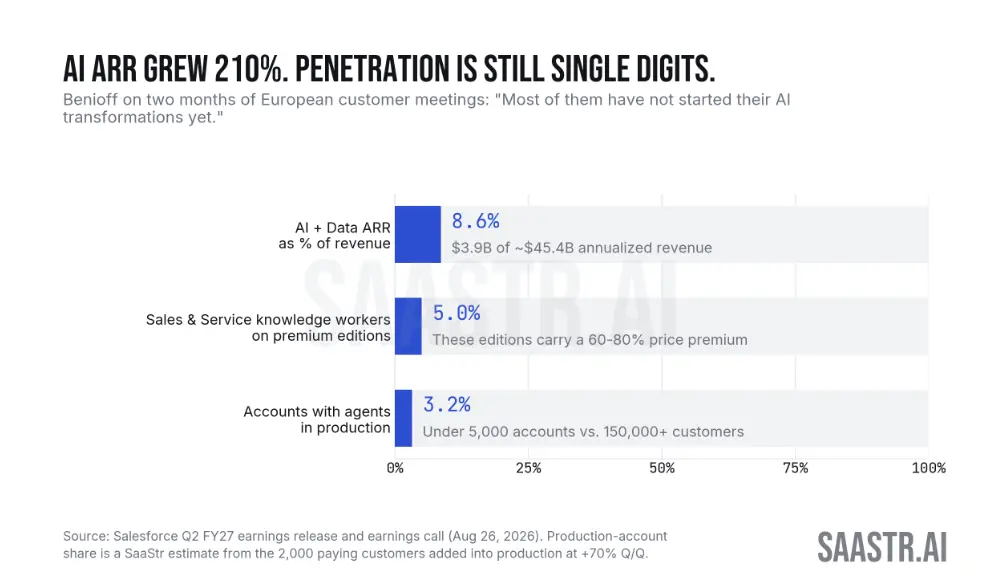
Salesforce’s artificial intelligence metrics commanded significant attention. The company reported that Agentforce ARR reached $1.5 billion (up 240% year-over-year), while combined AI and Data ARR hit $3.9 billion—representing roughly 8.6% of total annualized revenue.
However, analysts must contextualize these figures:
- Redefined Baselines: Effective this quarter, Salesforce redefined Agentforce ARR to include Slackbot and Headless 360, meaning the 240% growth metric is measured against a restructured baseline.
- Low Initial Production Penetration: Despite impressive revenue numbers, CEO Marc Benioff admitted that the vast majority of enterprise customers have not yet deployed AI in production. Two years into the Agentforce era, only a small fraction of total customer accounts have active deployments on the premium tier.
For other B2B software companies measuring their own AI attach rates against Salesforce’s press releases, the true north star is not the total ARR, but the underlying production-account penetration rate, which remains in its early innings.
5. Navigating a Quadruple Pricing Model Dilemma
Salesforce is currently attempting the difficult balancing act of running four distinct pricing models simultaneously: traditional per-user seats, per-agent licenses, consumption-based pricing via Flex Credits, and experimental outcome-based models.
When asked about monetizing headless deployments, Benioff offered a candid assessment:
"We’re still trapped in some ways in old per user pricing models. But the opportunity to build much more aggressive pricing, to really represent the value that we’re offering our customers, I think is enormous."
Executives highlighted active negotiations with major enterprise clients—such as a $40 million customer running an activation agent processing 45 million Agentic Work Units (AWUs)—who are actively weighing outcome-based contracts against unlimited license agreements. With Agentforce generating roughly 12 cents per AWU based on current volumes, and standard agent seats priced at $125/user/month, the company is rapidly iterating to bridge the gap between human and machine monetization.
Simultaneously, Salesforce continues to expand its human workforce footprint, maintaining a massive sales engine of 15,000 account executives with plans to hire 1,200 more by fiscal year-end, even while absorbing $94 million in restructuring charges during the same quarter.
Official Statements and Executive Sentiment
Management’s commentary during the Q2 earnings call reflected a mixture of unbridled optimism regarding the technological shift toward AI agents and pragmatic acknowledgment of execution hurdles.
Marc Benioff on the AI Paradigm Shift:
"The tsunami of AI has just begun to wash over pre-AI B2B software. It’s just begun. But there are signs the best are riding the wave, finally. Instead of just being crushed by it."
Robin Washington on Order Book Momentum:
"Net new annual order value growth outpacing total AOV growth is the mechanical precondition for organic revenue reacceleration in H2."
The overarching message from the executive suite is that Salesforce has successfully transitioned from an incumbent vulnerable to disruption into an aggressive platform orchestrating the agentic AI revolution.
Future Outlook: What to Watch at Dreamforce and Beyond
As the enterprise technology community looks toward Dreamforce and the second half of fiscal year 2027, three core metrics will determine whether Salesforce’s blockbuster Q2 represents the definitive start of a sustained re-acceleration or merely a quarter flattered by capital market gains:
- Organic Growth Acceleration: Will core organic revenue growth climb out of the mid-single digits as cRPO flows into recognized revenue?
- Production AI Adoption: Can Agentforce and Data 360 convert their impressive ARR figures into widespread, day-to-day production usage across the broader enterprise customer base?
- Pricing Model Evolution: How effectively can Salesforce transition its customer base away from legacy per-seat models toward consumption- and outcome-based pricing without alienating enterprise buyers?
Final Thoughts
The "SaaS-pocalypse" may not be entirely over, but Salesforce’s Q2 FY27 performance proves that premier enterprise software giants can adapt, pivot, and capture the immense economic value of the artificial intelligence wave. For the rest of the B2B software landscape, the blueprint has been laid: master the forward-looking order book, aggressively innovate in agentic workflows, and figure out how to bill for intelligence rather than just human headcount.