
Executive Overview
The debate surrounding the integration of artificial intelligence in video game development has reached a boiling point, moving past procedural generation and automated translation straight into the heart of rendering technology. At the center of this firestorm is NVIDIA’s controversial DLSS 5, a neural-rendering breakthrough that promises unprecedented visual fidelity while sparking severe anxiety among developers, artists, and players alike.
While critics point to DLSS 5’s trademark "uncanny valley" aesthetic and question whether real-time neural upscaling compromises artistic integrity, industry figures are increasingly divided. Among the most vocal defenders of the technology is Daniel Vávra, co-founder of Warhorse Studios and the creative director behind the critically acclaimed medieval RPG franchise Kingdom Come: Deliverance. Vávra recently took to social media to aggressively defend DLSS 5, dismissing its detractors and sharing side-by-side comparisons of Kingdom Come: Deliverance 2 to prove that neural rendering helped realize his team’s true vision—not distort it.
However, Vávra’s robust defense arrives against a backdrop of mounting distrust toward Warhorse Studios and its parent companies regarding AI adoption. Earlier this year, the studio faced fierce backlash when a leading translator and English-language editor publicly claimed he was fired and replaced by automated tools. As the gaming landscape navigates this paradigm shift, the clash over DLSS 5 highlights a deeper existential question: Where does engine limitation end, and artistic intent begin, when an algorithm is doing the rendering?
Detailed Chronology: From Neural Upscaling to Social Media Firestorm
To understand the current controversy, one must look at how DLSS (Deep Learning Super Sampling) has evolved from a clever frame-rate booster into an all-encompassing neural graphics pipeline.
The Evolution and the Reveal
NVIDIA’s announcement of DLSS 5 sent shockwaves through the PC gaming community. Unlike previous iterations that primarily focused on spatial reconstruction and temporal anti-aliasing to boost low-resolution frames, DLSS 5 introduced deep neural network passes capable of hallucinating texture data, lighting details, and surface properties in real time.
When industry journalists were privately given hands-on demonstrations of the tech running on heavy-hitting modern engines, the reactions were mixed. Observers described the output as simultaneously "beautiful, ugly, impressive, and troubling." While the raw pixel count and apparent lighting complexity were staggering, the output bore the unmistakable, waxy sheen associated with generative AI image models. Critics immediately dubbed the visual artifacts "AI slop," arguing that machine-learning algorithms lack the nuanced understanding of material science required to faithfully replicate human skin, cloth, and aged iron.
Vávra’s Counter-Offensive
Stepping directly into the crosshairs of this debate, Daniel Vávra published a fiery post on X (formerly Twitter) defending the technology, specifically utilizing assets from Kingdom Come: Deliverance 2.
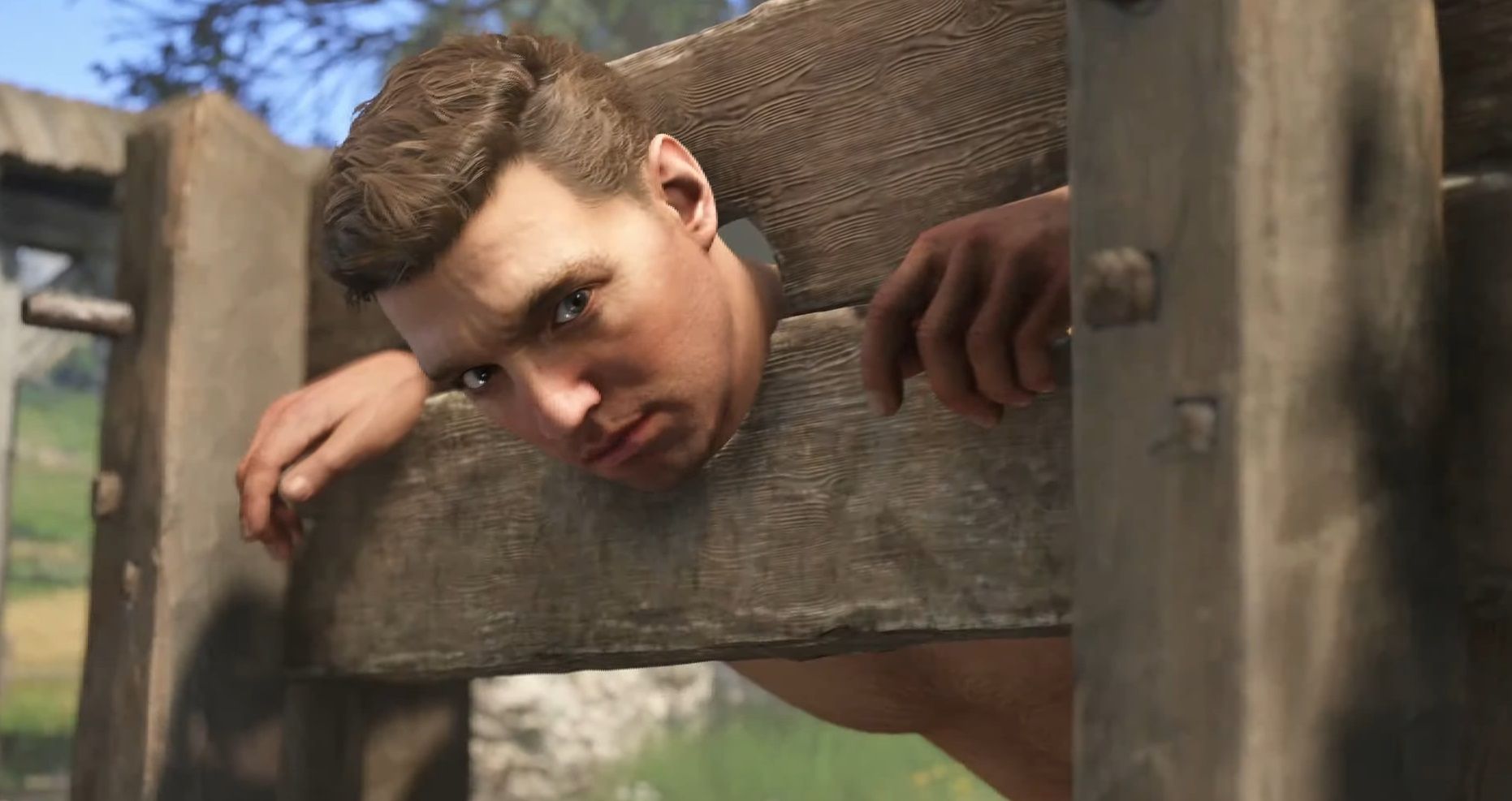
"Some people have literally gone crazy," Vávra posted, attaching a split-screen image of a character model. "On the left is a head messed up by the game engine’s very limited lighting system, which can’t properly render shadows, skin texture, and the detail of normal maps. On the right is THE SAME MODEL WITHOUT ANY GEOMETRY CHANGES…"
According to Vávra, the standard rendering pipeline of their engine introduced unintended visual flaws—such as the complete absence of helmet shadows on character faces and heavily degraded normal map rendering. He argued that these technical failures were mistakenly being defended by purists as part of the game’s "artistic vision," whereas DLSS 5 merely corrected the engine’s shortcomings to present what the developers actually wanted the characters to look like.
The Community Backlash
Vávra’s defense did little to quell the skepticism of players and digital artists. While some conceded that the technology successfully mitigated blocky shadows and flat textures, many argued that the cure was worse than the disease.
Community members pointed out that DLSS 5’s neural network homogenizes surfaces, giving characters an unnatural, "oiled-up" appearance that shatters immersion. Critics noted that technical flaws in game engines—much like grain in film or analog artifacts in music—often contribute to a tangible sense of realism and grittiness. By smoothing over these imperfections with predictive AI, developers risk sanitizing their virtual worlds into sterile, plastic environments.
Supporting Context & Metrics: The Philosophy of Imperfection
The debate over DLSS 5 touches upon a timeless philosophical debate in aesthetics: the value of human imperfection versus machine-driven perfection.
The "Paul McCartney Fallacy"
In media critique, imperfections are frequently cited as the bedrock of authentic artistic expression. Consider classic rock recordings: minor voice cracks, accidental guitar scrapes, or muffled studio chatter are often what make a track feel alive. As critics of neural rendering have noted, if an AI could instantly sanitize every recording to pitch-perfection, it might eliminate the very vulnerabilities that make art resonate with human audiences.
When applied to video games—especially historical epics like Kingdom Come: Deliverance 2, which prides itself on a gritty, mud-spattered, unglamorous depiction of 15th-century Bohemia—the introduction of hyper-clean, AI-generated skin textures and lighting passes creates a jarring dissonance.
Technical Realities vs. AI Intervention
Game engines operate under strict mathematical and computational constraints. Global illumination, ray tracing performance budgets, and polygon counts force developers to make compromises. Traditionally, artists and lighting directors spend months manually tweaking shaders, baking lighting, and painting normal maps to mask these engine limitations.
NVIDIA’s pitch for DLSS 5 is that it bypasses these grueling optimization pipelines by letting a neural network intelligently fill in the blanks. However, skeptics argue that outsourcing visual problem-solving to a black-box AI model strips artists of their agency. As one user on X summarized: "It’s not my fault you couldn’t put the effort into making it better. Instead, you use the machine that can’t think to make an artistic choice."
Official Statements & Industry Fallout
The friction surrounding DLSS 5 is compounded by Warhorse Studios’ broader history with artificial intelligence tools, creating an environment where every technical statement is viewed with suspicion.
The Translation Controversy
Earlier in the development cycle of Kingdom Come: Deliverance 2, Warhorse found itself at the center of a labor scandal when lead English-language editor and translator Max Hejtmánek went public with his termination. Hejtmánek alleged that he was let go by the studio so that his role could be absorbed and "replaced with AI" translation and localization workflows.
While Warhorse Studios defended their localization pipeline and emphasized the role of human oversight, the revelation alienated a significant portion of the narrative-focused gaming community. For fans who praised the first game’s rich, authentic localization and dialogue, the idea that a studio would automate creative writing and translation felt like a betrayal of the craft.
Nvidia’s Damage Control
NVIDIA, for its part, has worked diligently to frame DLSS 5 not as a replacement for human artists, but as a collaborative tool—a "smart brush" that accelerates the creative process. Representatives have argued that real-time neural rendering allows small-to-mid-sized studios to achieve AAA-tier graphical fidelity without expanding their art teams into unsustainable numbers.
Yet, as directors like Daniel Vávra double down on social media, the PR strategy appears to be polarizing rather than reassuring. By framing critics of the technology as "crazy" or uneducated about engine limitations, studio leaders risk alienating the hardcore PC enthusiast demographic that forms the core audience for graphically demanding titles like Kingdom Come: Deliverance 2.
Future Outlook: Where Do We Go From Here?
As neural rendering, generative textures, and AI-assisted pipelines transition from experimental R&D labs into mainstream game engines, the industry stands at a critical crossroads.
- The Standardization of Neural Graphics: Over the next several hardware generations, ray tracing and rasterization may take a back seat entirely to end-to-end neural rendering pipelines. Developers will have to decide whether they act as directors guiding a human team or prompters curating an algorithm’s output.
- The Rise of the "Purist" Market: Just as vinyl records and film photography experienced massive resurgences in the digital age, we may see a counter-movement in gaming: titles that explicitly advertise themselves as "AI-Free," celebrating raw geometry, hand-baked lighting, and deliberate human imperfections.
- Studio Accountability: Moving forward, studios utilizing technologies like DLSS 5 and automated localization will need unprecedented transparency to maintain consumer trust. Hiding behind defensive social media posts will no longer suffice when the line between human artistry and machine generation becomes increasingly blurred.
For Kingdom Come: Deliverance 2, the proof will ultimately rest in the playing. When players finally step back into the boots of Henry of Skalitz, they will judge the game not by the marketing debates on X, but by whether the world feels like a living, breathing piece of history—or an artifact of a silicon-driven future.