Executive Overview
Few video game franchises possess the cultural gravity of Tomb Raider. Since Lara Croft first burst onto the Sega Saturn and PlayStation in 1996 with her signature dual pistols, geometric silhouette, and unflappable aristocratic demeanor, the series has served as a cornerstone of interactive entertainment. Alongside icons like Super Mario Bros. and Chuckie Egg, the original title defined the 3D action-adventure genre, laying the groundwork for decades of platforming, environmental puzzle-solving, and cinematic storytelling.
Now, as Crystal Dynamics presses forward with its highly anticipated "unified timeline"—a sweeping narrative initiative designed to harmonize every distinct era of the franchise into a single, cohesive canon—the studio has unveiled its most ambitious undertaking yet: Tomb Raider: Legacy of Atlantis.
Billed as a ground-up reimagining of Lara’s seminal 1996 adventure, Legacy of Atlantis occupies a complex and controversial space. On one hand, it is a technical marvel. Running on cutting-edge hardware, the title presents a visual feast of retina-searing fidelity, where particle effects, volumetric lighting, and staggering verticality combine to evoke a genuine sense of awe. During a recent live-demosession utilizing a massive 115-inch display, the sheer graphical prowess of the title was impossible to ignore. Every flake of ancient dust, every drifting particle of bat guano, and every godray cutting through the stale, oppressive air of antiquity reinforces a world that feels palpably real.
Yet, beneath this breathtaking veneer lies a series of perplexing creative and ethical choices. By attempting to compress decades of disparate characterizations, mechanics, and tones into a single homogenized paste, Legacy of Atlantis struggles with a severe identity crisis. From mechanically discordant survival mechanics—such as foraging and crafting in a non-survival setting—to lingering community anxieties surrounding the studio’s early use of generative AI in prototyping, the title’s pre-release phase has sparked intense debate among industry veterans and die-hard fans alike.
As Legacy of Atlantis steers toward its eventual release, this report examines the intricate mechanics, tonal contradictions, and broader industry implications surrounding Crystal Dynamics’ latest bid to redefine gaming royalty.
Detailed Chronology & Structural Evolution
To understand the gravitational pull of Legacy of Atlantis, one must first chart the evolutionary arc of its protagonist. Over nearly three decades, Lara Croft has undergone three distinct thematic and mechanical evolutions, each deeply reflective of the socio-cultural zeitgeist in which they were conceived.
The Eras of Lara Croft
- The Classic Era (1996–2003): Characterized by blocky polygons, 32-bit hardware constraints, and an unabashed embrace of 1990s "Girl Power" mixed with retro-fitted Indiana Jones tropes and classic 1960s espionage flair. Lara was a self-possessed, witty, and unflappable aristocrat who treated lethal ruins as an aristocratic weekend hobby.
- The Legend/Survivor Era (2006–2018): Following various reboots, Crystal Dynamics eventually pivoted toward grit and psychological realism. The Survivor Trilogy (beginning with 2013’s Tomb Raider) transformed Lara from an untouchable action hero into a traumatized, bleeding survivor forced to murder dozens of mercenaries on a remote island just to stay alive. Tone-wise, it traded the campy self-awareness of the 90s for post-9/11 dourness and cinematic melodrama.
- The Unified Timeline (Future): Legacy of Atlantis seeks to stitch these eras together. It aims to replace both the original 1996 game and 2007’s Anniversary within the PS1 and Legend timelines, while acting as a direct narrative sequel to 2018’s Shadow of the Tomb Raider.
The Damocles Room Reimagined
The recent preview event heavily spotlighted the game’s interpretation of the infamous Damocles Room—a legendary chamber from the original Greek levels defined by its raining swords and instant-death punishment for the inattentive player.
In Legacy of Atlantis, the verticality of this space is staggering. The feeling of being a fragile human speck trapped inside an impossibly deep, crumbling cavern is amplified tenfold by modern graphical fidelity. However, the mechanical execution of the room has undergone a radical shift.
Rather than serving purely as lethal hazards to be avoided at all costs, the house-sized swords have been repurposed as puzzle traversal tools. Players can trigger the swords to drop from a safe distance by shooting them, after which Lara can expertly perch upon their hilts to scale the environment. The threat level has been dramatically dialed down; dodging the falling blades is trivial, turning what was once a heart-pounding gauntlet of death into a manageable, multi-path platforming puzzle.
Furthermore, the game’s combat encounters retain a peculiar brand of melodrama. During the trek to the ruins, an encounter with a leopard prompts the camera to linger majestically as Lara delivers a breathless "magnificent" right before dispatching the animal. While developers assure critics that Legacy of Atlantis is a "serious game with a serious tone," moments like this highlight an irreconcilable tonal mismatch between the campy bombast of the 90s and the grim survivalism of the 2010s.
Supporting Context & Metrics
The integration of disparate design philosophies has introduced several gameplay elements that critics argue undermine the core fantasy of being Lara Croft. Chief among these are the newly introduced survival systems.
Mechanical Discord: The Survival Paradox
Legacy of Atlantis incorporates crafting matrices, skill trees, and field-foraging mechanics directly into a reimagining of a classic exploratory adventure. From a thematic standpoint, these systems generate profound narrative dissonance:
- The Chronological Contradiction: If this game features a fully realized, veteran Lara who has emerged from the crucible of the Survivor Trilogy at the absolute zenith of her capabilities, the inclusion of progressive skill-tree unlocks feels fundamentally regressive. Why is a master adventurer still learning how to effectively use her tools?
- The Logistical Absurdity: Survival mechanics—such as cooking foraged moss and unidentifiable meat over an open fire—make little sense within the context of the setting. Lara is not shipwrecked or stranded in an uncharted hostile dimension; she is exploring accessible ruins in modern Greece, an environment easily reached via a twenty-pound budget airline ticket. A seasoned explorer would arrive equipped with a meticulous itinerary and a rucksack filled with protein bars, not a hunting knife and a dream of boiled vegetation.
Technical & Visual Metrics
Despite these narrative speedbumps, the technical achievements of the project are undeniable. Based on data and observations from preview builds, the game boasts:
- Fidelity Highlights: Full utilization of next-generation hardware pipelines, rendering realistic dust motes, volumetric fog, dynamic lighting, and hyper-detailed ruin textures.
- Animation Synergy: Lara’s movement set bridges the acrobatic, balletic flourishes of the Legend trilogy with the visceral, grounded impact weight of the Survivor series. Vaults, flips, and her signature handstand-backflip platform hoist are rendered with fluid, joyful precision.
- Optional Assistance: A newly added environmental scanner ("detective mode") provides historical commentary and puzzle hints. Crucially, this feature is entirely optional, serving as a direct countermeasure to player complaints regarding excessive self-talk in previous entries.
Official Statements & Industry Controversy
No discussion of Legacy of Atlantis is complete without addressing the swirling controversies surrounding its development process—most notably, Crystal Dynamics’ stance on generative artificial intelligence.
The Generative AI Debate
In previous statements, Crystal Dynamics acknowledged utilizing generative AI tools during the early prototyping phases of development, while maintaining that all final, shipped content is human-created or human-refined. Despite these assurances, the studio’s association with generative AI has cast a long shadow over the project’s public reception.
Within the gaming community, sentiment remains deeply fractured. While casual consumers may be largely unaware of or indifferent to the controversy, industry enthusiasts and purists view the mere inclusion of AI tools in an artistic medium as an unnecessary liability. Game director Raul Siqueira and the development team have repeatedly insisted that human artists craft the final product, but the psychological damage of the association is difficult to undo.
The "Slop" Controversy
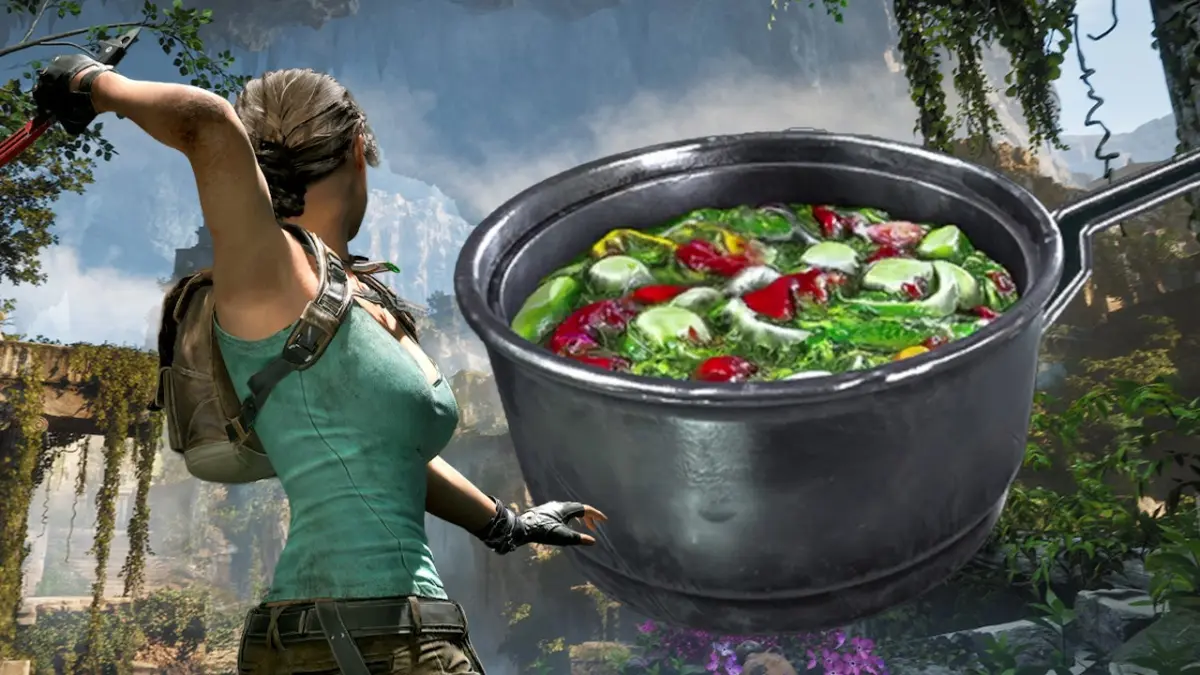
This anxiety crystallized around one of the game’s most mundane elements: the food crafting and inventory icons. In video game history, culinary depictions are often treated as art forms in their own right—think of the mouth-watering sweetrolls in The Elder Scrolls V: Skyrim or the gourmet feasts prepared in Final Fantasy XV.
In stark contrast, the culinary creations displayed in Legacy of Atlantis menus have drawn sharp, often humorous criticism for looking remarkably unappetizing. Described by previewers as unconvincing slop—mushy stews of unidentifiable plant matter and dubious meats—these visual assets have inadvertently become ground zero for fan speculation regarding potential AI generation.
While entirely circumstantial, these visual choices demonstrate a vital lesson for modern developers: even a faint, unproven association with generative AI can severely damage a game’s public perception if the resulting assets fail to meet basic aesthetic standards of craftsmanship.
Future Outlook
As Legacy of Atlantis looks toward its eventual release date, the title stands at a fascinating crossroads. It is undeniably one of the most visually stunning projects currently in development, offering a breathtaking, historically rich playground that honors the geographical sweep of the franchise’s history.
The decision to treat every past era of Tomb Raider as valid gospel is an admirable, if intensely challenging, balancing act. By reimagining iconic spaces like the Damocles Room with alternative traversal solutions, Crystal Dynamics proves that it is not afraid to innovate within familiar confines. Lara herself has never moved with such fluid, joyful grace, successfully merging her acrobatic heritage with modern physical acting.
However, the path forward requires careful course correction. To truly satisfy a passionate fanbase that has spanned decades, the development team must ensure that modern industry trends—such as shoehorned crafting systems, illogical survival loops, and controversial development shortcuts—do not overshadow the timeless thrill of exploration.
If Crystal Dynamics can iron out these mechanical wrinkles, strip away the lingering anxieties of automated asset generation, and ground Lara’s narrative in a tone that feels earned rather than forced, Legacy of Atlantis could very well become the definitive monument to gaming royalty. Until then, players are left hoping that the final product offers substance as refined as its breathtaking exterior—and leaves the questionable cafeteria slop firmly in the past.