Executive Overview
In a significant development for the cloud data engineering landscape, Amazon Web Services (AWS) has announced the general availability of AWS Glue 6.0. This latest iteration of the fully serverless data integration and extract, transform, and load (ETL) service introduces a compelling combination of deep architectural modernizations, extended open-table format capabilities, and a major structural price reduction.
Most notably, AWS Glue 6.0 delivers a 30% reduction in pricing compared to previous versions, lowering the barrier to entry for enterprise-scale data processing. Under the hood, the service has been rebuilt on a modernized runtime stack featuring Apache Spark 4.1, Python 3.13, and Scala 2.13. This foundation unlocks raw performance gains while positioning AWS Glue as the most complete implementation of Apache Iceberg v3 available on any fully serverless managed Spark service.
For data architects, analytics engineers, and enterprise data platform teams, AWS Glue 6.0 addresses some of the most persistent bottlenecks in modern data lakes: managing semi-structured data without complex flattening, handling real-time streaming pipelines with single-digit millisecond latency, and streamlining PySpark ETL authoring. With seamless migration paths and zero mandatory API alterations required for adoption, Glue 6.0 represents a watershed moment for serverless analytics on AWS.
Detailed Chronology & Technological Evolution
The journey toward AWS Glue 6.0 reflects a deliberate, multi-year evolution of the Apache Spark and Apache Iceberg ecosystems within managed cloud environments. To understand the significance of this release, it is necessary to examine how the underlying components have matured.
The Foundation: Apache Spark 4.1, Python 3.13, and Scala 2.13
AWS Glue 6.0 steps away from older runtime generations by anchoring itself directly in Apache Spark 4.1. Spark 4.1 brings a host of internal query optimization improvements, enhanced memory management, and execution plan refinements that translate to significantly reduced runtimes for resource-intensive data workloads.
Simultaneously, the integration of Python 3.13 and Scala 2.13 empowers developers to write cleaner, safer, and faster code. Python 3.13 introduces performance enhancements and modern language features that PySpark developers can immediately leverage, while Scala 2.13 ensures that enterprise pipelines built on robust, statically-typed JVM codebases remain performant and up-to-date with current compiler standards.
The Apache Iceberg v3 Milestone
Perhaps the crown jewel of the AWS Glue 6.0 release is its native support for the Apache Iceberg v3 specification, built on Iceberg 1.11.0. As data lakes continue to transition from rigid, proprietary formats to open table formats, Apache Iceberg has emerged as the de facto standard for building transactional data lakes on cloud object storage like Amazon S3.
Iceberg v3 introduces several breakthrough features, chief among them being the VARIANT data type with built-in shredding support. Historically, working with semi-structured data such as JSON logs, nested API payloads, and streaming event data required data engineers to perform one of two sub-optimal tasks:

- Flattening the schema entirely, which bloats storage, complicates queries, and introduces fragility when upstream schemas evolve.
- Storing data as large string blobs (like JSON strings), which forces compute engines to perform expensive, on-the-fly parsing during query execution, severely degrading read performance.
The VARIANT data type with shredding support solves this dilemma. It allows teams to ingest, store, and query semi-structured data natively without flattening. The engine automatically "shreds" the data into efficient internal column representations, yielding drastically faster query read performance compared to traditional string-based columns. Furthermore, when upstream JSON schemas shift or evolve, pipelines remain intact, eliminating costly pipeline breakage and manual schema maintenance.
Supporting Context & Metrics: Cost, Performance, and Architecture
The release of AWS Glue 6.0 is not merely an incremental version bump; it is an economic and architectural realignment designed to meet the demands of petabyte-scale data estates.
Economic Impact: 30% Price Reduction
In an era where cloud cost optimization is a board-level priority for CIOs and CTOs, AWS’s decision to lower Glue pricing by 30% across the board is transformative. By passing infrastructure efficiencies—gained through runtime modernizations and hardware-software co-design—directly to the consumer, AWS makes complex batch ETL and real-time streaming far more accessible for startups and Fortune 500 enterprises alike.
When combined with AWS Glue’s granular, second-by-second billing model for crawlers and ETL jobs, organizations can run high-frequency, complex pipelines without over-provisioning or incurring runaway costs. The AWS Glue Data Catalog maintains its predictable pricing structure: a streamlined monthly fee for storing and accessing metadata, with the first million objects stored and the first million accesses completely free of charge.
Real-Time Streaming and PySpark Enhancements
Beyond batch processing, AWS Glue 6.0 targets real-time analytics use cases. Modern data architectures increasingly rely on continuous ingestion streams from Apache Kafka, Amazon Kinesis, and other event buses. Glue 6.0 introduces specialized capabilities that enable real-time streaming transformations with single-digit millisecond latency.
By coupling Spark 4.1’s streaming execution engine with optimized Iceberg v3 write paths, data teams can stream mutable, ACID-compliant records directly into their data lakes. This bridges the traditional divide between streaming analytics and batch data warehousing, allowing businesses to operationalize fresh data almost instantly.
Developer Experience and Migration Pathways
Migrating to a major new runtime version has historically involved tedious code refactoring and API updates. AWS has systematically removed this friction in Glue 6.0:
- Zero API Changes: Transitioning existing infrastructure requires no modification to core API signatures. Engineers simply update the
--glue-versionparameter in theircreate-joborupdate-jobAPI calls. - Flexible Tooling Integration: Whether managing jobs via the AWS Command Line Interface (AWS CLI), AWS SDKs, AWS Glue Studio, Amazon SageMaker Unified Studio, or local integrated development environments (IDEs), developers have uniform access to Glue 6.0.
- The Spark Upgrade Agent: For organizations with sprawling legacy job portfolios, AWS provides the Spark Upgrade Agent directly within AWS Glue Studio. This tool automates the detection of breaking changes, suggests code refactoring steps, and can even auto-upgrade existing jobs to the Glue 6.0 runtime.
- Interactive Notebooks: Data scientists and data engineers utilizing Jupyter notebooks or AWS Glue Studio notebooks can activate the new environment instantly by setting
%glue_version 6.0within their interactive sessions.
Official Perspectives and Ecosystem Integration
The launch of AWS Glue 6.0 underscores AWS’s broader strategy of deep integration across its analytics and artificial intelligence portfolios. By aligning serverless compute with open standards like Apache Iceberg, AWS is giving customers complete ownership and flexibility over their data architecture while maintaining the operational simplicity of a fully managed service.

Industry observers have noted that Glue 6.0 positions AWS uniquely against competing cloud data warehouses and proprietary data platforms. By championing open formats like Iceberg v3, AWS ensures that data stored in Amazon S3 remains portable, queryable by multiple engines (such as Amazon Athena, Amazon EMR, and Redshift), and immune to vendor lock-in.
Furthermore, AWS has extended its modern developer tooling to support this release. Developers seeking immediate documentation, API references, regional availability matrices, or troubleshooting guides can leverage the AWS MCP Server and associated AI plugins. This allows engineering teams to query AWS knowledge bases and generate deployment scripts using their preferred AI-assisted development tools, drastically accelerating the adoption timeline for Glue 6.0.
Future Outlook: The Next Era of Serverless Data Engineering
As organizations look toward the horizon of 2026 and beyond, the demands placed on data infrastructure will only intensify. The exponential growth of semi-structured log data, IoT telemetry, and generative AI training pipelines requires data integration layers that are simultaneously faster, cheaper, and more intelligent.
AWS Glue 6.0 establishes a robust foundation for this future. By combining the raw compute efficiency of Apache Spark 4.1 with the advanced metadata management of Apache Iceberg v3, AWS has solved several long-standing performance and cost trade-offs in data engineering.
Looking forward, we can expect the industry to lean even more heavily on serverless architectures that abstract away cluster management entirely, allowing engineers to focus purely on business logic and data modeling. With its 30% price reduction and comprehensive feature set, AWS Glue 6.0 sets a high benchmark for the industry, signaling that high-performance big data processing can—and should—be both economically viable and developer-friendly.
Getting Started Today
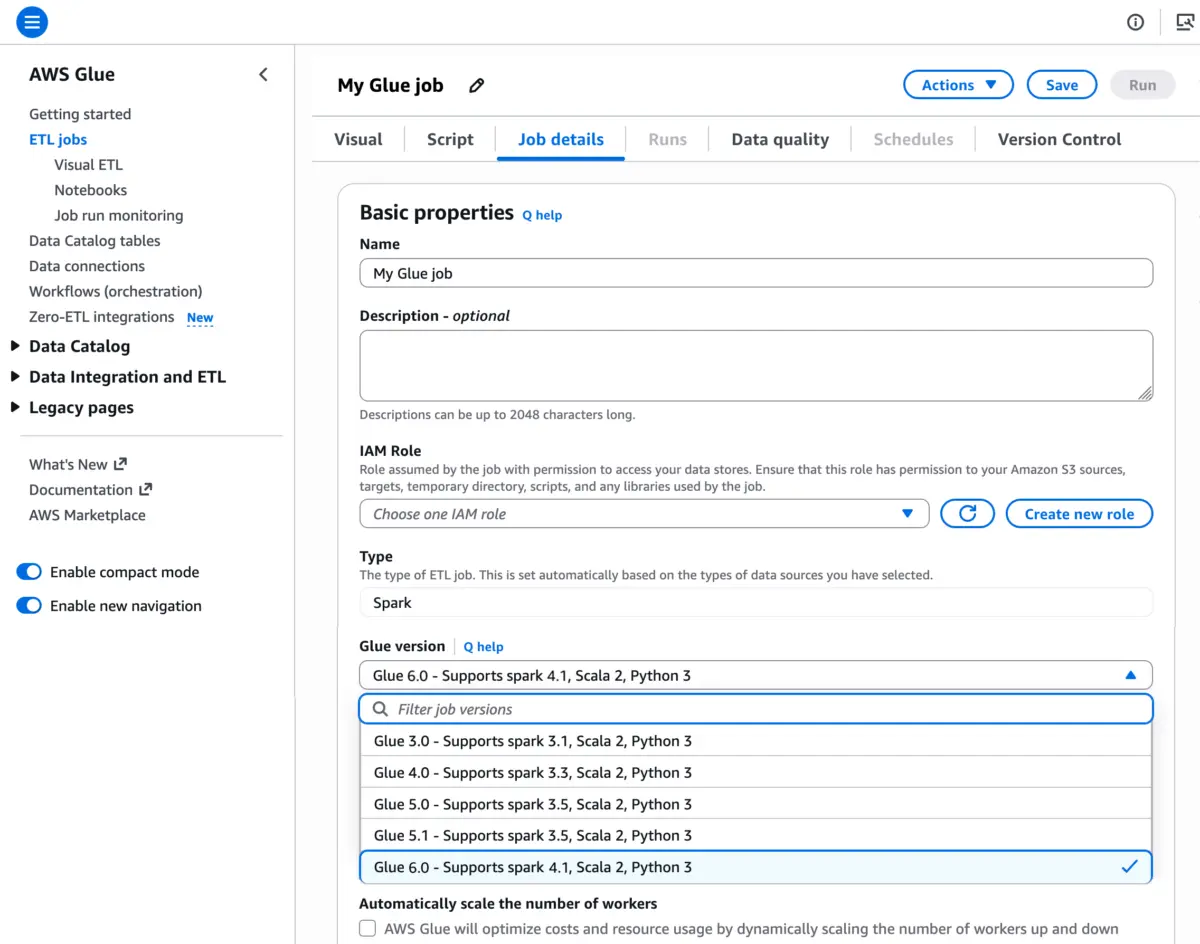
AWS Glue 6.0 is generally available today across all commercial AWS Regions where AWS Glue operates. Engineering teams can begin exploring the new capabilities by navigating to the AWS Glue Studio console, selecting Glue 6.0 – Supports Spark 4.1, Scala 2, Python 3 under the Job Details tab, or utilizing the AWS CLI and SDKs.
For a comprehensive guide on regional availability, roadmap projections, and migration documentation, practitioners are encouraged to consult the official AWS Glue documentation and the AWS Capabilities by Region portal.