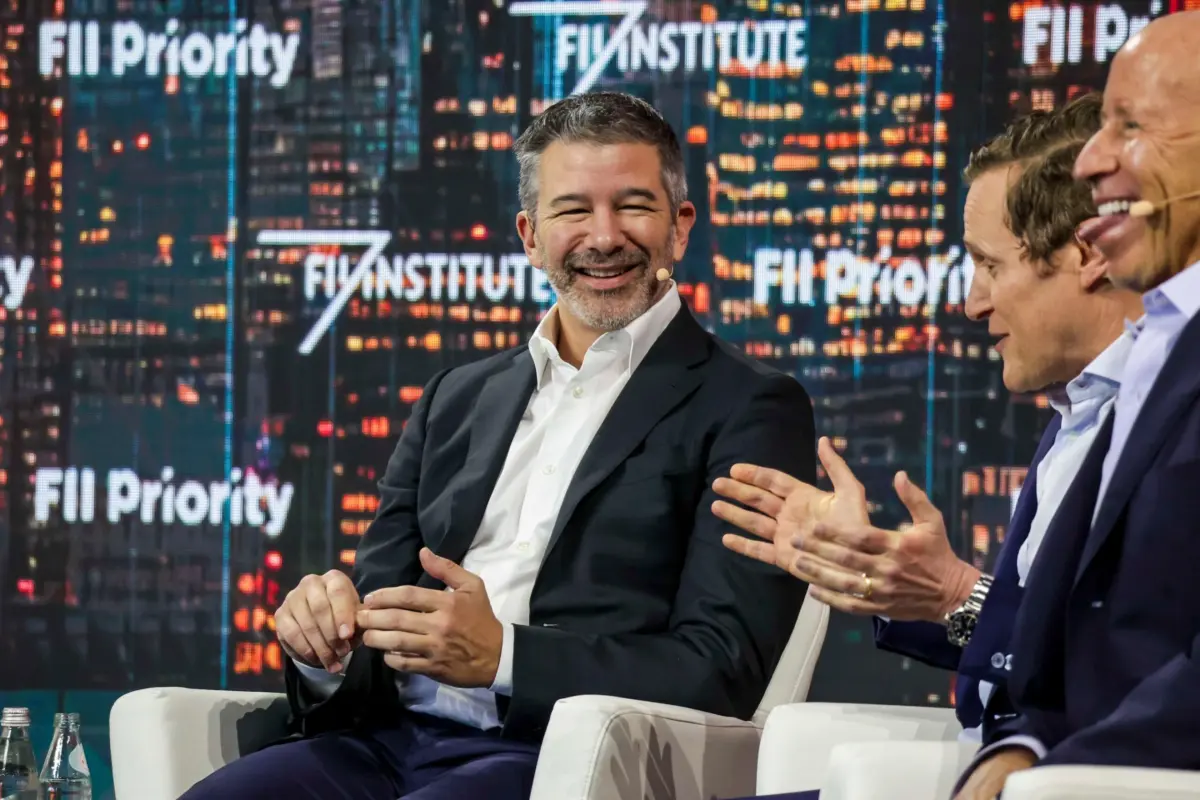
Nearly a decade after his sensational departure from Uber Technologies Inc., co-founder Travis Kalanick is positioning himself at the center of the autonomous vehicle revolution once again. His stealthy robotics venture, Atoms, which recently closed a monumental $1.7 billion financing round led by venture capital titan Andreessen Horowitz (a16z), is preparing a sweeping expansion into the robotaxi market.
New reporting from the Financial Times reveals that Atoms is orchestrating an aggressive growth strategy characterized by a forthcoming hiring spree, planned strategic acquisitions, and high-level commercial discussions with Uber itself. The revelation marks a dramatic full-circle narrative for Kalanick, who once viewed autonomous driving as an existential imperative for Uber before his resignation as CEO in 2017.
Crucially, Uber has already backed the venture, contributing $100 million to Atoms’ latest mega-round—a figure previously confirmed by TechCrunch. Armed with capital, key legacy talent, and acquired autonomous technologies, Kalanick’s new entity is aiming to become an indispensable infrastructure and vehicle supplier for the rapidly maturing autonomous mobility ecosystem.
Detailed Chronology of Events
The convergence of Travis Kalanick, autonomous technology, and Uber represents a multi-year trajectory defined by intense competition, corporate restructuring, and high-stakes venture capital investments.
+-----------------------------------------------------------------------------------+
|                                 TIMELINE OF EVENTS                                |
+-----------------------------------------------------------------------------------+
| 2017          | Kalanick resigns as Uber CEO amidst corporate governance crises.  |
| 2017 - 2020   | Anthony Levandowski faces trade secret litigation; sentenced to  |
|               | 18 months in prison, later pardoned by President Donald Trump.    |
| 2020 - 2025   | Levandowski launches Pronto (autonomous mining); Kalanick builds  |
|               | stealth ventures, including early iterations of Atoms.            |
| Early 2026    | Atoms quietly acquires Pronto, bringing Levandowski back into    |
|               | Kalanick's technological orbit.                                   |
| July 2026     | Atoms announces $1.7 billion funding round led by a16z, with      |
|               | Kalanick cryptically referring to "unfinished business."          |
| August 2026   | Atoms taps former Uber finance chief as Chief Financial Officer;   |
|               | TechCrunch confirms Uber's $100M direct equity stake in Atoms.    |
| Sept 2026     | Financial Times reports Atoms' imminent hiring/M&A spree and      |
|               | active commercial discussions to supply robotaxis to Uber.        |
+-----------------------------------------------------------------------------------+
The Departure and the Stealth Years
Following his exit from Uber in 2017, Kalanick redirected his attention toward distressed real estate, ghost kitchens (CloudKitchens), and emerging technology investments. However, his vision for autonomous transport remained unfulfilled. Uber’s initial self-driving unit, Advanced Technologies Group (ATG), was eventually divested to Aurora Innovation in late 2020, shifting Uber’s corporate strategy from direct hardware and software development to a platform marketplace model.
The Re-emergence of Atoms and Key Talent
While initially opaque regarding its core focus, Atoms systematically gathered intellectual property and high-level executive talent across the robotics and autonomous software sectors. A pivotal moment occurred with Atoms’ acquisition of Pronto, an autonomous technology firm specializing in heavy industrial and mining applications. Pronto was led by Anthony Levandowski, the controversial engineer who previously headed Uber’s self-driving division following Uber’s acquisition of Otto in 2016.
In August 2026, Atoms further solidified its operational leadership by hiring a former Uber finance chief as its Chief Financial Officer, signaling to public and private markets alike that a major corporate scaling phase was underway.
Summer 2026: The Capital Avalanche
In July 2026, Atoms formally announced a staggering $1.7 billion funding round. Led by Andreessen Horowitz, the capital injection instantly vaulted Atoms into the top tier of AI and robotics unicorns globally. While Kalanick publicly characterized the raise as addressing "unfinished business," specific product roadmaps remained closely guarded until subsequent market intelligence surfaced.
The scale of Atoms’ capitalization reflects both the immense balance-sheet requirements of autonomous hardware development and the renewed risk appetite of elite Silicon Valley institutions for physical artificial intelligence ("Physical AI").
Metric / Event
Detail
Total Round Size
$1.7 Billion USD
Lead Investor
Andreessen Horowitz (a16z)
Strategic Partner
Uber Technologies Inc. ($100 Million commitment)
Core Executive Hires
Ex-Uber Finance Chief (CFO)
Key Acquisition
Pronto (Autonomous Mining & Off-Road Software)
Primary Target Market
Robotaxi Fleets & Multi-use Autonomous Systems
The Levandowski Factor & The Pronto Acquisition
The integration of Pronto into Atoms bridges two of the most contentious and influential figures in autonomous vehicle history.
Historical Context: Anthony Levandowski was at the center of a high-profile 2017 civil lawsuit filed by Waymo (Alphabet Inc.), which alleged trade secret theft regarding LiDAR technology. Levandowski was later federally prosecuted, pled guilty to trade secret theft, and was sentenced to 18 months in prison in 2020. He subsequently received a presidential pardon from President Donald Trump before launching Pronto.
Technical Integration: Pronto initially pivoted away from public roads, focusing instead on off-road, high-margin, constrained environments such as industrial mining. The core autonomy software developed at Pronto, however, possesses high modularity. Under Atoms, this software stack is being adapted back into urban mobility applications, providing a pre-existing, field-tested foundation for full-stack autonomous vehicles.
Uber’s Multi-Fleet Aggregation Strategy
For Uber, investing $100 million into Atoms aligns seamlessly with the platform strategy crafted by CEO Dara Khosrowshahi. Having sold off ATG to eliminate massive capital burn, Uber transformed into a neutral dispatch and marketplace network for third-party autonomous fleets.
Uber’s current autonomous portfolio includes commercial partnerships, operational integration deals, or equity stakes across a diverse array of AV developers:
Waymo: Integrated ride-hailing deployments in select metropolitan areas.
Aurora Innovation: Long-haul trucking and driverless passenger vehicle integration agreements.
Avride, Serve Robotics, and Nuro: Delivery and sidewalk logistics operations.
Atoms: Direct capital investment ($100 million) and preliminary discussions to integrate Atoms-powered robotaxis into Uber’s ride-hailing dispatch platform.
Official Statements and Executive Intent
While Kalanick has historically favored limited media engagement, his rare public commentary surrounding the summer funding round underscored the emotional and strategic weight of his return to mobility.
"This is about unfinished business."
— Travis Kalanick, Founder of Atoms, on the $1.7 billion funding round.
The phrase "unfinished business" carries deep resonance across Silicon Valley. During Kalanick’s tenure at Uber, he famously asserted that the race toward autonomous vehicles was a zero-sum game for the platform, publicly stating that if Uber failed to lead the self-driving transition, rival driverless fleets would make its business model obsolete.
Industry and Sourcing Perspectives
Reporting from the Financial Times and independent validation by TechCrunch highlight how Atoms’ operational scope extends beyond standard ride-hailing applications:
On Fleet Expansion & Hiring: Sources familiar with Atoms’ internal operations confirmed to the Financial Times that the firm is actively building out a massive talent network in software engineering, automotive integration, and operational logistics, while simultaneously prospecting for additional M&A targets.
On Commercial Discussions: Sourcing indicates that Atoms has held concrete preliminary talks with Uber executives regarding the deployment of Atoms-enabled vehicles on the Uber network.
On Beyond-Robotaxi Applications: Insiders explicitly cautioned that while robotaxis are a high-profile component of the strategic vision, "robotaxis don’t represent the entirety of Atoms’ plans," hinting at industrial robotics, logistics, or custom hardware manufacturing capabilities.
Future Outlook & Strategic Implications
The emergence of Atoms as a heavily funded, highly specialized player alters the competitive dynamics of the autonomous vehicle landscape heading into the late 2020s.
   COMPETITION MATRIX (2026 AV LANDSCAPE)

   Player      Capital / Backing           Deployment Strategy
   ──────      ─────────────────           ───────────────────
   Waymo       Alphabet ($ billions)       Direct Fleet Operator / App
   Cruise      General Motors              Vertically Integrated OEM
   Zoox        Amazon                      Custom-Built Fleet Operator
   Atoms       a16z / Uber ($1.7B+)        Multi-use Hardware/Software Supplier
1. Intense Capital and Talent Competition
By raising $1.7 billion in a single private transaction, Atoms has created a war chest capable of poaching top-tier AI researchers, perception engineers, and roboticists from rivals such as Waymo, Cruise, Zoox, and Tesla. The planned acquisition spree will likely target smaller niche startups specializing in synthetic data generation, corner-case simulation, and vehicle orchestration platforms.
2. Dual-Track Product Architecture
Given Atoms’ acquisition of Pronto, the company is uniquely positioned to pursue a dual-revenue strategy:
Immediate Cash-Flow Generation: Deploying autonomous heavy machinery and off-road hauling solutions for industrial and mining operations, where regulatory barriers are significantly lower.
Long-Term High-Scale Growth: Developing standardized, platform-agnostic robotaxis designed to feed directly into high-density passenger networks like Uber.
3. Regulatory and Public Relations Scrutiny
Any commercial rollout led by Kalanick and Levandowski will face rigorous oversight from state and federal transport authorities, including the National Highway Traffic Safety Administration (NHTSA) and the California Department of Motor Vehicles (DMV). Given the public history of both executives, regulators will expect hyper-stringent safety metrics, transparent operational redundancy, and rigorous validation protocols before granting sweeping deployment permits on public roads.
Conclusion
With $1.7 billion in fresh capital, an existing $100 million strategic investment from Uber, and a leadership team composed of early AV pioneers, Atoms is rapidly transforming from a stealth experiment into an enterprise force. Whether Kalanick’s "unfinished business" ultimately reshapes urban transportation remains to be seen, but the foundation for one of the tech industry’s most ambitious comebacks is officially in place.