Executive Overview
In an era where the boundary between physical reality and synthetic media has grown increasingly porous, Instagram has announced a sweeping overhaul of its content-labeling and distribution policies. On Monday, the Meta-owned platform unveiled a strict regulatory framework targeting the proliferation of hyper-realistic, artificial intelligence-generated personas that masquerade as human creators.
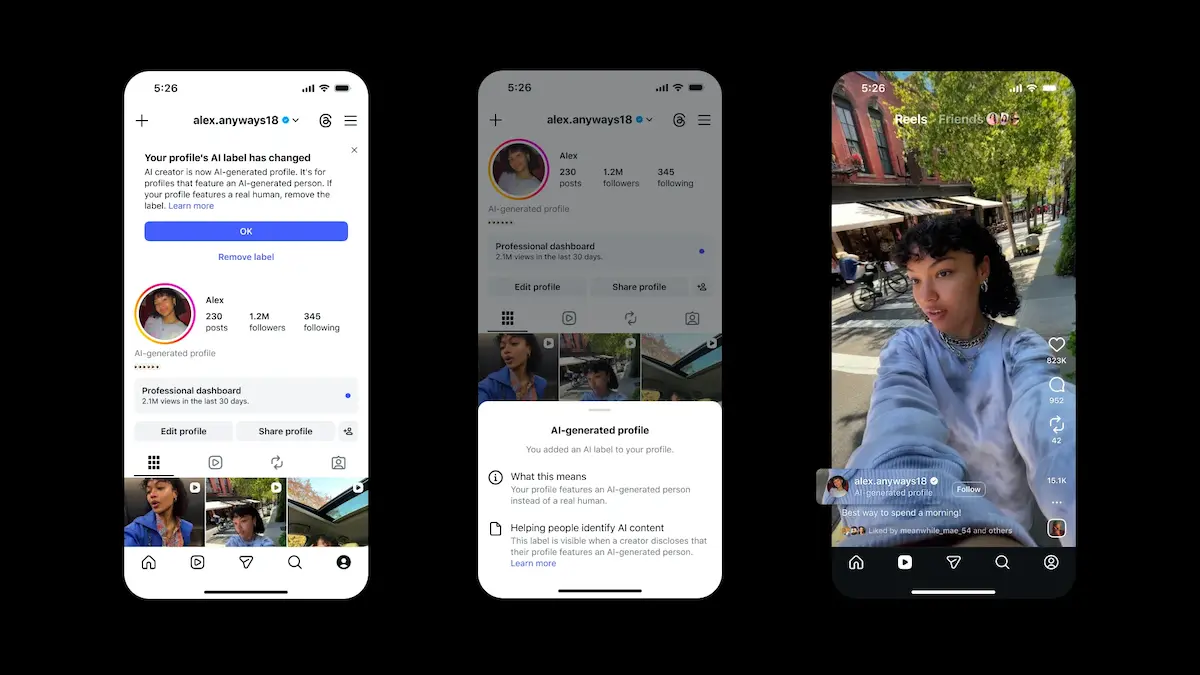
Under the newly instituted guidelines, Instagram will phase out its ambiguous "AI creator" tag in favor of a more explicit "AI-generated profile" label. Crucially, the platform is introducing aggressive enforcement mechanisms: accounts that publish synthetic human likenesses without proper disclosure will suffer severe algorithmic demotion, effectively throttling their organic reach across the platform. Conversely, accounts that proactively self-label will remain unpenalized, preserving their standing within Instagram’s recommendation engines.
This policy shift represents a critical turning point in social media governance. For years, platforms have relied on voluntary disclosures and soft-touch moderation to manage synthetic media. However, as generative AI tools reach a state of consumer-grade maturity—allowing bad actors, marketing agencies, and digital puppet masters to manufacture convincing human identities with minimal friction—Instagram has been forced to intervene. The decision reflects a broader, systemic effort by parent company Meta to reclaim user trust amidst mounting regulatory scrutiny, high-profile disinformation scandals, and a historic multi-billion-dollar legal reckoning over platform safety.
Detailed Chronology of the Synthetic Media Crisis
To understand the urgency behind Instagram’s policy shift, one must trace the rapid evolution of synthetic personas from novel digital curiosities to vehicles for coordinated social engineering and financial exploitation.
[Late 2010s] Rise of Virtual Influencers (e.g., Lil Miquela) - CGI-based, clearly commercial.
       │
[2023-2024] Democratization of Generative AI - Diffusion models allow rapid, cheap generation of photorealistic human faces.
       │
[Early 2026] Coordinated Bot Networks - AI influencers deployed for social engineering (e.g., Goose dating app investigation).
       │
[Mid 2026] Commercial Health Fraud - Hundreds of AI-generated "doctors" flood social media promoting unverified supplements.
       │
[August 2026] Instagram Policy Pivot - "AI-generated profile" label mandated; algorithmic penalties introduced for non-compliance.
The Era of the Virtual Influencer
The phenomenon of the non-human creator is not entirely new. In the late 2010s, CGI-created characters like Lil Miquela emerged, garnering millions of followers and securing lucrative brand partnerships with luxury fashion houses. However, these early iterations required highly skilled teams of 3D artists, graphic designers, and animators. They were capital-intensive, transparently commercial, and easily identifiable as digital constructs.
The landscape shifted dramatically with the democratization of open-source text-to-image and image-to-image diffusion models. By 2024 and 2025, generating a photorealistic human face, complete with natural blemishes, expressive lighting, and plausible background environments, became a trivial task requiring only a few seconds and minimal computational expense. This technological leap democratized the creation of "synthetic humans," giving rise to thousands of automated accounts that looked, spoke, and interacted exactly like real people.
The Goose App Investigation and Social Engineering
The potential for abuse became glaringly apparent in early 2026. A landmark investigation by Wired exposed a sophisticated influence campaign on Instagram promoting "Goose," a gay dating application. The investigation revealed a highly coordinated network of more than two dozen accounts. These accounts featured attractive, seemingly real young men living aspirational lifestyles.
In reality, these men did not exist; they were entirely AI-generated.
These synthetic personas did not merely post static images; they actively engaged in social engineering. They utilized automated direct messaging scripts to interact with real Instagram users, building rapport before directing them to download the Goose app. The campaign demonstrated that AI-generated profiles were no longer just passive content creators—they had been weaponized as active agents of deception, capable of conducting personalized outreach at scale.
The Proliferation of Synthetic Medical Disinformation
Beyond deceptive marketing, the rise of synthetic profiles has posed acute risks to public health. In July 2026, an investigation by The New York Times uncovered a vast ecosystem of AI-generated medical professionals, holistic healers, and wellness personalities active across major social networks, including Instagram and TikTok.
These virtual "doctors"—dressed in white lab coats and speaking with simulated authority—delivered convincing pitches for unverified dietary supplements, weight-loss cures, and alternative therapies. By bypassing the traditional scrutiny applied to real medical professionals, these synthetic actors exploited the visual cues of clinical authority to monetize health anxiety. The inability of the average user to distinguish between a licensed physician and a pixel-perfect, AI-generated rendering highlighted a glaring gap in platform integrity.
The Policy Mechanics: Labels, Penalties, and Permitted Exceptions
In response to these compounding crises, Instagram’s new policy establishes a clear boundary between human and synthetic identity. The platform’s intervention relies on a dual strategy of explicit labeling and algorithmic deterrence.
Defining the "AI-Generated Profile"
The cornerstone of the new policy is the transition from the "AI creator" tag to the "AI-generated profile" label. According to Instagram, the previous nomenclature was ambiguous, often leaving users confused as to whether the content was AI-assisted or the creator themselves was entirely artificial.
The new label is explicitly designed to signify that the person featured on the profile is a digital fabrication or has been substantially generated using artificial intelligence. This label will be prominently displayed on the account’s profile page and associated posts, ensuring immediate transparency for any user interacting with the account.
+-----------------------------------------------------------------------+
|                       INSTAGRAM AI LABELING FRAMEWORK                 |
+-----------------------------------------------------------------------+
| CATEGORY                      | REQUIRED LABEL? | ALGORITHMIC PENALTY?|
+-------------------------------+-----------------+---------------------+
| Fully AI-Generated Persona    | YES             | NO (If labeled)     |
| (e.g., Synthetic Influencer)  |                 | YES (If unlabeled)  |
+-------------------------------+-----------------+---------------------+
| AI-Assisted Human Creator     | NO              | NO                  |
| (e.g., Photoshop, AI Filters) |                 |                     |
+-------------------------------+-----------------+---------------------+
| AI Text/Caption Polish        | NO              | NO                  |
+-------------------------------+-----------------+---------------------+
| AI Graphic/Artistic Tweaks    | NO              | NO                  |
+-----------------------------------------------------------------------+
The Algorithmic Stick: Demotion and Reduced Reach
Instagram is leveraging its most powerful tool—the recommendation algorithm—to enforce compliance. Under the new guidelines, creators who deploy synthetic personas without utilizing the "AI-generated profile" label will face systemic penalties.
While the platform will not outright ban these accounts, it will significantly restrict their distribution. Unlabeled synthetic profiles will be excluded from high-traffic discovery surfaces, including:
- The Explore Page
- The Reels Tab
- Suggested User Recommendations
- Algorithmic Feed Injections
This penalty effectively neutralizes the economic viability of deceptive AI networks, which rely heavily on algorithmic discovery to build audiences and generate traffic. Conversely, creators who voluntarily adopt the label will be protected from these distribution penalties, allowing legitimate virtual creators to operate openly within the ecosystem.

The Boundaries of Permitted AI Utility
Importantly, Instagram has clarified that the new label is not a blanket requirement for all forms of artificial intelligence. The platform recognizes that AI has become deeply integrated into the modern creative workflow. Consequently, the "AI-generated profile" label is not required for:
- Creative Editing: Utilizing AI-driven photo editing tools, such as generative fill, background removal, or color grading.
- Text Optimization: Using large language models to draft, polish, or translate captions and hashtags.
- Graphic Enhancements: Integrating AI-generated graphic elements, stickers, or artistic filters into content featuring real humans.
The policy is strictly focused on identity: if the persona presenting themselves as the account holder or primary subject is synthetic, disclosure is mandatory.
Supporting Context: Meta’s Summer of Backlash and the $18 Billion Settlement
Instagram’s policy update does not exist in a vacuum. It is the latest in a series of defensive maneuvers by parent company Meta, which has faced a turbulent summer characterized by intense public backlash, product failures, and historic regulatory penalties.
The "Muse" Debacle and the Likeness Rights Struggle
In July 2026, Meta rolled out "Muse," a sophisticated generative AI tool integrated directly into Instagram that allowed users to generate high-fidelity images. However, the tool immediately sparked outrage when it was revealed that Muse allowed users to generate images using the likenesses of real, public Instagram users without their explicit consent.
The platform’s creator community reacted with fury, pointing out that their public portfolios were being scraped to train and power an engine that could clone their identities. Facing threats of mass boycotts and potential intellectual property lawsuits, Meta was forced to perform a humiliating U-turn, pulling the controversial feature just days after its launch. This incident left Meta highly sensitive to issues of digital consent and identity theft on its platforms.
The $18 Billion Multistate Settlement
Compounding its product-related public relations struggles, Meta reached an unprecedented $18 billion settlement in late August 2026 with a coalition of 29 U.S. states. The lawsuit accused Meta of knowingly designing features on Facebook and Instagram that hook children and teenagers, exacerbating mental health crises, and failing to protect minors from online harms.
As part of the sweeping consent decree, Meta agreed to implement structural changes to its platforms, including:
- A default two-hour daily usage limit for teenage accounts.
- A mandatory "Night Mode" block to prevent late-night scrolling.
- Muted notifications during school hours.
- Enhanced parental control dashboards.
Operating under the shadow of this massive financial penalty and the strict oversight of state attorneys general, Meta is highly motivated to demonstrate proactive self-regulation. Implementing clear labeling for AI-generated profiles is a direct attempt to stave off further regulatory intervention regarding consumer deception and platform safety.
Official Statements and Public Reaction
In its official blog post announcing the policy, Instagram framed the decision as a direct response to user feedback and a commitment to maintaining authentic connections.
"As generative AI becomes a bigger part of how people create, we’ve heard that people don’t like seeing a profile that seems human, only to find out later that the person featured is AI-generated," Instagram wrote. "They want to know when a profile features an AI-generated person. Our goal is to make these disclosures as clear and straightforward as possible so that users can make informed decisions about who they are engaging with online."
The reaction from the digital creator community has been cautiously optimistic, though many express skepticism regarding Meta’s ability to enforce the policy effectively.
"It’s a step in the right direction, but the devil is in the details," says Sarah Jenkins, a digital media strategist and advocate for creator rights. "Labeling is great for the creators who play by the rules. But the bad actors—the ones running scam networks, fake dating bots, and synthetic medical advice farms—have zero incentive to self-label. The real test will be whether Instagram’s automated detection systems can actually catch these accounts and enforce the reach reduction."
Future Outlook: The Arms Race of Verification and Detection
As Instagram deploys its new labeling policy, the social media landscape is entering a highly sophisticated arms race. The success of this initiative hinges on Meta’s technical capability to detect unlabeled synthetic media in real time.
The Technical Challenge of Detection
Detecting state-of-the-art generative AI is notoriously difficult. While early deepfakes exhibited telltale signs—such as unnatural blinking patterns, irregular shadows, or distorted fingers—modern diffusion models have largely corrected these flaws. Meta will need to rely on a combination of:
- Cryptographic Watermarking: Supporting industry standards like the Coalition for Content Provenance and Authenticity (C2PA) to track the metadata of AI-generated files from their creation.
- Algorithmic Analysis: Deploying deep learning classifiers trained to detect subtle pixel-level artifacts imperceptible to the human eye.
- Behavioral Heuristics: Monitoring account behavior, such as inhuman posting frequencies, automated DM patterns, and network connections, to flag potential synthetic botnets.
The Impact on the Creator Economy
The mandate will likely split the virtual creator space into two distinct segments. Legitimate virtual influencers who focus on art, fashion, and digital storytelling will likely embrace the "AI-generated profile" label, using it as a badge of creative transparency.
Conversely, opportunistic and malicious actors will continue to seek loopholes, utilizing hybrid workflows (such as mapping AI faces onto real human bodies) to evade algorithmic detection.
Ultimately, Instagram’s policy pivot represents a necessary acknowledgment of a permanent shift in online interaction. As synthetic entities become indistinguishable from real humans, the value of verified human identity will only increase. By penalizing deception and rewarding transparency, Instagram is attempting to preserve the foundational asset of its platform: the belief that behind every screen, there might actually be a human being.