In a milestone release that bridges the operational database landscape and the expanding universe of artificial intelligence, Amazon Web Services (AWS) has announced the general availability of native vector search in Amazon DynamoDB. This major update enables developers and enterprise architects to store high-dimensional vector embeddings directly alongside traditional operational data within their existing DynamoDB tables. By eliminating the necessity to provision, manage, and synchronize separate, dedicated vector stores, AWS is fundamentally streamlining how modern, AI-powered applications are architected.
The service is engineered to scale seamlessly to handle trillions of vectors while maintaining single-digit millisecond latency at 99%+ recall. Built entirely on DynamoDB’s robust serverless infrastructure, the native vector search capability retains the familiar pay-per-request pricing model, zero-downtime maintenance, and horizontal scaling characteristics that developers have relied on for mission-critical workloads. Whether powering advanced retrieval-augmented generation (RAG) pipelines, agentic memory frameworks, hyper-personalized recommendation engines, or real-time anomaly detection, engineering teams can now execute high-performance semantic retrieval without the historical friction of data movement and dual-database orchestration.
Detailed Chronology
The Architectural Burden of the Pre-Native Era
For years, the rapid proliferation of generative AI and large language models (LLMs) created a unique architectural dilemma for application developers. While operational databases like Amazon DynamoDB excelled at storing relational or key-value data—such as user profiles, transaction logs, and product catalogs—they were fundamentally blind to semantic meaning. Natural language queries, contextual similarity matching, and conceptual grouping required high-dimensional vector embeddings.
To bridge this gap, developers building applications that required semantic search had to adopt a multi-database pattern. This typically involved:

- Maintaining a primary operational data store in DynamoDB.
- Provisioning and managing a separate, dedicated vector database.
- Constructing and maintaining complex, asynchronous data synchronization pipelines (using change data capture or event-driven architectures) to keep both systems aligned.
This dual-store approach introduced significant technical debt. Engineering teams faced soaring infrastructure costs, heightened operational overhead, licensing fees for specialized vector stores, and the perennial challenge of maintaining predictable, low-latency performance at scale. Any lag in synchronization risked serving stale data to AI models, while managing separate scaling policies for disparate databases complicated deployment pipelines.
The Engineering Breakthrough: Native Vector Search
Recognizing these operational bottlenecks, AWS engineers developed a fully integrated, serverless vector search capability natively inside DynamoDB. Rather than treating vectors as foreign entities requiring external indexing infrastructure, DynamoDB now treats vector embeddings as native components of the table schema.
By introducing a specialized vector index type that can be created directly on an attribute storing vector embeddings, AWS has erased the boundary between operational storage and semantic retrieval. Developers can generate embeddings using industry-standard machine learning models—such as Amazon Bedrock Titan Text Embeddings, Cohere Embed, or various OpenAI text embedding models—and store them effortlessly inside standard DynamoDB tables using familiar API calls like PutItem or UpdateItem.
With this release, the vector index shares the exact same serverless infrastructure and elastic pricing model as the parent table. There are no maintenance windows to schedule, no versions to upgrade, and no servers to patch. As operational data grows, vector indexes scale horizontally, preserving predictable latency even when navigating multi-dimensional spaces containing trillions of vectors.

Supporting Context & Metrics
Technical Specifications and Performance Benchmarks
The newly released vector search capability in DynamoDB comes equipped with enterprise-grade performance metrics and flexible configuration options designed to support complex, high-throughput applications:
- Latency and Recall: The service delivers single-digit millisecond response times while achieving 99%+ recall accuracy, ensuring that applications receive the most relevant semantic matches instantaneously.
- Dimensionality Support: DynamoDB vector search accommodates embeddings with up to 4,096 dimensions, making it fully compatible with state-of-the-art foundational models.
- Distance Functions: Developers can choose from three primary distance calculation methods depending on their specific use case:
- Cosine: Measures the angle between vectors, highly effective for comparing the semantic similarity of text.
- Euclidean: Calculates the straight-line distance between two points in vector space.
- Dot Product: Measures the projection of one vector onto another, frequently utilized in recommendation systems.
- Partition Keys and Scaling: Vector index partition keys allow administrators to logically distribute vectors across partitions. This ensures that searches can be scoped to specific subsets of data—such as a single geographic marketplace or tenant—without scanning the entire index, thereby optimizing query performance.
- Inline Filtering: The service supports exact-match inline filtering on non-vector attributes (such as product categories or status flags) during the query phase, drastically reducing the search space and returning highly refined results in a single operation via the
SearchVectorsAPI.
A Practical Implementation: Transforming Product Catalogs
To understand the practical implications of this release, consider an online sporting goods retailer utilizing a ProductCatalog table. Traditionally, shoppers searching for items were restricted to exact keyword matches, often missing relevant products phrased differently in descriptions.
By adopting DynamoDB’s vector search, the implementation unfolds in three straightforward phases:
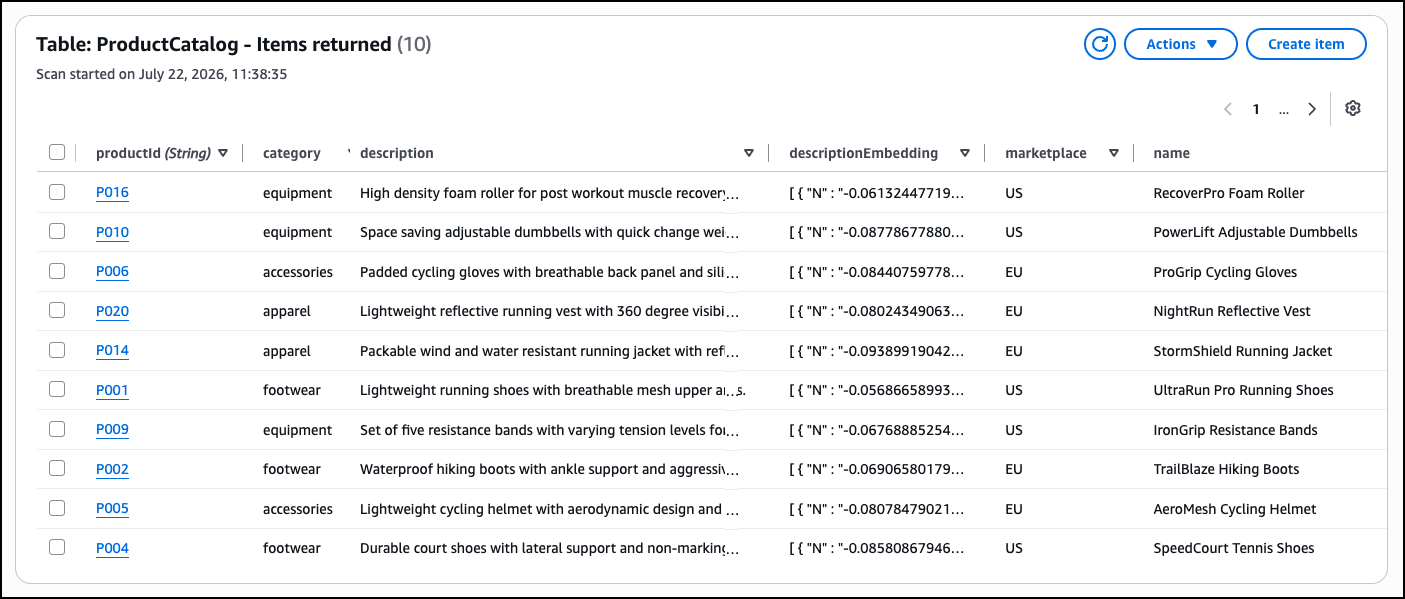
- Preparing the Table: The developer generates numerical vector embeddings from existing product descriptions using Amazon Bedrock Titan Text Embeddings. These embeddings are added to each item in the table under a new attribute (e.g.,
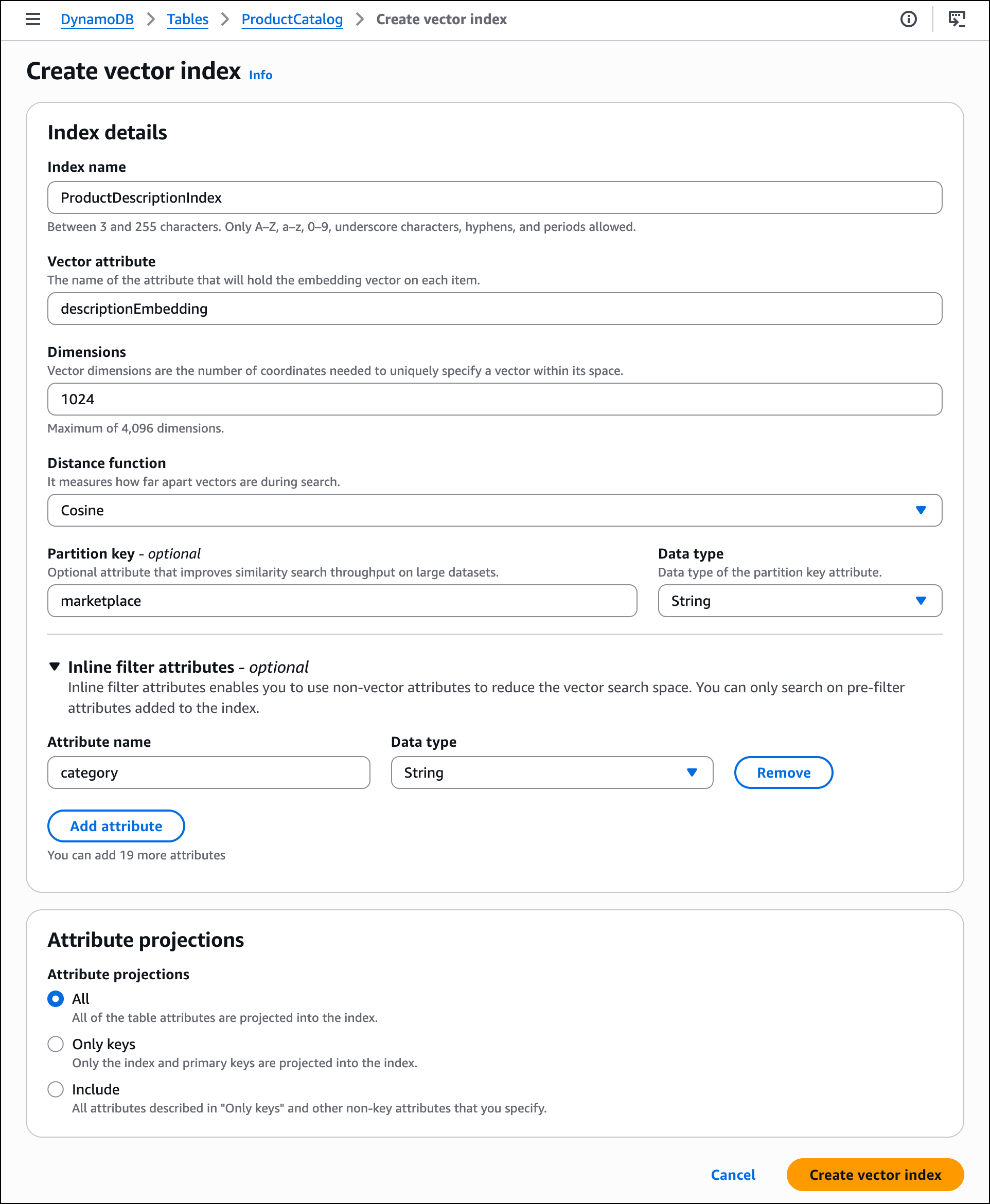
descriptionEmbedding) formatted simply as a standard DynamoDBListof numbers. No schema overhaul or complex data migration is required. - Creating the Vector Index: Using the AWS Management Console, CLI, or Infrastructure-as-Code (IaC) tools like AWS CloudFormation, the developer creates a vector index named
ProductDescriptionIndex. They specify the vector attribute, set the dimensions to match their embedding model, choose Cosine as the distance function, assignmarketplaceas the partition key for horizontal distribution, and addcategoryas an inline filter attribute. - Executing Semantic Queries: When a user inputs a natural language query such as "lightweight running shoes for summer," the application converts the phrase into a query vector using the same embedding model. Through the
SearchVectorsAPI, the query vector is passed along with a Top-K parameter (e.g., returning the top 5 results), the marketplace partition key, and the category filter (footwear). DynamoDB instantly returns the five most semantically relevant products, complete with standard operational attributes like pricing and name, all within a single unified response.
Official Statements
While direct quotes from individual executives are integrated into the technical deployment framework provided by AWS release documentation, the overarching strategic vision articulated by the development team underscores a clear commitment to simplification and AI enablement.
AWS engineering leads emphasize that the core motivation behind native vector search in DynamoDB is the elimination of architectural friction. By removing the requirement to stitch together disparate database technologies, organizations can accelerate their time-to-market for generative AI applications. The official documentation notes:
"With vector search built into DynamoDB, your vectors and operational data share the same serverless infrastructure and the same pay-per-request pricing model… You can now build applications that require semantic retrieval on agentic memory, retrieval augmented generation, recommendation engines, personalized experiences, anomaly detection, and more using DynamoDB and its native vector search."
Furthermore, AWS highlights the accessibility of the new tooling. By integrating vector search management directly into the DynamoDB console, AWS Command Line Interface (AWS CLI), SDKs, and CloudFormation, developers of all backgrounds can adopt semantic search patterns without requiring specialized database administration expertise. The introduction of support for the AWS MCP Server and AI coding tools further signals AWS’s dedication to modernizing developer workflows through intelligent agentic assistance.
Future Outlook
The general availability of vector search in Amazon DynamoDB marks a watershed moment in the evolution of cloud-native database architectures. As enterprises race to deploy sophisticated artificial intelligence systems—ranging from autonomous multi-agent frameworks requiring robust episodic and semantic memory to real-time recommendation engines processing petabytes of behavioral data—the demand for unified data persistence will only intensify.
Looking ahead, the convergence of operational data stores and vector capabilities points toward a future where specialized, standalone vector databases may become increasingly niche, reserved only for hyper-specialized workloads that exceed the massive operational scaling limits of mainstream databases. For the vast majority of enterprise applications, the ability to query operational records and high-dimensional vector spaces concurrently within a fully managed, serverless environment establishes a new industry standard.
As AWS continues to expand regional availability—rolling out the feature across all commercial regions and AWS GovCloud (US)—organizations are well-positioned to reduce architectural complexity, slash infrastructure costs, and deliver fluid, natural-language-driven experiences to their end users. The roadmap for DynamoDB firmly establishes the service not merely as a repository for transactional records, but as an intelligent, foundational bedrock for the next generation of generative AI applications.