Executive Overview
In the contemporary digital landscape, the pressure to produce high-volume, high-converting content has reached a critical tipping point. Marketers, enterprise SEO teams, and independent publishers face an unrelenting demand for fresh copy across blogs, social media channels, email marketing campaigns, and e-commerce listings. To bridge the widening gap between content supply and audience demand, the industry has turned en masse toward Artificial Intelligence (AI) content generation.
No longer a futuristic novelty, AI writing software has evolved into a sophisticated suite of tools driven by advanced Natural Language Processing (NLP) models. These platforms are capable of understanding context, emulating brand voices, conducting SEO audits, and generating human-like prose in a matter of seconds. For businesses navigating tight budgets and strained human resources, AI-powered copywriting tools offer a viable, highly efficient solution.

However, with dozens of options populating the marketplace, selecting the right software can be an overwhelming endeavor. Each platform boasts specialized strengths—ranging from long-form blog writing and programmatic SEO optimization to hyper-targeted e-commerce product descriptions. This comprehensive report investigates the top 10 AI content generators available on the market, analyzing their core architecture, features, pricing structures, and ideal use cases to help organizations make an informed, authoritative investment.
Detailed Chronology: The Evolution of AI Writing Assistants
The journey toward automated content creation began in earnest with basic predictive text algorithms and simple template-based software. These early iterations lacked contextual understanding, often producing rigid, repetitive text that required exhaustive human editing.
- 2018–2020 (The Rise of Transformer Models): The introduction of deep learning architectures, most notably OpenAI’s GPT models, marked a fundamental paradigm shift. Developers began building intuitive wrapper interfaces over these language models, giving birth to early dedicated commercial copywriting tools.
- 2021–2022 (Mainstream Adoption & Specialization): The market experienced an explosion of specialized AI writers. Tools like Jasper (formerly Jarvis) popularized the concept of "Boss Mode" workflows, while platforms like Frase integrated automated SEO research directly into the drafting process. Copywriters and marketing agencies shifted from viewing AI as a replacement threat to embracing it as an indispensable collaborative co-pilot.
- Present Day (Multimodal & Programmatic Ecosystems): Modern AI content generation has expanded far beyond simple text prompts. Today’s market-leading platforms feature integrated plagiarism checkers, grammar correction engines, automated outline builders, and multi-language support, cementing their place as core infrastructure in the modern digital marketing stack.
Supporting Context & Metrics: Analyzing the Top 10 AI Writing Platforms
To provide a rigorous evaluation, the following section examines the ten leading AI content generators, detailing their primary utility, feature sets, and financial commitments.
1. Jasper AI (Formerly Jarvis)
- Primary Focus: Versatile Long-Form Content & Advanced Workflow Automation
- Overview: Jasper stands as a premier writing and content generation platform designed to intuitively select the most effective phrasing, sentence structures, and tone for a given medium. By leveraging advanced AI, Jasper minimizes drafting time while maximizing creative output.
- Key Features: Over 50 short-form copywriting templates, long-form assistant capabilities, multi-language translation, and custom tone-of-voice training.
- Pricing: Features structured tiers, with the high-output "Boss Mode" package priced at $99/month, catering to power users who require rapid, long-form generation capabilities.
2. Copy.ai
- Primary Focus: Marketing Copy, Social Media, and Short-Form Content
- Overview: Copy.ai empowers marketers and business owners to rapidly generate ad copy, social media posts, and foundational website text. Utilizing over 90 specialized templates—ranging from bullet-point-to-blog converters to high-converting hook text—it streamlines both short-term campaigns and long-term content strategies.
- Key Features: Expansive template library, user-friendly interface, real-time collaboration tools, and structured workflows for product descriptions and sales reports.
- Pricing: Offers a robust 7-day free trial with 100 runs per day. The Pro Plan is billed at $49/month (or an annualized rate equivalent to $35/month).
3. Frase AI
- Primary Focus: SEO Research, Content Briefs, and Search Optimization
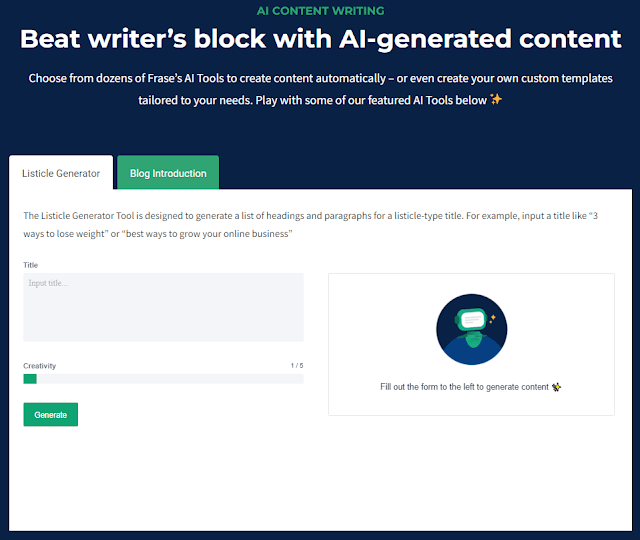
- Overview: Frase operates at the intersection of AI generation and search engine optimization. Rather than simply drafting text from scratch, Frase assists users in researching competitor landscapes, constructing comprehensive content briefs, and optimizing articles to rank competitively on search engine results pages (SERPs).
- Key Features: Automated content brief generation, SERP clustering, topic scoring, and direct optimization metrics.
- Pricing: Tiered structures include the Solo Plan ($14.99/month), Basic Plan ($44.99/month), and Team Plan ($114.99/month), with optional SEO add-ons available for advanced users.
4. Article Forge
- Primary Focus: Fully Automated, High-Efficiency Blog Writing
- Overview: Article Forge differentiates itself from prompt-heavy interfaces by operating on a streamlined, keyword-driven architecture. By simply inputting a target keyword and supplementary instructions, the software autonomously researches and drafts complete, end-to-end articles.
- Key Features: End-to-end automated article generation, automatic image and video insertion, and built-in Copyscape pass guarantees.
- Pricing: Offers a 30-day money-back guarantee with monthly and yearly billing options. Tiers include the Basic Plan ($27/month for up to 25k words), Standard Plan ($57/month), and Unlimited Plan ($117/month).
5. Rytr
- Primary Focus: Budget-Friendly Content Creation for Solopreneurs and Students
- Overview: Rytr.me is widely recognized as an accessible, feature-rich AI writing assistant tailored for small businesses, bloggers, and academic users. Its lightweight interface allows users to generate SEO-optimized articles, emails, and essays within minutes.
- Key Features: Built-in plagiarism checker, 30+ use cases and tones, rich-text editor, and browser extensions.
- Pricing: Features a limited free plan (up to 5,000 characters per month). Paid upgrades include the Saver Plan starting at $9/month (or $90/year).
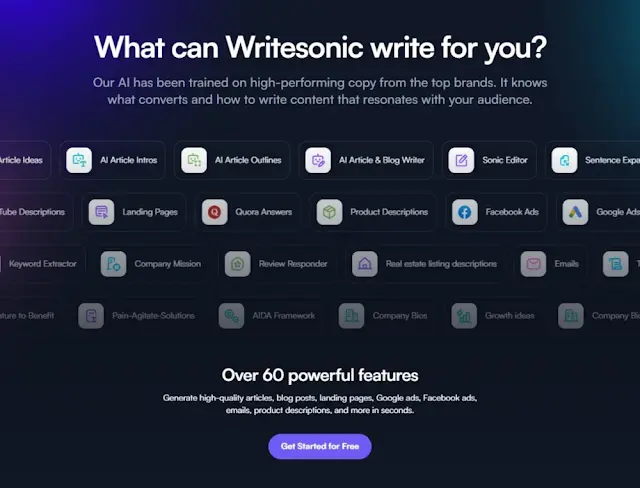
6. Writesonic
- Primary Focus: Marketing Copy & Long-Form Articles with Integrated Quality Checks
- Overview: Writesonic bridges the gap between marketing copy and long-form publishing. Designed specifically for solopreneurs and agencies operating on strict budgets, it includes robust grammatical and structural editing tools to ensure professional output quality.
- Key Features: Landing page copy generators, article rewrites, integrated grammar enhancement, and multi-tier content templates.
- Pricing: Operates on a credit-based trial model, transitioning into paid tiers such as the Short-form plan at $15/month and the Long-form plan starting at $19/month.
7. CopySmith
- Primary Focus: Enterprise-Grade Content Scaling & Bulk Generation
- Overview: CopySmith is engineered for organizations that require high-volume output across multiple formats, including personal documents, professional reports, presentations, and blog posts. Its ecosystem supports extensive team collaboration and campaign management.
- Key Features: Bulk content generation, e-commerce product description workflows, campaign management integrations, and API access.
- Pricing: Features a credit card-free trial, followed by the Starter Plan at $19/month and custom enterprise solutions.
8. Hypotenuse.ai
- Primary Focus: E-Commerce Product Descriptions and Visual-Textual Integration
- Overview: Hypotenuse.ai excels in the e-commerce sector, providing automated solutions for online retailers struggling to write unique, SEO-friendly descriptions for thousands of inventory items. Its interface is intentionally streamlined for rapid, batch-oriented workflows.
- Key Features: Bulk e-commerce product description generators, campaign copy formulation, and image generation tools.
- Pricing: Trial periods are available for evaluation. Paid structures include the Starter Plan at $29/month and the Growth Plan at $59/month.
9. Kafkai
- Primary Focus: Niche-Specific SEO Content and Bulk Blog Publishing
- Overview: Kafkai stands out as a specialized writing assistant built explicitly for SEO professionals and affiliate marketers. It utilizes niche-trained machine learning models to generate targeted content across specialized industry verticals.
- Key Features: Niche training models, bulk article generation, and programmatic publishing plugins.
- Pricing: Structured across high-volume tiers, including the Writer Plan ($29/month for 100 articles), Newsroom Plan ($49/month), Printing Press Plan ($129/month), and Industrial Printer Plan ($199/month).
10. Peppertype.ai
- Primary Focus: Content Ideation and Copywriting for Small Business Growth
- Overview: Peppertype.ai acts as a virtual copywriting team for small businesses, focusing heavily on creative ideation, blog outlines, social media engagement hooks, and ad copy variations.
- Key Features: Rapid content scaling, interactive content modules, and collaborative team dashboards.
- Pricing: Offers trial evaluations, with the Personal Plan priced at $35/month and Team Plans scaling to $199/month.
Official Statements & Industry Perspectives
Industry analysts and digital marketing pioneers have closely monitored the proliferation of generative AI tools. While early criticisms centered on the potential dilution of web content quality and the risk of algorithmic penalties from search engines, official stances from major tech institutions have evolved toward pragmatic regulation.

Search engine representatives have consistently emphasized that algorithmic evaluation focuses primarily on content quality, relevance, and user value, rather than the underlying production method. Consequently, industry thought leaders advocate for a "human-in-the-loop" model. In this framework, AI serves as an accelerator—handling initial research, structuring, and drafting—while human editors inject original insights, factual verification, and brand voice nuance.
A leading voice in enterprise SEO remarked:
"The competitive advantage no longer belongs to those who write every word by hand, nor to those who blindly publish unedited machine output. The winners are those who utilize AI to scale their ideation and foundational drafting, freeing up human capital to focus on strategic depth and authentic storytelling."
Future Outlook
As artificial intelligence models continue to mature, the trajectory of content generation points toward hyper-personalization, multimodal capabilities, and deep API integrations. Future iterations of AI writing assistants are projected to move beyond static text boxes, integrating directly into content management systems (CMS), Customer Relationship Management (CRM) platforms, and enterprise data warehouses.

Organizations that successfully integrate these tools into their operational workflows will likely experience unprecedented efficiencies in customer acquisition and brand visibility. However, as the digital ecosystem becomes increasingly saturated with automated text, the ultimate differentiator will remain human creativity. Brands that leverage AI to eliminate administrative friction—while doubling down on unique research, authentic experiences, and rigorous editorial oversight—will define the next era of digital publishing.
Disclaimer: Certain links referenced in this review may be affiliate links, meaning publishers may earn a modest commission at no additional cost to the consumer should a purchase be made.