Executive Overview
As autumn settles over New York City, bringing with it a brisk drop in temperatures and the full-throttle acceleration of the corporate calendar, the technology sector is experiencing its own seasonal surge. At the forefront of this autumn momentum is a landmark development in enterprise cloud infrastructure and artificial intelligence: the general availability of OpenAI’s GPT-6 Astra on Amazon Bedrock.
Announced this September, this integration represents a watershed moment for organizations seeking to scale high-end artificial intelligence across complex, secure workflows. GPT-6 Astra stands as OpenAI’s most capable and sophisticated model to date. By deploying it within the secure, enterprise-grade environment of Amazon Bedrock, Amazon Web Services (AWS) and OpenAI are bridging the gap between frontier-level cognitive reasoning and strict corporate data governance.
This release is not merely a routine software update; it is a paradigm shift for how enterprises manage massive data structures. Featuring an expansive context window of up to 1 million input tokens, GPT-6 Astra can ingest entire corporate codebases, multi-year legal contracts, and sprawling archival document libraries in a single prompt. For enterprise developers, systems architects, and business leaders, this capability transforms AI from an assistive chatbot into an autonomous reasoning engine capable of complex problem-solving, professional-grade design, and advanced computer-use workflows.
Beyond the headline-grabbing integration of GPT-6 Astra, the broader AWS ecosystem is moving at a rapid pace. This week’s updates underscore a fundamental evolution in how software engineers interact with intelligent systems: the most substantial productivity gains are no longer driven merely by superior tools, but by a holistic shift in workflow design and developer methodology. This comprehensive report explores the technical architecture of GPT-6 Astra on Amazon Bedrock, analyzes the security and governance frameworks safeguarding enterprise data, evaluates the implications for modern software development, and outlines the future trajectory of cloud-native generative AI.
Detailed Chronology of the Launch
The integration of OpenAI’s flagship model into Amazon Bedrock is the culmination of months of engineering collaboration between AWS and OpenAI, designed to meet the rigorous demands of enterprise environments.
The Lead-Up to General Availability
Throughout the summer, rumors swirled regarding the next generation of foundational models. Enterprise clients increasingly demanded models capable of true contextual understanding across disparate data silos. Standard models, while proficient at localized tasks, often stumbled when forced to reconcile conflicting directives embedded deep within extensive documentation.
OpenAI engineered GPT-6 Astra precisely to address these limitations. By prioritizing deep reasoning, advanced judgment, and native multimodal execution—including sophisticated browser and computer-use capabilities—the model was built to operate effectively within complex operational ecosystems. However, deploying such a powerful model presented significant logistical hurdles for risk-averse enterprises concerned with data privacy, latency, and API orchestration.
Deployment on Amazon Bedrock
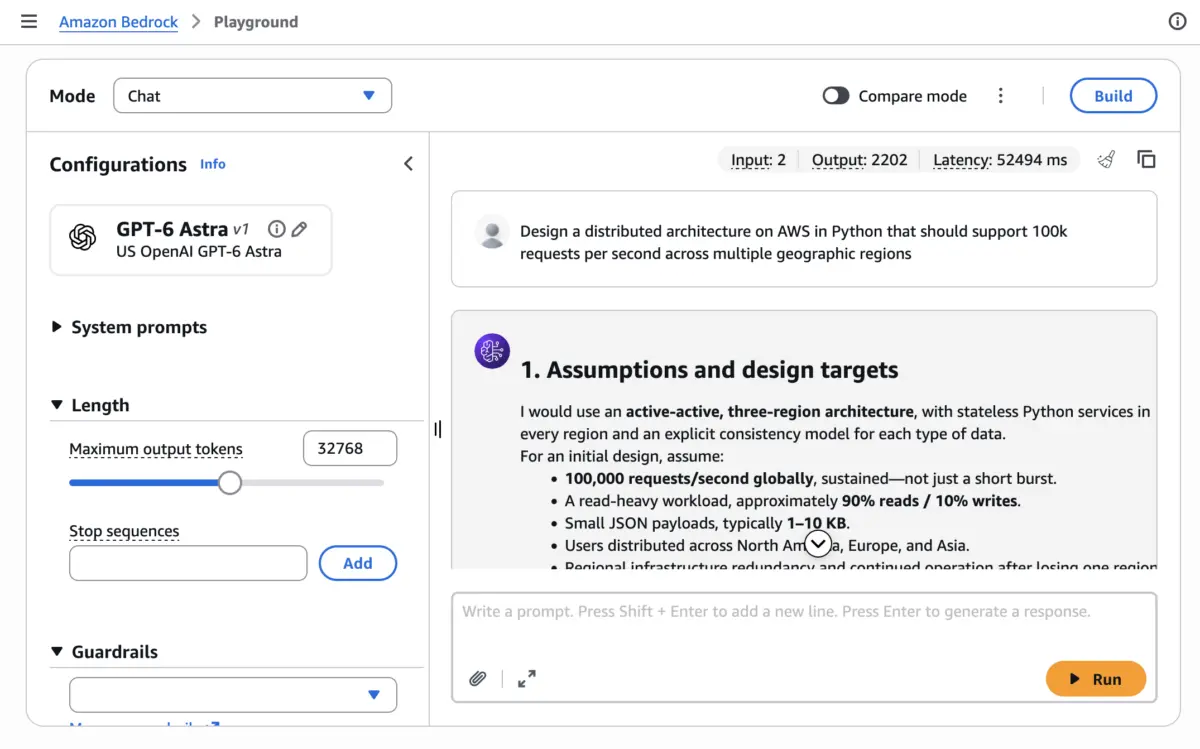
The deployment of GPT-6 Astra on Amazon Bedrock officially went live this week, establishing a seamless pathway for businesses to access the model without managing underlying infrastructure. Developers can now invoke GPT-6 Astra directly through standard, supported Amazon Bedrock APIs.
Simultaneously, OpenAI introduced configuration pathways for ChatGPT Work and Codex, allowing enterprise teams to leverage GPT-6 Astra directly within their existing developer environments. To maximize the utility of the model’s computer and browser-use features, OpenAI rolled out a suite of new enterprise plugins for ChatGPT Work. These plugins securely extend Astra’s operational reach across common business applications—such as enterprise resource planning (ERP) systems, customer relationship management (CRM) platforms, and collaborative workspace tools—enabling end-to-end task automation that was previously impossible.
Technical Architecture and Core Capabilities
To fully appreciate the impact of GPT-6 Astra on Amazon Bedrock, one must examine the underlying engineering specifications that separate this release from previous iterations of generative AI models.
The 1-Million-Token Context Window
The most transformative technical feature of GPT-6 Astra is its unprecedented 1-million-token input context window. In practical terms, this allows the model to process approximately 750,000 words—or roughly equivalent to dozens of dense technical manuals, entire legacy software repositories, or years of financial audits—in a single interaction.
[Enterprise Data Sources]
    ├── Sprawling Codebases (Millions of Lines)
    ├── Multi-Year Legal Contracts & Compliance Filings
    ├── Extensive Document Collections & Archives
    └── Real-Time Business Telemetry
            │
            ▼
[Amazon Bedrock Secure Gateway]
            │
            ▼
[OpenAI GPT-6 Astra (1M Token Context Window)]
    ├── Deep Reasoning & Logical Synthesis
    ├── Cross-Document Reconciliation
    └── Professional-Quality Writing & Design
            │
            ▼
[Enterprise Action & Automated Workflows]
In traditional retrieval-augmented generation (RAG) architectures, systems are forced to break large documents into smaller chunks, searching for relevant snippets to feed a model with a restricted context window. While effective, RAG systems frequently miss nuanced, cross-document dependencies. GPT-6 Astra bypasses many of these limitations by ingesting entire information ecosystems simultaneously.
For instance, a financial institution can upload an entire decade of regulatory compliance filings alongside its current operating procedures. The model can then analyze the entire corpus to identify subtle contradictions, flag compliance vulnerabilities, and suggest harmonized policy updates with a holistic understanding of the institution’s operational history.
Advanced Reasoning, Judgment, and Execution
Beyond raw data ingestion, GPT-6 Astra represents a generational leap in logical deduction and executive-level judgment. The model is fine-tuned to weigh competing inputs, evaluate trade-offs, and generate professional-grade outputs spanning technical documentation, architectural design, and software code generation.
Furthermore, its native computer and browser-use capabilities allow the model to interact with software interfaces much like a human operator. Rather than simply writing code, Astra can navigate development environments, execute test suites, analyze error logs in real time, and iteratively debug applications across web-based dashboards and integrated development environments (IDEs).
Security, Governance, and Data Privacy
For enterprise adopters, the integration of advanced artificial intelligence models invariably raises critical questions regarding data sovereignty, privacy, and security compliance. AWS and OpenAI have structured the Amazon Bedrock deployment of GPT-6 Astra to address these concerns head-on.
Enterprise-Grade Security Controls
Running GPT-6 Astra within Amazon Bedrock grants organizations immediate access to established, enterprise-grade AWS security frameworks. Organizations can leverage AWS Identity and Access Management (IAM) to govern granular access permissions, ensuring that only authorized personnel and automated pipelines can invoke the model.
Key security pillars of the integration include:
- Zero Data Retention for Training: Inference data submitted to GPT-6 Astra via Amazon Bedrock is strictly partitioned. Customer inputs and model outputs are never used to train or fine-tune OpenAI’s foundational models, protecting proprietary intellectual property and trade secrets.
- Encryption in Transit and at Rest: All data processed through the Bedrock API is encrypted using robust cryptographic protocols, satisfying rigorous regulatory frameworks such as HIPAA, GDPR, and SOC 2.
- Comprehensive Audit Logging: Through AWS CloudTrail, administrators can maintain a detailed, immutable audit trail of every model invocation, tracking usage patterns, latency metrics, and API call volumes across organizational units.
Supporting Context: The Evolution of Developer Workflows
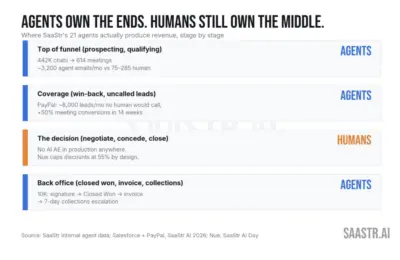
While the debut of GPT-6 Astra dominates technical discussions, the broader narrative emerging from AWS this September centers on human-AI collaboration. Industry analysts and AWS engineering leads point out that the organizations achieving the most dramatic productivity gains from AI agents are altering their fundamental workflows, rather than merely adopting superior software tools.
Beyond Tooling: Rethinking the Software Development Lifecycle (SDLC)
Historically, the introduction of a new development tool—such as an advanced IDE or an automated testing framework—yielded incremental efficiency gains. Developers simply executed their traditional tasks faster. AI agents, however, require a fundamental reimagining of the software development lifecycle.

Engineers are transitioning from direct coders to high-level system architects and proctors of autonomous agents. By delegating boilerplate code generation, rigorous unit-test writing, and continuous refactoring to models like GPT-6 Astra, human developers are able to focus on architectural integrity, user experience, security hardening, and complex system integration.
This shift demands new organizational habits: clear prompt engineering standards, rigorous automated guardrails to validate agentic outputs, and cross-functional collaboration models where human teams manage fleets of specialized AI agents operating in parallel.
Official Statements and Industry Perspective
The launch has drawn substantial commentary from industry leaders, highlighting the strategic alignment between cloud infrastructure providers and artificial intelligence innovators.
"The integration of GPT-6 Astra into Amazon Bedrock marks a pivotal milestone for enterprise artificial intelligence," noted a senior AWS product lead during the launch briefings. "Our enterprise customers no longer have to choose between cutting-edge cognitive capabilities and uncompromising data security. By combining OpenAI’s most advanced reasoning engine with the robust governance, scalability, and security of AWS, we are empowering organizations to tackle their most ambitious and complex workflows with absolute confidence."
Industry analysts have similarly echoed this sentiment, emphasizing that the availability of a 1-million-token context window within a managed cloud service democratizes capabilities previously restricted to heavily resourced technology monoliths. Regional enterprises, healthcare providers, financial institutions, and public sector organizations can now deploy sovereign, enterprise-grade reasoning engines tailored to their specific regulatory environments.
Future Outlook: What Lies Ahead
As the technology sector looks toward the remainder of the year and into the horizon of 2027, the deployment of GPT-6 Astra on Amazon Bedrock sets a new baseline for enterprise artificial intelligence.
The Road Ahead for Amazon Bedrock
AWS has signaled that the integration of OpenAI’s flagship model is part of a broader, continuous expansion of the Amazon Bedrock ecosystem. Future updates are expected to introduce even tighter integrations between Bedrock’s agentic frameworks, vector databases, and multi-model routing systems. This will allow enterprises to dynamically route specific tasks to the most cost-effective and capable model—whether that involves high-speed classification, deep logical reasoning via GPT-6 Astra, or specialized domain processing.
Developer Integration and Community Engagement
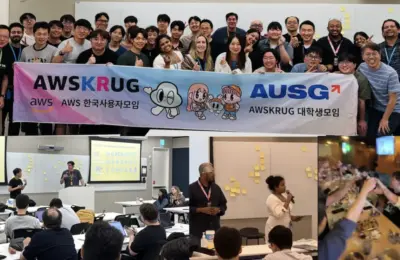
To support developers navigating this shifting landscape, AWS continues to expand its educational and collaborative resources. Builders are encouraged to join the AWS Builder Center to connect with peers, share architectural blueprints, and access specialized documentation designed to optimize agentic workflows.
Furthermore, AWS has published a robust schedule of upcoming virtual and in-person developer events, workshops, and technical deep-dives. These sessions aim to guide engineering teams through the nuances of migrating legacy architectures to take full advantage of ultra-long context windows and advanced autonomous agents.
As Micah and the AWS Weekly Roundup team noted in this week’s briefing: “The energy in New York is back at full speed, and so is the AWS launch calendar.” For enterprises ready to embrace the next generation of cloud-native intelligence, the tools are now fully in place, opening the door to unprecedented levels of automation, scale, and innovation.