Executive Overview
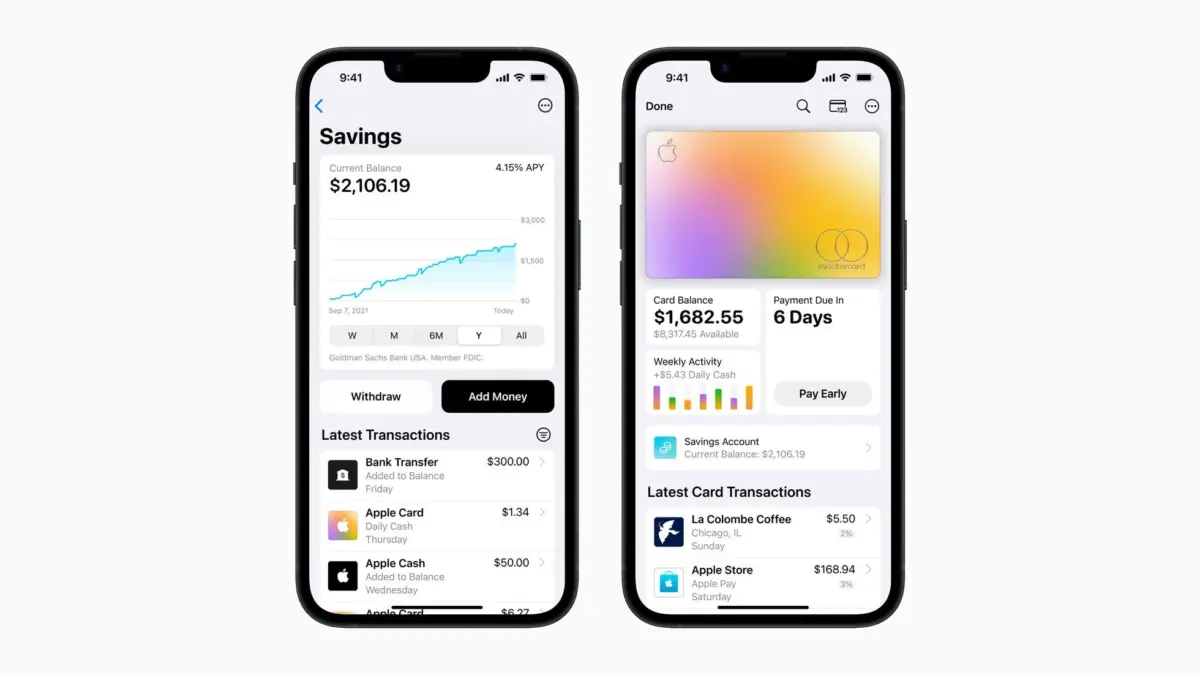
In an aggressive push to deepen its footprint in consumer finance, Apple—in strategic partnership with Wall Street titan Goldman Sachs—officially launched a high-yield savings account tailored exclusively for Apple Card users. Announced in April, the service allows cardholders to automatically deposit their "Daily Cash" rewards into an FDIC-insured savings vehicle boasting an impressive annual percentage yield (APY) of 4.15%.
This financial product represents a seismic shift in how technology companies interact with traditional banking infrastructure. By coupling the convenience of the iOS Wallet app with a competitive interest rate that dwarfs the national average, Apple is no longer just a hardware and software manufacturer; it is systematically constructing a closed-loop financial ecosystem.
Beyond capturing casual cashback rewards, the service empowers users to transfer personal funds directly from external bank accounts, up to a maximum balance of $250,000. While the 4.15% APY is subject to change based on macroeconomic shifts and Federal Reserve policies, it immediately positions Apple as a formidable competitor against both legacy brick-and-mortar institutions and digital-first neo-banks.
This rollout follows closely on the heels of other aggressive financial maneuvers, including the launch of Apple’s "Buy Now, Pay Later" (BNPL) service. Together, these initiatives signal a broader corporate strategy: transforming the iPhone from a communication device into an indispensable personal financial hub. As traditional banks face mounting pressure to retain deposits in a high-interest-rate environment, Apple’s seamless integration of spending, saving, and borrowing poses a profound challenge to the old guard of consumer banking.
Detailed Chronology: From Apple Card to High-Yield Savings
To understand the strategic gravity of Apple’s latest financial offering, one must examine the chronological progression of the company’s fintech roadmap. Apple’s entry into consumer finance was methodical, calculated, and executed over several years through deliberate phases.
Phase 1: The Genesis of the Apple Card (2019)
Apple first signaled its serious intent to disrupt personal finance in March 2019, when it unveiled the Apple Card during a high-profile Special Event at the Steve Jobs Theater. Launched in partnership with Goldman Sachs and backed by Mastercard, the physical and digital credit card was designed around a core value proposition: radical simplicity, transparency, and user privacy.
Crucially, the Apple Card introduced "Daily Cash"—a rewards program that immediately paid out cashback percentages (ranging from 1% on physical card purchases to 2% on Apple Pay transactions and 3% on purchases with select merchants like Uber, Walgreens, and Apple itself) directly to the user’s Apple Cash card within the Wallet app. At the time, Daily Cash could be spent using Apple Pay, sent to friends via Messages, or applied toward card balances. However, it lacked a dedicated mechanism for long-term wealth accumulation.
Phase 2: Expanding the Credit Ecosystem (2022–Early 2023)
As macroeconomic conditions shifted and interest rates began to climb globally, Apple recognized an opportunity to offer greater utility to its vast user base. In March 2023, Apple introduced its much-anticipated "Buy Now, Pay Later" (BNPL) service, dubbed Apple Pay Later. This feature allowed consumers to split purchases between $50 and $1,000 into four equal payments spread over six weeks, entirely interest- and fee-free.
The introduction of Apple Pay Later directly positioned Cupertino against established fintech heavyweights such as Klarna, Affirm, and Afterpay. It proved that Apple was willing to build sophisticated lending and credit evaluation tools natively into iOS, laying the administrative and technological groundwork for more complex banking products.
Phase 3: The Launch of High-Yield Savings (April 2023)
The logical culmination of these efforts arrived on a Monday morning in April 2023, when Apple and Goldman Sachs officially opened the doors to the Apple Card high-yield savings account. Within the span of four years, Apple had evolved from offering a simple cash-back credit card to providing a holistic suite of financial services that included instant rewards, short-term installment loans, and now, interest-bearing long-term savings.
Supporting Context & Metrics: The Mathematics of Apple’s Offer
To evaluate the true market disruption of Apple’s savings account, financial analysts must look closely at the numbers: the APY, deposit limits, comparative banking yields, and the broader macroeconomic climate.
Decoding the 4.15% APY
Upon launch, Apple’s high-yield savings account offered an annual percentage yield of 4.15%. To put this figure into perspective, the Federal Deposit Insurance Corporation (FDIC) reported that the national average savings account interest rate hovered at a meager 0.39% around the same period.
When compared against traditional, legacy banking institutions, the contrast is even starker. Consider the following comparative data:
- Bank of America Standard Savings: 0.01% APY
- Chase Savings: 0.01% APY
- Wells Fargo Way2Save: 0.01% APY
- Apple Card Savings Account (via Goldman Sachs): 4.15% APY
A consumer keeping $10,000 in a traditional Bank of America savings account would earn a negligible $1 per year in interest. That same $10,000 deposited into an Apple high-yield savings account would yield approximately $415 annually (assuming the rate remains constant).
Limits, Insurances, and External Deposits
Apple did not position the savings account merely as a novelty receptacle for casual cashback rewards. Users are permitted to transfer funds directly from external checking and savings accounts linked through the automated clearing house (ACH) network, up to a maximum balance cap of $250,000—the standard limit for FDIC insurance coverage per depositor.
Because the backend banking services are managed by Goldman Sachs Bank USA, customer deposits enjoy full FDIC protection. This institutional backing provides the necessary regulatory security to entice risk-averse consumers who might otherwise hesitate to trust a technology conglomerate with substantial sums of money.
The Macroeconomic Battlefield
Apple’s timing was not accidental. In the wake of aggressive interest rate hikes by the United States Federal Reserve designed to combat inflation, consumers became acutely aware of the yield on their liquid cash. Traditional banks faced a liquidity squeeze as depositors moved funds out of low-yielding checking and savings accounts into higher-yielding alternatives, such as Treasury bills, money market funds, and digital-first high-yield accounts offered by online banks like Marcus by Goldman Sachs, Ally, and Capital One.
By introducing a 4.15% APY savings vehicle directly inside the iPhone’s Wallet app, Apple captured this migrating capital with minimal friction. Users did not need to open a new browser window, upload identity verification documents to an unfamiliar web portal, or mail physical checks. They simply tapped their iPhone screens, accepted the terms, and redirected their money.
Official Statements & Industry Perspectives
The announcement generated immediate waves across both the technology and financial sectors. Executives from Apple framed the rollout as a mission-driven initiative aimed at improving the financial wellness of everyday consumers.
Jennifer Bailey, Apple’s vice president of Apple Pay and Apple Wallet, articulated the company’s vision in an official corporate statement:
"Our goal is to build tools that help users lead healthier financial lives, and building Savings into Apple Card in Wallet enables them to spend, send, and save Daily Cash directly and seamlessly — all from one place."
This emphasis on the phrase "all from one place" hits at the heart of Apple’s competitive advantage: the user interface and ecosystem lock-in.
The Goldman Sachs Partnership and Industry Scrutiny
While Apple provides the pristine user experience, intuitive interface, and hardware integration, Goldman Sachs provides the regulatory license, capital backing, and banking infrastructure. For Goldman Sachs, the partnership represents a crucial acquisition channel for retail deposits, reducing its reliance on wholesale funding markets.
However, financial analysts have pointed out the inherent complexities of this partnership. Goldman Sachs has faced internal questions and regulatory scrutiny regarding the profitability of its broader consumer lending operations, particularly its partnership with Apple on the credit card side. Despite these hurdles, the high-yield savings account successfully funnels billions of dollars in sticky deposits into Goldman’s banking arm.
Industry experts note that while Apple’s 4.15% APY is exceptionally competitive compared to traditional high street banks, it is not strictly the highest rate available on the open market. Specialized online banks and fintech aggregators occasionally feature promotional rates that edge higher. Nevertheless, convenience often supersedes fractional rate differences. For an existing Apple Card holder, the friction-free integration within iOS makes the Apple savings account an overwhelmingly attractive option.
Future Outlook: The Horizon of Apple Financial Services
As Apple consolidates its position in the fintech landscape, industry observers are left speculating about the company’s next evolutionary steps. What does the future hold for Apple Financial Services?
1. International Expansion
At launch, the Apple Card and its accompanying high-yield savings account were strictly limited to users residing within the United States. Regulatory hurdles, varying international banking regulations, and negotiations with foreign financial institutions have historically complicated the global rollout of Apple’s financial products. However, analysts predict that Apple will gradually expand these services into key international markets, starting with the United Kingdom, Canada, and the European Union, where digital wallet adoption is exceptionally high.
2. Advanced Wealth Management and Investment Products
With hundreds of thousands of users potentially parking significant liquidity—up to the $250,000 FDIC limit—in Apple-branded savings accounts, the natural next frontier is wealth management. Will Apple eventually offer automated investing, fractional stock trading, or retirement planning tools directly within the Wallet app?
Given Apple’s methodical, long-term approach to product development, it is entirely plausible that the company could introduce robo-advisory services or low-cost index fund investing. By keeping users within the Apple ecosystem for their daily spending, short-term borrowing, savings, and long-term investing, Apple would effectively disintermediate traditional retail banks entirely.
3. The Threat to Traditional Banking
The existential threat to legacy banks is no longer theoretical. When a technology company with over two billion active devices worldwide makes it effortless to bypass traditional banking apps in favor of an integrated iOS financial dashboard, traditional financial institutions risk being relegated to invisible background utilities.
Banks may retain the underlying ledger infrastructure, but they lose the direct customer relationship—the ultimate prize in modern commerce. As Apple continues to refine its financial ecosystem, the line separating Silicon Valley from Wall Street will continue to blur, forever altering how humanity manages its wealth.