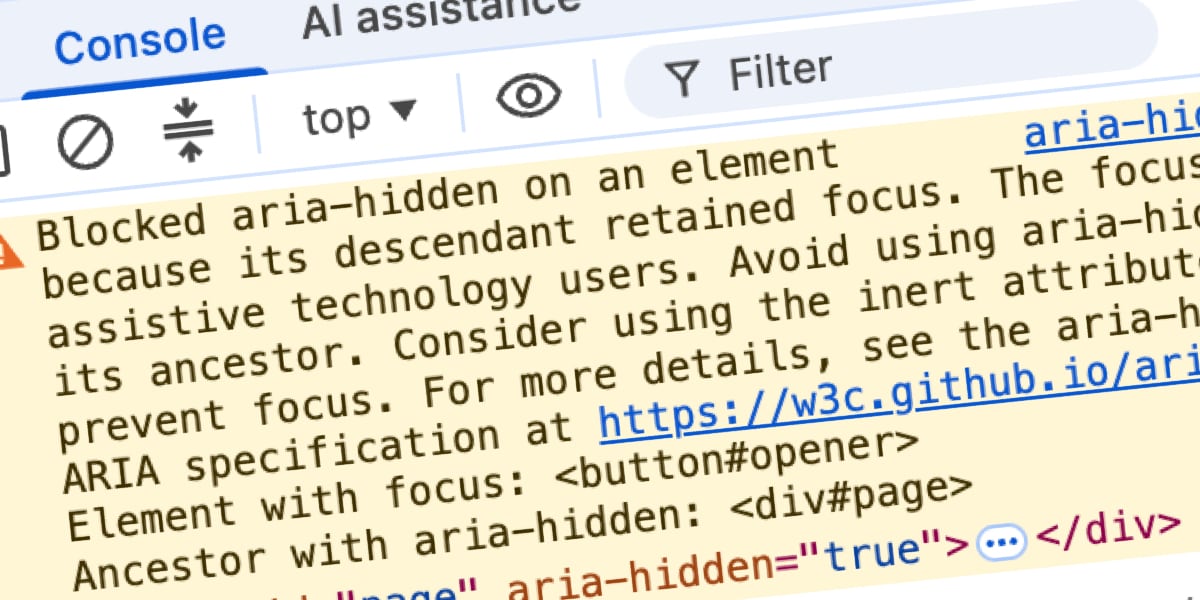
For thousands of front-end developers, a routine deployment hits a sudden wall when the browser console flashes an angry mustard-yellow warning. Whether working within Angular, Bootstrap, Ionic, or phpMyAdmin, a single string appears: a notification that focus remains inside a region marked as hidden.
For years, standard industry practice treated this message as low-priority noise—advisory text to be silenced with quick hacks like a blur() one-liner, a setTimeout shim, or the removal of aria-hidden attributes. However, investigative analysis reveals that these quick fixes quietly harm the very users the browser is trying to protect.
The console warning is not a minor style-guide notification; it is the browser engine overriding developer markup to repair a fundamentally flawed accessibility tree. When an element inside a hidden container maintains focus, screen readers encounter "ghost focus"—a state where assistive technologies experience sudden, confusing silence. This comprehensive report examines the technical origins of this issue, the widespread failure of common community workarounds, and the strict execution order required to resolve it permanently.
Detailed Chronology: How the "Ghost Focus" Crisis Evolved
The modern accessibility crisis surrounding modals and hidden regions did not emerge overnight. It is the result of a long-standing divergence between visual rendering specifications and accessibility tree generation.
Early Architecture and the aria-hidden Paradox
In the early days of complex web applications, modal dialogs required manual DOM management. Developers relied on aria-hidden="true" to hide background content from screen readers when a modal opened. However, a fundamental paradox was baked into the specification: aria-hidden removes an element from the accessibility tree, but it does not remove it from the keyboard focus order.
This decoupling created "ghost focus." When a user tabbed into a hidden subtree, screen readers received conflicting signals, often resulting in complete audio silence. Users were left stranded on the page, unable to determine if the application had crashed or if their navigation input had failed.
The Chromium Intervention (2020–2024)
To mitigate this user-experience failure, browser engines—led by Chromium—began silently patching accessibility trees. In early 2020, ARIA Working Group discussions (such as issue #1185) noted that Chrome engineers were exposing focusable aria-hidden nodes so users could at least perceive where their focus was landing.
By mid-2024, this internal repair mechanism was given a voice.
- Summer 2024 (Chrome 127): The open-time warning variant began clustering across major UI library trackers, including MUI (#43106), Ant Design (#50170), and Flowbite (#943).
- Late 2024 (Chrome 131): The close-time variant ("retained focus") arrived in release channels. Bug reports flooded repositories like Bootstrap (#41005) and Angular (#30187).
Instead of silently papering over the broken markup, Chrome decided to make the architectural flaw visible in the developer console. While the sudden influx of warnings frustrated development teams, browser engineers argued that silent fixes permitted broken code to ship indefinitely.
Supporting Context & Metrics: The Anatomy of the Four Failure Modes
Console warnings rarely manifest from a single source. Analysis of thousands of GitHub issues categorizes these failures into four distinct operational patterns.
+-----------------------------------------------------------------+
|                    THE FOUR FAILURE MODES                       |
+------------------------+----------------------------------------+
| 1. Close-Time Race     | Overlay fades out while focus is still |
|                        | trapped on the closing button.         |
+------------------------+----------------------------------------+
| 2. Open-Time Inversion | Background is hidden while the trigger |
|                        | button still holds initial focus.      |
+------------------------+----------------------------------------+
| 3. Nested Composition  | Multiple modal primitives (e.g.,       |
|                        | Select inside Dialog) fight for focus. |
+------------------------+----------------------------------------+
| 4. External Departure  | User Alt-Tabs away, stranding the      |
|                        | aria-hidden state on teardown.         |
+------------------------+----------------------------------------+
1. The Close-Time Race (Hidden Mid-Goodbye)
Accounting for roughly 70% of reported instances, this occurs when a user clicks a modal’s close button. The modal initiates a CSS fade-out transition lasting 150 to 300 milliseconds. During this transition, the close button still holds focus, yet the library has already marked the parent wrapper as aria-hidden="true". Because focus restoration is programmed to execute after the CSS transition completes, the browser detects a focused node inside a hidden subtree during the animation frames.
2. The Open-Time Inversion
The exact inverse of the close-time race. When a modal opens, the library marks the background page as aria-hidden="true". However, the trigger button—which lives in that background—briefly retains focus before programmatic focus moves inside the dialog.
3. Nested Composition Conflicts
Modern component design frequently nests interactive overlays—such as placing a <select> dropdown or a popover inside a <dialog>. Both components ship independent background-hiding logic. Under React 19, unmount timing changes cause focus to drop to <body> momentarily when an inner component tears down. The parent dialog interprets this as an outside click, re-hiding itself while the user’s focus remains trapped, effectively freezing keyboard navigation.
4. External Focus Departure
Nothing changes within the DOM, but the user switches browser tabs or uses Alt+Tab to move to another window while an overlay is open. The focus bookkeeping breaks down, stranding an aria-hidden state upon teardown with no active focus target to reconcile against.
Official Statements and Ecosystem Repercussions
The friction between browser vendors and library maintainers highlights a broader industry challenge.
Component library maintainers argued that the warnings were disruptive, penalizing codebases that had followed established patterns for years. For instance, Bootstrap’s architecture historically restored focus on the hidden.bs.modal event—firing after the CSS transition completed. From the maintainer’s perspective, updating core event lifecycles risked breaking thousands of consumer implementations.
Conversely, browser accessibility specialists maintained that the burden of correct accessibility trees outweighs the inconvenience of console logs. WAI-ARIA authoring practices explicitly demand that focus management precede structural hiding.
The industry response varied significantly across UI ecosystems:
- Bootstrap 6: Abandoned manual
inerttoggling by migrating native modals toshowModal(), placing dialogs in the top layer and rendering the background implicitly inert. - React Aria: Implemented rigorous
FocusScopemechanics that restore focus synchronously via layout effects, avoiding asynchronous race conditions entirely. - Radix UI: Relies on pre-unmount focus hooks, though complex nested compositions continue to require careful consumer-side management.
The Flawed Fixes: Why Popular Workarounds Fail
Faced with a red or yellow console during critical deployment windows, development teams historically adopted several common shortcuts. Each remedy successfully silences the log while degrading the user experience.
| Popular Workaround | Immediate Effect | Accessibility Consequence | WCAG Violation |
|---|---|---|---|
document.activeElement.blur() |
Clears the console warning. | Focus drops to <body>; screen reader goes silent; next Tab restarts from page top. |
WCAG 2.4.3 (Focus Order) |
setTimeout / requestAnimationFrame |
Delays focus restoration. | Fails under heavy CPU load or concurrent rendering, creating intermittent bugs. | WCAG 4.1.2 (Name, Role, Value) |
Stripping aria-hidden |
Removes the warning entirely. | Screen readers can read background content while a modal is open; breaks modal contract. | WCAG 2.4.3 (Focus Order) |
modal=false (Radix/shadcn) |
Silences console errors. | Dialog dismisses unexpectedly on outside interaction; removes the focus trap. | WCAG 3.2.1 (On Focus) |
The Danger of the blur() One-Liner
Calling blur() without a subsequent target sends focus directly to the <body> element. For a mouse user, this is invisible. For a screen reader user, the application becomes disorienting. The screen reader falls silent or reads the page title, and the user must tab through the entire document header to resume their workflow.
The Correct Architecture: The Four-Step Teardown Contract
To satisfy both the browser’s accessibility requirements and the user’s navigational needs, developers must enforce a strict operational sequence during modal closure.
The Core Invariant
Focus must leave a region before that region becomes hidden, inert, or unmounted.
The Four-Step Vanilla JavaScript Implementation
class RobustModalController
  #trigger = null;
  #background = null;

  constructor(backgroundElement)
    this.#background = backgroundElement;


  open(dialog)
    // Step 0: Capture the return target BEFORE moving focus inside
    this.#trigger = document.activeElement;

    // Inert the background content
    this.#background.setAttribute('inert', '');
    dialog.hidden = false;

    // Move focus inside the dialog
    dialog.querySelector('[autofocus], button, [href], input')?.focus();


  close(dialog)  0;

    if (dur + delay <= 0)
      done(); // Handle reduced-motion or zero-duration instantly
     else
      dialog.addEventListener('transitionend', finish);
      dialog.addEventListener('transitioncancel', finish);
Future Outlook
The trajectory of web standards suggests that custom modal engineering will eventually become obsolete.
- Native HTML
<dialog>Adoption: As component libraries and enterprise design systems migrate to the native<dialog>element and the browser’s top layer, entire categories of focus-management bugs disappear. The browser handles the complex focus stack natively. - Standardization of Accessibility Heuristics: Discussions within the W3C ARIA Working Group (such as issue #2422) indicate that browser engines will continue tightening automated heuristics around hidden subtrees. Developers can expect browsers to take an increasingly active role in enforcing accessibility standards directly within the rendering engine.
- The Death of Hacks: The era of silencing console warnings with
setTimeoutandblur()hacks is drawing to a close. As automated testing tools and accessibility audits become more sophisticated, engineering teams are recognizing that console logs are not merely nuisances to be hidden, but vital diagnostics reflecting the real-world usability of web applications.
Ultimately, a clean console is never the primary objective. The warning serves as a proxy for the user experience. By aligning architectural teardown contracts with native browser specifications, developers ensure that accessibility is built into the foundation of modern web applications rather than patched on as an afterthought.