Executive Overview
In the hyper-accelerated ecosystem of modern internet culture, the boundary between tragedy and transgressive comedy has grown perilously thin. The viral phenomenon known as "The Light Is Red Owen"—alternatively cataloged as the Owen Harris Memes—stands as a grim watershed moment for digital anthropology in late 2026. Centered on the preventable, fatal collision of a 14-year-old Utah resident riding an e-bike, the trend rapidly metastasized across TikTok, Instagram Reels, and niche meme communities. Featuring dark humor, surreal juxtaposition, and recurring motifs such as the "SpongeBob Driving Crazy" template, the trend turned a real-world tragedy into an inescapable loop of digital mockery.
This deep dive examines the anatomy of the phenomenon: its tragic genesis on a Utah roadway, its exponential spread across algorithmic video platforms, the cultural mechanics that fuel such anti-empathetic humor, and the fierce online pushback that followed. As society grapples with the normalization of gallows humor among digital natives, the Owen Harris discourse forces an uncomfortable reckoning regarding the ethics of viral attention, the psychological detachment of online spaces, and the human cost of treating real-world tragedies as disposable content.
Detailed Chronology: From Tragedy to Digital Infamy
The Incident: September 12th, 2026
The chain of events that birthed one of the most controversial internet memes of the decade began on a suburban roadway in Utah on September 12th, 2026. Owen Harris, a 14-year-old local resident, was operating an electric bicycle (e-bike). According to subsequent local news reports, Harris entered an intersection against a designated red traffic signal. Moments later, he was struck by a motor vehicle.
The physical impact of the collision was catastrophic. Despite emergency response efforts, the young teenager succumbed to his injuries, abruptly cutting short a life that had barely begun. For the local community, the incident was a devastating blow, sparking immediate grief, mourning, and renewed local discourse regarding e-bike safety among minors.
Public Reporting: September 15th, 2026
For the first 72 hours, the incident remained a localized tragedy, reported primarily by regional outlets detailing the inherent dangers of urban micromobility and traffic compliance. However, as details of the crash—specifically the detail that Harris had run a red light—disseminated through public police blotters and regional news aggregates, the story crossed the threshold from local news into the digital consciousness. In the modern interconnected ecosystem, localized accidents involving bizarre or easily caricatured parameters are frequently vacuumed up by algorithmic monitors and repurposed into fodder for broader internet subcultures.
The Spark: September 16th, 2026
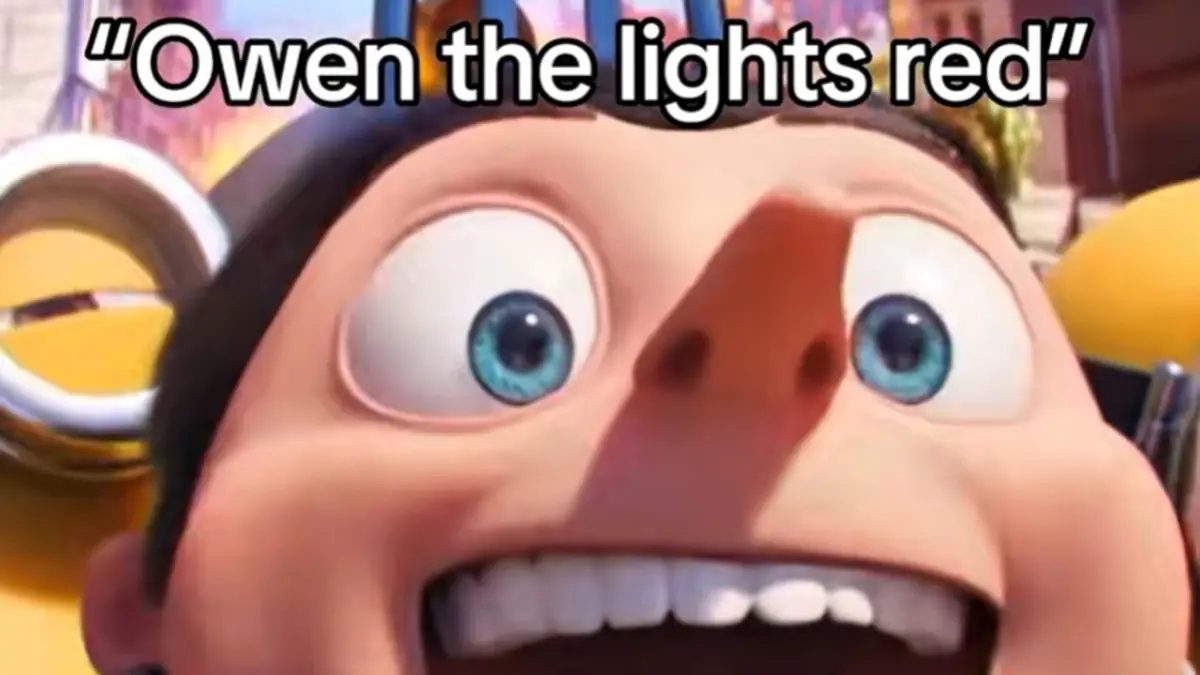
The transition from news story to dark humor meme occurred with blistering speed. On September 16th, 2026—just one day after widespread media reports—TikTok user @zephra.posts published a short-form video that would serve as the catalyst for the entire phenomenon.
The post utilized a recognizable, high-velocity clip from the animated film Despicable Me, featuring Gru and his Minions rocketing away in a modified vehicle. The video was explicitly captioned: "Owen the light’s red."
The cognitive dissonance between a beloved animated trope and the grim reality of a fatal traffic collision struck a discordant chord with the algorithm. Propelled by user engagement, morbid curiosity, and dark comedic subcultures, the video went viral. Within 48 hours, it accumulated over 3.3 million views, signaling to the wider TikTok creator economy that a new, highly reactive meme format had been born.
Exponential Acceleration and Diversification: September 17th, 2026
By September 17th, the meme had broken containment, proliferating across multiple platforms and incorporating a sprawling library of cinematic and animated references.
- The Cinematic Adaptations: TikTok creator
@skroznposted a variation incorporating high-octane, chaotic footage from the film Ghost Rider, paired with ironic audio tracks like "Life is a Highway," generating over 149,000 views within a single day. - The Cartoon Archetypes: Across Instagram Reels and TikTok, creators quickly established a standardized visual language. Drawing on the classic "SpongeBob Driving Crazy" meme—as well as adjacent templates like Beast Boy driving erratically—creators positioned these reckless animated characters as avatars for Owen approaching the fatal intersection.
- The Counter-Movement: Almost concurrently, a wave of digital exhaustion and moral outrage materialized. Creators such as
@hoopervalley8posted condemnation videos pointing out the staggering lack of empathy displayed by the trend, noting that Owen was a 14-year-old child and not a public figure. This critique video amassed over 1.2 million views in 24 hours, effectively establishing a meta-narrative war between purveyors of dark humor and advocates for basic human decency.
Supporting Context & Metrics: The Mechanics of Digital Edgelorism
To understand how a fatal accident involving a minor transforms into a trending audio-visual template, one must analyze the systemic drivers of contemporary meme culture.
The Rise of E-Bike Infrastructure and Youth Culture
In the mid-2020s, e-bikes transformed urban and suburban landscapes, offering teenagers unprecedented mobility. However, this shift outpaced local safety infrastructure and educational initiatives regarding traffic laws. Collisions involving minors on e-bikes became an increasingly common fixture in local news. The specific detail of "running a red light" provided internet users with an analytical hook—a tangible, albeit tragic, error in judgment that reductionist internet humor could seize upon to construct a narrative of avoidable fate.
Algorithmic Incentives and "Edgy" Humour
Platforms like TikTok and Instagram Reels operate on engagement-driven algorithms that heavily reward emotional arousal, speed, and novelty. Dark humor—often colloquially termed "edgy" or "post-ironic" humor—thrives in these environments because it elicits extreme reactions: shock, laughter, disgust, and outrage.
When users comment out of anger ("This is disgusting, delete this"), the algorithm registers high engagement and pushes the content to an even broader audience. Thus, the very mechanism designed to police or condemn insensitive content inadvertently acts as its primary amplifier.
The De-Individualization of Victims
In previous eras, the tragedy of a local teenager would remain contained within local obituaries and community spaces. In the digital age, a human life is instantly flattened into pixels, audio clips, and searchable metadata tags (#owen, #ebike, #ripowen). Because internet users never interacted with Owen Harris in the physical world, he functions less as a grieving human being and more as a digital symbol—a blank canvas onto which hyper-cynical internet aesthetics can be projected.
Official Statements & Community Backlash
The velocity of the "Light Is Red Owen" trend prompted significant pushback from digital communities, content creators, and commentators who viewed the phenomenon as a profound moral nadir for Gen Z and Gen Alpha meme culture.
The Cry for Empathy
As the meme dominated "For You" pages, a counter-wave of videos emerged urging users to reflect on the real-world consequences of their actions. Commentators emphasized the irreversible nature of death, highlighting statements such as: "I don’t think people comprehend that he is literally gone forever."
Family members, friends, and local community members faced the secondary trauma of seeing a loved one’s final moments trivialized into background noise for viral transitions. The backlash underscored a deep generational divide within social media users: a younger demographic utilizing hyper-detached irony as a coping mechanism or status symbol versus an older or more empathetic contingent advocating for digital hygiene and basic respect for the deceased.
Future Outlook: The Ongoing Evolution of Digital Morbidity
The "Light Is Red Owen" phenomenon will undoubtedly be studied by digital sociologists, ethicists, and platform trust-and-safety teams as a case study in modern internet pathology. As artificial intelligence tools, deepfakes, and hyper-efficient content generation pipelines continue to mature, the speed at which real-world tragedies can be weaponized into viral entertainment will only accelerate.
Key takeaways and future trajectories include:
- Stricter Algorithmic Guardrails: Platforms are under increasing pressure to develop semantic and visual recognition systems that can detect when a trending meme references a specific, real-world casualty, allowing for preemptive suppression before content goes viral.
- The Normalization of Post-Irony: The willingness of users to mock non-public figures suggests a broader cultural desensitization fostered by constant exposure to global trauma and rapid-fire digital content.
- The Lifespan of Viral Cruelty: While these trends burn brightly over a matter of days, leaving millions of impressions in their wake, they frequently vanish just as quickly, replaced by the next algorithmic fixation, leaving behind a digital wasteland of archived trauma and grieving families forced to navigate the immortalized digital footprint of their worst nightmares.
Ultimately, the Owen Harris memes serve as an uncomfortable mirror to modern digital culture—a testament to what happens when technological connectivity outpaces human empathy.