Transitioning artificial intelligence agents from isolated experimental prototypes into robust, enterprise-grade production systems has historically exposed critical infrastructure bottlenecks. While foundational models excel at processing data and generating human-like responses, the surrounding architecture required to maintain autonomous multi-step workflows—often spanning hours or days—demands sophisticated resource management.
Agents require reliable mechanisms to persist state, coordinate seamlessly with peer agents, share contextual memory, and occasionally tap into specialized hardware like Graphics Processing Units (GPUs) for intensive computational tasks. Historically, engineering teams aiming to scale these complex operations faced a tedious mountain of manual work: provisioning Amazon Elastic Compute Cloud (Amazon EC2) instances, configuring complex networking topologies, building custom session-management layers, handling scaling events, and stitching together disparate monitoring tools.
To alleviate this heavy operational burden, Amazon Web Services (AWS) has officially announced the launch of runtime instances, a powerful new complementary compute option integrated directly into the Amazon Bedrock AgentCore Runtime. This enterprise-grade capability introduces persistent, AWS-managed infrastructure purpose-built to handle complex, long-running agent workloads.
By leveraging AWS-managed EC2 infrastructure, developers can now deploy multiple distinct agents within a single runtime environment—each equipped with its own unique dependencies, artifact types, and frameworks. These agents can collaborate natively on a shared host within secure sessions that remain active for up to 14 days.
Coupled with native GPU acceleration support, flexible session hibernation and restoration to curb costs during idle phases, and containerized deployment pipelines, runtime instances fundamentally redefine how organizations scale cooperative, stateful artificial intelligence architectures.
Detailed Chronology: Building and Deploying Multi-Agent Collaborations
To understand the practical application of Amazon Bedrock AgentCore Runtime instances, it is helpful to examine a real-world implementation. Consider a dual-agent workflow consisting of a Code Writer Agent designed to generate Python logic from natural language prompts, and a Code Reviewer Agent tasked with evaluating that code for bugs, adherence to style guides, and security vulnerabilities.
Rather than forcing these agents to exchange complex network payloads or interact via fragile API calls, both agents operate natively on the same underlying EC2 capacity provider, leveraging a shared file system managed securely within a unified session context.
Step 1: Initializing the Agent Codebases
The foundational step involves developing individual agents using standard Python frameworks—such as Strands Agents—annotated simply with an @app.entrypoint decorator.
The Code Writer Agent is configured with a system prompt that mandates the output of clean Python code blocks based on natural language tasks:
writer = Agent(
    model="us.anthropic.claude-sonnet-4-5-20250929-v1:0",
    system_prompt=(
        "You are a senior Python engineer. "
        "Given a task, return ONLY a single Python code block—no prose."
    ),
)

@app.entrypoint
def handler(event, context):
    task = event.get("task") or event.get("prompt")
    session_id = getattr(context, "session_id", None) or event.get("session_id")
    session_dir = SHARED_DIR / session_id
    session_dir.mkdir(parents=True, exist_ok=True)

    code = str(writer(task))
    (session_dir / "code.py").write_text(code)

    return "agent": "writer", "wrote": str(session_dir / "code.py"), "code": code
Conversely, the Code Reviewer Agent is structured to ingest the file generated by its peer and return structured feedback:
Each agent is packaged independently as a compressed ZIP file, ready for deployment through the AWS Management Console, the AgentCore CLI, or standard Infrastructure as Code (IaC) templates.
Step 2: Provisioning the Capacity Provider
The capacity provider serves as the foundational abstraction defining the underlying EC2 hardware architecture that powers the agents.
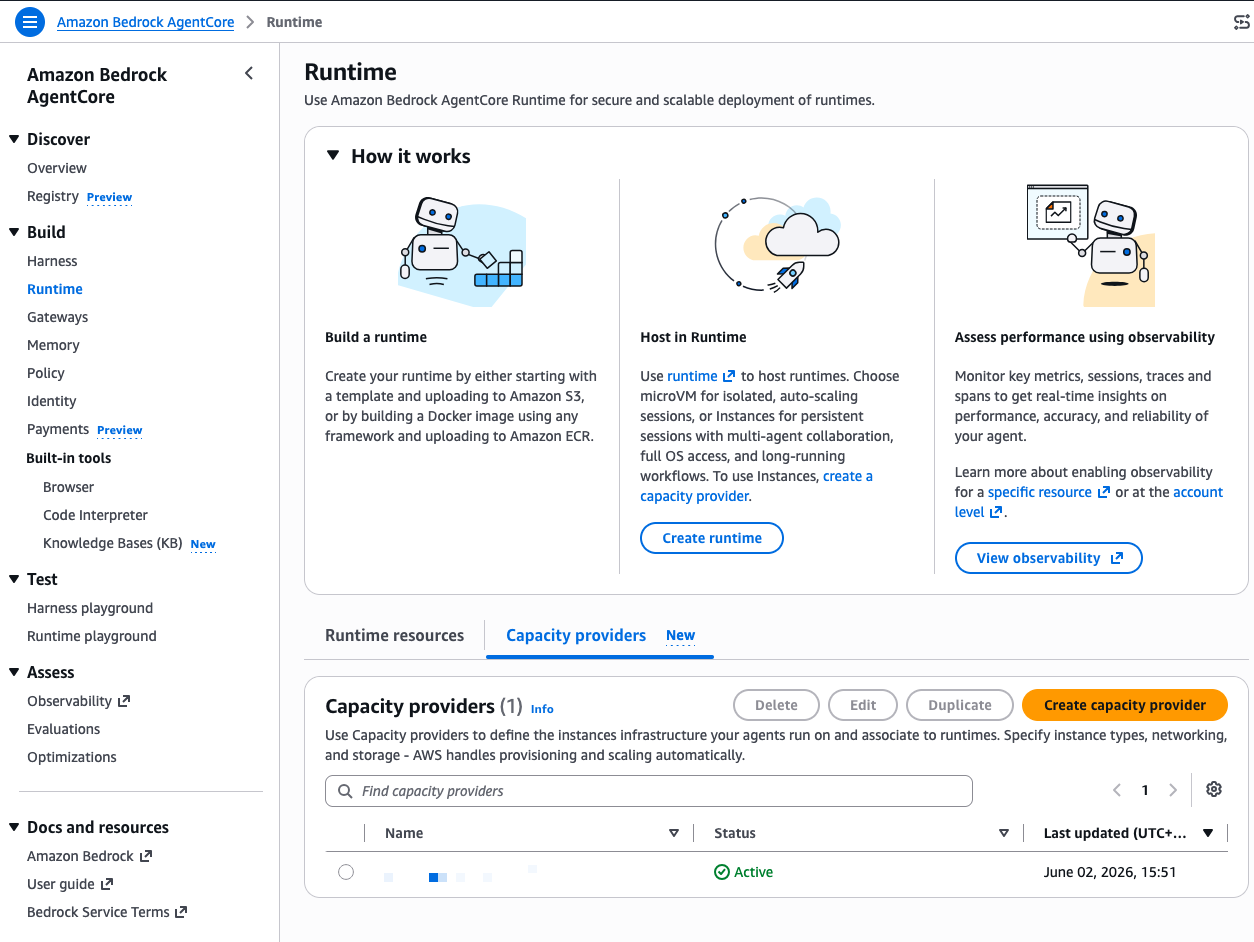
Navigation: Administrators access the Runtime section within the Amazon Bedrock AgentCore console, select the Capacity providers tab, and click Create capacity provider.
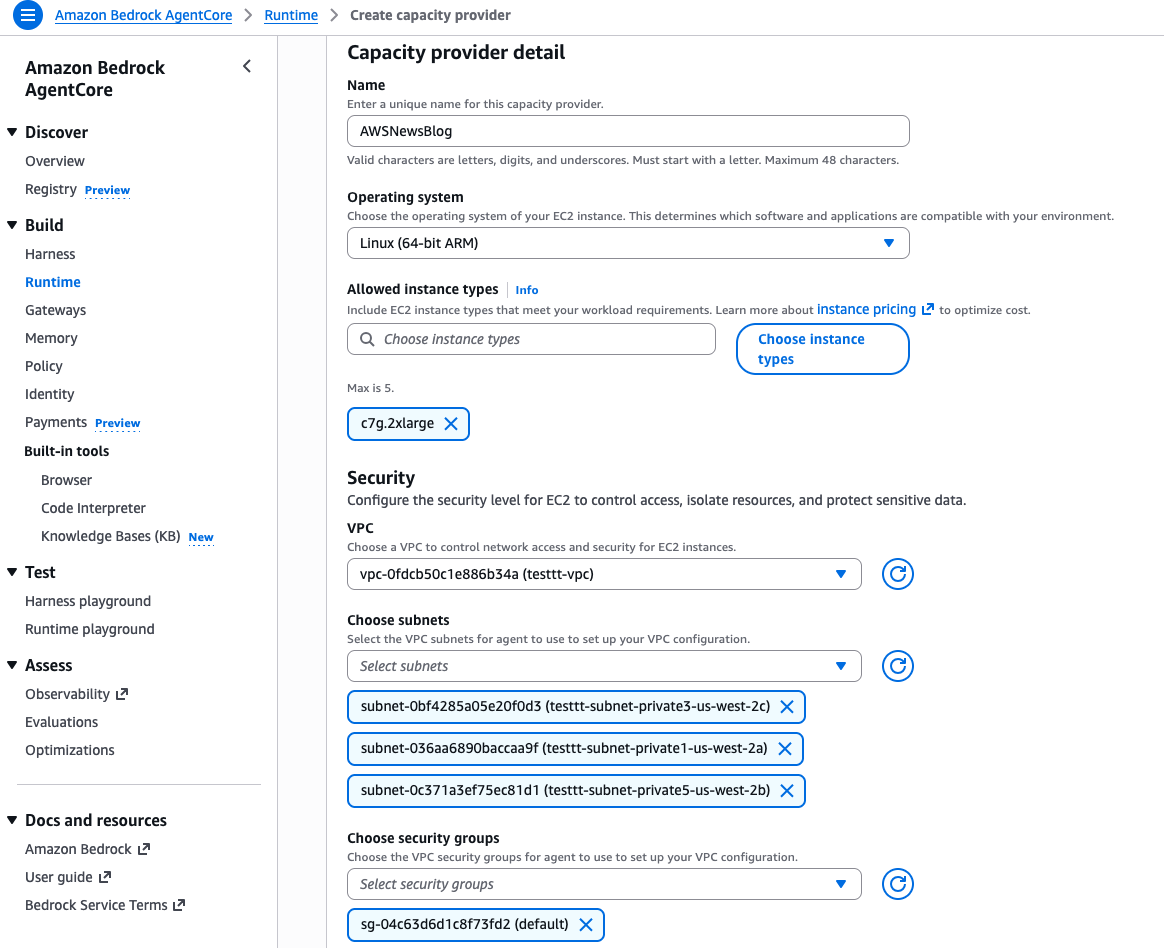
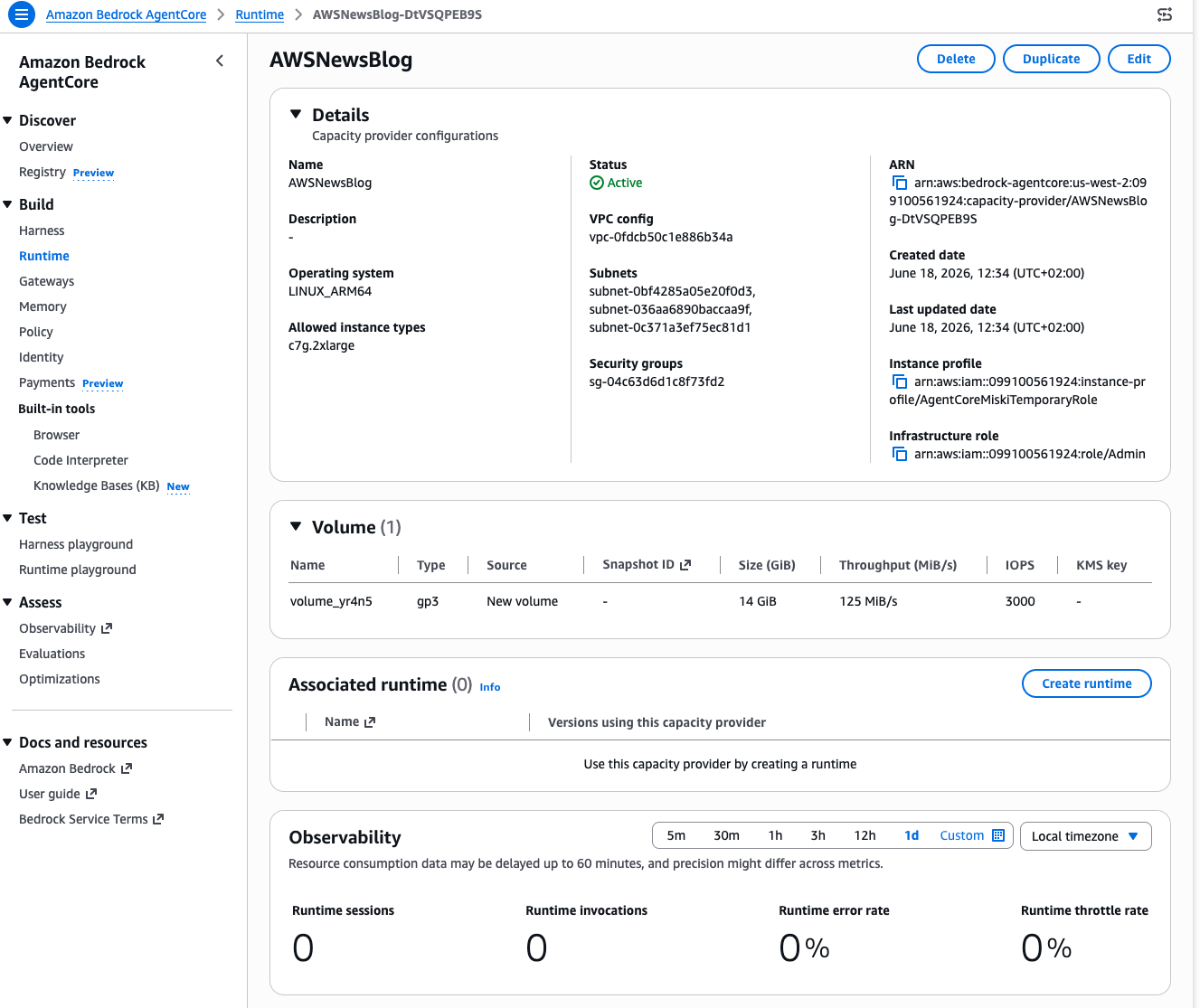
Configuration: The developer defines a unique name, selects Linux (64-bit ARM) as the operating system, and assigns c7g.2xlarge as the allowed instance type. This specific configuration provisions 8 vCPUs and 16 GiB of memory—optimal sizing to support multiple cooperating agents running concurrently side by side.
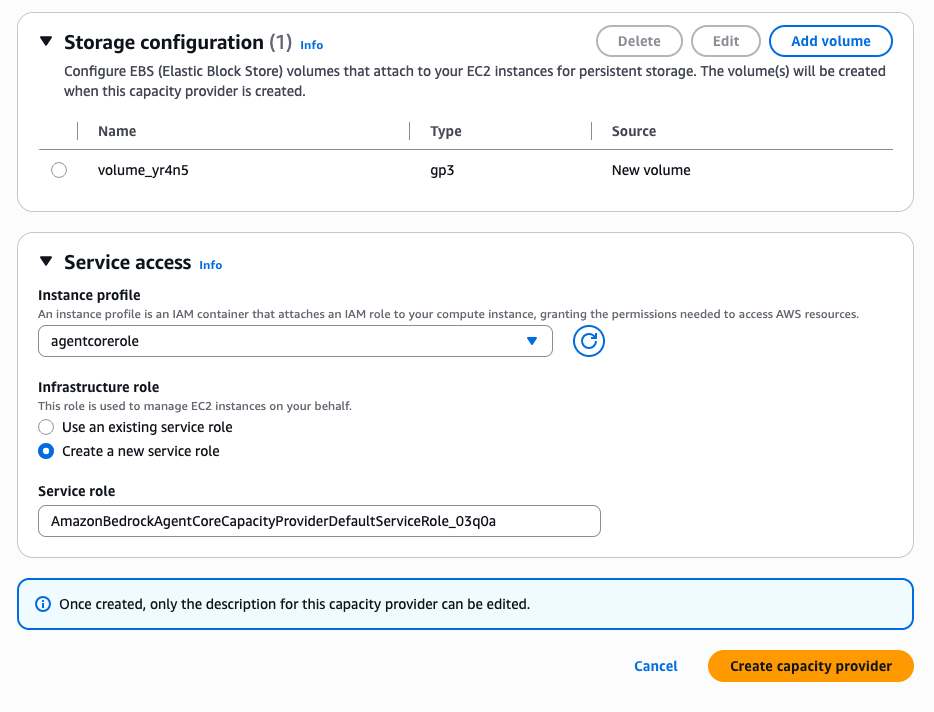
Networking & Storage: Network routing is established by assigning specific Virtual Private Clouds (VPCs), subnets, and security groups. Storage configurations default to high-performance gp3 volumes, while service access is seamlessly automated via a newly generated AWS Identity and Access Management (IAM) service role.
Once initialized, the capacity provider transitions rapidly to an Active state, establishing the bedrock hardware layer for subsequent deployments.
Step 3: Establishing Runtimes and Deploying Agents
With the capacity provider active, the next phase involves creating dedicated runtimes for each agent:
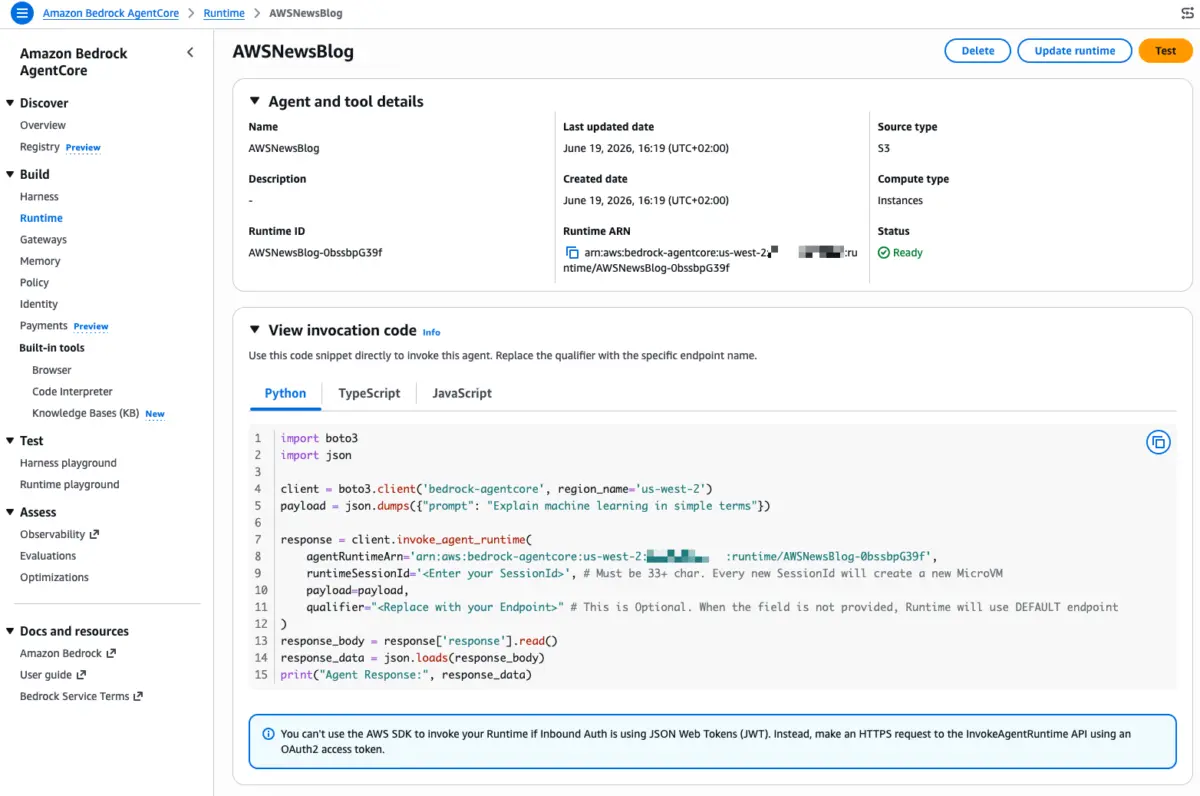
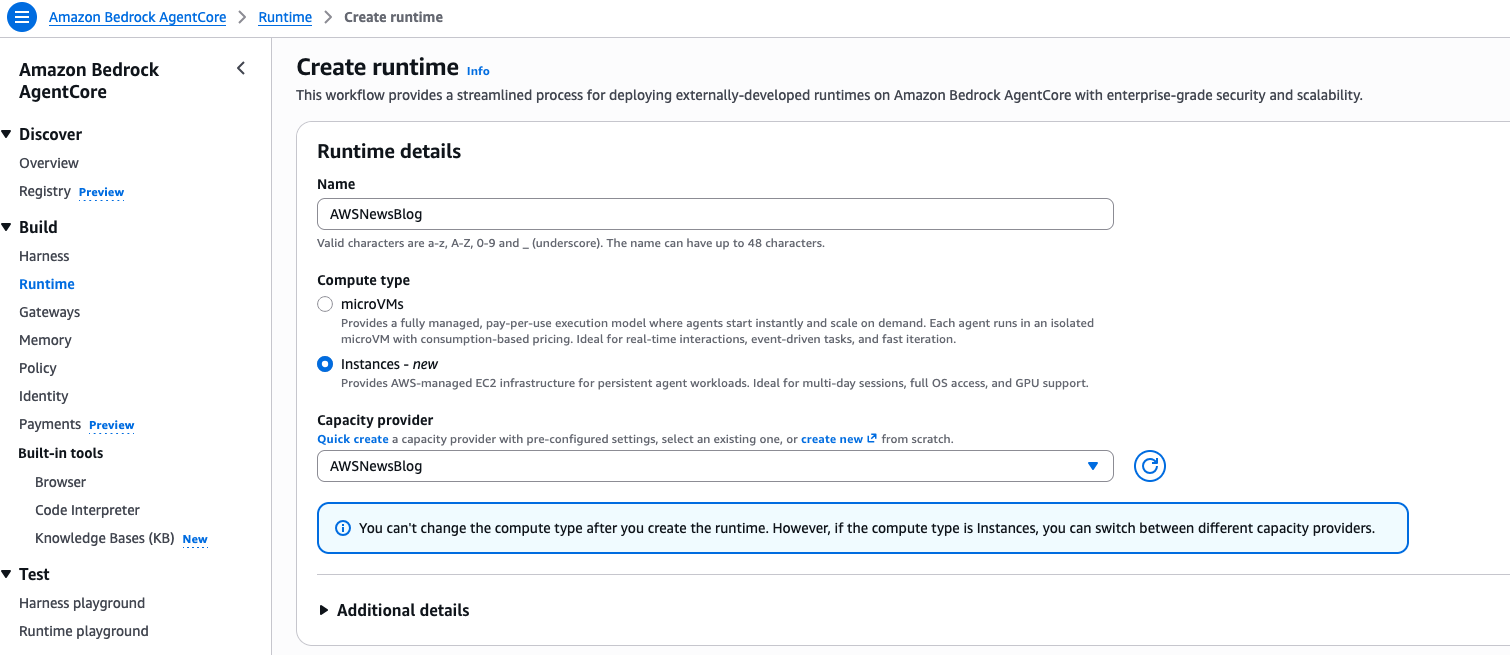
Runtime Deployment: Returning to the Runtime dashboard, the developer creates a new runtime, designates Instances as the compute type, and selects the newly minted capacity provider.
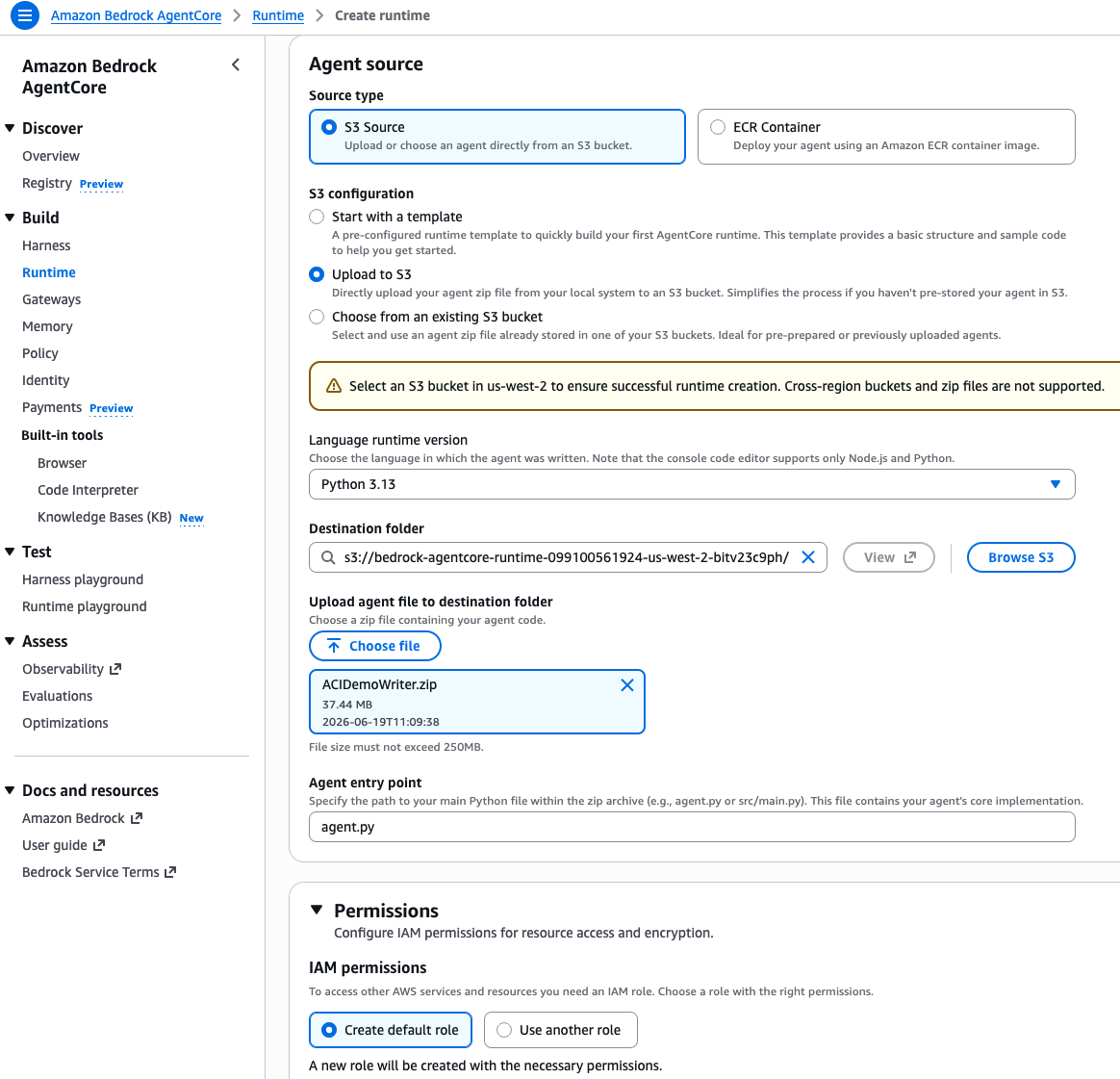
Source Integration: Using an S3 Source deployment model, the developer uploads the ACIDemoWriter.zip archive, specifies Python 3.13 as the language runtime, and points the system to agent.py as the designated entry point.
Replication: This exact provisioning flow is repeated for the Code Reviewer agent, ensuring both distinct applications share identical underlying hardware resources while maintaining completely isolated code execution paths.
Step 4: Execution, Session Continuity, and Agent Collaboration
Once both runtimes report a Ready status, administrators can test interactions directly via the built-in Runtime Playground:
Code Generation: The developer selects the ACIDemoWriter runtime, notes the automatically generated Session ID, and inputs a natural language JSON payload: "prompt": "write a fibonacci suite".
State Persistence: The writer agent executes, generating a Python module featuring multiple sequence implementations, and writes the output directly to a shared session directory path: /tmp/agentcore-session/session_id/code.py.
Peer Review: The operator switches the runtime dropdown to the ACIDemoReviewer agent while explicitly retaining the identical Session ID. Triggering a review prompt instructs the reviewer agent to scan the shared file system directory. Without a single direct API call between the agents, the reviewer reads the script, evaluates its logic, and returns detailed, constructive feedback regarding type hints, input validation, and edge-case handling.
To fully appreciate the scope of this release, it is essential to examine how runtime instances complement existing Amazon Bedrock features—specifically runtime microVMs.
Compute Dimension
Runtime MicroVMs
Runtime Instances
Max Invocation Duration
Up to 8 hours
Up to 14 days (with session pause/resume)
Hardware Access
Fully managed serverless environment
Dedicated EC2 hosts with optional GPU acceleration
OS & File System Access
Sandboxed, restricted access
Direct underlying OS and shared file system access
Multi-Agent Coordination
Individual execution contexts
Shared host collaboration within unified session spaces
Rather than forcing developers to choose a single infrastructure paradigm, AgentCore allows microVMs and instances to operate in harmonious concert.
For instance, a lightweight orchestrator agent running on a fast-scaling runtime microVM can handle incoming API routing, task dispatching, and result aggregation. Meanwhile, specialized worker agents operating on high-capacity runtime instances can execute heavy computational loads—such as intensive software compilation, automated security vulnerability scanning, or complex graphical user interface (GUI) automation—that demand persistent state retention and direct operating system visibility.
Furthermore, runtime instances integrate seamlessly with Amazon Elastic Block Store (Amazon EBS) and AgentCore Memory. This ensures that critical operational knowledge is not bound strictly to temporary session lifecycles, enabling long-term recall across disparate environments and recurring execution cycles.
Official Statements and Industry Impact
The introduction of runtime instances addresses a glaring architectural gap that has frustrated enterprise AI developers since the proliferation of large language models.
"When engineering teams push AI agents beyond simple query-response wrappers into autonomous production environments, infrastructure complexity skyrockets," noted senior AWS engineering leadership during the release. "Agents require prolonged operational windows, deep contextual memory sharing, and specialized compute capacity. With runtime instances, we are eliminating the heavy lifting of infrastructure management, giving developers secure, persistent, and elastic environments where multi-agent systems can collaborate as fluidly as human engineering teams."
Industry analysts have similarly praised the flexibility of the release. By remaining framework-agnostic—supporting popular orchestration frameworks like CrewAI, LangGraph, LlamaIndex, and Strands—AWS has ensured that developers are never locked into proprietary development paradigms. Teams retain absolute freedom to select their preferred foundational models while abstracting away the underlying infrastructure scaling and security configurations.
Future Outlook: The Next Horizon for Autonomous Enterprise Agents
As organizations increasingly transition from human-in-the-loop workflows to fully autonomous multi-agent ecosystems, the demand for resilient, long-lived computational infrastructure will continue to accelerate.
The capabilities introduced by Amazon Bedrock AgentCore runtime instances point toward a future where complex software engineering tasks, automated financial audits, and large-scale data migrations are handled entirely by collaborative agent swarms operating continuously across multi-day execution windows.
By streamlining infrastructure provisioning, enabling native multi-agent file sharing, and supporting advanced hardware acceleration without sacrificing enterprise-grade security or identity controls, AWS has laid a formidable foundation for the next generation of artificial intelligence applications.
For engineering organizations looking to scale beyond prototype limitations, exploring the Amazon Bedrock AgentCore documentation and spinning up a foundational capacity provider represents the definitive first step toward true production-grade agent autonomy.