By Global Science Desk
Published February 7, 2018
Executive Overview
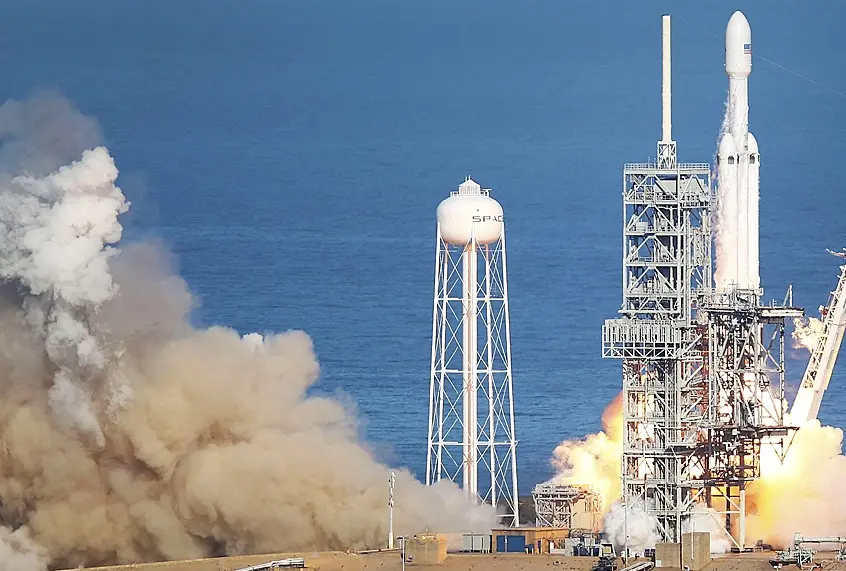
On Tuesday, February 6, 2018, the aerospace industry crossed a historic threshold. From historic Launch Complex 39A at the Kennedy Space Center in Florida—the very site from which humanity once departed for the Moon—Elon Musk’s private aerospace enterprise, SpaceX, successfully executed the maiden flight of the Falcon Heavy. Billed as the most powerful operational rocket in the world by a factor of two, the monumental launch captivated a global audience, blending unprecedented engineering milestones with pop-culture showmanship.
Atop the towering rocket sat an unorthodox payload: a cherry-red Tesla Roadster, complete with a mannequin driver dubbed "Starman," looping a permanent stream of David Bowie’s "Space Oddity" into the cosmos. Yet, beyond the spectacle of a sports car cruising through the vacuum of space, the mission provided something far more contentious in the digital age: crystal-clear, uninterrupted live footage of Earth’s undeniable curvature from deep orbit.
As the breathtaking imagery flooded social media, a collective question echoed across the internet: Will this finally put an end to the resurgent flat-Earth conspiracy movement?
This report examines the technical triumphs of the Falcon Heavy launch, the unyielding psychology of pseudoscientific belief systems, the mechanics of how the public consumes empirical evidence, and the profound disconnect between modern aerospace achievement and digital-era denialism.
Detailed Chronology of the Launch
The Build-Up to Launch Pad 39A
For years, the aerospace community anticipated the debut of the Falcon Heavy. Essentially comprising three Falcon 9 first-stage cores strapped together to create a colossal 27-merlin-engine powerhouse, the rocket was designed to generate more than 5 million pounds of thrust at liftoff. Delays, technical hurdles, and skepticism from legacy aerospace competitors had dogged the project for years. Elon Musk himself repeatedly downplayed expectations, frequently warning the public that the probability of a catastrophic failure on the maiden voyage was exceedingly high.
Despite the warnings, anticipation reached a fever pitch by early February 2018. Hundreds of thousands of space enthusiasts converged on the beaches surrounding Cape Canaveral, while millions more tuned in via live streams provided by SpaceX and major news networks.
Liftoff and the Synchronized Boosters
At 3:45 PM EST, the countdown reached zero. The Falcon Heavy ignited its 27 engines, roaring off Launch Pad 39A in a pillar of fire and acoustic shockwaves that rattled windows miles away. The ascent was clean, visually arresting, and broadcast from multiple camera angles mounted on the vehicle itself.
Minutes into the flight, the mission achieved what many considered its most astonishing technological feat. While the central core faced a high-speed impact in the Atlantic Ocean due to fuel depletion issues, the two side boosters—having successfully separated from the second stage—executed a synchronized, retro-propulsion flip maneuver. They returned triumphantly to Cape Canaveral Air Force Station, touching down simultaneously on Landing Zones 1 and 2 in a ballet of precision engineering that looked more like science fiction than reality.
Into Deep Orbit and the View of a Spheroid Home
While the boosters claimed headlines for their reusable potential, the second stage continued its journey, coasting out of the Earth’s immediate gravitational grip. Hours after launch, SpaceX broadcast live feeds from the upper stage. There, drifting serenely against the black canvas of space, was the cherry-red Tesla Roadster. Behind it, illuminated by the unfiltered brilliance of the sun, was our home planet: an unmistakable, vibrant, oblate spheroid, glowing with atmospheric blue and swirled with white cloud patterns.
The high-definition perspective offered a humbling, visceral reminder of our place in the universe. It also provided an unprecedented visual dataset that scientists hoped would silence the vocal minority of skeptics who claim the planet is flat.
Supporting Context & Metrics: Engineering Marvels and Pseudoscience
The Falcon Heavy: By the Numbers
To understand the significance of the February 6 launch, one must look at the raw capabilities demonstrated by SpaceX:
- Total Thrust at Liftoff: ~5.1 million pounds (roughly equivalent to 18 Boeing 747 aircraft at full power).
- Payload Capacity to Low Earth Orbit (LEO): 63,800 kilograms (140,600 lbs).
- Payload Capacity to Mars: 16,800 kilograms (37,000 lbs).
- Cost Efficiency: At an estimated $90 million per launch for standard configurations, the Falcon Heavy dramatically undercut the cost-per-pound metrics of traditional government and contractor-built heavy-lift vehicles.
The Anatomy of Modern Flat-Earth Belief
In stark contrast to the multi-billion-dollar triumphs of empirical science and aerospace engineering sits the flat-Earth movement. Far from being a relic of medieval superstition, modern flat-Earthers have found a potent incubator in the algorithms of social media platforms like YouTube, Facebook, and Twitter (now X).
Adherents generally subscribe to the following tenets, despite centuries of navigation, physics, and photographic evidence:
- The Disk Model: The Earth is envisioned as a flat disc centered around the North Pole, bounded by an impassable wall of ice (Antarctica) that government agencies allegedly guard to prevent people from falling off the edge.
- The Fake Space Paradigm: All space agencies—NASA, SpaceX, ESA, Roscosmos—are accused of participating in a multi-billion-dollar global conspiracy to fake space exploration, utilizing CGI, fish-eye lenses, and underwater training facilities.
- Sensory Validation Over Science: Proponents argue that because water always "finds its level" and horizons appear flat to the naked eye at sea level, global curvature is an illusion.
Sociologists and psychologists note that flat-Earth ideology is rarely just about geography; it serves as a gateway framework for deep-seated institutional distrust. It offers adherents a sense of community, intellectual superiority, and certainty in an increasingly complex world.
Official Statements and Social Media Reactions
The immediate aftermath of the launch sparked a massive digital dialogue, neatly dividing the internet into those celebrating scientific progress and those mocking pseudoscientific denialism.
Leadership and Corporate Triumphs
Elon Musk captured the sentiment of his engineering team during a post-launch press conference:
"Life cannot just be about solving one miserable problem after another. There need to be things that inspire you, that make you glad to wake up in the morning and be a part of humanity. That is why we did this. That is why you should care."
Later, Musk took to social media to highlight the surreal reality of the mission, posting:
"View from SpaceX Launch Control. Apparently, there is a car in orbit around Earth."
The Internet Reacts: Sarcasm, Science, and Satire
Social media users wasted no time leveraging the high-altitude footage to target flat-Earthers. Comedian and internet personality Dave Days tweeted:
"Flat earth officially debunked… with style @SpaceX #FlatEarth"
Another user, Sebastian Bell, wrote succinctly:
"Suck it Flat Earthers. #Starman"
Others adopted heavy sarcasm to mock the cognitive dissonance required to maintain flat-Earth beliefs in the face of live panoramic video. User Darin posted:
"Look at that flat earth," accompanying a link to the pristine live stream of the globe’s sweeping horizon.
Future Outlook: The Intersection of Truth, Technology, and Trust
Will the Footage Change Any Minds?
Experts in cognitive science and media literacy offer a sobering prognosis: No.
When confronted with overwhelming empirical contradictions, individuals deeply entrenched in conspiracy theories rarely capitulate. Instead, psychological defense mechanisms such as confirmation bias and motivated reasoning kick in. Within hours of the Falcon Heavy launch, online flat-Earth forums were already churning out counter-theories. Some claimed the live stream video was generated using advanced CGI; others asserted that the camera lenses were intentionally warped to create a fake curvature effect.
The Broader Implications for Science Communication
The Falcon Heavy launch serves as a micro-cosm of a broader cultural challenge: the democratization of information has unfortunately coincided with the democratization of misinformation. While organizations like SpaceX can build rockets capable of landing themselves vertically on floating drone ships, bridging the gap between verifiable scientific reality and public trust remains an unfinished frontier.
As humanity looks toward the horizon of crewed missions to the Moon and Mars, the triumph of the Falcon Heavy stands as a testament to human ingenuity. It proved that vision, mathematics, and raw physical power can break the bonds of Earth. Whether or not it convinces every resident of that Earth to look up and accept its true shape, the rocket has irrevocably altered the trajectory of space exploration—leaving flat-Earthers standing firmly behind, staring up at a round world they refuse to see.