Executive Overview
London Fashion Week is no stranger to theatricality, yet Ukrainian-born, London-based designer Natasha Zinko routinely manages to eclipse the standard cadence of the runway. Building upon the viral momentum of her Autumn/Winter 2026 presentation—which famously enlisted Spice Girl Mel B to close the show—Zinko returned for Spring/Summer 2027 with a concept that was as intellectually rigorous as it was culturally provocative. Entitled Pay Per View, the collection transformed a brutalist landmark in the heart of Islington into a living, breathing architectural metaphor for institutional control, digital voyeurism, and the relentless architectures of the modern attention economy.
Staged inside the cavernous concrete belly of the Collins Music Hall, the SS27 presentation was preceded by days of intense speculation. WhatsApp groups and industry insiders whispered feverishly about the casting lineup, recognising that topping the cultural shockwave of the previous season would require an unprecedented approach. Zinko delivered precisely that, assembling a cross-generational, cross-industry cast of pop-culture disruptors—including Katie Price, The Sopranos alumnus Drea de Matteo, and Kelly Osbourne—and imprisoning them within a multi-tiered concrete atrium designed to mimic Jeremy Bentham’s infamous panopticon.
More than just a spectacle of celebrity cameos, however, Pay Per View served as a poignant fashion-cultural critique. Informed by the theoretical writings of Michel Foucault, the collection examined how contemporary society operates as an unescapable circuit of digital surveillance, algorithmic peeping, and monetised visibility. Through a high-profile collaboration with subscription platform OnlyFans, Zinko blurred the boundaries between the private and the public, asking a deceptively simple question: in an economy that demands total exposure, who is truly the watcher, and who is the watched?
Detailed Chronology: From Whispers to the Panopticon
The Prelude: Anticipation and Arrival
Days before the official doors opened, the ecosystem of London Fashion Week was alive with rumors. The digital grapevine—pulsing through WhatsApp chats, private Instagram DMs, and whispered conversations at Somerset House—had fixed its attention on Natasha Zinko. Following the viral triumph of Mel B’s runway appearance months prior, expectations for SS27 had reached a fever pitch. If Zinko intended to top the previous season, industry observers knew she would have to look far beyond traditional modeling pools.
The reality on the ground matched the frenetic energy of the rumors. Outside Zinko’s north London presentation space, the crowd swelled into a dense, unruly mass. A solitary, unassuming doorway served as the exclusive portal for hundreds of eager guests, creating an immediate bottleneck that tested the patience of editors, buyers, and influencers alike. Forcing one’s way through the threshold felt less like entering a traditional fashion show and more like breaching the gates of an exclusive, subterranean club.
Descent into the Brutalist Core
Once inside, attendees navigated the raw, dusty corridors of an industrial labyrinth before stepping into the main venue: the Collins Music Hall. A towering brutalist monolith located in Islington, the building immediately imposed its architectural authority on the gathered audience.
The interior revealed a breathtaking, dizzying atrium slicing vertically through the core of the structure. Mezzanine floors were fractured into precise, square-shaped openings, partitioned by raw concrete columns and skeletal metal railings. A tentative glance downward over the balconies exposed a densely packed grid of black stools situated on the ground floor, arranged so closely together that the boundaries between individual seats vanished entirely.
Guests were directed to these stools, finding themselves squeezed knee-to-knee in a deliberate exercise in spatial claustrophobia. For forty-five agonizing minutes, the audience sat in mounting anticipation, surrounded by the towering, echoing concrete walls of the atrium.
The Awakening of Pay Per View
As the silence broke and the show officially commenced under the title Pay Per View, the architectural logic of the venue slammed into sharp focus. Blindingly harsh spotlights cut through the industrial gloom, illuminating the square openings carved into the mezzanine levels. Within these isolated concrete cells, the rumored cast materialized.
[MEZZANINE TIER 3]  -> Opera Singers, Cowboys, Indie Rockers (Illuminated by Harsh Spotlights)
[MEZZANINE TIER 2]  -> Drea de Matteo, Kelly Osbourne, Footballers, Sailors
[MEZZANINE TIER 1]  -> Katie Price, Cleaning Ladies, Casualties of the Attention Economy
[GROUND FLOOR]      -> The Trapped Audience (Seated Knee-to-Knee, Playing the Role of the Jailer)
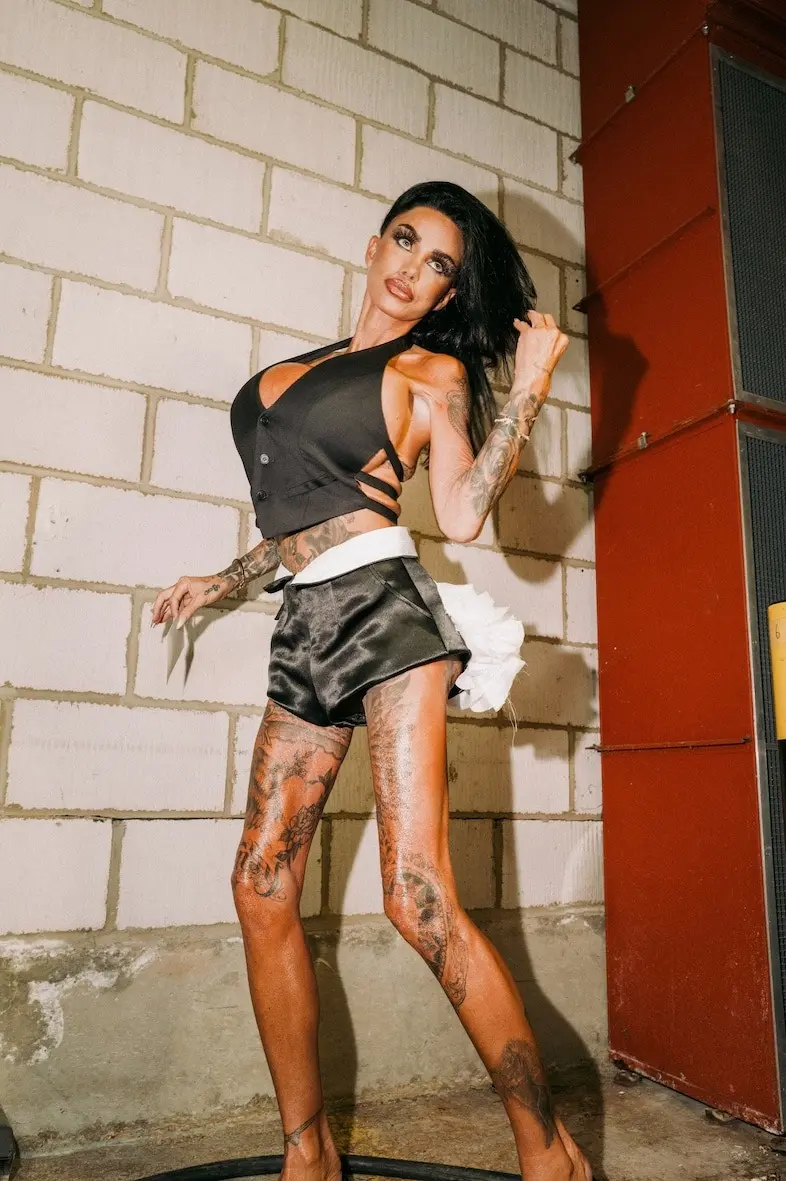
The lineup was an eclectic, sociological cross-section of modern fame and archetype. British glamour model and television icon Katie Price appeared first in a razor-sharp black waistcoat and matching shorts, projecting unyielding defiance. Next to her, The Sopranos star Drea de Matteo smoked a cigarette with nonchalant cool, standing adjacent to a director’s chair emblazoned with her name. Kelly Osbourne cut a striking silhouette, rocking a sleek black bob and wearing a bat pendant as a poignant personal tribute to her late father, Ozzy Osbourne.
Surrounding these high-profile figures were an army of unexpected characters: cowboys, cleaning ladies, indie rock musicians, opera sopranos, professional footballers, and sailors. Each occupied their designated concrete cell like modern-day prisoners trapped within the unyielding grid of social stratification and public visibility.
The Great Escape
The climax of the presentation arrived when the static nature of the panopticon shattered. Breaking free from their architectural confinement, the models abandoned their cells, descending the stairwells and ramps to breach the ground floor. They waded directly into the audience, navigating the suffocatingly narrow gaps between the tightly packed black stools in a frantic bid for liberation.
Because the seating had been engineered to enforce physical discomfort, the models’ descent forced intimate, uncomfortably close interactions with the front rows. Brushing past shoulders and treading carefully over knees, the cast embodied the inescapable friction of a world where personal space has been entirely eroded by the demands of perpetual visibility.
Supporting Context & Metrics: Fashion, Surveillance, and the Attention Economy
Theoretical Framework: Foucault and the Panopticon
To fully understand the gravity of Natasha Zinko’s SS27 presentation, one must examine the intellectual scaffolding underpinning the collection. According to official show notes, Zinko spent the months leading up to the collection deeply immersed in the philosophical writings of French theorist Michel Foucault, specifically his analyses of disciplinary power outlined in Discipline and Punish.
At the heart of Foucault’s work is the panopticon—an architectural design originally conceived by philosopher Jeremy Bentham in the late 18th century. Designed for prisons, insane asylums, and schools, the panopticon features a central watchtower surrounded by an outer ring of cells. Because the inmates in the outer ring are backlit and exposed to the central tower, but cannot see into the darkened watchtower itself, they never know when they are being observed. Consequently, the inmates internalize the gaze, modifying their behavior under the constant, paranoid assumption of surveillance.
Zinko brilliantly inverted this architectural power dynamic for Pay Per View. By seating the audience in the central floor space, she cast the fashion crowd—critics, buyers, and consumers alike—in the role of the panoptic jailer. Meanwhile, the models, confined to the perimeter cells, represented the modern citizenry: perpetually illuminated, hyper-visible, and endlessly scrutinized.
+-------------------------------------------------------------+
|               THE PANOPTICON ARCHITECTURE                   |
|                                                             |
|   [Cell]       [Cell]       [Cell]       [Cell]             |
|                 |            |            /                |
|      v           v            v           v                 |
|   +---------------------------------------------+           |
|   |          THE AUDIENCE / JAILERS             |           |
|   |   (Immobilized, voyeuristic, complicit)     |           |
|   +---------------------------------------------+           |
|      ^           ^            ^           ^                 |
|     /            |            |                            |
|   [Cell]       [Cell]       [Cell]       [Cell]             |
|                                                             |
|   Concept: The observed become the observers; the           |
|   jailer is trapped by their own voyeurism.                 |
+-------------------------------------------------------------+
The Contemporary Surveillance State and the Attention Economy
While rooted in 18th-century philosophy, Zinko’s collection addressed the terrifyingly digitized reality of the 21st century. Modern surveillance no longer relies solely on concrete walls and watchtowers; it is distributed via AI-powered smart glasses, corporate data harvesting, algorithmic social media feeds, and the ubiquitous smartphone camera.
In an interview following the presentation, Zinko elaborated on the psychological toll of this reality:
"Like the prisoners in this ingenious construct, we the Modern Humans walk out of our homes into a world where any one of us may be under numerous kinds of surveillance anytime, whether that be from the state or some schmo with a camera."
This observation cuts straight to the core of the contemporary attention economy. In an era where visibility equates to currency, survival often depends on one’s ability to package and monetize personal identity. Those who successfully navigate this system thrive; those who resist find themselves culturally marginalized.
The OnlyFans Partnership: Monetizing the Gaze
The collection’s commercial core reflected this tension directly. Through an unexpected yet conceptually cohesive partnership with subscription platform OnlyFans, Zinko integrated explicit commentary on the commodification of intimacy into the garments themselves.
The runway featured specialized shorts, utilitarian outerwear, and tongue-in-cheek "Pay for View" pants. These pieces served as sartorial manifestations of the digital creator economy—an ecosystem where personal exposure is directly tied to financial remuneration. By collaborating with a platform built entirely around voluntary surveillance and monetized intimacy, Zinko bridged high-concept theoretical critique with raw commercial reality.
Official Statements and Designer Insights
The conceptual depth of Pay Per View was further elucidated through direct statements released by Natasha Zinko and her creative team. Rather than relying on traditional PR platitudes, the designer utilized the show notes and post-show debriefs to challenge her audience to look beyond the garments and confront their own complicity in the modern surveillance apparatus.
Natasha Zinko on the Modern Human Condition
Reflecting on the motivations behind the SS27 collection, Zinko emphasized that modern existence is defined by an involuntary performance. Whether engaging with corporate data collection, state-sanctioned monitoring, or peer-to-peer social media stalking, the individual is never truly off-stage.
"The individuals who thrive in this attention-based attention economy are precisely those who have managed to establish monetisable public personas," Zinko noted. "We live in a world where everyone is simultaneously a voyeur and a product. The clothes this season reflect that vulnerability—they armor the wearer while exposing them to the relentless glare of the public eye."
Industry Reception and Cultural Impact
Fashion critics and cultural commentators were quick to praise Zinko’s ability to merge high-concept philosophy with populist spectacle. By recruiting figures like Katie Price and Drea de Matteo—women who have spent decades navigating, weaponizing, and suffering under the relentless glare of tabloid and digital media scrutiny—Zinko added authentic lived experience to the runway narrative.
Unlike traditional runway presentations that prioritize sterile perfection, Zinko’s casting celebrated endurance, resilience, and the grit of public survival. The inclusion of diverse archetypes—from opera singers to cleaning ladies—reinforced the universal nature of the theme: in the panoptic society, no socioeconomic class remains unobserved.
Future Outlook: The Evolution of Immersive Fashion
As the dust settles on the brutalist halls of Islington and the fashion world decodes the final images of Pay Per View, Natasha Zinko’s SS27 presentation leaves a lasting blueprint for the future of runway shows.
1. The Death of the Passive Runway
Zinko’s success signals a definitive shift away from passive, linear fashion presentations. As audiences become increasingly desensitized to traditional walk-and-turn modeling, designers are discovering that intellectual immersion and spatial discomfort are powerful tools for audience engagement. By forcing guests into uncomfortably close quarters and surrounding them with architectural metaphors, Zinko transformed viewers from passive consumers into active participants within a narrative.
2. Radical Casting as Political Discourse
The viral success of bringing icons like Mel B in AW26 and the powerhouse ensemble of Katie Price, Drea de Matteo, and Kelly Osbourne in SS27 demonstrates that casting is no longer merely about aesthetic representation—it is a vehicle for storytelling and social commentary. Future collections across the industry will likely look toward intergenerational, cross-industry talent not just for headlines, but to imbue garments with authentic cultural resonance.
3. The Intersection of Fashion and the Digital Economy
As platforms like OnlyFans and decentralized creator economies redefine how individuals generate income through personal branding, fashion will continue to explore the boundaries of privacy and exposure. Zinko’s willingness to directly engage with the mechanics of monetized intimacy establishes a precedent for designers seeking to comment on the realities of digital capitalism rather than escaping into fantasy.
Ultimately, Pay Per View proved that Natasha Zinko is not merely a designer of clothes, but a cultural architect. By locking her audience into a panopticon of their own making, she forced fashion to look in the mirror—and what we saw staring back was both profoundly unsettling and brilliantly stylish.