Executive Overview
In the rapidly accelerating landscape of artificial intelligence and digital content creation, few brand transformations are as striking as that of LimeWire. Once internationally recognized during the 2000s as a ubiquitous, disruptive peer-to-peer (P2P) file-sharing protocol, the platform has completed a deliberate and comprehensive resurrection. Today, LimeWire operates as a cutting-edge, blockchain-integrated generative AI publishing platform—a digital ecosystem where creators, designers, musicians, and enthusiasts can generate, share, own, and monetize synthetic media.
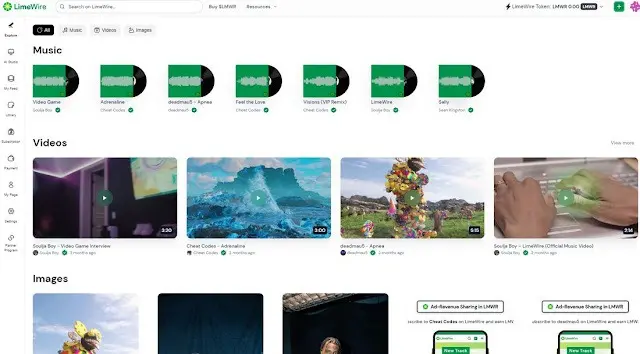
Far from merely offering another text-to-image generator, LimeWire bridges the gap between advanced generative algorithms and decentralized Web3 monetization. By integrating industry-leading AI models—such as Stable Diffusion 2.1, Stable Diffusion XL, and DALL-E 2—alongside automated NFT (Non-Fungible Token) minting on the Polygon and Algorand blockchains, the platform establishes a novel economic model for digital artists. High-profile cultural figures, including musicians Deadmau5, Soulja Boy, and Sean Kingston, have already leveraged the ecosystem to publish tokenized digital assets, signaling mainstream validation of the platform’s vision.
This investigative report examines the mechanics of LimeWire’s modern iteration, detailing its core image generation toolkit, blockchain-backed distribution framework, native cryptocurrency economy (LMWR), tiered pricing architecture, and strategic roadmap toward video and audio synthesis.
Detailed Chronology
The 2000s: The P2P Era and Legal Twilight
To understand the magnitude of LimeWire’s current evolution, one must examine its origins. Founded in 2000 by Mark Gorton, LimeWire became the definitive P2P file-sharing application of the early Internet era, competing directly with Napster and Kazaa. Built on the Gnutella network, the software allowed millions of global users to exchange music, software, and documents freely.
However, the platform’s decentralized architecture made it a primary conduit for unauthorized media distribution. This culminated in a landmark, multi-year legal battle with the Recording Industry Association of America (RIAA). In May 2010, a U.S. federal court ordered LimeWire to shut down its operations, resulting in a staggering $105 million copyright infringement settlement in 2011. For over a decade, the brand remained a dormant relic of early Web1 and Web2 nostalgia.
The 2023–Present Rebirth: Entering the Generative AI Era
The modern iteration of LimeWire bears little technical or operational resemblance to its predecessor. Acquired and completely re-engineered by new leadership, the brand was strategically repositioned to capitalize on two of the most disruptive technological waves of the decade: generative artificial intelligence and Web3 decentralization.
- Early 2023: LimeWire launched its initial AI studio, pivoting explicitly toward image generation and digital creator empowerment.
- Mid-2023 to 2024: The platform integrated multi-model support (introducing Stable Diffusion variants and DALL-E 2), launched native blockchain minting via Polygon and Algorand, and introduced its utility token, LMWR.
- Present Day: LimeWire functions as an all-in-one AI publishing platform and subscription-based marketplace, boasting expansive monetization structures, tiered user models, and preparations for multi-modal expansion into audio and video generation.
Supporting Context & Metrics
The contemporary creator economy faces a dual challenge: widespread content saturation on traditional social media networks and inadequate creator compensation models. LimeWire attempts to solve these friction points by merging AI utility with direct-to-fan monetization and cryptographic ownership.
The LimeWire AI Studio & Multi-Model Engine
At the core of the ecosystem is LimeWire Studio, a web-based interface designed to democratize professional-grade visual asset creation. Rather than forcing users to master complex open-source repositories or run high-end local hardware, LimeWire hosts enterprise-grade generative models natively in the cloud.
- Stable Diffusion 2.1 & XL: Ideal for high-definition, photorealistic, and highly detailed artistic compositions.
- DALL-E 2: Renowned for conceptual accuracy and prompt adherence.
- Stylistic Versatility: Users can instantly apply design filters ranging from cinematic lighting and digital painting to pixel art, anime, and analog film aesthetics.
- Advanced Controls: Features such as negative prompts, samplers, and custom aspect ratios allow both novices and professional digital artists to exercise precise creative control.
Automated Blockchain Minting and Web3 Integration
Once an AI asset is generated and finalized within LimeWire Studio, creators face a crucial fork in their workflow: publication. Unlike conventional platforms where user-generated content (UGC) is locked inside proprietary platform silos, LimeWire automatically mints published creations as NFTs on either the Polygon or Algorand blockchains.
This blockchain integration delivers several distinct advantages:
- Verifiable Provenance: Every digital asset receives an immutable digital signature, guaranteeing authenticity and original authorship.
- Flexible Distribution: Creators choose between making their work entirely public (maximizing discoverability and secondary market trading) or locking content behind a paywall reserved exclusively for premium subscribers.
- Perpetual Royalties: Whenever a user’s publicly traded NFT changes hands on secondary marketplaces, the original creator automatically earns a 2.5% royalty commission, establishing a persistent passive revenue stream.
The LMWR Token Economy and Ad Revenue Share
LimeWire operates an internal financial engine powered by its native utility cryptocurrency, LMWR. This token serves as the lifeblood of the platform’s economic loops:
- Ad Revenue Sharing: Creators earn a direct percentage of the advertising revenue generated when other users view their images, music, and videos on the platform. Depending on the creator’s subscription tier, this revenue share ranges from 50% to an industry-leading 70%.
- Monthly Payouts: Earnings are distributed monthly in LMWR tokens. Creators can liquidate these tokens on major global cryptocurrency exchanges—including Kraken, ByBit, and Uniswap—or reinvest them directly into the platform to purchase additional generation credits and prompts.
Official Statements & Platform Philosophy
In official communications regarding the platform’s strategic direction, LimeWire executives have emphasized a commitment to empowering independent creators rather than replacing human artistry with automated machinery.
"LimeWire is designed to act as an equalizer in the modern creative landscape," noted a platform representative during a recent product rollout. "By combining the raw power of generative AI with frictionless blockchain ownership and transparent ad-revenue sharing, we are building an ecosystem where artists retain total sovereignty over their work while engaging directly with their audience."
Industry analysts have observed that LimeWire’s pivot represents a textbook case of brand rehabilitation. By shedding its controversial past and embracing decentralized creator tools, the company has successfully reframed its historical brand equity for a new generation of digital natives and Web3 investors.
Future Outlook
LimeWire’s current positioning in the generative AI market is merely a stepping stone toward a broader, multi-modal vision.
Expanding Beyond Still Imagery
While image generation currently anchors the platform’s utility, official roadmaps confirm that LimeWire is actively developing proprietary AI models alongside expansive toolkits for AI music generation and video synthesis. As these features roll out, the platform aims to transform into a comprehensive digital studio where multimedia artists can produce entirely synthetic, tokenized albums, short films, and digital campaigns under one unified dashboard.
Pricing Architecture & Accessibility
To accommodate everyone from casual hobbyists to enterprise-level digital agencies, LimeWire utilizes a freemium pricing structure:
- Free Tier: Users receive 10 complimentary credits upon sign-up (permitting up to 20 image generations per day) alongside a 50% ad revenue share.
- Standard ($9.99/month): Delivers 1,000 monthly credits (up to 2,000 image generations), early access to emerging AI models, a 50% ad revenue share, a Pro profile badge, full creation history, and an ad-free interface.
- Plus ($29/month): Provides 3,750 credits (up to 7,500 generations) and an elevated 60% ad revenue share.
- Pro ($49/month): Yields 5,000 credits (up to 10,000 generations) and a 70% ad revenue share.
- Ultimate ($99/month): Tailored for power users and agencies, offering 11,250 credits (up to 22,500 generations), priority generation speeds, and a 70% ad revenue share.
Conclusion
LimeWire’s transition from a legally beleaguered P2P file-sharing network into a state-of-the-art generative AI and Web3 publishing platform stands as one of the most remarkable corporate evolutions in digital history. By democratizing access to advanced AI models, automating NFT minting, and returning up to 70% of ad revenue to creators via LMWR tokens, LimeWire has established a robust blueprint for the future of digital art creation. As the platform prepares to launch its anticipated audio and video generation suites, it cements its status as an indispensable engine for the next generation of digital content creators.