In the contemporary landscape of international cinema, few figures remain as resolutely uncompromised—or as polarizing—as the Danish auteur Nicolas Winding Refn. From his grimy, hyper-realistic origins in the Copenhagen underworld to the dazzling, neon-drenched surrealism of his recent output, Refn has consistently charted a singular, erratic trajectory. His latest cinematic venture, Her Private Hell, represents a radical departure even by his own dizzying standards. Set within a magical, cloud-floating neon hotel, the film operates on a dreamlike logic characterized by hazy background smoke, glacial pacing, and operatic dialogue deliveries. Yet, behind its avant-garde facade lies a profound existential narrative, one directly informed by a near-death medical emergency that effectively resurrected the director’s creative consciousness.
This comprehensive profile examines the genesis of Her Private Hell, exploring how a 25-minute cardiac arrest in 2023 breathed new life into a filmmaker who believed he had reached artistic retirement. Through an exploration of the film’s labyrinthine production design, its high-fashion ensemble cast, its nods to classic giallo slashers, and Refn’s fierce defense of uncompromising artistic singularity, this piece traces the evolution of a director who proudly operates in the "Nic Refn business."
Detailed Chronology: From Hyper-Realism to Neon Surrealism
The Gritty Genesis
To fully understand the ethereal abstraction of Her Private Hell, one must first examine where Nicolas Winding Refn began. At the dawn of his career, the Danish filmmaker possessed an almost obsessive dedication to capturing unfiltered reality. During the production of his breakout 1996 crime thriller Pusher, the onscreen cocaine was entirely genuine, functioning as a tactile emblem of the gritty Copenhagen drug trade. For its 2004 sequel, Pusher II, Refn doubled down on this hyper-realistic ethos by casting actual career criminals in prominent gang roles, blurring the line between documentary vérité and narrative fiction.
The Stylistic Pivot
Over the ensuing decades, however, Refn swung the pendulum violently in the opposite direction. Abandoning handheld grit for symmetrical compositions, saturated color palettes, and hypnotic synth scores, he transformed into an architect of artificiality. This aesthetic maturation yielded films like Bronson, Valhalla Rising, and the neon-soaked thriller Drive, which earned him the Best Director prize at the 2006 Cannes Film Festival.
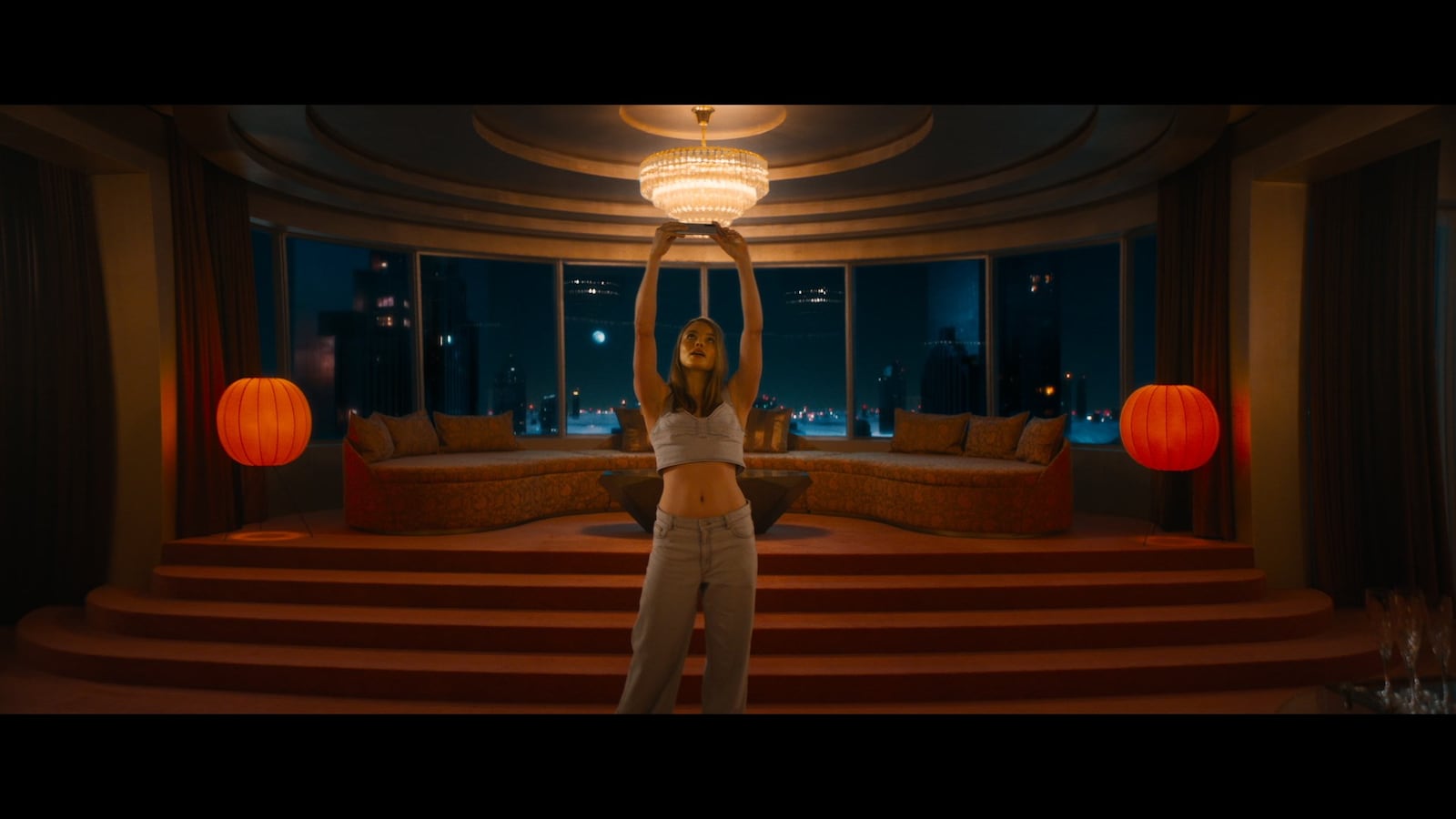
Yet, Her Private Hell represents an exponential leap into the abstract. The film is set inside the Tower Hotel, a whimsical architectural marvel floating perpetually among the clouds. Its tone is so deliberately disorienting that thick, hazy smoke persistently hovers in the background of scenes, actors recite dialogue at a pace slower than a court filibuster, and historical figures like Hans Christian Andersen are dropped casually into conversation with a knowing wink. At any given moment, a viewer might expect a character to jolt awake, revealing the entire ordeal to have been a fever dream conjured by the mind behind Drive.
Supporting Context & Metrics: The Mechanics of Her Private Hell
Meta-Cinematic Storytelling and Star Power
Despite its surreal atmosphere, Her Private Hell borrows a page from Pusher II by casting major movie stars to play versions of themselves within a fractured narrative. Within the plush confines of the Tower Hotel reside Elle (Sophie Thatcher), Hunter (Kristine Froseth), and Dominique (Havana Rose Liu)—the glamorous, idiosyncratic leads of an in-universe, kitschy sci-fi production titled Candyfloss.
Away from the fictional soundstages, these characters lounge in outfits as outlandish as their spaceship-flying counterparts while wrestling with deeply personal, melodramatic turmoil. Dominique is preparing to marry Elle’s father, a union complicated by palpable erotic tension between the two younger women. Meanwhile, Hunter literally crawls on all fours across hotel carpets to win the approval of an eccentric filmmaker named Nico (played by Diego Calva), who cheerfully declares, "I love freaky shit."
The Giallo Pulse and the Objectification of Flesh
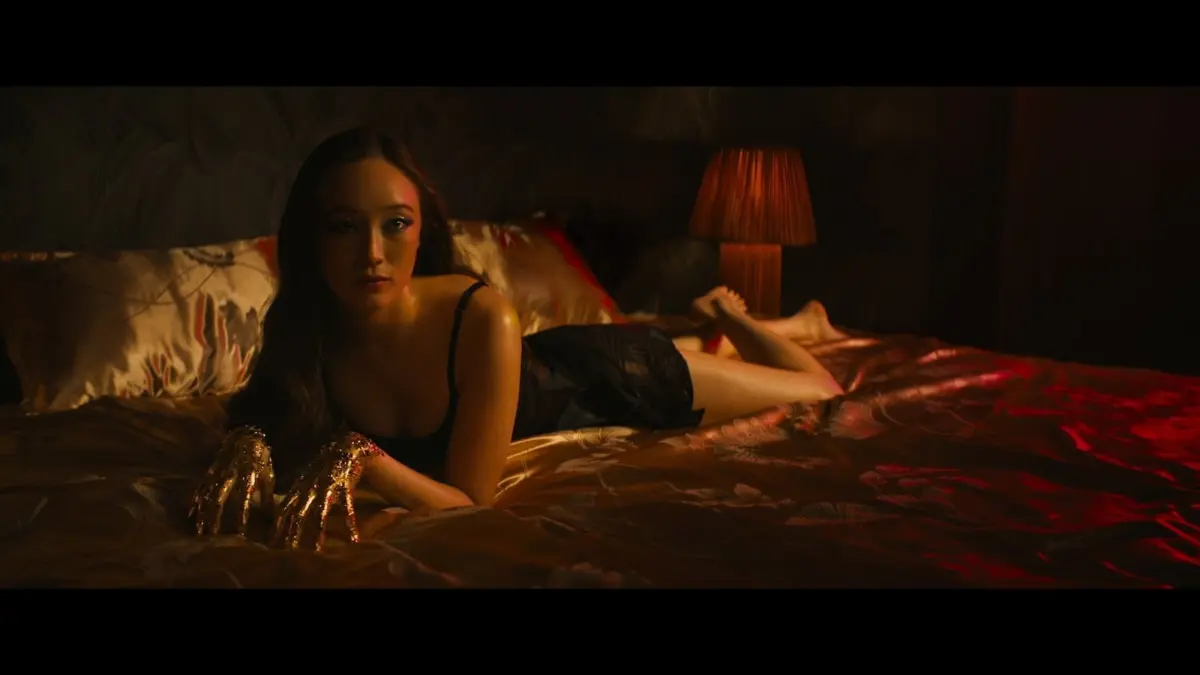
Running parallel to this high-fashion soap opera is a brutal, violent subplot that channels the stylistic DNA of Italian giallo masters like Dario Argento. A glove-wearing serial killer known only as "Leatherman" is systematically slicing up young women. Hot on his heels is Private K (Charles Melton), a former American GI seeking vengeance for his deceased daughter. Private K’s cross-continental crusade involves battling the yakuza and inexplicably breaching the boundary into the world of Candyfloss.
Refn previously flirted with giallo aesthetics through the lurid crimson lighting of Only God Forgives. In Her Private Hell, however, he fully embraces—and gleefully exaggerates—the inherent absurdity of the genre. When the Leatherman dispatches a victim, she does not deliver a standard plea for mercy; instead, she screams a single, operatic word: "Daddy!"
Furthermore, the camera unashamedly fetishizes the physical beauty of its ensemble cast. The female leads venture out to a sleazy club’s "uniform night" dressed as though they have stepped off a high-end runway. Simultaneously, Charles Melton is framed as an object of physical sculpture, frequently captured topless with glistening sweat tracing his abdominal muscles, occasionally framed so tightly that his face is entirely cut out of the shot.
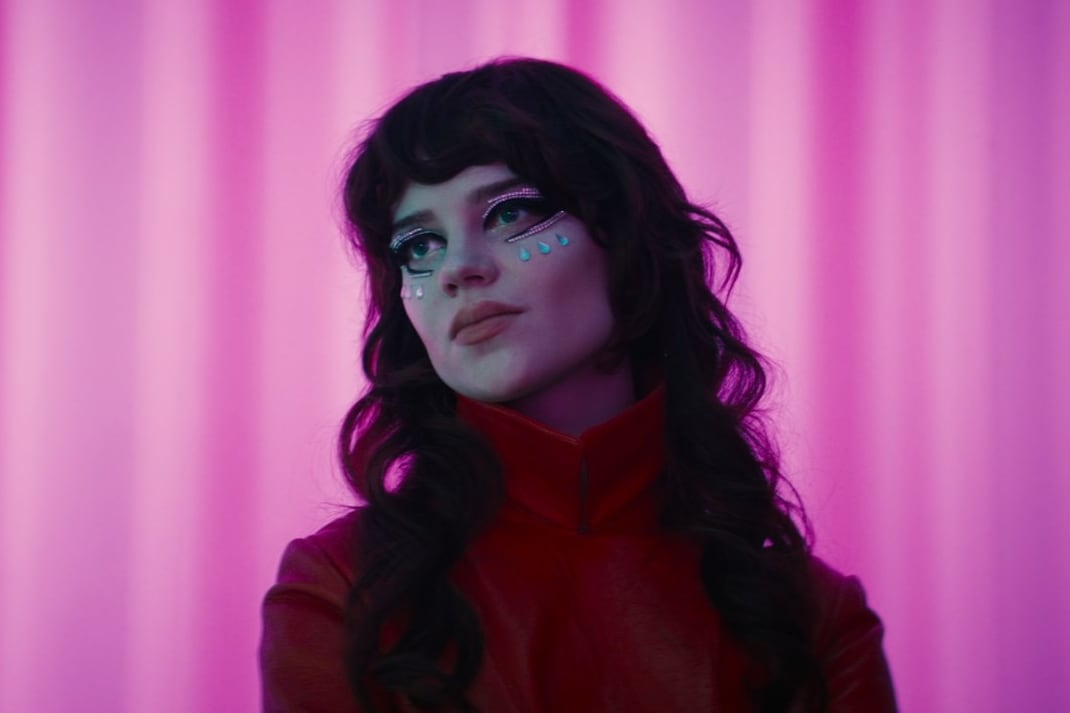
"It’s a kind of objectification of flesh," Refn explains of his framing choices. "It’s like playing with action dolls, and I can place them around these sets I’ve built like a dollhouse."
Official Statements: Death, Resurrection, and Artistic Rebirth
The 25-Minute Death
When sitting down for an interview in London, Nicolas Winding Refn immediately lays bare the primary catalyst behind the esoteric nature of Her Private Hell. In 2023, the director suffered a leaking heart valve, resulting in a medical emergency during which he was clinically dead for approximately 25 minutes.
"Prior to that, my creative flame had burned out," Refn reflects candidly. "I didn’t have anything in me. I was at a sense of artistic retirement. To reignite it, they had to literally operate on my heart and bring me back from the dead. Even though it’s traumatic, it’s actually the best experience I’ve ever had, because it gave me a chance to live again. Now the flame is red hot, as if I was 24—but I’m 55. I have the arrogance and curiosity of youth again."
Refn draws a direct parallel between this cardiac resurrection and his early career milestones. He notes that while Pusher II and III are technically "better" crafted films than the original, they lacked the raw, innocent attitude of his debut.
"The first time you make something is the best time, because it gives you a sense of childish excitement," he says. "Her Private Hell is the first film after being brought back from the other side. That in itself becomes the first time." When asked what fate awaited him had his heart not failed, Refn doesn’t hesitate: "That’s the thing. It was over. I had nothing to do. I would have ended up doing boring advertisements."
Defending the Pacing and Streaming Experiments
Her Private Hell marks Refn’s first traditional feature film since 2016’s The Neon Demon. In the intervening years, however, he directed two high-budget, ambitious streaming television series: Amazon’s Too Old to Die Young and Netflix’s Copenhagen Cowboy. These projects amplified the elements that general audiences and critics frequently lambnoted in Only God Forgives—namely, slow-burn storytelling, minimal dialogue, and lingering, hypnotic tracking shots—pushing them to patience-testing extremes.
While Her Private Hell clocks in at a relatively brisk runtime of under two hours, its editorial rhythm is heavily influenced by his television output. It compels viewers to luxuriate in stark, painterly compositions during prolonged stretches of silence. Refn defends this artificial theatricality:
"I worked with the actors to be very still and precise. That gives it a form of artificial presentation, because the world they exist in is all built. It’s a theatrical world, a bit like an opera. They perform their lines like they’re singing in an opera."
Remarkably, Refn’s commitment to abstraction extends to the very structure of the viewing experience. When asked if the film’s disjointed scenes could be watched out of sequence, his response is entirely uninhibited: "Oh, yeah. You can click between the situations as much as you want." When asked if he is actively encouraging fans to remix his film, he replies, "I encourage that very much. I wanted it to feel like when I was eight years old, clicking channels on a television, and you could travel into an experience, and do the same again, and lose yourself in a kaleidoscope of mini-impulses."
The Shadow of Fear X and Studio Interference
The conversation inevitably turns to his troubled 2003 psychological thriller, Fear X, starring John Turturro, in which the camera ventures deep into the protagonist’s psyche against washes of blood-red light. Some critics have theorized that Fear X was an early, tentative experiment in visualizing the inner workings of a strained mind—a theme Refn now explores with visceral maturity following his clinical death.
Refn, however, reacts to the comparison with mock frustration: "Fear X is a movie I rarely talk about, because I consider it a complete failure on all fronts, both artistically and financially. But I was happy to have failed at that age, because it set my path straight." The financial catastrophe of Fear X forced him into bankruptcy, which in turn drove him to write and direct Pusher II and III as guaranteed commercial lifelines. "If it wasn’t for that extreme failure, I wouldn’t be sitting here."
This uncompromising stance has occasionally put him at odds with major Hollywood studios. Reflecting on his work with Amazon on Too Old to Die Young, which concluded with a remarkably brief, minimalist finale, Refn addresses rumors of budget constraints or studio interference.
"No, no, no. It’s like an epilogue of a book. With Amazon, you don’t run out of money. They print more money," he chuckles. "What I made at Amazon, I enjoyed, and there were no restrictions. It was afterwards that they realised what I had made, and they decided to bury it. It was a lot of good work, but Amazon was scared of it. They wanted a 10-hour Drive? I don’t know what they wanted. But that’s not for me to say. I do what I do. I’m in the Nic Refn business."
This stubborn independence is precisely why Refn famously turned down directing the James Bond film Spectre, choosing instead to helm the deeply idiosyncratic Only God Forgives in pursuit of total creative autonomy. Consequently, Her Private Hell is predictably divisive. During a press screening in London, one disgruntled critic unleashed an audible, profanity-laced tirade against the film immediately after the credits rolled. Refn remains entirely unbothered by such visceral backlash:
"It’s not that I enjoy it, but polarisation is a great way to penetrate the mind, and plant a seed. Whether you love it or hate it, that’s irrelevant."
Future Outlook
As Her Private Hell prepares for its UK theatrical release on September 25, Nicolas Winding Refn is already casting his gaze toward the horizon. Among his prospective upcoming projects is Maniac Cop, a comic-book-inflected genre adaptation that he has circled for nearly a decade. Whether he will approach the material with the raw kineticism of his early work or dive even deeper into the hallucinatory abstraction of Her Private Hell remains an open question.
Refn maintains a profound skepticism toward the stagnation of modern cinema, drawing inspiration from his friendships with unconventional visionaries like game designer Hideo Kojima and filmmaker Harmony Korine. In Refn’s view, contemporary filmmaking risks becoming sterile unless artists continually seek out radical ways to reinvent the medium.
Assuming he will not require another 25-minute cardiac arrest to jumpstart his next creative cycle, how does he plan to push the boundaries of cinema moving forward?
"It’s staying true to what you want to do. Singularity is still futuristic," Refn concludes. Having proven that he understands how to manufacture commercial hits when survival demands it, does he ever feel tempted to cater directly to what audiences claim to want?
"I try not to think like that," he says firmly. "I don’t seek validation. I don’t care what other people think. If you do exactly what you want, you will always fly."