Executive Overview
Nearly two weeks after Apple rolled out iOS 27 to the general public—bringing with it the much-anticipated, flagship integration of advanced Siri AI capabilities—users and developers alike are beginning to navigate both the profound power and the lingering friction points of the tech giant’s latest operating system. While Siri AI represents a massive generational leap forward in on-device intelligence, conversational context, and cross-app execution, it is far from infallible. Everyday workflows often expose minor operational gaps: the friction of repetitive typing, the lack of a native "skills" or macro-learning system, and the tedium of re-entering multi-step commands.
Enter QuillCue, a clever and timely utility developed by independent creator Parker Ortolani. Featured prominently in this week’s Indie App Spotlight, QuillCue cleverly bypasses these limitations by deploying a custom iOS keyboard designed explicitly for saving, organizing, and instantly deploying prewritten prompts directly into Siri AI. By transforming complex, multi-layered queries into a single swipe-and-tap action, QuillCue addresses a fundamental user-experience bottleneck in iOS 27. Available completely free on the App Store with zero ads or in-app purchases, QuillCue signals a growing wave of indie developer ingenuity aimed at refining and supercharging Apple’s native AI ecosystem.
Detailed Chronology: The Evolution Leading to QuillCue
The iOS 27 Milestone and the Promise of Siri AI
The journey toward QuillCue begins in earnest with the release cycle of iOS 27. Apple marketed the release heavily around its overhauled, deeply integrated artificial intelligence infrastructure. Unlike previous iterations of Siri—which often struggled with complex semantic understanding, multi-turn context retention, and direct third-party application execution—Siri AI was designed to operate as a ubiquitous, fluid assistant embedded deep within the operating system’s architecture.
Upon launch, tech analysts and early adopters praised the update for its fluid conversational abilities and responsive on-device processing. However, power users quickly identified a systemic usability friction: while Siri AI could handle immensely sophisticated requests, users frequently found themselves typing or dictating identical, highly structured prompts multiple times a day. Because iOS 27 currently lacks a robust, native macro system, persistent prompt library, or user-defined behavioral "skills," executing routine, multi-step queries remained a manual, repetitive chore.
The Genesis of an Indie Solution
Recognizing this operational friction, developer Parker Ortolani conceptualized a utility that could bridge the gap between user intent and Siri AI’s input requirements. Leveraging iOS’s mature custom keyboard architecture, Ortolani built QuillCue—a lightweight, privacy-focused application centered around a singular mission: eliminating repetitive keystrokes for AI interactions.
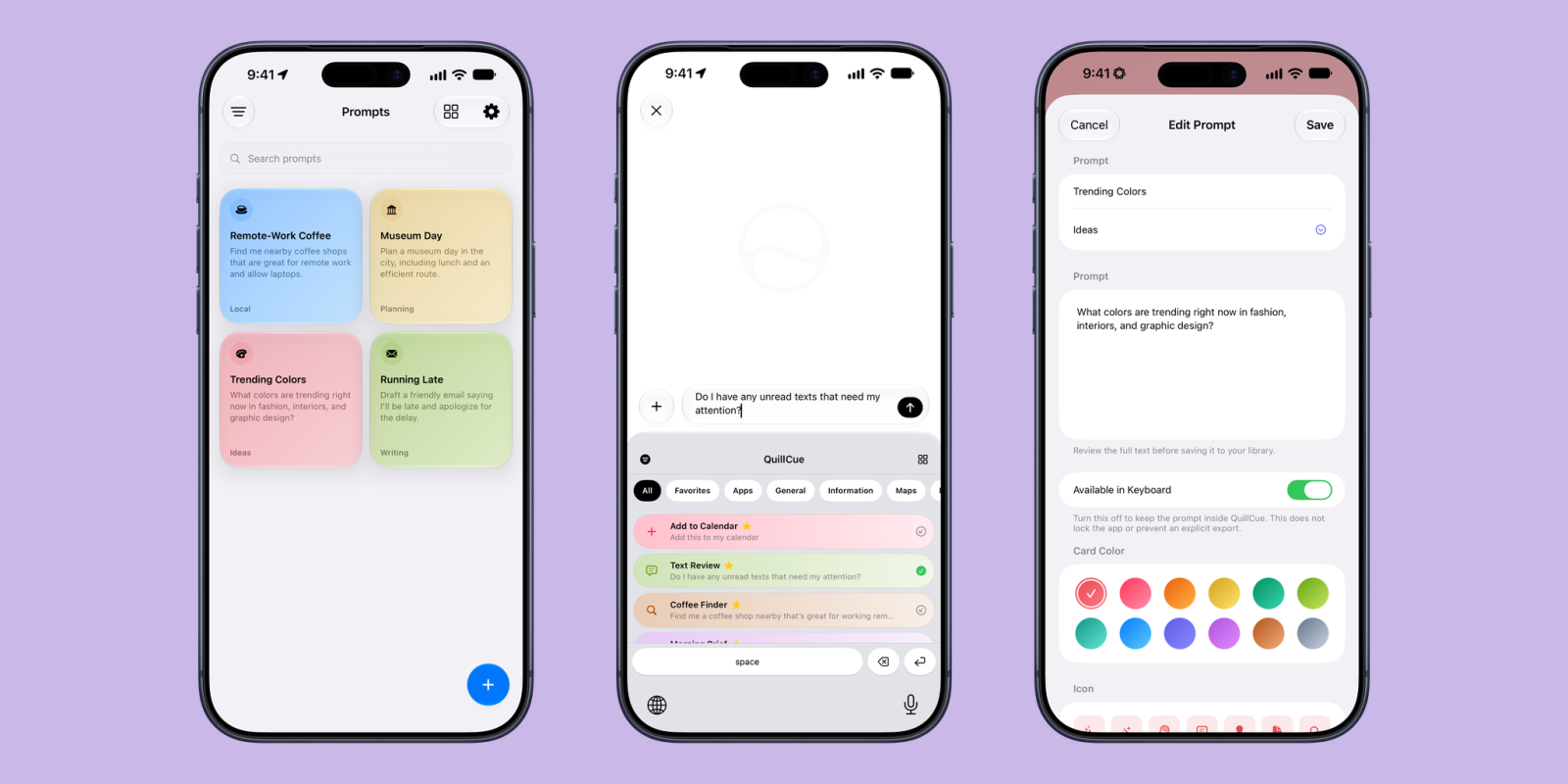
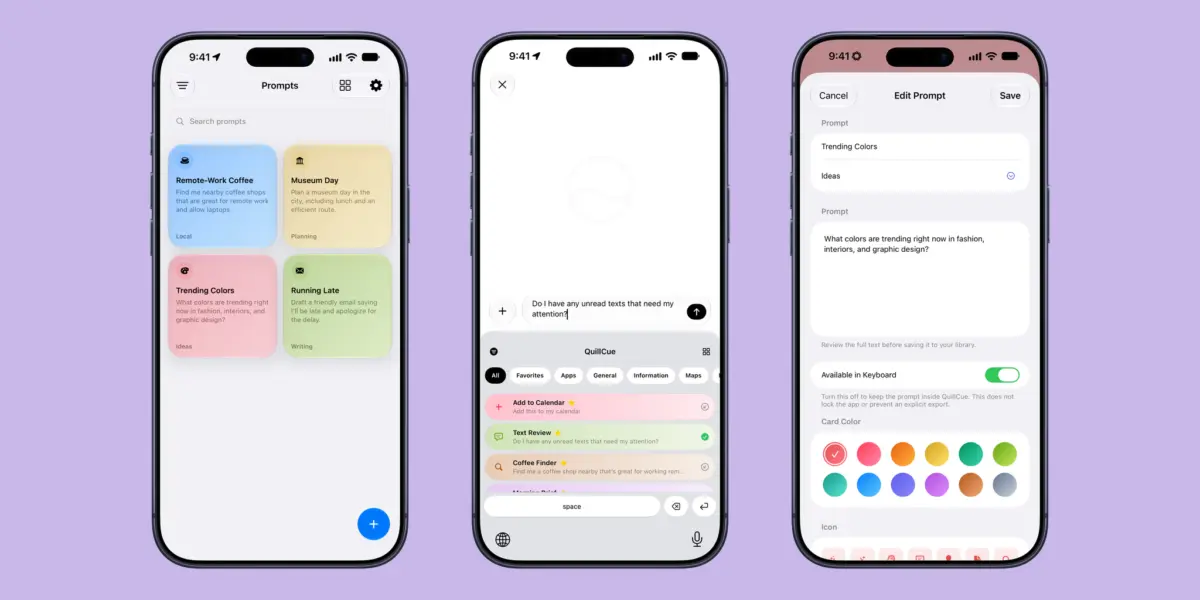
Rather than trying to build a competing voice assistant or an overly complex wrapper app, QuillCue utilized a form factor that iPhone users already understand intimately: the software keyboard. By embedding prompt management directly into the keyboard interface, QuillCue positioned itself invisibly yet accessibly within any text input field where Siri AI could be invoked, creating a frictionless loop between stored prompt templates and AI execution.
Supporting Context & Metrics: The Mechanics of QuillCue
To understand the value proposition of QuillCue, one must examine how it integrates into the daily habits of power users navigating iOS 27.
Core Features and Workflow Integration
At its technical and functional core, QuillCue is designed around speed and minimalism. The application introduces several standout features:
- Custom Keyboard Architecture: By switching to the QuillCue keyboard via the standard iOS input switcher, users gain instant access to a curated grid of pre-saved prompts without needing to leave their active application interface.
- Dynamic and Static Prompt Management: Users can store anything from simple conversational starters to highly intricate, multi-clause analytical instructions. For example, a default template designed to locate nearby coffee shops that cater to remote workers (specifically highlighting laptop-friendly policies and power outlet availability) demonstrates how prompts can dynamically interface with location-based AI retrieval.
- Organizational Folders: As a user’s prompt library expands, managing dozens of disparate queries can become messy. QuillCue incorporates a clean folder-sorting mechanism, allowing users to categorize prompts by workflow type—such as coding, writing assistance, travel planning, or daily productivity.
- Import/Export Capabilities: Understanding that productivity setups are frequently shared among teams or migrated across hardware upgrades, QuillCue features seamless prompt library import and export functions. Users can easily package their favorite prompt collections and share them with friends, colleagues, or transfer them to a new iPhone.
Market Position and Accessibility Metrics
QuillCue’s rollout has been characterized by an unusually consumer-friendly distribution model. Key deployment metrics include:
- Pricing: 100% free on the App Store.
- Monetization: Zero advertisements, zero paywalls, and zero in-app purchases.
- System Requirements: Requires an iPhone running iOS 27.0 or later.
- Geographic Availability: Currently restricted to users within the United States (tied closely to the initial regional rollouts and linguistic optimizations of advanced Siri AI features).
Official Statements and Developer Insights
The development philosophy behind QuillCue reflects a broader movement within the indie app ecosystem: identifying micro-frustrations in major platform updates and engineering elegant, highly focused antidotes before the platform holder can address them natively.

Parker Ortolani, speaking on the design ethos of the app via social media channels, emphasized the importance of minimizing cognitive and physical load when interacting with mobile AI. "When you’re using an AI assistant dozens of times a day for specialized tasks, every extra tap or spoken sentence adds up," industry observers note of similar utility tools. By cutting down the friction of re-entry, QuillCue effectively treats prompts as programmable shortcuts—a philosophy that aligns closely with Apple’s own historical focus on workflow automation via shortcuts and macros, but tailored specifically for the generative AI era.
Early reviews from the 9to5Mac Indie App Spotlight have underscored the app’s clever utilization of existing iOS frameworks. By relying on the custom keyboard API rather than demanding deep system-level privileges, QuillCue maintains a high standard of user privacy and system stability, avoiding the memory bloat or battery drain often associated with heavier utility applications.
Future Outlook: What QuillCue Means for the Future of iOS AI
As iOS 27 matures and Apple inevitably refines Siri AI in upcoming point releases, the role of third-party indie utilities like QuillCue will likely evolve.
Potential Platform Adoption vs. Independent Longevity
A central question facing utilities that solve platform "gaps" is whether the platform holder will eventually absorb the feature natively. It is entirely plausible that future iterations of iOS—perhaps iOS 28 or later software updates—might introduce native prompt memory, macros, or a "skills" registry directly into Siri AI.
However, indie developers possess an agility that massive technology conglomerates often lack. Even if Apple introduces native prompt management down the line, tools like QuillCue demonstrate the power of specialized, user-driven design. Furthermore, the ability to effortlessly export, share, and import custom prompt libraries across devices and user groups is a social layer that operating system developers rarely prioritize out-of-the-box.

The Role of Indie Developers in the AI Era
QuillCue serves as a case study for the vitality of the indie app market in an era dominated by trillion-dollar artificial intelligence rollouts. While tech giants focus on foundational models, neural engines, and system-wide integrations, indie creators are uniquely positioned to polish the rough edges of daily human-computer interaction.
By focusing on the micro-interactions—the single tap, the saved string of text, the organized folder—QuillCue proves that the ultimate success of an AI platform often relies not just on how smart the artificial intelligence is, but on how effortlessly the human can talk to it. For iPhone users in the US running iOS 27, QuillCue is an essential, frictionless addition to the toolkit, and a compelling glimpse into how the indie community continues to shape the modern mobile experience.