Executive Overview
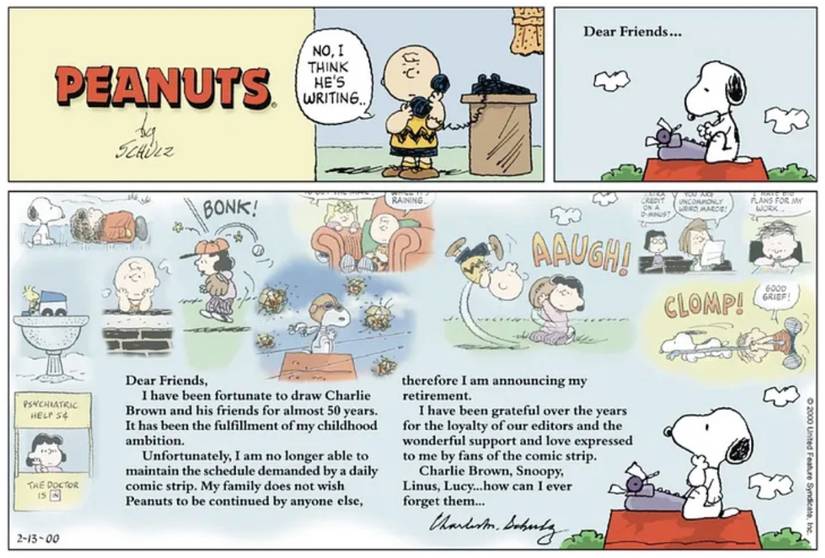
For half a century, Charles M. Schulz’s Peanuts served as a daily mirror for the American psyche. Through a cast of insecure children and one philosophical beagle, Schulz mapped the contours of anxiety, unrequited affection, existential dread, and the quiet resilience required to face a world that rarely delivers on its promises. When the final strip was published on February 13, 2000—merely a day after Schulz’s passing at the age of 77—it felt like a carefully orchestrated farewell. Though the realities of newspaper production schedules made this timing a poignant coincidence rather than a planned final act, it cemented the author’s legacy as a cultural titan who defined generations of comic strip storytelling.
Yet, amidst the nearly 18,000 strips Schulz meticulously crafted over his 50-year career, one particular piece of dialogue stands out not merely as a punchline or a moment of childhood melancholy, but as a genuine piece of life philosophy. Found tucked away in a 1966 storyline centered around a school spelling bee, the line is deceptively simple. When berated by Lucy van Pelt for the sheer audacity of volunteering to represent his class, Charlie Brown retorts with a question that pierces to the core of human existence:
"What’s the good of living if you don’t try a few things?"
Despite the profound weight of this query—a sentiment that rivals the musings of classical philosophers and existentialist thinkers—its brilliance appears to have eluded everyone, including the characters who uttered it and the man who wrote it. Neither the skeptical Lucy nor the perpetually defeated Charlie Brown grasped the universal truth of the statement. More shockingly, when Schulz adapted this very narrative arc into the 1969 feature film A Boy Named Charlie Brown, the line was conspicuously omitted.
This retrospective examines the genesis of that iconic 1966 storyline, the broader cultural context of Schulz’s masterwork, the curious oversight of a master craftsman failing to recognize his own brilliant prose, and the enduring legacy of a philosophy born from the ink-stained drawing board of a quiet cartoonist from Minnesota.

Detailed Chronology: The Anatomy of a Spelling Bee
To understand how one of the greatest philosophical statements in comic history came to be, one must look back at the winter of 1966. Schulz was at the absolute peak of his creative powers. Peanuts was a global cultural phenomenon, dominating newspapers, merchandising agreements, and television screens following the massive success of A Charlie Brown Christmas just a few months prior in December 1965.
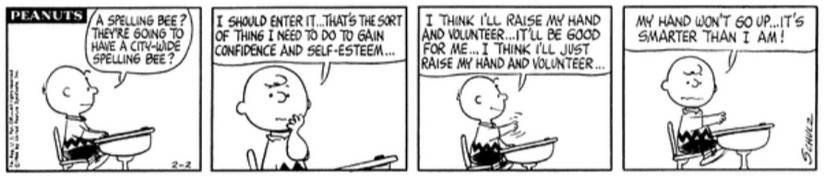
Beginning on February 2, 1966, Schulz launched a sprawling, multi-part continuity arc that would consume the daily comic pages for nearly three weeks. The premise was deceptively mundane: Charlie Brown, driven by an uncharacteristic surge of optimism, volunteers for his school’s spelling bee.
The 16-Day Saga
Unlike Sunday strips, which were standalone color broadsheets requiring months of advance lead time, daily strips allowed Schulz to develop serialized narratives that unfolded over weeks. The spelling bee sequence ran for 16 consecutive daily strips, concluding on February 20, 1966 (excluding Sundays).
- February 2, 1966 (Day 1): The setup is established. Charlie Brown announces his intention to compete, inviting immediate skepticism and mockery from his peers.
- February 3, 1966 (Day 2): The narrative reaches its thematic apex. Lucy confronts Charlie Brown with absolute disbelief, questioning why he would willingly subject himself to potential humiliation. It is within this strip that Charlie Brown delivers his definitive manifesto on effort, risk, and existence: "What’s the good of living if you don’t try a few things?"
- Mid-February 1966 (Days 3–15): The grueling preparation, the anxiety of public performance, and the inevitable comedic tragedy unfold. Charlie Brown studies voraciously, buoyed by temporary support from his friends, only to face the inevitable executioner’s block of competitive pressure.
- Late February 1966 (Day 16): The tragicomic climax arrives. When finally stepping up to the microphone for his very first word, a stressed-out Charlie Brown is given the word "maze." Choking under the spotlight, he famously spells it: "m-a-y-s."
The aftermath is swift and brutal in its emotional realism. Crushed by his failure, Charlie Brown returns to his desk, buries his face in his arms, and refuses to look up. When his teacher commands him to lift his head, he snaps at her in frustration—a rare moment of open rebellion that lands him in the principal’s office. Though he eventually returns to class to offer a contrite apology, the psychological bruise lingers. For Charlie Brown, the spelling bee was a disaster. But for the reader, it was a masterclass in human vulnerability.
Supporting Context & Metrics: The Scale of Schulz’s Genius
To truly appreciate the weight of Charlie Brown’s spelling bee declaration, one must contextualize the sheer volume and cultural footprint of the Peanuts enterprise.

By the Numbers: The Peanuts Corpus
- 50 Years: The duration of the comic strip’s continuous run, stretching from October 2, 1950, to February 13, 2000.
- 17,897: The total number of published strips written and drawn entirely by Charles M. Schulz.
- 2,600+: The peak number of newspapers that carried Peanuts across 75 countries, translated in 21 languages.
- 1: The number of primary creators. Unlike many modern comic syndicates that rely on ghostwriters, assistants, and inkers, Schulz famously wrote, penciled, inked, and lettered every single strip himself from his studio in California.
This solitary creative process meant that every line of dialogue, every dropped football, and every existential query muttered over a brick wall sprang directly from Schulz’s internal world. He was an observer of human frailty, channeling his own childhood insecurities, rejections, and quiet triumphs into a bald-headed boy in a zig-zag shirt.
When Charlie Brown asked, "What’s the good of living if you don’t try a few things?" he was articulating the core engine of Schulz’s worldview. Charlie Brown never wins. He never kicks the football. His kite is perpetually devoured by the kite-eating tree. His baseball team loses by staggering margins. Yet, day after day, year after year, he steps back onto the field. He walks up to the plate. He holds the football for Lucy. The genius of Schulz was not in giving his characters happy endings, but in validating the sheer, unadulterated courage it takes to keep participating in a game that seems rigged against you.
Official Statements & Historical Reflection: The Loss in Translation
Despite the universal acclaim the strip received over the decades, the specific trajectory of the 1966 spelling bee storyline reveals a fascinating blind spot in how creators interact with their own work.
When the time came to transition Peanuts from the printed page to the silver screen, Hollywood came calling. Lee Mendelson and Bill Melendez, the creative forces behind the television specials, partnered with Schulz to produce the very first full-length theatrical animated feature: A Boy Named Charlie Brown. Released on December 4, 1969, by National General Pictures, the film was a critical and commercial success, earning an Academy Award nomination for Best Original Song Score.
The foundational plot for the movie? The exact 20-part spelling bee storyline from the winter of 1966.
The Editing Room Floor
Expanding a 16-day newspaper comic arc into an 85-minute feature film required substantial padding, musical numbers, and visual expansion—such as the famous, surreal multi-minute sequence where Charlie Brown competes in the national spelling bee in New York City.
However, in adapting the material, certain narrative elements from the original comics were discarded. Most notably, the iconic exchange between Lucy and Charlie Brown—featuring the line "What’s the good of living if you don’t try a few things?"—did not make the final script.
Film historians and comic scholars have long debated why the line was omitted. Was it deemed too philosophical for an animated feature aimed at families? Did it clash with the rhythmic pacing of the screenplay? Or, more plausibly, did Charles Schulz himself—writing the screenplay alongside bedfellows who revered his work—simply overlook its transcendent value?
In the fast-paced world of daily syndication, creators often treated individual strips as fleeting ephemeral thoughts, moving immediately from one deadline to the next. Schulz was famously prolific, working weeks in advance without the luxury of pausing to audit his past brilliance. To him, the line was likely just another piece of dialogue serving the immediate dramatic need of getting Charlie Brown into the spelling bee. He could not have predicted that decades later, cultural critics would look back at those panels as modern scripture.
Future Outlook: The Timeless Resonance of Peanuts
More than two decades after Charles Schulz laid down his pen and the final panel of Peanuts was inked, the cultural footprint of the strip remains remarkably robust. In an era dominated by hyper-fast digital media, algorithmic validation, and a cultural obsession with instant success, the philosophy of Charlie Brown feels more radical than ever.
Modern society is saturated with narratives of optimization, winning, and avoiding failure at all costs. We curate our lives to project absolute competence, terrified of looking foolish, stumbling over our words, or misspelling our own personal "maze."
Charlie Brown’s simple, desperate plea—“What’s the good of living if you don’t try a few things?”—acts as a necessary antidote to this modern anxiety. It reframes failure not as a moral defect or a permanent disqualification from happiness, but as the mandatory toll for participating in a meaningful life. To try, to fail, to be laughed at by Lucy, and to wake up the next morning ready to kick a football that will inevitably be pulled away—that is the essence of the human condition as diagnosed by a quiet cartoonist from Minnesota.
As new generations discover the strip through archival collections, digital re-releases, and streaming platforms, the brilliance of Schulz’s creation continues to shine past the creator’s own modest estimations. Charles Schulz may not have realized that he had penned one of the most profound meditations on existence in American literary history. But nearly sixty years after those ink lines dried on a page in 1966, the rest of the world is finally catching up to what the blockhead knew all along: the point isn’t winning; the point is that you dared to try.