Executive Overview
It has been precisely twelve months since the seismic shift of the historic SS26 fashion month, a period defined by an unprecedented musical chairs of creative directors at the apex of global luxury labels. Yet, despite the brevity of that timeframe, the contemporary fashion ecosystem has continued to steamroll forward at a breakneck, almost dizzying pace. The traditional parameters of seasonality and creative digestion have been utterly rewritten.
While heavyweights like Demna at Gucci, Matthieu Blazy at Chanel, and Jonathan Anderson at Dior have been locked in a relentless cycle of production—churning out upward of five to ten collections in a single year across ready-to-wear, menswear, and haute couture—one designer has deliberately chosen to step off the hyper-accelerated treadmill. Louise Trotter, since making her auspicious Bottega Veneta debut in September 2025, has charted a markedly different course.
Presenting her third ready-to-wear collection for Spring/Summer 2027 (SS27) at Milan Fashion Week, Trotter has steadfastly refused to succumb to the industry’s frantic exhaustion. While neighboring houses grapple with the compounding pressures of pre-collections, resort, and couture, Bottega Veneta maintains a comparatively restrained, highly curated runway calendar. This measured tempo has afforded Trotter the rare luxury of time: the space to slowly carve out a distinct, enduring design universe that exists well within the gravitational pull of the luxury establishment, yet moves entirely to the rhythm of its own orbit.
Against a backdrop of A-list star power—featuring everyone from a rare front-row appearance by Tyler, the Creator, to the viral moment of Jacob Elordi snapping photos of Kendall Jenner on the runway—Trotter’s SS27 collection proved that profound resonance does not require daily reinvention. Instead, true luxury lies in evolution, material alchemy, and a profound sensitivity to the changing world.
Detailed Chronology: The SS27 Milan Fashion Week Showcase
The atmosphere inside the Bottega Veneta venue was charged with a palpable sense of anticipation. Milan Fashion Week is routinely dominated by sensory overload, but Trotter’s presentations consistently cultivate an air of cool, intellectual sanctuary. The SS27 show was no exception, unfolding as a masterclass in pacing, choreography, and material storytelling.
The Front Row: A Gathering of Cultural Titans
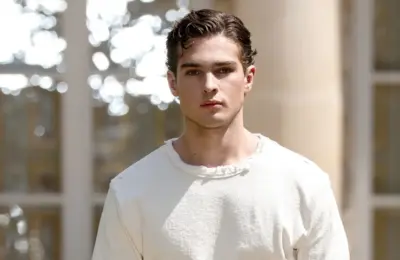
Long before the first look emerged, the front row generated its own seismic cultural shockwaves. Most notable was the return of Tyler, the Creator, marking his first major fashion week appearance since sitting front row at Pharrell Williams’s SS24 Louis Vuitton menswear collection in June 2023. Having officially aligned himself with Bottega Veneta last year—appearing alongside an eclectic pantheon of brand faces including Zadie Smith, Dario Argento, and Jack Antonoff—Tyler’s presence underscored the house’s unique cross-pollination of hip-hop royalty, literary prestige, and cinematic cool.
The rest of the front row (FROW) was a masterclass in modern casting curation. Brand ambassadors Julianne Moore and Jacob Elordi anchored the seating arrangement, joined by a dynamic cross-section of cultural architects: rising actor Owen Cooper, musician Solange Knowles, creative force Audrey Hobert, and songstress Jorja Smith.
Materiality in Motion: The Garments Take Flight
When the lights dimmed and the first models emerged, it became immediately clear that fluidity—a foundational principle of Trotter’s vision for Bottega Veneta since day one—was once again steering the ship.
Recall the house’s trajectory over the past year: the debut show featured coats constructed from ribbons of swishing fabric and woven leather accessories sprouting rows of tassels, punctuated by Awar Odhiang in that unforgettable tinsel-like golden “fur” crafted from recycled fiberglass. By Autumn/Winter 2026 (AW26), Trotter had expanded upon these flouncy, textural fiberglass creations in a kaleidoscope of new hues.
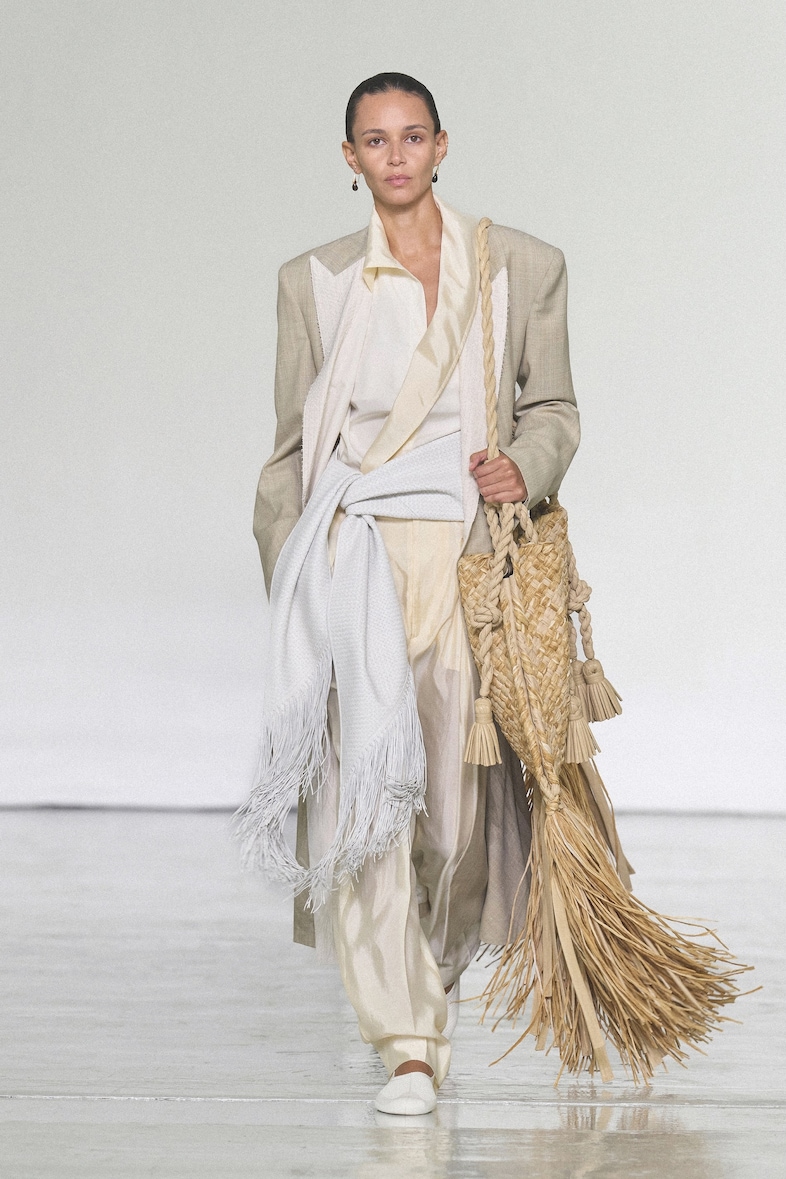
For SS27, this kinetic philosophy reached a fever pitch. The collection opened with a masterclass in contrasting silhouettes: a pair of sharp, black disco flares swished hypnotically below a voluminous, feathered puffball skirt. A classic black trench coat was reimagined through meticulous craftsmanship, stitched with shifting, multi-dimensional layers of white leather tassels that caught the light with every stride.
Midway through the presentation came what industry insiders immediately pegged as the undisputed It-item of the upcoming season: a series of tasselled skirts that appeared as though they had narrowly survived a high-fashion industrial shredder. Bouncing, rippling, and cascading down the runway, these garments transformed static textiles into living, breathing entities.
The Grand Finale: Jenner, Elordi, and the Viral Moment
As is customary for a major house closing, the tension culminated in the final sequence. Cult supermodel Mariacarla Boscono had earlier graced the runway in razor-sharp pleated trousers paired with a liquid-like lilac silk top, while Dazed cover stars Mona Tougaard and Awar Odhiang embodied Trotter’s uber-chic, globally diverse casting ethos.
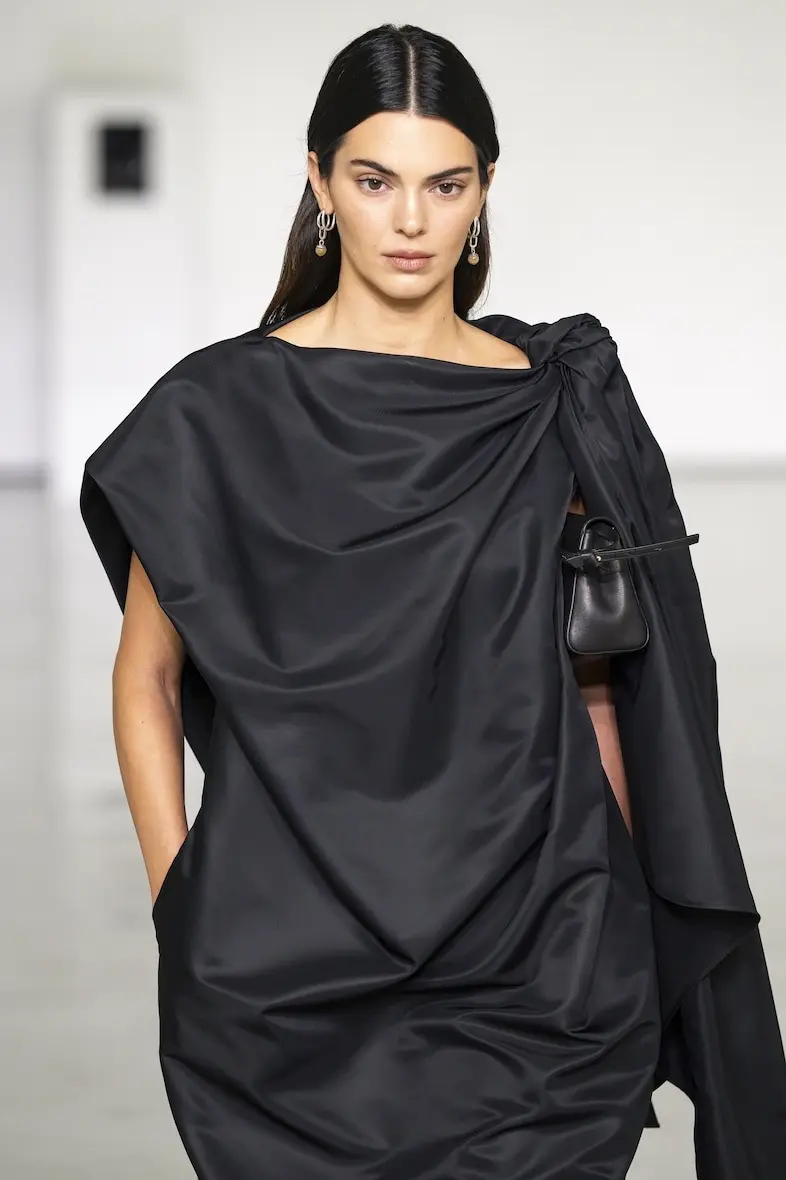
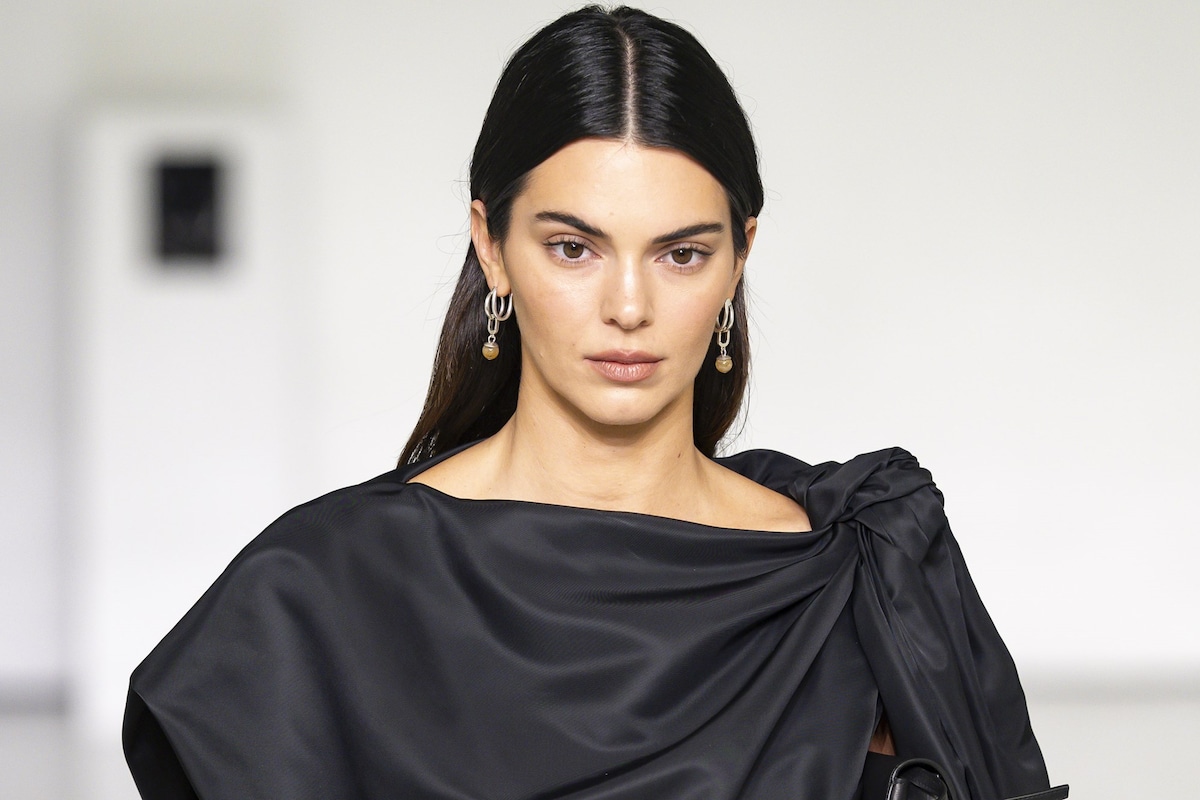
However, the final stride belonged to Kendall Jenner. Swaddled in a statuesque, architectural black toga-esque garment, dramatically knotted in a sweeping structural bow at her left shoulder, Jenner commanded the room. As she executed her final turn, she glided past her rumored partner, Jacob Elordi, who was seated front row.
Though neither the American supermodel nor the Australian actor has ever officially confirmed the romantic speculation surrounding them, the human element pierced through the austere perfection of the runway. Elordi beamed unabashedly as Jenner passed, pulling out a small silver digital camera to capture the moment in real-time. It was a viral-ready confluence of old-world fashion grandeur and contemporary pop-culture mythology.
Supporting Context & Metrics: The Cost of Velocity in Modern Luxury
To fully contextualize Louise Trotter’s measured approach at Bottega Veneta, one must examine the frantic mathematical reality of the contemporary design calendar. The modern luxury landscape has transformed into an insatiable machine, demanding an unprecedented output from creative directors.
The Numbers Game: A Year in Review
Consider the staggering comparative metrics across major European fashion houses over the past twelve months:
- Gucci (Demna): Following the historic SS26 reset, Demna presented his fifth collection for the house in the span of a single year with this SS27 offering—a prolific output celebrating the house’s archival stereotypes.
- Chanel (Matthieu Blazy): Another high-profile hire for SS26, Blazy has overseen an astonishing six catwalk presentations in Paris over the past year alone, with his seventh scheduled just days after Milan.
- Dior (Jonathan Anderson): Taking up residence across the Champs-Élysées, Anderson has produced a staggering ten collections for the house since his appointment, eight of which have been full-scale runway productions.
In stark contrast, Trotter’s timeline is an exercise in intentional restraint. Since her Bottega Veneta debut in September 2025, she has delivered just two ready-to-wear collections prior to this outing, returning now for her third. While Chanel and Dior must continuously feed the beast of haute couture, and brands like Gucci perpetually churn out Resort and Pre-Fall intermissions, Bottega Veneta has consciously maintained a restrained, focused runway schedule.
This disciplined cadence allows Trotter to bypass creative burnout. It protects the integrity of the product, ensuring that every woven intrecciato leather piece, every fiberglass fringe, and every meticulously tailored coat is the result of deep material research rather than panicked deadline management.
Official Statements and Design Philosophy: The Metamorphosis of Seasons
At the heart of Bottega Veneta’s SS27 collection lies a deeply personal, philosophical meditation on the passage of time. As a British designer currently making her home and professional life in Milan, Trotter experiences the shifts in climate and atmosphere far more acutely than she might have in her native Sunderland.
This shifting sense of seasonality became the intellectual anchor of the SS27 presentation. In her official show notes, Trotter articulated this transition with characteristic poetry:
"Living in Milan makes the passing of seasons particularly felt. Light changes, the city sheds its cloak without becoming bare, and so does the way one lives, moves, dresses," the designer wrote. "This collection inhabits that movement. Spring anticipating summer. Summer beginning to bloom. One state quietly mutating into another."
This quote encapsulates the core of Trotter’s tenure at Bottega Veneta. Rather than designing for a rigid, hyper-segmented retail calendar, she designs for real human transitions. Her clothes do not just sit on the body; they track the micro-movements of daily life—the rustle of silk against skin, the heavy drape of a winter coat giving way to the breezy flutter of shredded leather fringes, the ethereal lightness of a silk top paired with structured trousers.
Industry analysts have continually praised this approach. By focusing on metamorphosis rather than trend obsolescence, Trotter has successfully safeguarded Bottega Veneta’s reputation as a house of quiet, enduring luxury—one that speaks softly in an industry increasingly prone to shouting.
Future Outlook: Where Does Bottega Veneta Go From Here?
As the dust settles on Milan Fashion Week and the fashion circus packs its trunks for Paris, the overarching question facing the luxury sector is sustainability—not merely ecological sustainability, but creative and human sustainability.
The burn rate of creative directors across historic houses has reached critical levels. When designers are forced to conceptualize upwards of eight to ten collections annually, the risk of artistic homogenization and exhaustion is mathematically inevitable.
Louise Trotter’s ongoing tenure at Bottega Veneta offers a vital blueprint for the industry’s future. By resisting the temptation to flood the market with endless commercial drops and secondary lines, Trotter and the leadership at Bottega Veneta are proving that scarcity breeds desire, and time breeds excellence.
Looking ahead, the commercial and critical success of the SS27 collection—signaled by viral moments on the FROW, universal acclaim for its kinetic tailoring, and the guaranteed sell-out status of its shredded leather skirts—suggests that consumers are craving authenticity and pacing.
Bottega Veneta under Trotter is not trying to win a race against the calendar. Instead, it is building a timeless wardrobe for a world in motion. As the seasons continue to shift and the luxury landscape evolves, Trotter’s steady, measured orbit may well become the gold standard to which the rest of the fashion universe is forced to return.