Executive Overview
Paris Fashion Week rarely suffers from a lack of dramatic contrast, yet the scheduling alignments on September 29 produced a rare stylistic synergy that reverberated across the global fashion landscape. Two of the most anticipated presentations of the season—Dior and Maison Margiela—arrived at strikingly parallel conceptual destinations despite traveling entirely different creative routes.
At the heart of this season’s unexpected dialogue was a foundational French atelier dichotomy: the tension between flou and tailleur. In haute couture and luxury ready-to-wear traditions, flou denotes the delicate, free-flowing, and liberated silhouettes typically achieved when working with weightless fabrics to construct gowns and dresses. Conversely, tailleur demands architectural precision, rigid structure, and heavy materials engineered to master the human form through sharply tailored jackets, structured shirts, and disciplined trousers.
On this particular afternoon, Dior’s creative director Jonathan Anderson inverted these historical codes, transforming archetypal tailleur garments into weightless, floating apparitions normally reserved for the atelier’s flou specialists. Hours later, Glenn Martens unveiled Maison Margiela’s Spring/Summer 2027 collection, aptly titled HARD and SOFT, which directly engaged this exact thematic binary.
Yet, the convergence extended far beyond shared technical vocabulary. In an extraordinary moment of inter-brand homage and historical pastiche, Margiela recreated—and subverted—one of the most iconic set designs in modern fashion history: Raf Simons’ legendary 2012 Dior couture debut. By resurrecting Mark Colle’s floral installation through a lens of decay and resurrection, and aligning structurally with contemporary conversations on garment subversion, the Paris runways proved that fashion is engaged in a profound, self-referential dialogue about its own legacy, materiality, and the shifting boundaries between rigidity and fluidity.
Detailed Chronology: A Tale of Two Houses
Dior: Jonathan Anderson’s Deconstruction of Tailoring
The day’s proceedings commenced under the grand tents of Dior, where Jonathan Anderson continued his intellectual exploration of the house’s heritage. Known for his disruptive yet deeply respectful approach to historical archives, Anderson turned his attention to the strict hierarchies of the French atelier.
Within traditional Parisian atelier structures, work is sharply divided. Artisans in the tailleur section spend decades mastering the canvas interlinings, shoulder pads, and geometric darts required to construct unyielding menswear-inspired tailoring. Meanwhile, the flou artisans operate as masters of the drape, manipulating chiffon, silk, and organza to capture movement and ease.
Anderson’s collection effectively scrambled these distinct divisions. Classic wool blazers, crisp poplin shirts, and sharp trousers were executed in mediums so ethereal and weightless that they behaved with the fluid grace of chiffon gowns. A heavy-looking double-breasted jacket defied gravity, hovering around the wearer’s frame with a deceptive lightness, while trousers pooled fluidly at the ankles like liquid silk.
By weaponizing lightness against garments historically designed to restrict and posture, Anderson established a conceptual playground. He asked the industry to reconsider what gives a garment its authority: is it the heavy architecture of the tailleur, or the liberating poetry of the flou?
Maison Margiela SS27: HARD and SOFT at L’Élysée Montmartre
Later that afternoon, the fashion pack relocated to L’Élysée Montmartre for Maison Margiela’s Spring/Summer 2027 presentation, titled HARD and SOFT. Under the creative direction of Glenn Martens, the house leaned directly into the exact design tensions that Dior had explored hours earlier.
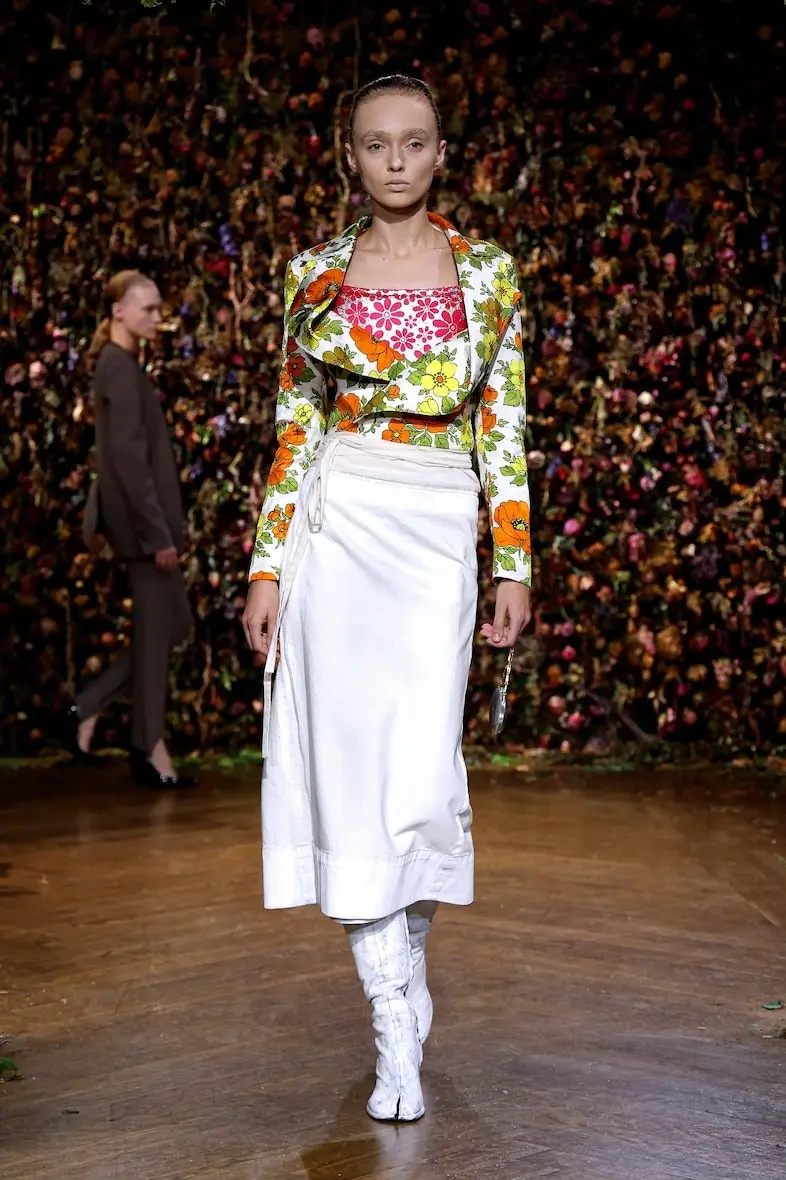
Guests entering the historic venue were immediately enveloped by an overwhelming atmosphere of melancholic opulence. The cavernous rooms of L’Élysée Montmartre were lined floor-to-ceiling with cascading walls of decaying, wilted flora. The installation was an unmistakable homage to Raf Simons’ celebrated 2012 debut haute couture collection for Dior—a watershed moment in fashion history where millions of fresh blooms blanketed the interior walls of a Parisian mansion.
To execute this nostalgic yet haunting replication, Margiela enlisted Mark Colle, the very same florist who engineered the original 2012 Dior set. However, Martens introduced a poignant temporal twist. Unlike Simons’ pristine, vibrant garden of a decade and a half ago, Margiela’s flowers were starkly dehydrated, hanging limply from the architectural framing as if left unattended to wither and rot through the intervening years.
[Timeline of Events - September 29]
 ├── Morning: Dior (Jonathan Anderson)
 │    └── Focus: Transforming 'tailleur' (structure) into 'flou' (fluidity).
 └── Afternoon: Maison Margiela (Glenn Martens)
      └── Focus: 'HARD and SOFT' SS27 collection, featuring decaying floral homage to Raf Simons (2012 Dior).
Supporting Context & Metrics: The Anatomy of the Homage
The intertextuality of the September 29 presentations generated immense discourse across digital analytics platforms, media outlets, and industry circles. To understand the gravity of Margiela’s set design choice, one must examine the lineage of Belgian designers shaping the contemporary luxury landscape.
The Belgian Axis: Simons, Martens, and Collective Memory
Raf Simons, Glenn Martens, and Jonathan Anderson (though British, deeply tied to continental conceptualism) occupy a lineage of intellectual garment-making. Simons’ 2012 Dior couture collection is widely regarded as a masterclass in modernizing Christian Dior’s New Look through a minimalist, floral-heavy lens. For Martens—a fellow Belgian—paying homage to Simons is both a nod to national pride and an acknowledgment of a shared design pedigree.
According to official show notes distributed by Maison Margiela:
"The set concept follows our on-going founding interest in replication and our deep love of fashion."
This commitment to replication is a foundational pillar of the Margiela ethos, tracing back to Martin Margiela’s original tenure, where the copy, the archival reference, and the deconstruction of pre-existing tropes were central operational strategies. By resurrecting the 2012 Dior flowers in a state of terminal decay, Martens bridged historical reverence with dark surrealism.
The floral motif extended far beyond the venue walls. Blossoming, psychedelic prints evocative of 1960s counterculture were immortalized directly onto the textiles of the collection. Even the physical invitations sent to editors and buyers featured a tangible token: a small silver lapel pin holding three delicate peonies, signaling the botanical theme well before guests arrived at the venue.
Garment Construction: Juxtaposition and Strategic Glitches
The runway presentation itself was a physical manifestation of the HARD and SOFT manifesto. Every look played with structural contradictions:
- The Metallic Armored Gown: The most literal interpretation of the collection’s title was a sweeping, pristine white evening gown reinforced with crushed metal cans and discarded silverware, transforming a classic silhouette into a makeshift suit of modern armor.
- Exposed Internal Structures: Softly draped, romantic dresses appeared to fracture violently at the chest, peeling open to reveal rigid, highly structured corsetry underneath.
- Deliberate Glitches: Garments appeared to malfunction in real-time. Looks featured jarring style juxtapositions—such as high-visibility orange trainers paired with avant-garde tailoring, full theatrical drag makeup on unexpected silhouettes, and coat linings that spilled outward to form the primary structure of the dress.
This aesthetic of the "digital or physical glitch" is gaining traction across the international fashion capitals. Notably, emerging London-based designer Petra Fagerström explored parallel themes of structural displacement and stylistic dissonance during her own presentation earlier in the season, signaling a broader generational fatigue with perfectionism in design.
Official Statements and Industry Reception
The overlapping themes of Dior and Margiela sparked an immediate flurry of debate among critics, historians, and consumer analysts regarding collective unconsciousness in design.
While neither house explicitly coordinated their schedules to test the flou-versus-tailleur dichotomy, the shared nomenclature in their respective show notes suggests an invisible zeitgeist at play. Industry veterans noted that when two powerhouses of this magnitude arrive at parallel conceptual conclusions on the exact same afternoon, it points to a deeper industry-wide reaction against hyper-curated, algorithmic perfection.
A senior fashion critic remarked following the Margiela presentation:
"What we witnessed today was not mere coincidence, but a collective exorcism. Anderson stripped tailoring of its bones, while Martens stripped romance of its eternal youth. By allowing the 2012 Dior flowers to rot on Margiela’s walls, Glenn Martens brilliantly questioned fashion’s obsession with preservation, permanence, and pristine beauty."
Another cultural commentator playfully suggested an alternate source of inspiration, noting the thematic overlap with pop icon Billie Eilish’s critically acclaimed album Hit Me Hard and Soft—though structural analysis firmly anchors Martens’ vision in avant-garde conceptualism and Belgian design heritage.
Future Outlook: What the Hard and Soft Dichotomy Means for Luxury
As the dust settles on Paris Fashion Week, the fallout from the Dior and Margiela presentations will likely dictate design trajectories for seasons to come. The intersection of flou and tailleur is not merely an academic tailoring exercise; it represents a fundamental shift in how consumers dress for a hybrid world that demands both professional armor and emotional comfort.
- The Evolution of Atelier Boundaries: Expect subsequent collections from major luxury houses to further blur the lines between specialized atelier departments. The rigid walls separating flou and tailleur artisans are breaking down, encouraging technical hybridity where structured garments behave fluidly, and fluid garments maintain architectural integrity.
- Nostalgia as a Living, Decaying Medium: Margiela’s use of wilted, dying florals shifts the industry away from sterile, museum-like homages toward a more honest engagement with time, decay, and cyclical renewal. Designers will likely lean further into "imperfect archiving," utilizing historical references not as sacred relics to be preserved in amber, but as living, evolving materials subject to entropy.
- The Rise of Strategic Dissonance: The "glitched" aesthetic—where garments appear intentionally disrupted by mismatched accessories, exposed structural undergarments, or clashing eras—will cement itself as a dominant styling code for the avant-garde market. As automated perfection becomes easily replicable by artificial intelligence and fast-fashion copyists, human error, deliberate subversion, and structural tension will remain the ultimate luxuries.
Ultimately, the convergence of Jonathan Anderson’s floating tailoring at Dior and Glenn Martens’ decaying romanticism at Margiela serves as a powerful reminder of fashion’s capacity for dialogue. It proved that when two brilliant creative minds interpret the same cultural lexicon through entirely distinct filters, the result is nothing short of a masterclass in modern sartorial storytelling.