Executive Overview
In an era dominated by generative artificial intelligence, billionaire-backed political machinations, and an escalating wave of "A.I. doomerism," society frequently acts as though the moral dilemmas of big tech are entirely unprecedented. Yet, long before algorithms dictated social media feeds or tech magnates openly aligned themselves with aggressive populist movements, warning voices echoed through the digital frontier. Chief among them was Paulina Borsook.
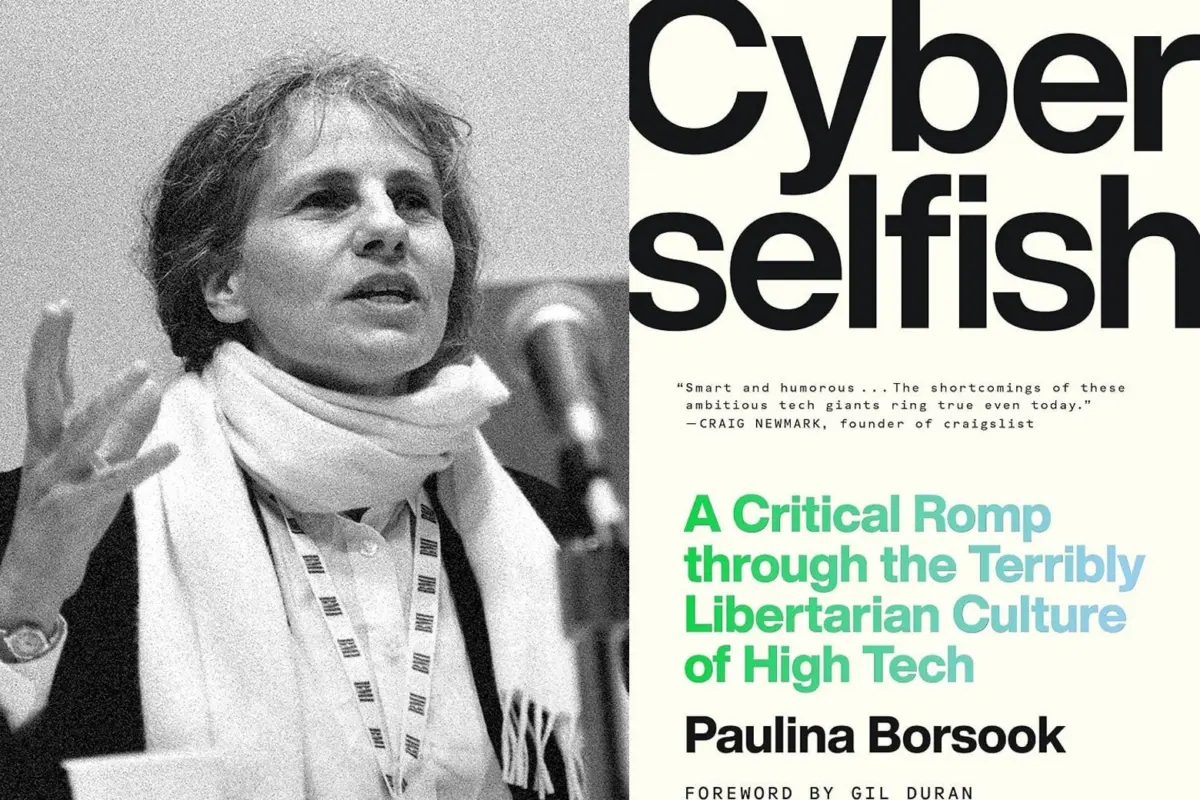
An early participant in the Bay Area software explosion of the 1980s and a regular contributor to Wired during its formative 1990s run, Borsook recognized early on that the technological revolution was tethered to a dangerous ideological shift. In her seminal 1996 Mother Jones essay "Cyberselfish" and the subsequent 2000 book, Cyberselfish: A Critical Romp Through the Terribly Libertarian Culture of High Tech, she diagnosed a profound cultural rot: a deep-seated contempt for public institutions, an unearned sense of intellectual supremacy, and a hyper-individualistic worldview that treated civic responsibility as an obsolete burden.
Though initially overshadowed by the 2000 dot-com crash and largely dismissed as an eccentric polemic, Cyberselfish has experienced a staggering cultural resurrection. As Silicon Valley’s elite increasingly embraces hardline right-wing politics, anti-democratic governance models, and unyielding technocratic hegemony, contemporary tech critics, writers, and academics have begun to treat Borsook’s work not as a relic, but as an oracle. Prompted by this wave of renewed interest, Tin House has officially reissued the book. In an in-depth conversation, Borsook reflects on her cult status, the degradation of tech culture over the decades, the historical evolution of Wired, and why the ultimate antidote to digital feudalism lies in old-fashioned local activism.
Detailed Chronology: From the 1980s Boom to the MAGA Silicon Valley
To understand how Silicon Valley transitioned from a countercultural haven into a citadel of technolibertarianism, one must trace the ideological evolution of its workforce over the past four decades.
1. The Old Guard vs. The Transplants (1980s–1990s)
When Borsook first entered the Bay Area software scene in the 1980s, the tech ecosystem operated under a fundamentally different paradigm. The pioneers of early computing and networking—figures shaped by projects like ARPANET or defense-adjacent research institutions like Lockheed—maintained a baseline awareness of their debts to public infrastructure and government funding.
However, as the 1990s internet boom accelerated, a new class of engineering talent flooded the Valley from across the globe. Unmoored from any historical context regarding the origins of public goods, these transplants harbored an instinctive hostility toward government organization as a philosophical concept. They viewed themselves not merely as software developers, but as an enlightened vanguard destined to govern society through code.
2. The Birth of "Technolibertarianism" and Cyberselfish (1996–2000)
As the business world caught wind of the internet’s commercial potential, this isolationist techno-supremacism hardened into what Borsook defined as "technolibertarianism." Recognizing the dangers of this insulated worldview, Borsook penned her landmark 1996 essay "Cyberselfish" for Mother Jones. The piece went viral by the standards of the 1990s web, capturing the growing unease surrounding the digital elite’s lack of social empathy.
Borsook expanded the essay into Cyberselfish: A Critical Romp Through the Terribly Libertarian Culture of High Tech, published in 2000. Almost immediately, the book’s release coincided with the catastrophic shock waves of the dot-com bust. The resulting economic carnage swallowed public discourse, casting a long shadow over Borsook’s warnings and leaving her to navigate an uncertain professional landscape in the decades that followed.
3. The Digital Renaissance and The Reissue (Present Day)
For years, Cyberselfish circulated primarily as an underground artifact among academics and critical tech scholars, referenced in specialized texts like David Golumbia’s Cyberlibertarianism. Yet, as the political alignment of Silicon Valley underwent a sharp rightward pivot—culminating in an explicit embrace of Donald Trump, the MAGA movement, and deregulation-obsessed figures like Elon Musk—readers began combing through history to find the root causes of the shift.
Writers on platforms like Bluesky and major publications began highlighting Borsook’s prophetic accuracy. The modern realization that the tech sector’s anti-government ethos had materialized into concrete threats against democratic stability drove a surge in demand, pushing used copies to exorbitant prices and ultimately prompting Tin House to bring the text back into print.
Supporting Context & Metrics: The Algorithmic Colonization of Culture
The cultural resonance of Cyberselfish in the modern era is underscored by several structural shifts in the technology sector over the past thirty years:
- The Monoculture of Experience: In the 1990s, tech companies frequently hired individuals from diverse intellectual backgrounds—humanities graduates, artists, and social scientists who brought external frameworks to engineering problems. Today, industry pipelines often track individuals who began coding in elementary school, resulting in a workforce characterized by what Borsook describes as an "appalling ignorance" of basic humanities, biology, and sociology.
- The Spreadsheet Metricization of Life: The infiltration of hyper-efficient, data-driven management frameworks has colonized spaces where metrics cannot apply. From evaluating public education through rigid performance KPIs to attempting to quantify artistic joy in classrooms, the "spreadsheet way of knowledge" has eroded qualitative human experiences.
- Economic Shocks and Muted Labor Resistance: During the first Trump administration, high-profile internal activism—such as the Google walkout, the Microsoft ICE contract protests, and Uber whistleblower disclosures—demonstrated robust worker solidarity. However, subsequent waves of mass layoffs across Silicon Valley systematically undermined worker leverage, forcing dissent underground, even as localized pockets of resistance persist.
Official Statements & Insights: A Conversation with Paulina Borsook
In an exclusive interview, Borsook unpacked the strange journey of her book’s revival and shared her unfiltered assessments of contemporary tech culture.
On the Unexpected Revival of Cyberselfish
Discussing why her book is experiencing a rare nonfiction renaissance, Borsook admits she remains baffled by the mechanics of reputational revivals.
"I always say, ‘I don’t know.’ These kinds of reputational revivals, you hear them happening with novels or movies, but you don’t often hear it with nonfiction. I wondered if that’s because my book is not written journalistically. The facts are correct, but it was written in a literary and polemical way."
She notes that while Cyberselfish received wide reviews upon release, it failed to register in the broader cultural consciousness because the mainstream had not yet caught up to the phenomenon. "There really wasn’t a technology culture section in the bookstore," she recalls. "I was always going to bookstores and finding the book placed in the business section, next to some sort of Programming for Dummies volume."
On Wired Magazine and the Intolerance of Modern Tech
As one of the earliest regular contributors to Wired, Borsook remembers an era when the publication championed technology as a cultural medium rather than an corporate ideology.
"When I first started writing for them, what I loved was technology as culture, and they let me do that, and they were supportive of it. I didn’t have to sign a purity pledge. I could write whatever I wanted."
Over time, however, she observed both the publication and the broader tech sector become rigidly ideological and intolerant of internal dissent. Commenting on the defensive hostility of today’s tech moguls toward public criticism, she observes:
"What strikes me about many people in tech these days is they will not tolerate any dissent, any criticism. How dare you question us? We are going for the greater good, and I’m going to stomp on you, grasshopper. It’s a kind of intellectual and emotional stillness I see these people having."
On Workplace Activism and Gender Dynamics
Reflecting on the employee protests that roiled big tech firms during the late 2010s, Borsook offers a perspective that departs from conventional progressive commentary, drawing on her memories of 1980s and 1990s workplace culture.
"There was a workplace culture that wasn’t so uncommon throughout the ’90s—that usually, as long as you did your job, nobody cared what you thought about anything else, and work wasn’t the place to get political. I remember being very surprised and kind of unsettled by the fact that at Google, there were all these in-company bulletin boards where people would talk about politics… I had this reaction of: Your private life is your own. I don’t know if the workplace is the place to do this kind of organizing."
Paradoxically, Borsook notes that the tech industry of the 1980s and 1990s was, in many ways, far more hospitable to women than the hyper-masculinized environments of today.
"We all knew lots of women that worked in tech, not a ton, but they were there and it wasn’t a big deal. This sort of stupid sociobiological sexist crap just was not there… It really was more like: Can you do the job? Can we work with you? Then it’s fine. It’s so much worse now, with the obsession over these silly ideas about presenting masculinity and all this stuff."
She points to recent cultural phenomena—such as startups dispatching image consultants to help awkward artificial intelligence developers present themselves in dating markets—as evidence of an insecure subculture attempting to mask its public toxicity. "They’re nervous about presenting themselves as being A.I. guys because they know how loathed it is," she notes. "So they’re trying to have a presentation of self that doesn’t look like A.I. guy."
Future Outlook: Guarding Against Digital Feudalism
As technological monopolies expand their footprint into municipal governance, surveillance infrastructure, and educational systems, Borsook rejects fatalism in favor of grassroots tactical resistance. When asked what advice she offers for navigating the current tech landscape, her prescription is refreshingly grounded.
"I’m a big believer in local politics, in thinking globally and acting locally. There’s a data center coming, you do something about it. They want to put stupid A.I. in your kid’s third grade class, do something about it. That’s not a grand statement, but I think you should never underestimate the efficiency of doing that."
Pointing to successful community mobilizations against automated surveillance tools like Flock cameras, Borsook emphasizes that civic power remains potent when applied at the hyper-local level. By eschewing shrill rhetoric in favor of patient, deliberate municipal activism, citizens can successfully counter the overreach of unelected technocrats.
As Cyberselfish finds a new lease on life thirty years after its author first surveyed the digital landscape, its message serves as an enduring reminder: the architecture of the modern web was built by human hands, and it can—and must—be held accountable by human communities.