Executive Overview
As anxieties surrounding the exponential rise of artificial intelligence, screen fatigue, and the cascading climate crisis reach a fever pitch, contemporary culture is undergoing a visceral recalibration. People are actively seeking out nature not merely as a weekend recreational escape, but as a primary source of psychological and physical resilience. This cultural impulse manifests in diverse ways across the social landscape: the resurgence of community-led guerrilla gardening initiatives spearheaded by organizations like Grow to Know, the viral popularity of TikTok trends featuring DIY "natural tattoos" stamped from freshly plucked ferns, and, most permanently, a burgeoning movement in body art.
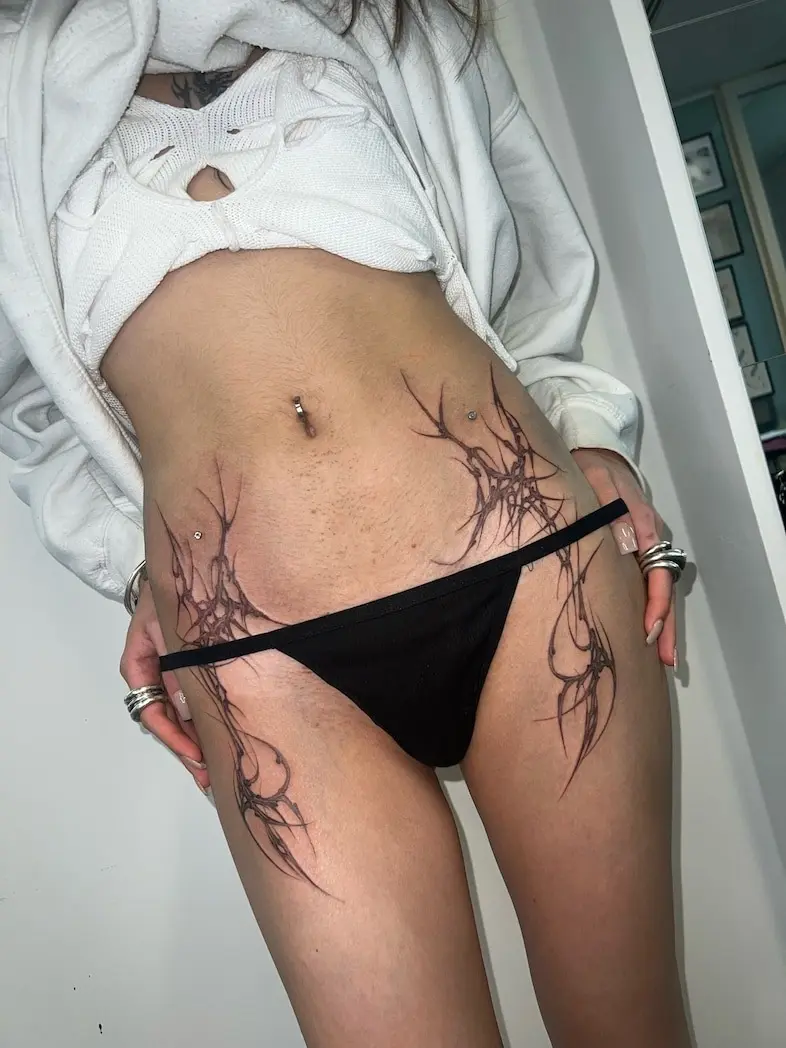
Enter the biomorphic tattoo. Rooted in the avant-garde art movements of the 20th century, these inky, botanical abstractions are rapidly populating digital feeds and Instagram carousels worldwide. Characterized by fine-line etchings of organic forms—reminiscent of the spiral of a snail’s shell or the amorphous, shifting shape of an amoeba—biomorphic tattoos break away from literal botanical illustration. Instead, they reconfigure the foundational blueprints of the natural world into sleek, futuristic designs.
Far from being a mere aesthetic whim, this burgeoning tattoo style reflects a profound cultural resistance to artificial structures and hyper-surveilled, screen-dominated environments. By permanently etching primordial shapes, cellular networks, and plant-like tendrils onto human skin, wearers are carving out a tactile counter-narrative to our increasingly digital existence. This comprehensive investigation explores the origins, philosophies, and cultural drivers behind the biomorphic tattoo phenomenon, examining how tattoo artists and their clients are utilizing ink to imagine a symbiotic, resilient future where nature and technology finally converge.
Detailed Chronology: From 20th-Century Modernism to the Modern Epidermal Canvas
To fully understand the current proliferation of biomorphic tattoos, one must trace a historical lineage that bridges early modern art, historical body modification traditions, and contemporary cyber-culture.
The Roots of Biomorphism in Art History
The term "biomorphism" finds its origin in the early-to-mid 20th-century art movement, wherein avant-garde painters and sculptors—such as Jean Arp, Henry Moore, and Joan Miró—rejected the rigid, mechanical geometry of the industrial age. Instead, they drew direct inspiration from the curving, sinuous, and irregular shapes found in living organisms. As art critic Jennifer Higgie has noted, biomorphic art celebrates the amorphous, the microscopic, and the dynamically unstable aspects of life.
While bodily ornamentation featuring plants has deep historical roots—ranging from the centuries-old cultural rituals of Mehndi (henna) to the proliferation of traditional botanical tattoos in late 19th-century Western Europe—the modern biomorphic tattoo departs sharply from these historical precedents. Rather than rendering a recognizable rose, fern, or vine, contemporary biomorphic tattoos pay homage to the intricate, often invisible structures of biological cells, mycelial networks, and microscopic organisms.
The Shift from Cybersigilism to the Organic
In the late 2010s and early 2020s, the global tattoo community was dominated by hyper-digital aesthetics, most notably Cybersigilism—a style defined by sharp, tribal-adjacent, metal-like digital vector lines that echoed early internet aesthetics and Y2K cyber-dystopianism. However, a noticeable cultural pendulum swing has occurred over the past twenty-four months.
Tattoo artists working at the vanguard of this movement report a sharp decline in requests for hard-edged mechanical geometry, replaced by an overwhelming demand for soft, flowing, organic line-work. This transition did not happen in a vacuum; it maps directly onto the public’s growing wariness of generative AI, automated workplaces, and the relentless creep of algorithmic optimization into everyday life. The skin has become a site of protest and grounding—a biological canvas reclaiming territory from the pixel.
Supporting Context & Metrics: The Psychology of Return-to-Nature in the Digital Era
The rise of biomorphic body art cannot be separated from the broader psychological landscape of the 2020s. As human beings spend record numbers of hours staring into backlit glass screens, mental health professionals and cultural analysts have documented a sharp rise in systemic anxiety, depersonalization, and climate grief.
The Antidote to Screen Fatigue
According to recent sociological observations compiled by mental health advocacy groups like Mind, immersion in or close proxy to nature remains one of the most effective empirical buffers against chronic stress and eco-anxiety. When individuals can no longer escape to physical wilderness due to urban density or professional constraints, they seek micro-doses of the organic.
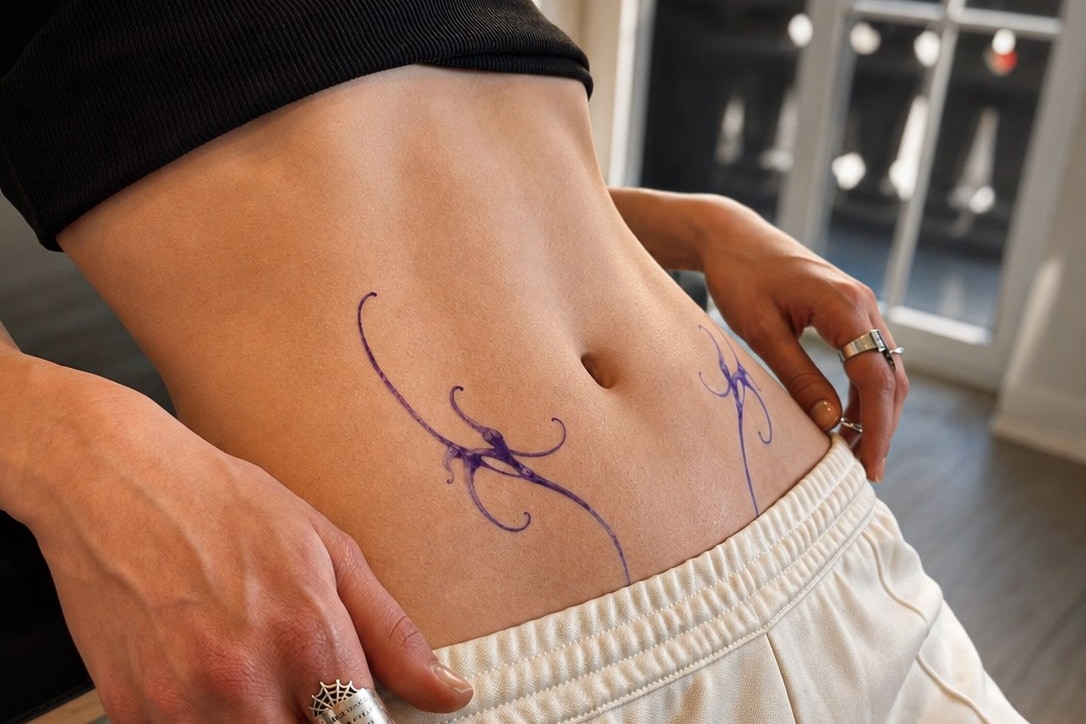
Biomorphic tattoos serve as permanent, wearable micro-ecosystems. By mapping plant-like tendrils, fungal spores, and cellular abstractions across anatomical contours—such as wrapping around a collarbone or cascading down a spine—these tattoos bridge the psychological gap between the human animal and the natural world. They offer a tangible, tactile counter-weight to the intangible, weightless nature of the digital cloud.
Identity, Transformation, and Queer Symbolism
Beyond ecological anxieties, biomorphic tattoos are frequently deployed as markers of profound personal transformation. Tattoo artists report that clients often seek out these organic designs during major life transitions, healing journeys, or periods of intense self-reflection.
Furthermore, the natural world has historically served as a fertile ground for coded symbols of queer and gender-fluid identities. From the biological reality of numerous plant species that naturally alter their sex, to historical literary nods such as the sprigs of lavender and bunches of violets associated with the ancient Greek poet Sappho, botanical and biomorphic imagery allows individuals to communicate deeply personal truths. In an era where bodily autonomy is increasingly contested globally, claiming one’s skin with designs that celebrate natural fluidity and adaptation becomes an act of quiet, resilient defiance.
Official Statements & Industry Perspectives
To understand the mechanics and philosophy of this movement, we turn to the artists who are actively shaping the biomorphic tattoo lexicon on the ground.
Goldensu: Rejecting Artificial Structures
Operating out of Mercury Design Studio in East London, tattoo artist Goldensu has become a central figure in the UK’s biomorphic tattooing scene. Reflecting on the evolution of her client base, she notes a distinct departure from previous aesthetic trends.
"A few years ago, styles like Cybersigilism and mechanical geometry were incredibly popular," Goldensu explains. "While those aesthetics still have their place, I’ve personally felt a noticeable shift in what my clients seek. As AI and screen-based activities continue to dominate our routines, people seem to be looking for something contrasting on their bodies—forms that are raw and deeply organic."
Goldensu’s work frequently utilizes freehand application techniques, allowing the ink to flow organically with the natural contours and musculature of the client’s body. Whether it is vine-like tendrils sprouting delicately over a collarbone or utilizing negative space and light diffusion to render the relief of an indeterminate climbing plant, her work resists uniform replication.
"People are paying much more attention to their personal well-being and spirituality now," Goldensu adds, discussing the therapeutic aspect of her art. "Many of my clients choose botanical designs during major life transitions or healing journeys. These kinds of tattoos help to conceal scars but also change how someone views a part of their body they might have previously struggled with."
Pale.vine: Pioneering "Biopunk" and Xenobiology
Moving across the continent to Belgrade, Serbia, tattoo artist Sofia, widely known online as Pale.vine, takes the biomorphic concept into speculative, science-fiction territory. Sofia describes her distinctive aesthetic as biopunk—an offshoot of the xenobiology design movement that twists organic structures through a dark, futuristic lens.
Rather than treating nature and technology as mortal enemies locked in an apocalyptic battle, Sofia envisions a future where technology has learned from, and integrated with, biological systems.
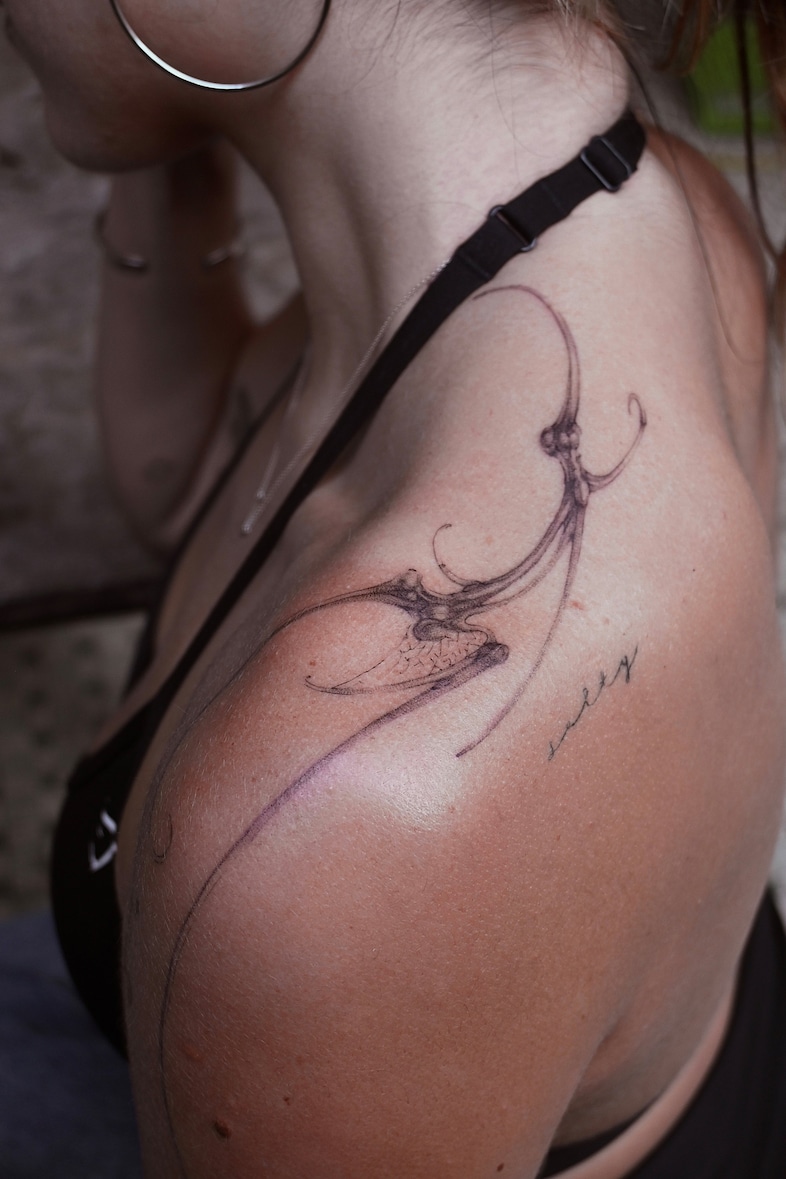
"What I find especially interesting is that nature and technology no longer exist as two completely separate worlds," Sofia states. "Through my designs, I’m not imagining nature in direct opposition to a technological future, but creating one where it has already inspired the foundations."
Drawing artistic inspiration from avant-garde Dutch fashion designer Iris van Herpen, Pierre Huyghe’s immersive bio-art installations, and her own digital archives of Ermine moth cobwebs, shed snakeskin, and alien-looking microscopic plant cells, Sofia creates tattoos that appear to crawl across the skin like sophisticated, engineered organisms.
Intriguingly, Sofia notes that her clients are often initially drawn to her work on an entirely pre-rational, visceral level.
"Sometimes people simply see my work and say, ‘I don’t really know what it is, but I want something like that on my body,’" she reflects. "And I love that reaction. I don’t think we always need to be able to rationally explain why we are drawn to a certain form."
This embrace of the unexplainable stands in stark contrast to a contemporary society obsessed with quantitative metrics, health-tracking wearables, and algorithmic data points. Biomorphic tattoos provide a welcome refuge of mystery.
Future Outlook: The Intersection of Skin, Silicon, and Ecosystems
As we look toward the horizon, the trajectory of biomorphic tattooing suggests a deeper integration between how we conceptualize our bodies and our environment. Far from being a fleeting Instagram micro-trend, this artistic movement points toward a permanent cultural shift in tattoo aesthetics—one that values fluidity, adaptability, and imperfection over rigid symmetry and mechanical coldness.
Designing a Symbiotic Future
The narrative of human progress has long been framed as a trajectory moving away from nature and toward complete industrial and digital automation. However, the popularity of biomorphic body art signals a collective course correction. By permanently fusing our epidermis with abstracted cellular forms, fungal networks, and speculative botanical structures, we are signaling a psychological readiness to co-evolve with our technologies rather than be consumed by them.
Whether styled as delicate, flowing vine-work by East London minimalists or eerie, hyper-detailed biopunk organisms by Belgrade visionaries, these tattoos serve as living testaments to human resilience. They remind us that even as our external environments become increasingly hyper-digital, automated, and artificial, our internal desire for the organic, the wild, and the unfathomable remains entirely unyielding. In the battle to escape the algorithm, the human canvas has proven that our most powerful sanctuary is, and has always been, the biological blueprint of life itself.