Valve’s highly anticipated yet still unreleased third-person tactical hero shooter-MOBA hybrid, Deadlock, continues to capture the imagination of the gaming community—not merely for its tight mechanical loop, but for the astonishing depth and atmospheric density of its setting. Following a major content deployment, the game’s map has undergone a transformative aesthetic and structural overhaul. Valve has pushed the envelope of environmental storytelling, rendering its occult, Prohibition-era New York City an arresting, breathing, and deeply immersive playground.
Yet, this triumph in world-building has sparked a curious existential dilemma among critics and prospective players alike. The hyper-detailed architecture, arcane storefronts, and cryptic lore fragments scattered throughout the map are so intoxicatingly rich that they provoke an unusual brand of FOMO (fear of missing out). Players are not just lamenting the competitive friction of learning a complex MOBA; they are mourning the fact that they cannot simply walk the cobblestone alleys, browse esoteric retail shops, or engage with the city’s bizarre supernatural denizens as a tourist.
This report examines the architectural and narrative evolution of Deadlock’s map, the brilliance of its environmental design, the paradoxical nature of housing such rich lore within a fast-paced competitive arena, and what this means for Valve’s burgeoning new intellectual property.
Detailed Chronology: The Evolution of Valve’s Occult Metropolis
To understand why Deadlock’s setting commands such fervent devotion, one must trace the iterative journey of its map design from closed-door playtests to its current public playtest phase.
The Early Blueprint Phase
When initial leaks and early-access invites first began circulating under codenames like Citadel, Deadlock was viewed strictly through a mechanical lens. Industry observers and early testers analyzed it as a hybrid experiment—a stylistic melting pot combining the verticality and lane pressure of a traditional Defense of the Ancients (DotA) game with the third-person aiming mechanics of a hero shooter. Early environments were largely block-outs: functional grids of concrete, placeholder textures, and rudimentary geometry designed to test line-of-sight, hero movement fluidity, and objective pacing.
The Atmospheric Pivot
As development progressed, Valve’s legendary art and level design teams began injecting the map with its signature identity: a supernatural, noir-infused vision of New York City during the early 20th century. This wasn’t merely a cosmetic skin applied over standard MOBA lanes; it was a total environmental conceptualization. The city was reimagined as a place where modern industrialization collided head-on with dark magic, esoteric societies, and otherworldly incursions. Gaslamps flickered alongside eldritch glow, and towering art deco skyscrapers scraped against perpetually storm-laden skies.
The Recent Map Overhaul
The most recent patch marks a watershed moment in the game’s visual development. Valve has fleshed out the accursed Big Apple with distinct district stylings, sharper architectural contrasts, and thoroughly reworked lanes that improve both competitive flow and exploratory eye candy. Back alleys have grown narrower and more claustrophobic; commercial districts gleam with deceptive, occult-backed prosperity; and academic zones drip with academic hubris and forbidden knowledge. The update has elevated the map from a mere backdrop for competitive violence into a character in its own right—a sprawling, haunted labyrinth that demands to be explored at a walking pace rather than sprinted through under fire.
Supporting Context & Metrics: Environmental Storytelling and World-Building Brilliance
What separates Deadlock’s environment from standard multiplayer maps is the staggering density of environmental narrative cues. Valve has always been a master of passive storytelling—a lineage stretching from Half-Life’s Black Mesa to Portal’s Aperture Science—and Deadlock represents the studio’s most ambitious multiplayer world-building effort to date.
Micro-Narratives Hidden in Plain Sight
While players are busy managing gold economies, tracking soul fragments, and coordinating ganks, the map quietly tells hundreds of micro-stories through posters, shopfronts, and background architecture. A stroll through the newly refined lanes reveals an incredible array of flavor text and world-building artifacts:
- The Dimensional Chess Tournament: Faded posters peeling off damp brick walls advertise an upcoming interdimensional chess championship, hinting at a city where cosmic entities mingle casually—or competitively—with mortal denizens.
- Salt & Chalk Ritual Supplies: A neighborhood occult storefront complete with window displays featuring warding salts, esoteric chalks, and curiosities that imply magic is an ordinary, regulated (or unregulated) consumer market in this alternate New York.
- Umbria University: A grand, brooding academic institution featuring a portrait gallery. A particular painting of a claw-handed man immediately draws the eye, leaving players with more unsettling questions than answers about the institution’s faculty and curriculum.
The MOBA Dilemma: Art vs. Action
This introduces a fascinating friction unique to the genre. MOBAs are inherently frantic, high-stakes environments. Success requires tunnel vision: monitoring minimaps, tracking cooldowns, listening for audio cues, and maintaining absolute focus on mechanical execution.
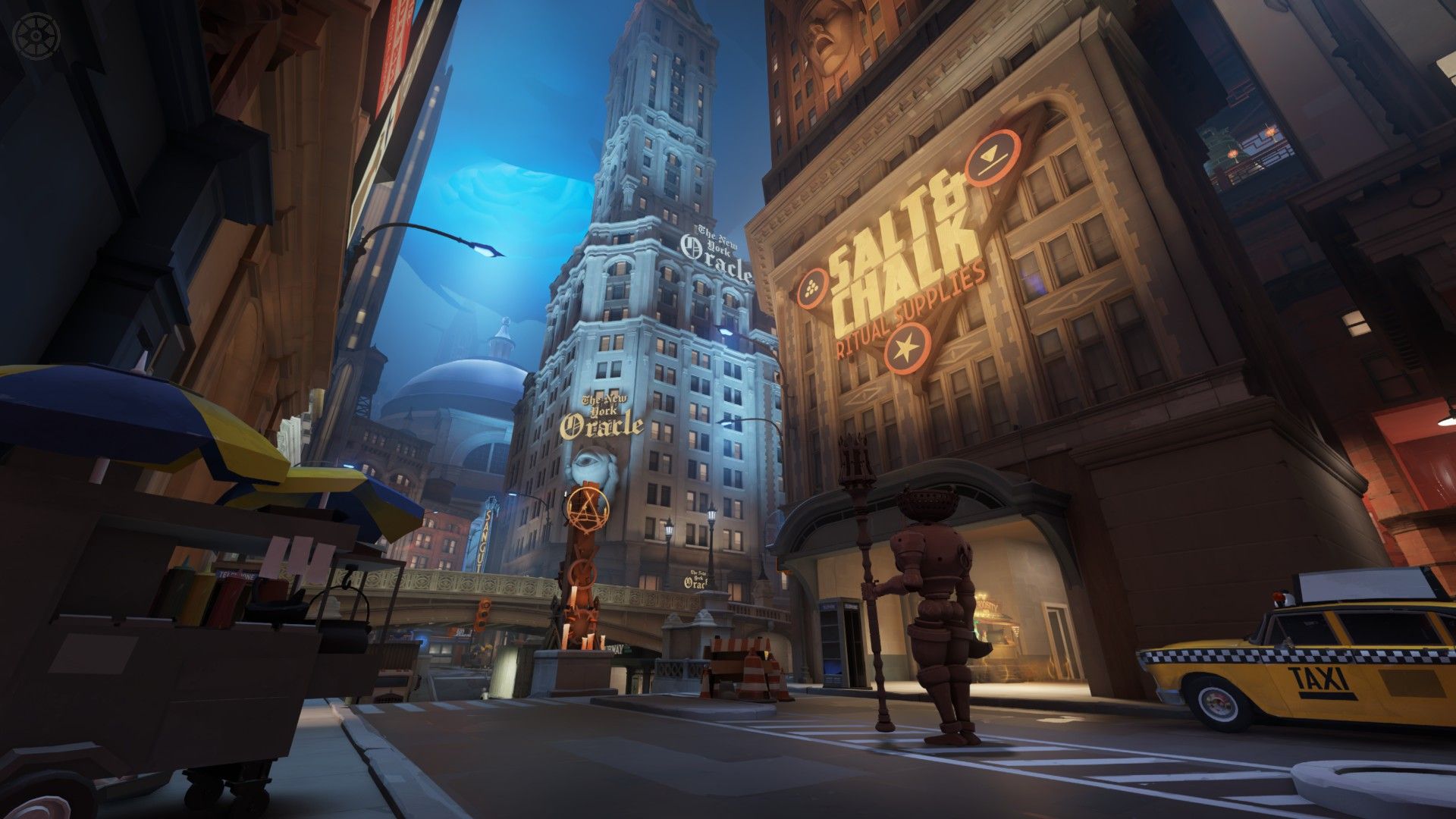
Consequently, the very players who appreciate these environmental details are often punished for stopping to admire them. Standing still to read an advertisement for a dimensional chess tournament or inspecting the architectural flourishes of a Gothic revival apartment building is a quick ticket to the respawn screen. The tragedy of Deadlock’s map is that its beauty is weaponized against anyone who dares to slow down and appreciate it.
This has led to a surreal cultural phenomenon: non-MOBA players—those traditionally repelled by the steep learning curves, toxic competitive loops, and high-stress management of games like Dota 2 or League of Legends—seriously contemplating diving into the genre solely to witness how Valve unfolds this grim, supernatural metropolis.
Official Statements and Industry Reception
While Valve has historically maintained a tight-lipped communication policy regarding unreleased or early-access projects—relying primarily on patch notes and community playtest feedback channels rather than traditional press tours—the response from the industry has been overwhelmingly vocal.
Industry critics, streaming personalities, and veteran developers have singled out Deadlock’s environmental art direction as a masterclass in mood-setting. Early sentiment highlights how Valve has managed to blend disparate thematic elements—1930s noir crime syndicates, Lovecraftian horror, dieselpunk machinery, and arcane mysticism—into a cohesive, believable urban ecosystem.
Community managers and developers within Valve’s ecosystem have occasionally noted in internal forums and Discord playtest channels that the goal of the map design was to make the world feel "lived-in and dangerous." The implicit philosophy is that a competitive map should not just be a symmetric arena for balancing teams, but a place with a history, a culture, and an ecosystem that existed long before the first hero stepped onto the lane and will continue long after the match concludes.
Future Outlook: Where Can Valve Take This Occult Universe?
As Deadlock continues its developmental march toward a formal release, the overwhelming success of its environmental design opens up profound strategic questions regarding the future of the franchise and Valve’s broader portfolio.
Expanding the Lore Horizon
The appetite for Deadlock’s lore is already outstripping the confines of a traditional MOBA match. Fans are clamoring for supplementary media—comic books, animated shorts (in the vein of Team Fortress 2’s "Meet the Team" series), or even narrative-driven spin-offs. The rich texture of occult New York begs for a single-player campaign, an atmospheric walking simulator, or an interactive detective RPG where players can leisurely investigate the mysteries of Umbria University and shop at Salt & Chalk Ritual Supplies without a timer ticking down.
Balancing Competitive Integrity with Atmospheric Immersion
Moving forward, Valve faces the delicate task of expanding the map without cluttering competitive readability. As new districts are added and existing lanes are reworked, the design team must maintain the delicate balance between visual richness and gameplay clarity. Hero silhouettes must pop against gritty Victorian-occult architecture, and ability particle effects must remain distinguishable against complex background geometry.
The Conversion of the Non-MOBA Player
Perhaps the most lasting legacy of Deadlock’s map design during this early phase is its power of conversion. By crafting a world with such potent, intoxicating "vibes," Valve is successfully luring players who typically wouldn’t touch a competitive lane-pushing game with a ten-foot pole. Whether these players stick around long enough to master soul mechanics and item builds remains to be seen. But one thing is certain: Valve has built a New York City so atmospheric, so dripping with occult charm, that people are willing to endure the crucible of MOBA competition just to catch a glimpse of what lies down its accursed alleys.