In a major architectural leap designed to eliminate the engineering overhead of data duplication, Amazon Web Services (AWS) has announced a native capability for Amazon Aurora PostgreSQL: the ability to directly query operational data alongside analytical data lakes stored in Apache Iceberg and Apache Parquet formats.
By embedding the high-performance DuckDB analytics engine directly inside the Aurora PostgreSQL database architecture, AWS has removed the historical requirement for complex Extract, Transform, and Load (ETL) pipelines and reverse-ETL sync mechanisms. Developers and database administrators can now execute unified queries using standard, familiar PostgreSQL syntax. These queries seamlessly combine live transactional updates—including uncommitted writes residing within the operational engine—with massive, multi-year historical archives sitting in Amazon S3, S3 Tables, or Iceberg REST Catalog (IRC)-compatible data repositories.
This integration addresses one of the most stubborn bottlenecks in modern cloud architecture: the artificial divide between transactional systems (OLTP) and analytical systems (OLAP). Organizations no longer need to provision separate infrastructure, build brittle synchronization scripts, or duplicate petabytes of data simply to enrich live customer transactions with historical context, power real-time dashboards, or supply large language models (LLMs) and autonomous AI agents with comprehensive data access.
Available immediately across all commercial and AWS GovCloud regions at no additional software license cost, this feature represents a watershed moment for database engineering, signaling a deeper convergence of analytical processing power into enterprise relational systems.
Detailed Chronology & Technical Architecture
The Genesis: Bringing DuckLabs into the AWS Ecosystem
The foundation of this breakthrough stems from a strategic talent and technology acquisition: DuckLabs, the core development team behind the open-source DuckDB project, recently joined Amazon. Known for its vectorized query execution engine and blazing-fast in-process analytical performance, DuckDB has rapidly become the gold standard for localized analytical workloads.
Rather than treating DuckDB as a separate service or an external query federation tool that requires cross-network data movement, AWS engineers deeply embedded the DuckDB engine directly into the Aurora PostgreSQL runtime process. Query processing is executed entirely within the memory and compute boundaries of Aurora, eliminating extra network hops, inter-service serialization costs, and infrastructure duplication.
Supported Versions and Setup Mechanics
This new feature is integrated natively into two major releases of Aurora PostgreSQL:
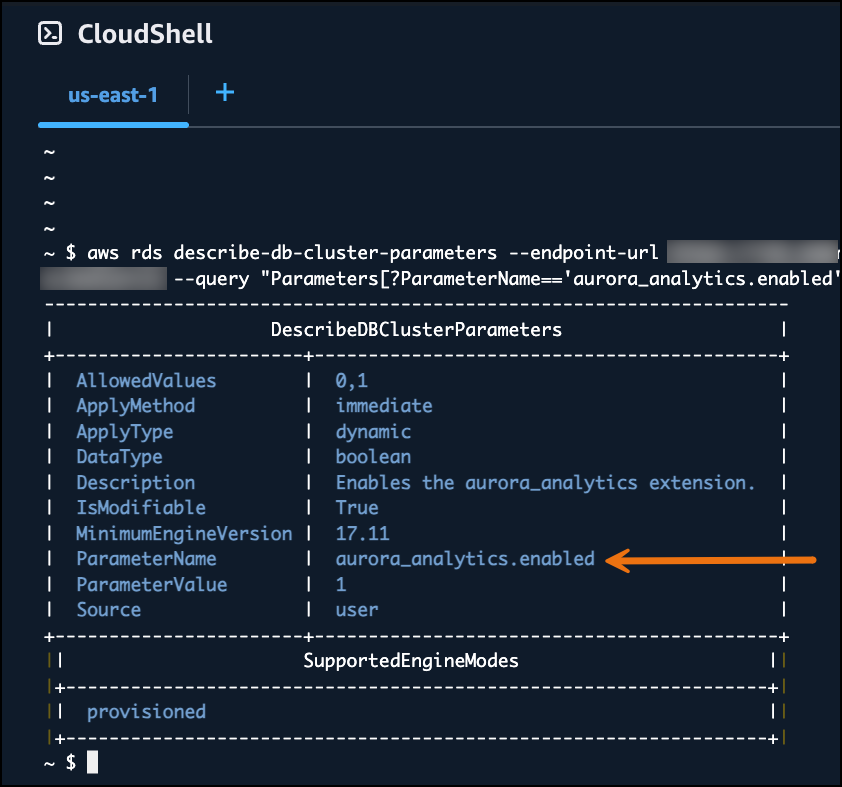
Aurora PostgreSQL 17 (starting with version 17.11)
Aurora PostgreSQL 18 (starting with version 18.6)
Enabling the capability requires a straightforward administrative sequence:
Cluster Configuration: The user provisions or updates an Aurora PostgreSQL cluster, attaching an AWS Identity and Access Management (IAM) role provisioned with the necessary permissions (AuroraAnalytics feature integration). This role grants Aurora secure, governed read access to designated data assets in Amazon S3 and the AWS Glue Data Catalog.
Extension Activation: Within the database session, an administrator enables the analytics extension using standard PostgreSQL DDL:
CREATE EXTENSION aurora_analytics;
Foreign Table Declaration: Instead of manually defining complex table schemas column-by-column, users can map external data lake files instantly. For instance, pointing to a Parquet file in Amazon S3 requires a minimal declaration:
CREATE FOREIGN TABLE transaction_history ()
SERVER aurora_analytics_server
OPTIONS (
   location 's3://<my-bucket>/finance/transaction_history.parquet',
   format 'parquet'
);
Note: The empty parentheses are intentional. Aurora dynamically inspects the file’s metadata to automatically infer and construct the schema. For enterprise environments managing hundreds or thousands of tables, a single IMPORT FOREIGN SCHEMA command bulk-creates foreign table mappings for an entire AWS Glue Data Catalog database in a single step.
Advanced Federation via Iceberg REST Catalogs
Modern data lakes rarely exist in a single silo. To accommodate heterogeneous enterprise architectures, Aurora PostgreSQL supports external IRC-compatible catalogs through AWS Glue Data Catalog federation.
By registering an external catalog once within AWS Glue, data engineers can generate foreign tables for any underlying Iceberg dataset. A single, unified SQL query can then perform complex joins across live operational Aurora tables and Iceberg tables distributed across multiple external catalogs. This leaves existing catalog investments intact while providing applications with a singular, unified data view.
Optimization and Performance Internals
Direct querying over distributed object storage can easily become a performance liability if not managed intelligently. To combat this, Aurora applies advanced query optimization techniques driven by the underlying DuckDB architecture:
Predicate Pushdown: Filters specified in the SQL WHERE clause are pushed directly down to the storage layer, ensuring that unneeded rows are filtered out before being transferred across memory boundaries.
Column Pruning: Only the specific columns referenced in the query are read from Amazon S3, drastically reducing I/O bandwidth consumption.
Intelligent Caching: Frequently accessed data lake segments are cached within the Aurora instance. Subsequent queries accessing the same data blocks execute significantly faster.
Execution Introspection: Database administrators can monitor performance metrics on a per-query basis using the aurora_analytics_stat_statements() utility, tracking vital operational metrics such as rows scanned, bytes read from Amazon S3, and cache-hit ratios.
Supporting Context & Metrics
The True Cost of Traditional ETL Pipelines
For decades, enterprises requiring a unified view of operational and historical data relied on reverse-ETL pipelines. These architectures followed a rigid, expensive pattern:
Transactional data written to Aurora was continuously captured via change data capture (CDC) tools.
Streaming frameworks (such as Apache Kafka or AWS Glue jobs) transformed the data streams.
Batches were written out to Amazon S3 data lakes in columnar formats.
Separate analytical engines (such as Amazon Athena or Amazon Redshift) were queried alongside operational stores, requiring application developers to write complex application-tier glue logic to merge the result sets.
This approach incurred heavy technical debt:
Infrastructure Overhead: Maintaining multiple storage tiers, ingestion clusters, and synchronization jobs drove up cloud expenditure.
Latency Synchronization Gaps: Data in the data lake was inherently stale, delayed by minutes, hours, or even days depending on batch window schedules.
Storage Bloat: Duplicating operational tables into analytical formats multiplied storage footprints across the organization.
Practical Query Demonstration
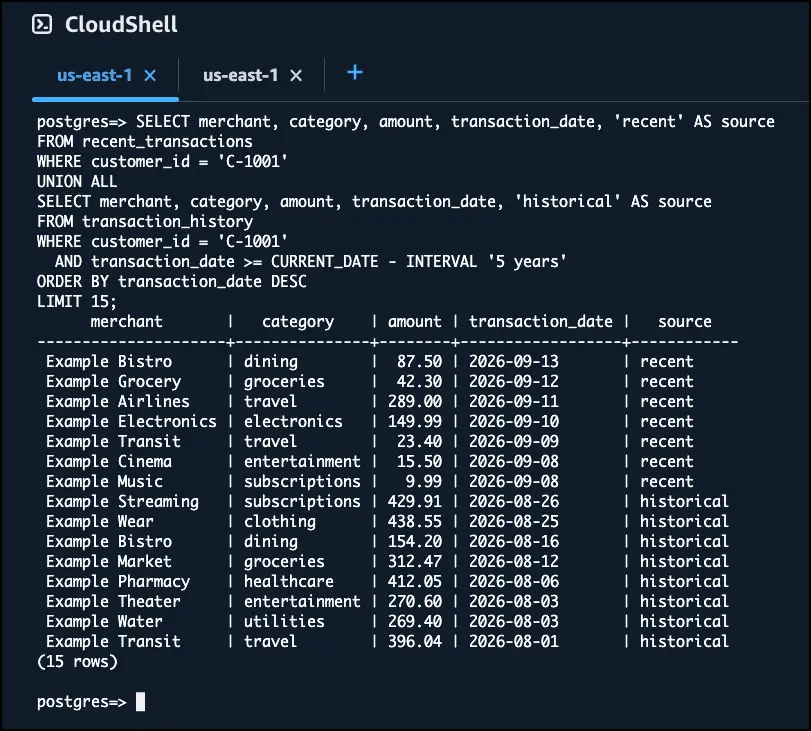
To illustrate the power of this integration, consider a financial fraud-detection or customer service scenario. An organization maintains a recent_transactions table inside Aurora containing the last 7 days of live customer activity, while a 5-year historical archive sits inside a Parquet file on Amazon S3.
By executing a single query utilizing UNION ALL, the database seamlessly stitches operational and historical datasets together:
SELECT merchant, category, amount, transaction_date, 'recent' AS source
FROM recent_transactions
WHERE customer_id = 'C-1001'
UNION ALL
SELECT merchant, category, amount, transaction_date, 'historical' AS source
FROM transaction_history
WHERE customer_id = 'C-1001'
  AND transaction_date >= CURRENT_DATE - INTERVAL '5 years'
ORDER BY transaction_date DESC
LIMIT 15;
Under the hood, DuckDB handles the massive vectorized scan of the historical Parquet file on Amazon S3, while Aurora manages the ultra-fast operational scan of the recent uncommitted writes. The database engine returns a consolidated result set where the most recent records originate directly from Aurora’s transactional storage engine, and older records stream straight from the object storage tier.
When to Materialize: Bridging the Gap for Sub-Millisecond Latency
While direct querying over S3 provides immense flexibility and cost savings, certain mission-critical queries demand single-digit-millisecond read latencies. For these hot paths, Aurora allows engineers to easily materialize data lake contents directly into native Aurora PostgreSQL tables using standard commands such as:
CREATE TABLE AS SELECT
INSERT INTO ... SELECT
MERGE INTO
Once materialized, the data resides as a native relational table within Aurora, providing high-speed access for real-time applications. Furthermore, because read queries can execute across any read replica in an Aurora cluster, analytical and exploratory scans can be completely offloaded from the primary writer instance, safeguarding operational availability.
Official Statements & Industry Implications
AWS executives and database architects emphasize that this release is a direct response to the architectural shifts brought on by modern enterprise applications, particularly the explosive growth of artificial intelligence.
"Whether you’re powering real-time dashboards, enriching transactions with historical context, or building AI agents that reason over both live and archived data, you can now do it all through a single, familiar interface," noted members of the Amazon Aurora product engineering team. "As organizations increasingly embed AI agents into their applications, it is entirely impractical to predict and pre-replicate every dataset an agent might need. Direct querying eliminates this guessing game."
Industry analysts have noted that this move blurs the traditional lines between transactional databases and data warehouses/lakehouses. By bringing analytical execution directly into the operational database engine rather than forcing data out to an external engine, AWS is lowering the barrier to entry for hybrid transactional/analytical processing (HTAP).
Furthermore, because this capability is built upon the open-source DuckDB engine, AWS has positioned Aurora to benefit directly from future performance optimizations, memory management upgrades, and feature expansions contributed by the broader open-source analytics community.
Future Outlook
The integration of DuckDB technology into Amazon Aurora PostgreSQL opens up profound possibilities for enterprise cloud architecture over the coming years.
1. Supercharging Autonomous AI Agents
As generative AI shifts from simple conversational chat interfaces to autonomous agents capable of executing complex business workflows, data access patterns are becoming unpredictable. An AI agent investigating a supply chain anomaly or an automated financial audit cannot wait for an engineer to build a dedicated ETL pipeline for a newly required log file. With direct querying of Apache Iceberg and Parquet data lakes through a standard SQL interface, AI agents can dynamically query live operational state alongside petabytes of historical logs, archives, and unstructured metrics on the fly.
2. Radical Simplification of Enterprise Data Stacks
Organizations are continuously seeking ways to reduce architectural complexity and prune redundant cloud spend. By replacing brittle, multi-stage reverse-ETL pipelines with native, query-time federation, enterprises can significantly shrink their data engineering maintenance footprint. Data engineers can redirect their focus from building ingestion plumbing to delivering higher-value business logic and data governance frameworks.
3. Economic Accessibility
Crucially, AWS has chosen to make this capability available at no additional software licensing cost across all commercial and AWS GovCloud regions. Customers pay only for the incremental Aurora compute consumed during query execution and standard Amazon S3 request and data retrieval charges. This pay-as-you-go economic model ensures that organizations of all sizes—from agile startups to global financial institutions—can immediately adopt modern lakehouse querying patterns without upfront capital expenditure or complex license negotiations.
Getting Started
Engineering teams looking to evaluate this capability can begin immediately by provisioning or updating an Aurora PostgreSQL cluster running version 17.11+ or 18.6+. Comprehensive documentation, step-by-step console configuration guides, and architectural best practices are currently available through the official Amazon Aurora User Guide and the Amazon RDS Management Console.