Executive Overview
There is a distinct, terror-tinged embarrassment that comes from dozing off on a beach towel, only to find an unannounced rising tide intruding upon your nap—lapping at your toes, soaking your belongings, and sweeping your sunglasses out to sea. It is a primal, inescapable lesson that arrives every summer: the ocean is relentless, and Poseidon always reclaims his own.
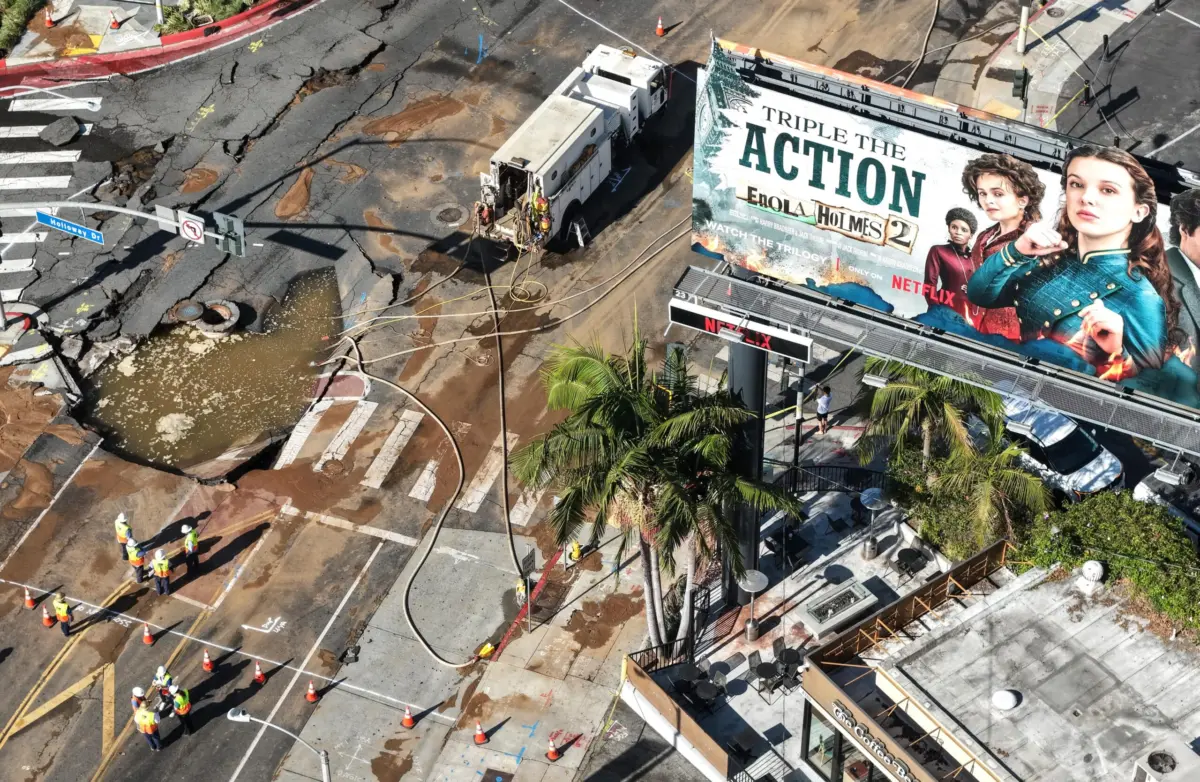
Actor Nicolas Cage learned a far more serious—and exponentially more expensive—version of that lesson earlier this month. A furious high-surf event siphoned the sandy ground directly beneath his Malibu, California, mansion, triggering a catastrophic collapse that sent his driveway and front porch careening into a massive 30-foot-by-30-foot crater. The sudden cave-in ruptured a gas main, swallowed a vital access road, and forced dozens of local residents to evacuate their homes. In a single, dramatic afternoon, the incident put into stark, cinematic relief the unyielding threat of coastal erosion facing nearly every community in the nation with a view of the sea.
While it is tempting to imagine Cage standing at the edge of that yawning abyss with the signature, bombastic bafflement of his silver-screen performances, the disaster was entirely predictable. For decades, geologists, environmental historians, and coastal regulators have warned that we are building civilizations on shifting, temporary foundations. As rising sea levels and intensifying storm systems slam our borders, the catastrophe in Malibu serves as a flashing warning light for the nearly one-third of Americans who live along a coastline. The era of fighting the ocean with temporary engineering is coming to an end, forcing communities to confront a sobering reality: we can either manage our retreat from the water, or let the sea take it all piece by piece.
Detailed Chronology: A History of Ignoring the Waves
To understand how a multi-million-dollar property ended up suspended over a gaping void, one must look backward through decades of bureaucratic warnings, architectural bravado, and environmental defiance.
Decades of Warnings
Long before Nicolas Cage ever envisioned owning a tranquil seaside retreat, regulatory bodies recognized the inherent danger of the lot. As far back as 1976, the California Coastal Commission formally denied a proposal to construct a residential home on the exact parcel of land where Cage’s Malibu mansion now teeters over the void. The commission cited explicit “concerns over wave hazards.”
Ten years later, in 1986, the commission reviewed a subsequent residential proposal for the same plot and rejected it once again, officially deeming the parcel an “extremely hazardous area” constantly threatened by aggressive wave action and severe coastal erosion.
The Illusion of Engineering
So how did a house come to occupy a stretch of land twice labeled too dangerous for habitation?
A few years after the initial rejections, the waterfront lot’s original owners managed to persuade the California Coastal Commission that modern engineering could conquer nature. Armed with architectural plans for a massive sea wall and deep concrete stilts, they argued that the home—along with its septic system, driveway, and access road—could be permanently shielded from the ocean’s wrath. The commission relented, permits were granted, and construction commenced.
Much like the mythological Odysseus testing the patience of the sea god, the property’s subsequent owners found out the hard way that the ocean does not easily forget its due. Cage himself once mused to The New York Times while mythologizing his eclectic real estate portfolio, "What is the Grail but Earth itself? The divine object is Earth."
In this instance, however, the actor chose the wrong cup. When the heavy high surf struck earlier this month, the engineered sea wall failed to stop the water from scouring away the saturated soil underneath the asphalt, proving that human hubris remains no match for a rising tide.
Supporting Context & Metrics: The Crisis on America’s Coasts
While the collapse of a celebrity’s driveway makes national headlines, the vulnerability exposed in Malibu is a systemic crisis threatening millions of ordinary citizens.

A Nation by the Water
Statistics from the Center for the Blue Economy highlight a sobering demographic reality: nearly one-third of the entire United States population lives along a coastline. While the vast majority of these citizens do not enjoy the multi-million-dollar oceanfront vistas commanded by Hollywood elite, their daily lives are inextricably linked to coastal infrastructure. Beachside apartment complexes, underground utility lines, municipal water systems, and major economic lifelines like the Pacific Coast Highway face the exact same erosive pressures that swallowed Cage’s driveway.
However, unlike wealthy celebrities who can effortlessly retreat to private islands or secondary estates when catastrophe strikes, working-class and middle-class coastal residents rarely have a financial parachute.
The "Sinkhole" Misnomer
Geologically speaking, the void that swallowed Cage’s driveway was not a true sinkhole at all. Michael Sukop, a hydrogeology professor at Florida International University, notes that true sinkholes form inland when rainwater or a leaking pipe slowly seeps into soluble, porous bedrock—such as limestone in places like Florida or Missouri—creating subterranean caverns that eventually collapse under surface weight.
By contrast, the Malibu crater was born entirely of hydrodynamic force. A ferocious high surf slipped beneath the engineered barriers, liquefying and washing away the soggy coastal soil. It was driven not by rainwater or failing municipal pipes, but by relentless tidal energy—a force capable of ruining a casual beach day or, in this case, dismantling a multi-million-dollar foundation.
The Endless, Expensive Battle of Beach Renourishment
To maintain the illusion of permanent, sandy shores, the federal government and local municipalities spend hundreds of millions of dollars every year on beach renourishment—the process of dredging sand from the ocean floor and pumping it onto eroded coastlines. Billions more are funneled into concrete sea walls, groins, and offshore breakwaters designed to freeze the coastline in place.
Robert Young, director of the Program for the Study of Developed Shorelines, points out the profound unsustainability of this approach. "The most endangered species on the coast is not a turtle or a piping plover; it’s an unengineered beach," Young explains. "And it’s unsustainable because as sea level continue to rise, we are having to pump that sand more and more frequently."
These interventions act merely as costly bandages, masking an underlying geographic truth: the coast is not a static line on a map; it is a dynamic, shifting boundary.
Official Statements and Expert Perspectives
As local authorities grapple with the aftermath of the Malibu collapse, environmental historians and geological experts are urging policymakers to wake up to the broader implications of the disaster.
The Voice of Historians
Kara Murphy Schlichting, an environmental historian at Queens College in New York City, emphasizes that the crisis is not limited to elite California enclaves.
"This is not a problem that is unique to Malibu, which just so happens to be some of the most spectacularly beautiful and spectacularly expensive real estate in America," Schlichting notes. "This is a question that is coming for all of America’s coastal communities."
Schlichting stresses that our cultural attachment to fixed coastal boundaries is a modern fiction. For centuries, human settlements adapted to natural landscape shifts; today, we spend billions trying to force nature to stand still—a battle we are inherently designed to lose.

The Infrastructure Gauntlet
Earlier this year, the City of Malibu released its long-awaited Coastal Vulnerability Assessment, explicitly warning of the acute, escalating dangers that erosion poses to Sea Level Drive—the exact private road where Nicolas Cage’s driveway vanished. With severe El Niño weather patterns gaining momentum, local officials warn that the actor’s misfortune is unlikely to be an isolated incident.
The legendary Pacific Coast Highway (PCH) faces an unprecedented gauntlet of environmental threats, including inland landslides, raging wildfires, and a relentless ocean creeping closer by the month. Recent warnings issued for local beaches highlighted "severe beach erosion" that has exposed jagged steel and concrete debris directly along the coastline, transforming recreational shores into industrial hazard zones.
"Nature itself does not destroy the coast. It moves the coast," Young reiterates. "No matter where you are, whether you are in California or South Carolina or New Jersey, we are still building in dumb places."
Future Outlook: Embracing Managed Retreat
If sea walls are temporary palliatives and beach renourishment is an endless financial treadmill, what is the path forward for America’s vulnerable coastal communities?
The answer, according to many scientists and urban planners, is managed retreat—the intentional, systematic relocation of human infrastructure, homes, and public utilities away from high-risk shorelines.
Learning from History: The Cape Hatteras Relocation
While moving entire towns sounds logistically impossible—akin to stealing the Declaration of Independence—it has been successfully achieved before. In 1999, Robert Young helped oversee one of the most daring relocation projects in American history: moving the 129-year-old, 264,500-pound Cape Hatteras Lighthouse 2,900 feet inland away from the encroaching Atlantic Ocean in North Carolina.
At the time, local residents were furious, certain that the historic masonry structure would crumble during the move. Today, the lighthouse stands safely out of harm’s way, a testament to what is technically possible when society acknowledges environmental reality. Meanwhile, just down the road in communities like Buxton and Rodanthe, dozens of homes that remained in place have catastrophically collapsed into the ocean since 2020.
Breaking the Cycle
Despite proven successes, managed retreat remains a deeply difficult political and psychological sell. Local elected officials are often reluctant to utter the word "retreat," fearing plummeting property values and panicked constituents.
Yet, as Young points out, coastal communities are already retreating—they are just doing so in the worst way possible. When septic tanks break loose and tumble into the surf, or when multimillion-dollar homes slide unceremoniously into the breakers, the retreat is chaotic, toxic, and expensive.
Ultimately, the gaping crater in Nicolas Cage’s Malibu driveway is more than just a piece of sensational celebrity news; it is a physical manifestation of an impending national reckoning. If America wishes to preserve its coastal heritage without bankrupting future generations on endless, futile engineering projects, we must learn to pack up our metaphorical beach towels, honor the dynamic power of the ocean, and gracefully step back from the edge.