Executive Overview
For over a decade, the Holy Grail of B2B software-as-a-service (SaaS) sales has been the multi-year contract. Securing a three-year commitment from a new logo was treated as the ultimate validation of product-market fit, providing predictable revenue, bolstering enterprise valuations, and mitigating customer acquisition costs (CAC). Sales teams were incentivized—often aggressively—to push for long-term lock-ins, frequently using deep upfront discounts as bait.
However, the ground beneath the software industry has shifted beneath our feet. Entering 2026, the meteoric rise of artificial intelligence has fundamentally altered how enterprise buyers evaluate, purchase, and deploy technology. According to landmark data from ICONIQ, the traditional three-year enterprise software contract is in structural decline.
Today, forcing a multi-year deal is no longer just an uphill battle against reluctant buyers; it is a counterproductive strategy that stalls sales cycles, irritates prospective clients, and ultimately damages long-term net retention rates (NRR). In the Age of AI, technology cycles compress every 12 to 18 months. Locking a customer into a multi-year agreement for a product that risks technological obsolescence within a year is no longer rational buyer behavior—it is financial recklessness.
This comprehensive report examines the structural collapse of the multi-year contract, analyzes the underlying data driving this paradigm shift, and outlines the operational pivots B2B founders and go-to-market (GTM) leaders must make to thrive in a landscape where short-term contracts are the new baseline.
Detailed Chronology: The Evolution of SaaS Commitment Terms
To understand why the multi-year contract is losing its grip on the B2B market, it is necessary to trace how enterprise procurement has evolved over the past decade.
Phase 1: The Golden Age of Predictability (Pre-2020)
In the classic SaaS era, software categories were relatively stable. Once an enterprise chose a CRM, an ERP, or an HRIS system, the switching costs were astronomical. Vendors could comfortably demand three-to-five-year upfront commitments because the underlying technology stack remained static for years at a time. Multi-year agreements were mutually beneficial: buyers secured locked-in pricing against inflation, and vendors secured long-term predictability to fuel their hyper-growth metrics.
Phase 2: The Post-Pandemic Correction (2021–2023)
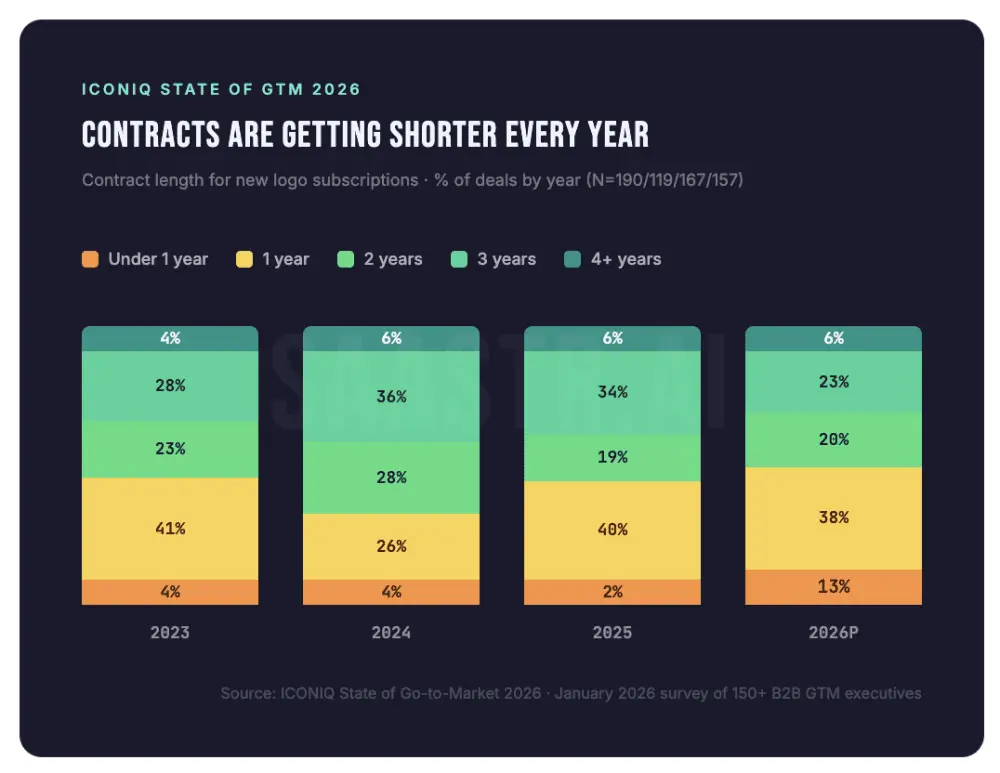
As macroeconomic conditions tightened following the 2021 tech boom, enterprise procurement departments began scrutinizing software budgets with unprecedented rigor. CFOs demanded proof of immediate return on investment (ROI). Even so, three-year deals remained a staple of enterprise sales, representing over a quarter of all new logo acquisitions as recently as 2023. Vendors still possessed enough leverage—and buyers still felt enough category stability—to justify multi-year paper.
Phase 3: The AI Compression and the New Procurement Reality (2024–2026)
The widespread commercialization of generative AI and autonomous software agents triggered an unprecedented acceleration in software development cycles. AI-driven startups began solving complex enterprise workflows in weeks, not years.
By 2026, the shelf life of a standard B2B software category had plummeted. Enterprises realized that signing a three-year contract meant running the severe risk of being contractually tethered to a vendor that might be leapfrogged, acquired, or rendered entirely obsolete within 12 to 18 months. Procurement teams pushed back, demanding shorter commitments, flexible usage terms, and the freedom to pivot as AI capabilities advanced. The market had officially crossed a tipping point.
Supporting Context & Metrics: What the Data Tells Us
The anecdotal complaints of frustrated sales reps are now fully backed by hard market data. The latest benchmarks from ICONIQ Capital paint a stark picture of how drastically enterprise buying behaviors have changed between 2023 and 2026.
The Shrinking Lifespan of Initial Agreements
According to ICONIQ’s 2026 data analysis:
- Three-year contracts for new logos dropped sharply from 28% in 2023 to just 23% in 2026. While nearly a quarter of buyers still sign longer initial agreements, that slice of the pie is rapidly narrowing.
- Sub-one-year contracts experienced a dramatic surge, jumping from 4% in 2023 to 13% in 2026.
This more than threefold increase in sub-year commitments is not a temporary negotiating tactic or a cyclical blip; it is a permanent structural shift. Buyers are acting rationally. They are refusing to absorb the risk of rapid technological obsolescence on behalf of software vendors.
The Top-Quartile Exception: Proof Over Promises
A critical nuance in the data reveals that some companies are still successfully closing multi-year initial deals—not by forcing them through aggressive discounting, but through undeniable pre-sales momentum.
Top-quartile software enterprises—industry heavyweights like Datadog, Figma, Databricks, and Snowflake—routinely boast Net Revenue Retention (NRR) rates sitting between 110% and 123%. How do they secure longer commitments? They don’t close three-year deals on pitch decks.
Instead, their prospective customers experience undeniable, quantifiable ROI during proof-of-concept (PoC) phases or via usage-led growth before the formal renewal conversation even begins. By the time the contract is signed, the customer has already decided to expand, turning what would normally be a risky multi-year bet into a natural, low-friction extension of value.
Official Industry Perspectives & Strategic Analysis
Industry leaders and venture capital advisors are increasingly vocal about the dangers of clinging to outdated sales playbooks. Pushing for multi-year contracts in an environment where buyers are terrified of technological stagnation creates a toxic dynamic across the entire revenue funnel.
The Pitfalls of Forced Multi-Year Deals
When GTM teams are measured strictly on contract length, perverse incentives take root. Sales representatives often resort to slashing prices or offering aggressive, margin-eroding discounts simply to force a customer onto a three-year paper.
This creates a cascade of negative consequences:
- Prolonged Sales Cycles: When buyers are forced to consider a multi-year commitment for an AI tool whose landscape shifts every quarter, legal and procurement reviews grind to a halt. Deals that should close in weeks stretch into quarters.
- Artificial Revenue Inflation: Discounting future revenue to secure long-term commitments damages unit economics and distorts true product demand.
- Resentful Customers and Churn: A customer who is strong-armed into a multi-year contract by aggressive sales tactics often experiences buyer’s remorse by month 18—especially if an agile competitor launches a superior AI-native solution. When renewal time finally arrives, that customer doesn’t just churn; they leave with an active resentment of your brand.
Optimizing for NRR Over Initial Length
Industry consensus dictates that early-stage B2B and AI companies must stop obsessing over initial contract length and instead optimize for Net Revenue Retention (NRR) and renewal quality.
A startup targeting a healthy NRR of 120% by their Series B milestone should view short initial contracts not as an existential threat, but as an opportunity. If your product delivers explosive, measurable value, a six-month or one-year initial contract is merely the opening chapter of a long-term commercial relationship. You earn the extension not through contractual handcuffs, but through relentless delivery of results.
Future Outlook: How to Win in the Post-Multi-Year Era
As the B2B tech ecosystem adapts to the realities of 2026 and beyond, winning companies are redesigning their organizational structures to win renewals naturally. The playbook for driving revenue growth has fundamentally changed:
1. Invest Heavily in Forward-Deployed Engineers (FDEs) and Deployment
The window to prove value has compressed from quarters to weeks. Organizations must shift capital away from bloated top-of-funnel sales teams and reinvest it into post-sales infrastructure, customer success, and Forward-Deployed Engineers (FDEs).
2. Compress Time-to-Value (TTV) to 60–90 Days
Your primary operational metric should be how fast a newly onboarded enterprise client achieves undeniable, production-grade ROI. If a customer can look at their dashboard within 60 to 90 days and clearly calculate the financial or operational upside of your software, the renewal conversation transforms from a tense negotiation into a routine formality.
3. Build for Flexibility and Trust
In an AI-driven market, trust is your most valuable currency. By offering flexible, shorter-term commitments, you signal to enterprise procurement officers that you are confident in your product’s ability to retain them on merit alone. This transparency lowers friction, accelerates deal velocity, and positions your company as a modern, forward-thinking partner.
Conclusion
The era of artificially locking enterprise customers into multi-year software agreements is drawing to a close. Driven by the rapid, relentless evolution of artificial intelligence, buyers are demanding agility, transparency, and proof of value over long-term commitments.
For B2B founders and revenue leaders, the path forward is clear: abandon the antiquated crusade for multi-year contracts at all costs. Instead, focus on engineering rapid time-to-value, delivering exceptional post-sales support, and driving world-class Net Revenue Retention. In the Age of AI, the best way to secure a long-term customer is to make staying with you the most obvious, high-ROI choice they make every single day.