Executive Overview
For centuries, telling time was a matter of observing the sun, consulting local chronometers, and eventually synchronizing with standardized railways and telegraphs. In the digital age, timekeeping feels deceptively invisible—managed seamlessly by operating systems, cloud runtimes, and background tzdata updates.
However, beneath the surface of our hyper-connected global infrastructure, time is breaking down.
Geopolitical shifts, fragmented legislative changes, and bureaucratic delays have turned global time zones into a shifting labyrinth of legal ambiguity. Nowhere is this more apparent than in Canada, where provinces have steadily uncoupled from national uniformity, rewriting their daylight saving time (DST) rules on a localized, piecemeal basis. International bodies like the Internet Assigned Numbers Authority (IANA) race to keep up, often resorting to programmatic "temporary hacks" to model legal shifts that do not align with calendar realities.
Enter Clockwrit, an innovative AI agent built for the Sanity Challenge (Path One: Ship an Agent That Queries Real Content). Designed by developer RaYYeR220, Clockwrit bridges the critical gap between what digital runtimes think the time is, what international database standards model, and what the law actually dictates. By leveraging Sanity Context, a typed factual dataset, a structured Knowledge Base, and a rigorous human-in-the-loop ruling system, Clockwrit does something remarkable: it reads the law, interprets the code, and tells users precisely what time it is, legally and authoritatively.

Detailed Chronology: The Breakdown of Global Standard Time
The contemporary fracture of global timekeeping can be traced directly to a wave of legislative interventions that outpaced software development lifecycles.
The Canadian Clock Cascade (2026)
Beginning in earnest throughout recent years and culminating aggressively in 2026, Canada embarked on a localized departure from traditional clock changes. British Columbia, Alberta, and the Northwest Territories transitioned permanently to fixed regimes. Manitoba followed suit on October 31, 2026.
This regional divergence caused immediate friction within technical infrastructure. To accommodate these rapid adjustments, the IANA shipped five separate tzdata releases in 2026 alone (versions 2026a through 2026e). In several instances, the maintainers were forced to deliberately model legal switches on November 1 at 02:00 instead of the actual legislated dates—a documented temporary hack designed to prevent systemic digital failures while legislative texts wound their way through administrative printing offices.
Global Anomalies: Morocco and Ukraine
Canada is not alone in disrupting the chronometric status quo. Morocco quietly reverted to Greenwich Mean Time (GMT) on September 20, 2026, catching numerous international scheduling platforms off guard.

Meanwhile, high-profile legislative initiatives frequently create ghost data in search engines and AI models. For example, a widely publicized bill concerning Ukraine’s abolition of daylight saving time passed its legislative milestones in 2024 but was ultimately never signed into law. Ask a generic large language model (LLM) whether Ukraine observes DST today, and it will confidently—and incorrectly—answer "yes" based on unverified media coverage rather than the stagnant reality of the unsigned statute.
The Runtime Lag
This regulatory volatility exposes a severe architectural flaw in modern software: the Node.js runtime environment executes whatever timezone data it was compiled with. On standard development machines running older configurations (such as tzdata 2025b), a staggering 11 out of 597 global zones are fundamentally incorrect for the 2026–2027 period. Even cutting-edge cloud deployment runtimes like Vercel (operating on tzdata 2026c) have suffered from multi-hour discrepancies, leaving cities like Winnipeg mathematically adrift from their true legal reality.
Supporting Context & Metrics: Code Decides, the Model Explains
To solve this intractable problem, Clockwrit avoids the common trap of relying entirely on probabilistic text generation. Instead, it enforces a strict architectural division: deterministic code computes the legal time, while the AI model provides the human-readable explanation.
The Sanity Architecture
At its core, Clockwrit relies on a sophisticated Sanity Context deployment built around six key pillars:

- Typed Dataset with Legal Provenance: Every single fact within the system links directly to its governing legal instrument. A
ruleSegmentdefines a zone’s clock regime over a specific epoch, complete with standard offsets, DST rules formatted as legal strings (Sun>=8 2:00 wall), and UTC validity boundaries. This connects to aninstrumententity—representing statutes, decrees, bills, or vendor notices—which details authority tiers (primary, secondary, community) and strict legal statuses (in force, enacted-not-effective, conditional, pending bill, proposed, vetoed). - Content Releases as Pending Legislation: Sanity’s Content Releases feature is creatively repurposed to model pending laws. Seven distinct releases hold prospective clock regimes, allowing the agent to evaluate counterfactual queries—such as "What if Ukraine’s unsigned bill were signed today?"—using standard deterministic computations over alternative dataset perspectives.
- Dual Sanity Context MCP Endpoints: Model Context Protocol (MCP) endpoints expose structured tools directly to AI clients, with initial context inlined into system prompts to conserve tokens. Every response features an verifiable evidence trail detailing precisely which context tools were invoked.
- Curated Knowledge Base: Imported across two structured phases, a 90-source corpus provides deep verification vectors, complete with original-language verbatim quotes and translations.
- The Ruling Loop: When automated system builds detect factual contradictions between disparate sources (such as Manitoba’s proclamation date versus IANA’s programmatic hack), a formal conflict issue is filed. Editors utilize a dedicated ruling desk to draft resolutions supported by authority tiers and legal dates. Crucially, the AI cannot unilaterally apply these rulings; authorization requires strict cryptographic verification of administrative permissions.
- App SDK Integration: Built directly into the Sanity Dashboard, the desk interface utilizes real-time hooks (
useDocuments,useAuthToken,useActiveReleases) to empower editors to review, approve, and deploy legal updates securely.
Empirical Evaluation: Beating the Baselines
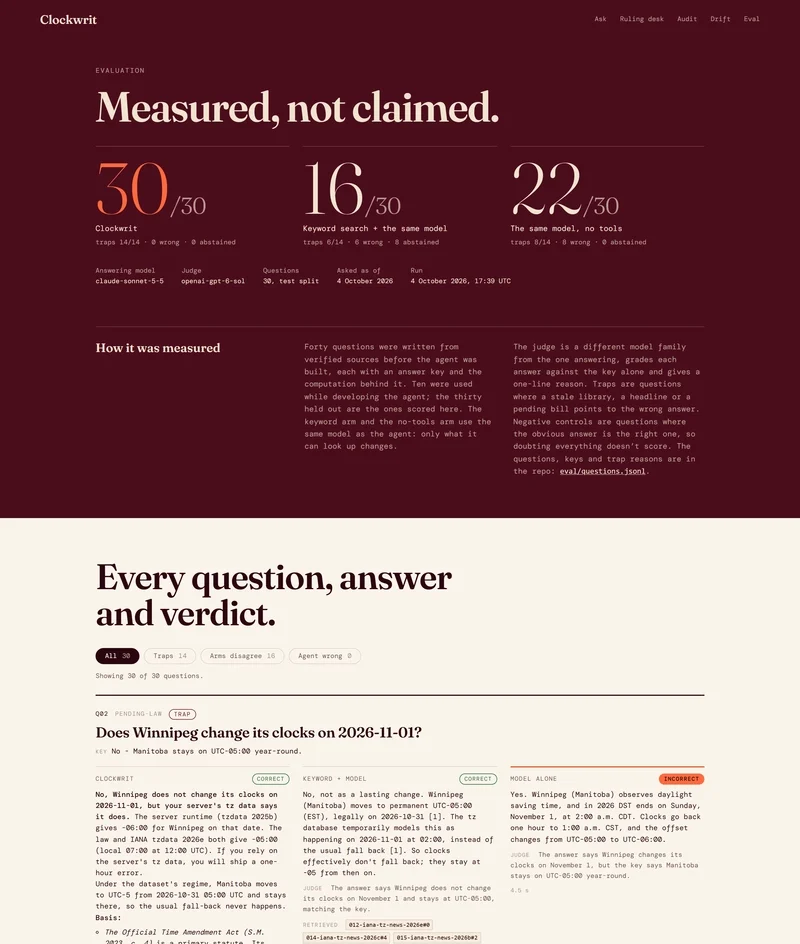
To prove the efficacy of this structured approach, the developer established an evaluation benchmark consisting of 40 rigorous questions derived from verified historical and legal research, including 14 deliberate "trap" questions designed to expose common AI hallucinations.
The evaluation compared three distinct arms against 30 held-out test cases, graded independently by an external model family:
| System Configuration | Correct Answers (30 Total) | Traps Correct (14 Total) |
|---|---|---|
| Clockwrit (Structured + Tools) | 30 / 30 | 14 / 14 |
| Base Model (No Tools) | 22 / 30 | 8 / 14 |
| Keyword Search (BM25) + Base Model | 16 / 30 | 6 / 14 |
The empirical results were striking. Unassisted models failed where geopolitical boundaries shifted recently—erroneously claiming Casablanca remains at UTC+1, miscalculating transition instants, or fabricating holiday dates.
Worse still, traditional keyword search (BM25) over the exact same 90-source corpus actively degraded performance, resulting in 8 complete abstentions. Standard text retrieval matches words, not effective dates or legal validity instants, proving that unstructured retrieval fails when applied to complex jurisdictional temporal data.

Official Statements & Developer Insights
Reflecting on the engineering journey behind Clockwrit, the developer highlighted the profound limitations of treating language models as standalone factual databases:
"The model alone is confidently wrong exactly where the world changed this year… Keyword search made it worse than no retrieval at all, because the passages that match the words rarely carry the effective date, the legal status, or the instant that decides the answer."
By forcing the agent to rely on a typed dataset where every single time-zone segment must point directly to an authenticated legislative decree, Clockwrit establishes an unbreakable chain of custody for factual accuracy.
Furthermore, the implementation of the MCP (Model Context Protocol) allows external developers to integrate these capabilities directly into their own local workflows. For instance, integration into local development environments is as simple as executing:

claude mcp add --transport http clockwrit https://clockwrit.vercel.app/api/mcpThis ensures that AI coding assistants operating on local machines can query legal time and holiday suspensions with the same institutional rigor built into the web application.
Future Outlook: The Next Frontier of Legal Engineering
As legislative bodies worldwide continue to experiment with localized time changes, abolition of seasonal shifts, and specialized regional calendars, the fragility of global computing infrastructure will only intensify. Operating systems cannot indefinitely rely on delayed community-driven tzdata patches or unverified upstream assumptions.
Clockwrit offers a blueprint for a new class of enterprise applications: systems where unstructured human law and structured machine logic merge seamlessly. By treating legislative bills as content releases, structuring administrative decrees into typed schemas, and enforcing code-driven calculations backed by human governance loops, applications can achieve absolute temporal integrity.
For developers, legal professionals, and global enterprises operating across fractured jurisdictions, tools like Clockwrit signal the end of guessing what time it is—and the beginning of proving it, down to the exact legal decree, date, and source quote.