Executive Overview
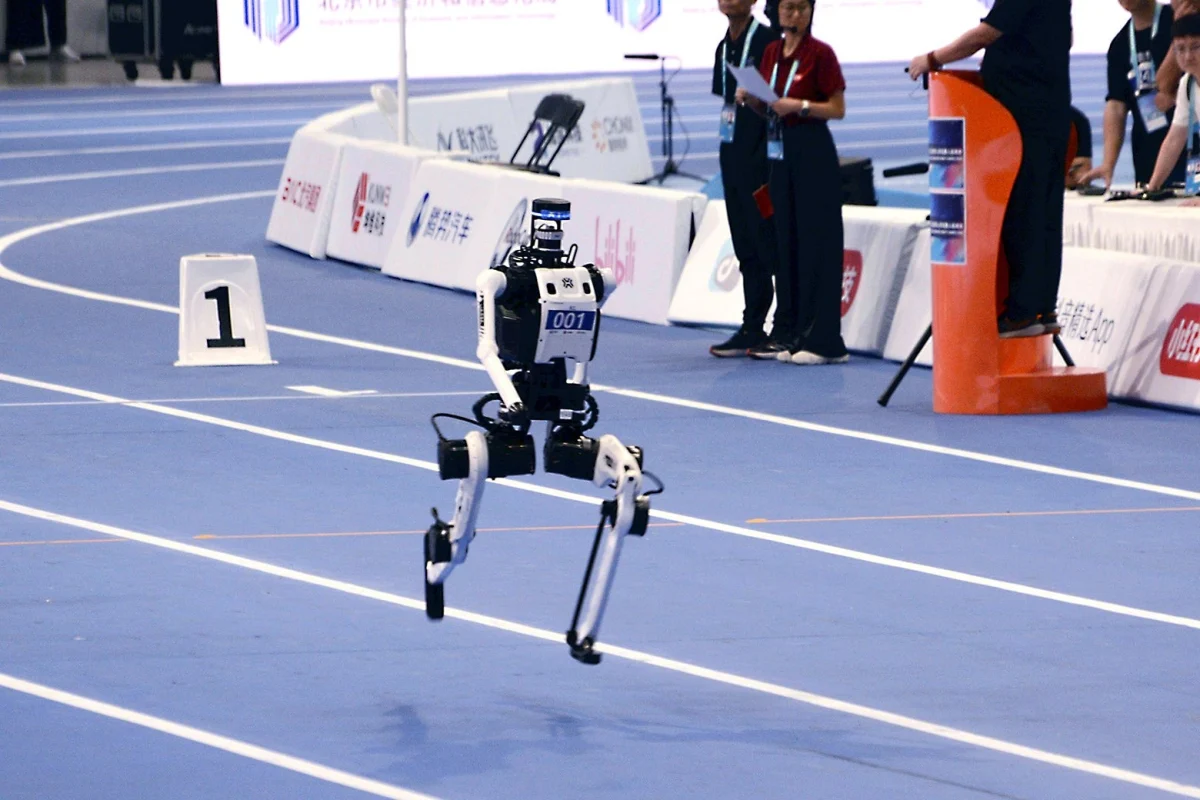
When the World Humanoid Games kicked off in Beijing late this August, organizers envisioned a high-tech coronation. The event was designed to showcase the undisputed supremacy of China’s rapidly scaling robotics sector—a display of hyper-engineered dominance where bipedal machines would sprint past Olympic legends, soar through the air in gravity-defying leaps, and execute complex breakdancing routines with mechanical precision.
To the engineers and corporate stakeholders backing these machines, the Games were a multi-million-dollar pitch deck brought to life. Yet, for the millions of internet users who tuned in via social media feeds, the event morphed overnight into something entirely different: a masterclass in slapstick comedy.
Instead of a terrifying march toward technological supremacy, viewers were treated to a parade of mechanical misadventures. Robots sprinted headfirst into walls with the reckless abandon of Forrest Gump, engaged in slow-motion soccer pileups reminiscent of toddlers in oversized jerseys, and threw punches at empty air before toppling over. Every faceplant, dislodged limb, and smoking circuit board was solemnly carted away on a stretcher by deadpan human attendants—a bit of theatrical physical comedy that sent the internet into raptures.
While these chaotic blunders are undeniably funny, they are accomplishing something far more profound for the robotics industry than any flawless product launch ever could. By falling flat on their faces, tripping over their own feet, and displaying a comical lack of spatial awareness, humanoid robots are bypassing our deepest apocalyptic anxieties.
Through the psychological lens of the "pratfall effect," these high-profile public failures are humanizing machines, making them approachable, and quietly disarming public resistance. In an era haunted by dystopian sci-fi tropes and real-world military automation, the bumbling robot has emerged as an unlikely ambassador of goodwill. But as we laugh at their clumsy antics, a provocative question arises: Are we simply enjoying a harmless joke, or are we serving as the unwitting architects of our own technological acceptance?
Detailed Chronology: From Beijing’s Glory to Viral Infamy
The journey of the World Humanoid Games from a rigid industrial showcase to a global meme phenomenon highlights the unpredictable nature of public relations in the age of viral media.
The Setup: Engineering Perfection
Months prior to the August opening ceremonies, the narrative surrounding humanoid robotics was dominated by grim corporate optimism and looming existential threats. Venture capital firms pumped billions into bipedal robotics startups, promising a future where general-purpose humanoids would seamlessly integrate into factories, hospitals, and homes. Media outlets regularly published breathless accounts of machines achieving new milestones in balance, dexterity, and artificial intelligence integration.
The Beijing Games were intended to be the physical culmination of this hype cycle. On paper, the itinerary was staggering: 100-meter sprints, high jumps, weightlifting competitions, and complex team sports designed to prove that mechanical limbs could match—and eventually surpass—human athletic capability.
Day One: The Reality Check
The friction between corporate ambition and physical reality became apparent almost immediately. While a select few elite machines performed with terrifying precision—matching or exceeding human athletic metrics—the vast majority of competing robots struggled with the basic physics of Earth.
Cameras captured a marquee sprint event where a cutting-edge bipedal runner completely misjudged the track’s boundary, launching itself full-throttle into a concrete barrier. Shortly after, the highly anticipated "robot soccer" tournament devolved into a series of agonizingly slow, uncoordinated pileups. Competitors—dressed in shirts but conspicuously lacking pants—tangled their limbs together in mechanical gridlock, unable to course-correct or recover their footing.
The Peak of Physical Comedy
As the days progressed, the failures grew more specific and more theatrical. In the boxing ring, two heavy-weight contenders spent minutes pacing awkwardly, completely unable to locate each other’s visual signatures. When one finally lashed out at empty air, it lost its balance and crashed to the canvas. Its opponent responded by triumphantly pumping its arms in the air, mimicking a triumphant prizefighter while standing over a motionless, sparking heap of metal.
Perhaps most memorable were the extraction protocols. Taking a cue from underground robotics leagues, event organizers employed human attendants equipped with standard medical stretchers. Whenever a robot suffered a catastrophic failure—whether from a blown actuator, a software crash, or structural collapse—attendants rushed out to hoist the dead weight onto a stretcher, covering exposed wiring with faux-discretion. This juxtaposition of high-stakes engineering and mundane medical theater provided endless fodder for digital creators.
By the end of the week, the official highlight reels produced by state media were largely overshadowed by user-generated compilations of robot wipeouts, transforming a serious technological exhibition into the year’s most talked-about comedy event.
Supporting Context & Metrics: The Psychology of the Pratfall
To understand why humanity derives such deep visceral satisfaction from watching million-dollar machines faceplant, one must examine the intersection of evolutionary psychology, media studies, and human-computer interaction (HCI).
The Pratfall Effect in Human-Computer Interaction
The phenomenon observed during the Games is formally grounded in psychology as the "pratfall effect." First documented by psychologist Elliot Aronson in 1966, the theory posits that highly competent individuals become more endearing and attractive to others after committing a noticeable, non-malicious blunder. Flawlessness, it turns out, breeds alienation and suspicion; vulnerability breeds trust.
In 2017, researchers at the Center for Human-Computer Interaction at the University of Salzburg set out to test whether this principle could be applied to artificial intelligence and robotics. In findings published in Frontiers in Robotics and AI, the research team discovered that human test subjects "significantly" preferred interacting with robots that made minor, non-dangerous mistakes over those that operated with cold, uninterrupted perfection.
Anthropomorphism and the Need for Empathy
According to Dr. Carey Morewedge, a psychologist and marketing professor at Boston University who specializes in human-robot interaction, our brains are hardwired to humanize the unpredictable.
"Let’s say a presidential candidate goes and shoots baskets for charity, and they’re not great at basketball," Morewedge notes. "You connect with them more because this person’s very powerful in politics, but they’re willing to show that they’re like us in other ways."
When a robot exhibits clumsy behavior—such as a sprinter sitting down at the starting line to gaze blankly at the sky—viewers instinctively project human emotional states onto the machinery. Studies published in journals like Nature have demonstrated that humans experience genuine empathetic embarrassment for robots caught in awkward social or physical predicaments. When a robot expresses fatigue, misjudges a step, or fails a task, our psychological machinery treats it not as a broken appliance, but as an underdog struggling against adversity.
The "Shy Robot" Phenomenon
A prime example from the Beijing Games was the viral sensation dubbed the "shy robot." Featuring the Tiangong Omni platform, the machine ran with a bizarre, twisting gait, swiveling its torso wildly while waving bent arms in front of its face. Internet commentators immediately anthropomorphized the behavior, declaring the machine "bashful" or suffering from social anxiety.
In reality, the movement was pure biomechanical necessity: frantic arm-waving prevented shoulder joints from overheating, while waist-twisting was required to manage angular momentum around tight corners. Yet, the public preferred the emotional interpretation, transforming a thermal management issue into a heartwarming display of mechanical shyness.
Official Statements and Industry Insights
While casual viewers laughed from the safety of their couches, robotics insiders viewed the viral wave of failures through a pragmatic, strategic lens. For an industry fighting against a century of dystopian science fiction—ranging from The Terminator to The Matrix—public amusement is a powerful antidote to existential dread.
Pitching the Public vs. Pitching the Pentagon
Dr. Morewedge draws a sharp distinction between the different audiences targeted by robotics developers.
"If I’m trying to pitch DARPA on my killer robot, I don’t want to show it failing to pick up a letter," Morewedge explains. "But seeing failures of these kinds of systems assuages the public in general. Doing this in a very public way is certainly targeting an audience with a message of reassurance."
This dual-track communication strategy allows defense-oriented and industrial developers to maintain an aura of rugged reliability where capital is concerned, while simultaneously feeding the consumer market a steady diet of lovable incompetence.
Ultimate Bots: Weaponizing Failure
Xenia Bulatov, co-founder of Ultimate Bots—an organization that evolved from underground San Francisco robot fight clubs into a structured sports league—understands this dynamic intimately. For Bulatov, orchestrating mechanical chaos is not an embarrassment; it is the core product.
"Humanoid robots are an amazing technology. Done well, the impact will be positive for society. That’s the future I want to live in," Bulatov stated. "So it’s important for people to see that robots are not foes, but friends."
Unlike traditional American robotics firms that rely on heavily scripted, sterile product launches, Ultimate Bots leans entirely into the unpredictable nature of mechanical combat.
"Laughter is something we engage in to soothe us," Bulatov notes. "If we show that robots are kind of clumsy and a little stupid right now, it puts people at ease."
The now-iconic use of medical stretchers at the World Humanoid Games—designed to cart away dismantled machinery with deadpan gravity—traces its conceptual roots back to these grassroots leagues. Dragging a bipedal body offstage by a single arm felt too jarring and macabre; wrapping it in a stretcher humanized the removal process, turning a grim scene into a visual punchline.
In a widely discussed essay posted to social media, Bulatov encapsulated the long-term strategy of the consumer robotics movement:
"Trust in an unfamiliar technology—one shaped like a person, with a century of hostile fiction attached to it—does not get built by a product launch. It gets built by years of positive, repeated, emotionally legible exposure."
Future Outlook: The Trojan Horse of Cute Clumsiness
As the robotics industry looks toward the next generation of hardware iterations, the implications of this mass charm offensive are coming into focus. The humanoid robots competing in today’s arenas are not being built merely to entertain crowds; they are destined for the commercial labor market. Developers intend to deploy them across healthcare facilities, retail environments, hospitality sectors, and heavy manufacturing. Some variants will undoubtedly find applications in logistics and defense.
Overcoming technical hurdles—such as teaching a bipedal machine to navigate cluttered environments or sprint around tight corners without losing balance—is primarily a matter of time and engineering investment. However, overcoming the psychological barrier of public acceptance is an entirely different challenge.
When consumers watch a robot faceplant, laugh at its misfortune, and affectionately dub it "clumsy" or "relatable," they are actively participating in a cultural acclimatization process. By lowering our guard through comedy, we are helping the robotics industry neutralize the very valid concerns surrounding automation, economic displacement, and autonomous power.
The machines may currently be the butt of the joke, stumbling through obstacle courses and tumbling awkwardly into walls. But as these platforms mature—shedding their clumsiness while retaining the emotional equity they won during their awkward adolescence—humanity may discover that by laughing along with our future replacements, we served as their most effective PR agents.