Executive Overview
As LinkedIn wages an aggressive silent war against inauthentic automation, digital marketers face a high-stakes crossroads. The professional networking platform has quietly blocked hundreds of thousands of automated comment attempts daily and billions of posting attempts over recent months. Armed with newly introduced reporting tools that allow users to flag suspected "AI slop," the platform is actively training its detection algorithms while redefining how creators integrate artificial intelligence into their workflows.
At the same time, LinkedIn is systematically dismantling its old "enhance your post" feature—which historically rewrote content in a homogenized, robotic AI voice—replacing it with a streamlined, proofreading-only tool designed to safeguard an author’s unique voice. The overarching message from platform leadership is unambiguous: artificial intelligence should serve as a functional assistant, never as a total replacement for human perspective.
For B2B marketers, thought leaders, and enterprise brands, mastering this delicate equilibrium is no longer optional. It dictates whether content commands authority, builds genuine professional equity, or gets quietly buried by an increasingly sophisticated algorithm. Insights shared by LinkedIn Ads expert AJ Wilcox, alongside analysis from industry veterans, reveal a tactical playbook for successfully integrating AI into content ideation, comment-led growth, live streams, and paid advertising campaigns without triggering penalties or alienating audiences.
Detailed Chronology: The Evolution of LinkedIn’s AI Crackdown
To understand how to safely use AI on LinkedIn today, one must trace the rapid evolution of the platform’s technical guardrails and community feedback mechanisms.
The Shift from Passive Algorithms to Active Community Policing
For years, social media algorithms bore the sole responsibility of detecting spam and automated text. However, LinkedIn has fundamentally decentralized this enforcement mechanism by empowering its user base. By rolling out the "AI slop" reporting feature, the platform has turned its hundreds of millions of active professionals into active auditors.
According to AJ Wilcox, this feature currently acts primarily as a training mechanism for LinkedIn’s machine learning detection models rather than an immediate, punitive weapon. Posts flagged by users are not yet facing explicit algorithmic suppression. Nevertheless, the downstream effects are damaging enough: AI-generated comments that trigger user skepticism routinely fail to secure likes or replies, causing natural user engagement dynamics to push them straight to the bottom of the thread.
The Refinement of Native AI Tools
Recognizing that creators want assistance with drafting, LinkedIn pivoted away from generic content generation. The legacy "enhance your post" tool, which frequently output recognizable, formulaic copy, is being phased out in favor of grammar, syntax, and proofreading utilities. This shift ensures that the raw substance, narrative arc, and industry-specific insights originate entirely from the human author.
Supporting Context & Metrics: The "Ideation-Expertise-Polish" Framework
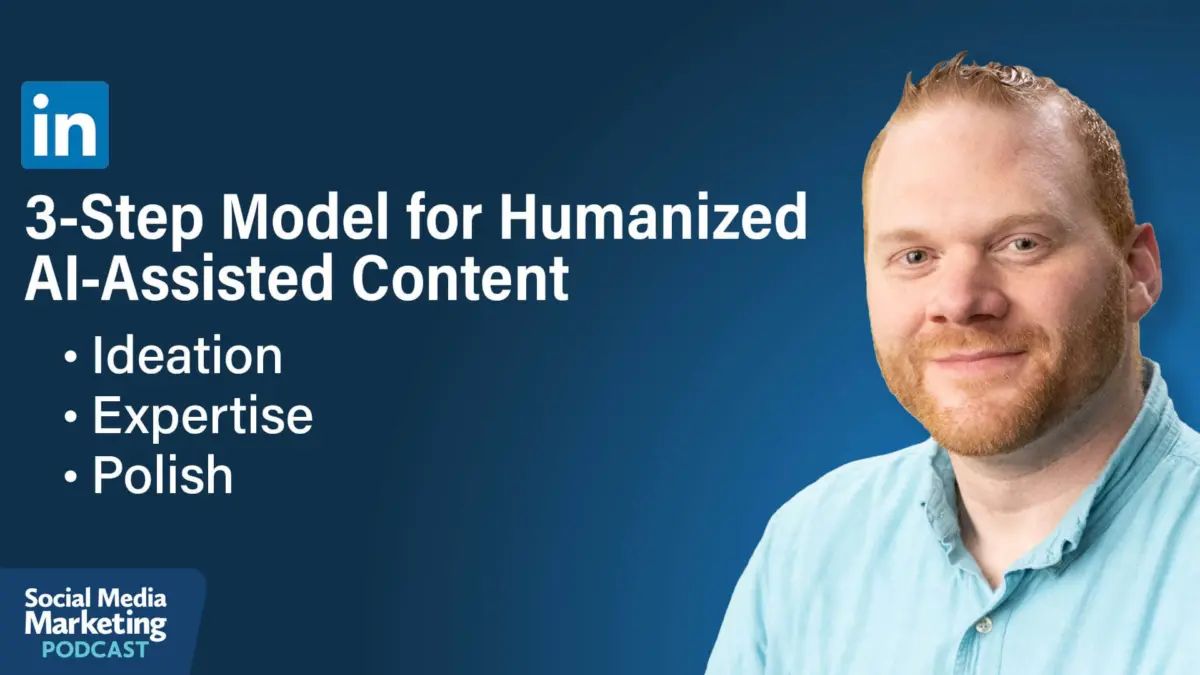
Surviving and thriving in this new environment requires a structured framework that respects the boundaries of automated tools. Wilcox advocates for the Ideation-Expertise-Polish Model—visualized as an intellectual sandwich with AI serving as the bread on the outside and human expertise forming the substance in the middle.
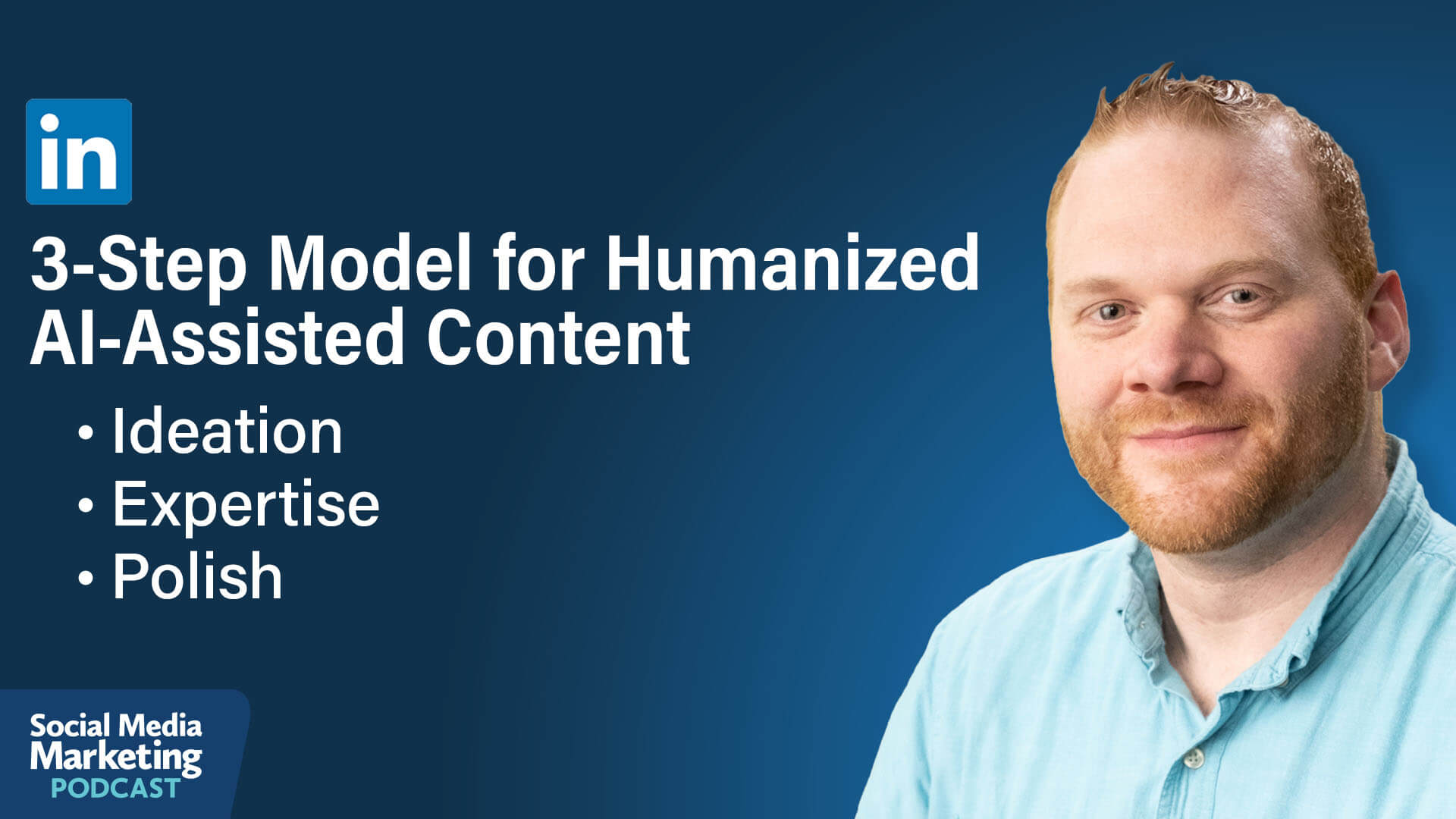
[ AI: Ideation & Brainstorming ] (Volume & Angles)
               ↓
[ Human: Industry Expertise ] (Real Experience & Nuance)
               ↓
[ AI: Polish & Readability ] (Grammar, Syntax & Formatting)
Stage 1: AI-Driven Ideation
Artificial intelligence excels at volume, breadth, and rapid conceptualization. Before sitting down to draft a piece of content, creators can leverage AI to brainstorm content angles, map out structural frameworks, and generate supporting points around complex industry topics. This phase focuses entirely on exploring possibilities rather than generating finished prose.
Stage 2: The Crucial Core of Human Expertise
This is the non-negotiable anchor of effective LinkedIn content. It houses the creator’s raw experiences, proprietary data, real-world case studies, and industry-specific nuance—elements that algorithms simply cannot synthesize. Skipping this stage and relying entirely on a prompt output is what users immediately recognize and reject as "AI slop."
Stage 3: The Editing and Polish Phase
Once the human voice and core arguments are written down, AI can step back in to refine readability. This includes tightening up verbose sentences, correcting minor grammatical errors, and optimizing structural formatting for easy mobile scanning. Crucially, the AI is editing the creator’s words, not inventing new thoughts from scratch.
Avoiding Common "AI Tells"
As detection metrics evolve, human readers have become hyper-aware of specific syntactical patterns native to large language models. Avoiding these common traps is essential:
- The Em Dash Overuse: AI models rely on em dashes far more frequently than human writers do. Their constant presence in a professional post serves as an immediate red flag.
- Uncharacteristic Emojis: Dropping heavily stylized emojis into comments or text bodies that do not match the author’s historical communication style triggers immediate reader skepticism.
- Melodramatic Phraseology: Phrasing such as "guard your mental faculties" or "this is silently killing you" reflects the default dramatic flair LLMs default to when attempting to hook readers.
- The Myth of Intentional Typos: Some creators attempt to fool detectors by deliberately leaving typos in AI-generated text. Experts caution that this is ineffective; prompts can instruct an AI to introduce errors just as easily, rendering intentional mistakes an unreliable marker of humanity.
Official Platform Mechanics: Timing, Comment Strategy, and Live Streams
Beyond standard text posts, LinkedIn’s underlying ecosystem has evolved across several key features, transforming how impressions are gathered and measured.
Optimal Publishing Schedules and Frequency Rules
Data-driven publishing remains critical for maximizing organic reach. Wilcox recommends a measured cadence:
- Two Posts Per Week: Publish on Tuesday and Thursday.
- One Post Per Week: Publish on Wednesday, which consistently stands out as the strongest single day for engagement.
- Days to Avoid: Monday is plagued by heavy inbox competition as professionals catch up on work, while Friday sees users mentally checking out for the weekend.
Furthermore, creators must strictly adhere to a golden rule: Never post twice in a single day. Publishing a second piece of content cannibalizes the reach of the first, forcing the algorithm to split attention. Similarly, publishers must allow previous posts sufficient time to breathe. If an older post is still actively accumulating impressions and comments, publishing a new update too quickly will prematurely truncate its lifespan.
Comment-Led Growth and "Comment Density"
Comment visibility has transformed into a powerful, standalone growth engine. LinkedIn now displays comment impressions publicly, allowing micro-creators to measure their secondary reach when engaging with enterprise accounts. With overall platform time spent in comment sections up 18% year-over-year, an active commenting strategy often yields higher visibility with less creative overhead than writing original long-form posts.
According to insights gathered from LinkedIn’s company pages team, the metric that matters most to the algorithm is "comment density"—the depth, substance, and variety of contributors within a thread, rather than sheer volume. Shallow remarks like "Great post!" or "Thanks for sharing" carry zero algorithmic weight. Instead, threads are driven by substantive engagement, often unlocked by closing remarks such as "Am I wrong?" or "What am I missing?" to invite diverse perspectives.
AI-Powered Live Stream Replays
Live streaming on LinkedIn historically suffered from poor discoverability; once a broadcast ended, the replay was largely unwatchable because users had to scrub through hours of raw footage without chapters.
LinkedIn’s AI tools now automatically generate chapters for replays and extract standout 30- to 60-second clips from the broader conversation. This dramatically lowers the production barrier for company executives and founders who previously avoided video due to editing overhead. With replays remaining accessible on the platform for roughly six months—significantly longer than competitors like Meta—executives can build robust, multi-channel video content libraries derived from a single live recording session.
Future Outlook: Navigating Advertising Best Practices
As artificial intelligence continues to reshape the B2B marketing landscape, platform-specific optimization remains paramount—particularly within paid media environments.
LinkedIn’s native ad platform has integrated AI creative generation tools tailored for headlines and introductory copy. However, marketers must exercise caution when applying traditional multi-channel playbooks—particularly those imported from Meta—to LinkedIn campaigns.
While platforms like Meta reward high-volume creative testing (often recommending five or more ad variations per campaign to feed their algorithmic auctions), executing this on LinkedIn breaks the platform’s internal frequency capping. Because LinkedIn limits ad exposure to roughly twice per user per day, flooding an ad set with excessive variations forces the system to treat each asset as a distinct auction item, artificially inflating CPMs and exhausting target audiences.
Instead, advertisers are advised to stick to two to four creative variations per ad set—such as pairing a single high-performing visual with two distinct intro texts, or vice versa. This approach preserves frequency limits while providing adequate testing parameters.
Conclusion
The evolution of artificial intelligence on LinkedIn signals the death of low-effort automation and the renaissance of authentic, human-led expertise. By embracing structured frameworks like the Ideation-Expertise-Polish model, respecting platform-specific mechanics like comment density and posting cadence, and treating AI as an operational assistant rather than a ghostwriter, modern marketers can secure sustained organic visibility and forge genuine business relationships in an increasingly crowded digital ecosystem.