Executive Overview
In the sprawling, high-stakes theater of modern technology, presentation has always been a strategic weapon. From Steve Jobs’ iconic black mock turtlenecks to Mark Zuckerberg’s early-career uniform of hoodies and jeans, the fashion choices of Silicon Valley executives have long signaled their corporate ethos. However, a profound and calculated shift is currently underway. Today’s technocratic elite—men amassing unprecedented wealth and overseeing systems that track, evaluate, and occasionally militarize human existence—have discovered the immense utility of looking utterly harmless.
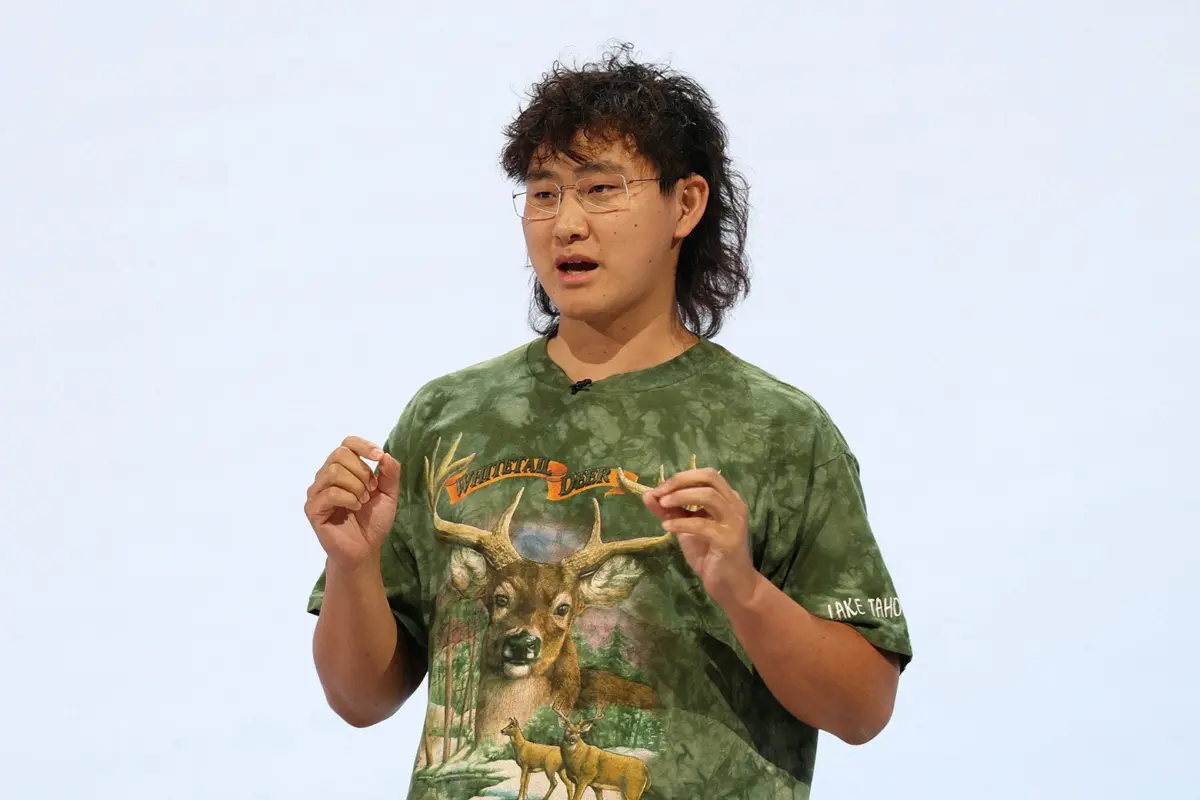
The archetype of the sleek, hyper-polished titan of industry is being consciously dismantled. In its place stands a new, counter-signaling aesthetic: the tech executive as an innocuous slacker, a nostalgic millennial, or your cool, slightly chaotic cousin. At the epicenter of this trend is Alexandr Wang. Once known as the ultra-polished, buttoned-up wunderkind who built Scale AI into a multi-billion-dollar data titan at age 24, Wang reappeared on stage at the recent Meta Connect conference sporting a shaggy mullet, wire-rimmed glasses, black joggers, Realtree camo Crocs, and a thrifted “Lake Tahoe” graphic tee.
This transformation is far more than a mid-career wardrobe change. It is a sophisticated public relations maneuver designed to disarm a skeptical public. As tech companies pivot toward ubiquitous, deeply invasive products—ranging from personal AI agents that harvest intimate user habits to autonomous military systems—their leaders are engaged in a coordinated campaign of aesthetic subversion. By cloaking themselves in the garb of the ordinary, the eccentric, or the chronically unserious, these billionaires hope to obscure the immense, unchecked power they wield over the modern world.
Detailed Chronology: The Evolution of Technocratic Disguise
To understand the current wave of counter-signaling fashion, one must chart the journey of the modern tech executive from corporate drone to calculated counter-culture icon.
The Rise of the Boy Wonder (Circa 2019–2021)
Five years ago, Alexandr Wang was the poster child for youthful tech ambition. At just 24 years old, his startup, Scale AI, achieved a staggering $7.3 billion valuation, briefly catapulting him into the global spotlight as the world’s youngest self-made billionaire. At the time, Wang’s aesthetic matched the traditional expectations of a high-flying prodigy: crisp button-down shirts, neatly cropped hair, and an eager-to-please corporate demeanor.
Beneath the magazine covers, however, Scale AI was building the unglamorous infrastructure of the artificial intelligence boom. The company relied heavily on armies of contract workers—many located in developing nations—to label massive datasets and evaluate large language models. While controversies regarding labor practices and compensation simmered, Wang maintained the sanitized, corporate-ready look of a Silicon Valley disruptor.
The Great Makeover Era (2022–2025)
Over the next few years, a broader stylistic metamorphosis swept across Silicon Valley’s old guard. Mark Zuckerberg cast off his rigid, uniform Brunello Cucinelli gray T-shirts in favor of oversized Amiri tees, signaling a desperate pivot toward street-style relevance just as Meta aggressively re-oriented its business toward generative AI. Nvidia CEO Jensen Huang permanently welded himself into custom black leather jackets, transforming from a standard-issue polo-shirt-wearing engineer into an omnipresent rockstar of hardware. Amazon founder Jeff Bezos traded his cautious corporate suits for resort-wear that looked suspiciously like the leftovers of a Greek life themed mixer.
Yet, these changes were often evolutionary—attempts by older executives to age gracefully into cool capitalism. What happened next, however, was entirely different.
The Meta Connect Revelation (Late 2025)
At the Meta Connect conference, Wang—now 29 and serving as a high-ranking AI executive within Meta following a massive $14.3 billion capital integration—shattered all expectations. Stepping onto the stage beneath a loose, shaggy mullet, he wore a $30 thrifted graphic T-shirt, black joggers, and Realtree camouflage Crocs.
The internet erupted. Online commentators frantically attempted to decode the outfit, assuming it must be an ironic, high-fashion statement piece worth thousands of dollars. Social media users speculated that the Crocs were Balenciaga collaborations and the joggers were Prada.
Wang quickly jumped onto X (formerly Twitter) to "correct the record," posting an annotated graphic breaking down the pricing of his ensemble. He proudly revealed that his shirt cost $30, his Calvin Klein underwear cost $5, and—for reasons known only to him—drew a deliberate arrow pointing directly to his crotch. The message was unmistakable: Look at me. I am just a goofy guy. How could a man in $60 camo Crocs possibly pose a threat to your autonomy?
Supporting Context & Metrics: The Mechanics of Counter-Signaling
The phenomenon of tech executives dressing down is not an accident of personal preference; it is a calculated response to a profound crisis of public trust.
The Public Relations Crisis of Big AI
The technology sector is currently navigating an unprecedented wave of public skepticism. Consumers are increasingly wary of the adverse impacts of artificial intelligence on employment, privacy, and psychological well-being. Furthermore, the sheer concentration of capital and infrastructure within a handful of mega-corporations has sparked intense regulatory scrutiny.
When tech companies launch invasive products—such as Meta’s line of data-collecting smart glasses, continuous personal assistant agents, and automated surveillance integrations—they face immediate pushback. To counteract this, executives have weaponized counter-signaling: the practice of publicly displaying traits that run counter to one’s actual status, power, or intentions in order to project authenticity and harmlessness.
Case Studies in Counter-Signaling
- Palantir: In April, amidst intense public backlash over a $30 million contract with Immigration and Customs Enforcement (ICE) to build an "ImmigrationOS" surveillance platform, Palantir released a controversial mini-manifesto defending its military tech work. Simultaneously, the company began marketing a trendy "chore coat" in its corporate merchandise line. The juxtaposition of rugged, working-class apparel with high-end military surveillance software is a textbook exercise in aesthetic laundering.
- Anduril Industries: Palmer Luckey, the 34-year-old co-founder of defense tech unicorn Anduril, builds autonomous, AI-powered military drones designed to scan battlefields and execute targets with lethal precision. Yet, Luckey’s public uniform consists exclusively of Hawaiian shirts, cargo shorts, and a soul patch. The visual dissonance is intentional: How can the man in the tropical shirt be engineering the future of automated warfare?
| Executive | Company | Primary Product Focus | Signature "Harmless" Aesthetic | Underlying High-Stakes Reality |
|---|---|---|---|---|
| Alexandr Wang | Meta / Scale AI | Personal AI Agents, LLM Data Infrastructure | Thrifted tees, mullet, camo Crocs | Multi-billion dollar behavioral tracking and data harvesting |
| Palmer Luckey | Anduril Industries | Autonomous military drones, defense systems | Hawaiian shirts, cargo shorts | Pentagon-backed autonomous lethal warfare systems |
| Mark Zuckerberg | Meta | Spatial computing, AI assistants, smart glasses | Oversized graphic tees ("Building is my love language") | Amassing global user data across social and spatial networks |
Official Statements & Industry Narratives
During his keynote address at Meta Connect, Wang presented the latest iterations of Meta Muse, the company’s flagship personal AI agent ecosystem. Demonstrating new security measures, a dedicated Mac application, and international rollouts, Wang framed the technology as an essential, benign companion for everyday life.
"This is how you make personal agents for everyone," Wang declared to the audience.
To humanize the software, Wang shared anecdotal examples of how users interacted with Muse, citing scenarios ranging from someone planning a vacation with their spouse to an individual seeking advice after breaking their mother-in-law’s favorite china set. The narrative was clear: AI is not an inscrutable, corporate behemoth; it is a clumsy, relatable assistant helping you navigate the minor fumbles of daily life.
Similarly, Mark Zuckerberg leaned heavily into the emotional branding of the event. Sporting a customized tee bearing the slogan "Building is my love language," Zuckerberg sought to reframe ruthless corporate expansion as an act of intimate, vulnerable creation.
Critics, however, point out the sharp contradiction between these cozy public personas and the aggressive, zero-sum maneuvers happening behind the scenes. Meta and OpenAI are currently locked in a fierce, multi-billion-dollar war for dominance over personal AI agent tools. The psychological framing of these tools—often represented by whimsical, cartoonish mascots like Meta’s "Jolly"—is designed to bypass adult skepticism by borrowing the visual language of childhood animation.
Future Outlook: The Mask-Off Technocracy
As we look toward the future of the digital economy, the aesthetic of harmlessness is likely to reach new extremes. We have officially entered an era of mask-off technocratic rule, where the general public is acutely aware that a small handful of unelected billionaires hold unprecedented influence over global information, communication, and commerce.
Because traditional corporate public relations can no longer completely mask the sheer scale of this power, executives have pivoted to radical relatability. They want us to believe that their products are safe precisely because the men building them appear unpolished, distracted, or slightly ridiculous.
Yet, consumers must look past the camo Crocs, the thrifted T-shirts, and the ironic mullets. Underneath the carefully curated affectation of the high school slacker or the casual artist lies the most capitalized, technologically aggressive infrastructure in human history. Whether they are dressing like tech-bro royalty or your quirky cousin who works at a record store, the titans of Silicon Valley are not building for love—they are building for total digital dominance.