Executive Overview
In the interconnected ecosystem of the modern web, the illusion of digital isolation has finally shattered. A sophisticated software supply chain attack has demonstrated how easily the security posture of the world’s most prominent digital destinations can be undermined without a single line of their own core infrastructure being breached.
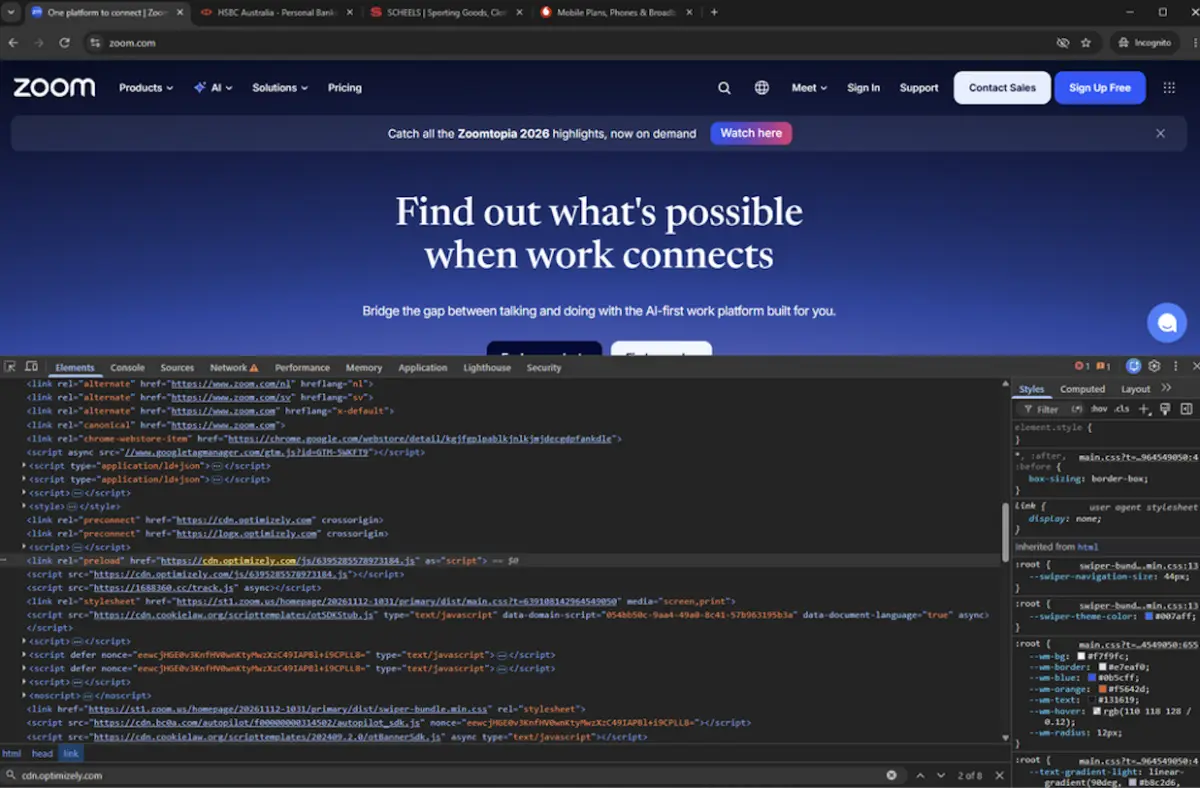
Over a dramatic 24-hour window, at least 178 top-tier web destinations—including household names such as the BBC, CNN, Equifax, Ledger, and Zoom—unwittingly served malicious JavaScript payloads to millions of unsuspecting visitors. The vector for this mass infection was a security vulnerability discovered within Optimizely, a globally trusted platform heavily relied upon by enterprises to manage customer experience, execute A/B testing, and deploy personalized website features.
According to telemetry and incident reports compiled by security firm Report URI, the breach deployed a shape-shifting, multi-purpose malware kit. This malicious payload continuously mutated—rebuilding itself 26 times over the course of a single day—to evade signature-based detection. The objectives of the injected code were comprehensive and predatory: harvesting payment card details, capturing user cookies, recording browsing screenshots, and dynamically swapping cryptocurrency destination addresses to divert digital assets directly into the attackers’ digital wallets.
Beyond general data theft, security researchers identified targeted zero-click exploit kits tailored to exploit unpatched vulnerabilities in legacy Apple iPhones and iPads. These exploits, operating under monikers like "DarkSword" and "Coruna," chained together multiple zero-day and known flaws to achieve complete remote code execution and system takeover on outdated mobile devices.
This incident serves as a glaring wake-up call for an industry that has long prioritized marketing agility and frictionless user experiences over rigid infrastructural hygiene. As experts warn, the modern web operates much like the Wild West—largely lacking fundamental guardrails, such as strict Content Security Policies (CSPs), that could otherwise prevent a single compromised vendor from instantly weaponizing hundreds of the internet’s most trusted domains.
Detailed Chronology: How the Attack Unfolded
The Initial Compromise
The genesis of the incident traces back to an architectural vulnerability identified within Optimizely Experimentation. On November 16, malicious actors successfully breached the platform’s cloud infrastructure, bypassing authorization controls to inject rogue JavaScript code directly into live customer projects. Because of Optimizely’s deep integration into the document object model (DOM) of target websites, the injected code was seamlessly blended into the legitimate scripts delivered to end users.
Immediate In-Browser Execution
Unlike traditional web attacks that require a user to click a phishing link, download an untrusted file, or interact with a deceptive prompt, this supply chain attack leveraged the inherent trust placed in third-party vendors.
Zach Edwards, a security researcher at Infoblox and co-founder of ad-tracking service DecryptAds, explained the mechanics of the exposure. Because Optimizely is built primarily for real-time experimentation and continuous data collection, its JavaScript snippets are routinely placed at the very top of a website’s source code (<head> tag) to ensure immediate execution upon page load.
Crucially, this meant the code was designed to fire prior to any consent dialog boxes or cookie banners rendering on the page. Consequently, visitors to major sites like Zoom or CNN did not need to interact with anything; merely navigating to the homepage was enough to trigger the malicious payload instantly.
Payload Mutation and Device Exploitation
Once active in the browser environment, the injected script acted as a staging ground for a diverse array of malicious activities. Scott Helme, security researcher and founder of Report URI, noted that the threat actors dynamically rebuilt the malware payload 26 separate times throughout the day. This rapid iteration was designed to frustrate real-time threat intelligence feeds and automated security mitigations.
The deployed toolkit was designed to siphon sensitive user data across multiple vectors:
- Credential & Cookie Theft: Extracting active authentication tokens to enable session hijacking.
- Financial Fraud: Scraping payment card data during checkout or form interactions.
- Cryptocurrency Hijacking: Real-time manipulation of the Document Object Model (DOM) to replace legitimate cryptocurrency recipient addresses with attacker-controlled wallets during transactions.
- Mobile-Specific Exploits: Delivering secondary zero-click exploit chains designed to compromise outdated iOS operating systems through weaponized web traffic.
Supporting Context & Metrics: The Anatomy of a Flawed Web Architecture
The Ubiquity of Third-Party Dependencies
The Optimizely incident highlights a systemic vulnerability inherent in how modern websites are constructed. To deliver dynamic, interactive, and personalized experiences, organizations routinely lean on dozens of external vendors. According to the 2025 Web Almanac published by the HTTP Archive, the median enterprise homepage loads a staggering 22 distinct JavaScript files from various third-party domains.
While these scripts drive analytics, advertising, tracking, and customer experience enhancements, they also introduce a massive surface area for supply chain attacks. When a third-party script is embedded into a webpage, the browser treats it with a high degree of trust, granting it permission to read local storage, manipulate page elements, and communicate with external servers.

The Content Security Policy (CSP) Deficit
A robust Content Security Policy (CSP) is an HTTP header that allows site operators to restrict and control the resources—such as JavaScript, CSS, and images—that the browser is allowed to load for a given page. When properly configured, a CSP acts as a vital circuit breaker, ensuring that even if a trusted vendor’s server is compromised, the browser will refuse to execute unauthorized scripts or connect to unknown domains.
However, the empirical data gathered by Report URI following the Optimizely attack reveals a profound industry-wide reluctance to implement strict CSPs:
- No Protection: 68 of the affected organizations had deployed no Content Security Policy at all, leaving their visitors entirely defenseless against unauthorized code injection.
- Permissive Policies: 50 organizations had implemented a CSP, but the policy was configured so loosely that it actively permitted both the malicious malware payload and the subsequent data exfiltration.
- Effective Blockades: Only 24 of the 178 affected sites (a meager 15 percent) possessed CSPs robustly configured to block the malicious payload entirely.
Across the broader internet, crawler data from Helme’s scanning platform crawler.ninja indicates that only about 10 percent of the web’s busiest million sites maintain effective, restrictive CSP configurations. For the remaining 90%, marketing expediency continues to supersede security hardening, leaving platforms vulnerable to third-party poisoning.
Official Statements and Remediation Efforts
Upon discovering the unauthorized activity, Optimizely initiated an aggressive containment and remediation protocol. In an official written statement released to security researchers, the company detailed the timeline and scope of its defensive response:
"On November 16, 2026, Optimizely identified a security incident in which an unauthorized party exploited a vulnerability in the Optimizely Experimentation platform to add malicious JavaScript to some customer projects.
We acted swiftly to contain the incident and have fully remediated the identified vulnerability. These measures included blocking access to the vulnerable path, deploying a fix, removing the injected code from affected projects, ending active sessions, revoking tokens, and resetting access for affected user accounts. We have also implemented additional protections to prevent malicious code from being delivered via Cloudflare. While the incident has been fully remediated, we are working with third-party experts on a comprehensive investigation."
Despite the speed of Optimizely’s remediation, security analysts emphasize that vendor remediation is only half the battle. Downstream organizations that embed third-party widgets retain the ultimate responsibility for governing what code executes within their users’ browsers.
Future Outlook: Navigating the Age of Supply Chain Vulnerabilities
The Role of Artificial Intelligence in Threat Evolution
As security researchers analyze the speed at which the Optimizely payload was mutated, a darker reality emerges regarding the intersection of software vulnerabilities and artificial intelligence.
In an interview with KrebsOnSecurity, Scott Helme emphasized that the scale and adaptability of modern web attacks are increasingly driven by automation and generative technologies.
"Organizations are running all this code, but they don’t know what it’s doing," Helme stated. "This is why we keep seeing such large-scale breaches in places where there are no checks and rules in place on the code we’re running, so this was kind of inevitable. Once an attacker gets to the point of running code on your site, the question is what do they want to do with that and can they write the script to do it. Now, with AI, that’s not a problem anymore."
Defensive Strategies for Operators and End-Users
For Website Operators and Enterprise Architects:
- Mandate Strict Content Security Policies: Move away from overly permissive marketing configurations. Enterprises must map out every third-party dependency and enforce rigid domain whitelisting via CSP headers.
- Subresource Integrity (SRI): Where applicable, implement cryptographic hashes to verify that fetched JavaScript files have not been altered in transit.
- Vendor Risk Management: Continually audit third-party integrations, treating marketing and analytics vendors with the same rigorous security scrutiny applied to core infrastructure providers.
For End-Users and Consumers:
Historically, standard cybersecurity guidance instructed users to rely on local antivirus software and operating system firewalls. However, in an era where malicious payloads are delivered dynamically through encrypted HTTPS channels on otherwise trusted mainstream websites, traditional endpoint defenses are often blind to in-browser script manipulation.
Today, advanced ad-blocking and script-filtering software effectively serves as the modern user’s primary firewall. Tools that block unauthorized third-party trackers, scripts, and domain requests provide an essential layer of insulation, neutralizing drive-by malware campaigns before malicious code can execute in the browser.
The Optimizely incident stands as a definitive milestone in the evolution of cyber threats—a stark reminder that in the hyper-connected digital economy, your security is only as robust as the weakest, most deeply buried third-party script running on your page.