Executive Overview
In the rapidly evolving landscape of artificial intelligence, the line between groundbreaking scientific achievement and corporate-sponsored hyperbole is increasingly razor-thin. This tension took center stage following a high-profile segment on CBS’s legendary newsmagazine 60 Minutes, which featured an in-depth interview with Google CEO Sundar Pichai. During the broadcast, correspondent Scott Pelley presented a narrative that captivated millions of viewers: an advanced AI model developed by Google had allegedly learned an entirely new human language from scratch, completely unassisted, through a mysterious phenomenon known as "emergent properties."
However, the aftermath of the broadcast triggered swift and sharp condemnation from the global artificial intelligence research community. Prominent ethicists, computer scientists, and linguists took to social media and public forums to push back against the claims made by both CBS and Google executives. Critics argued that the narrative presented on national television fundamentally misrepresented how modern large language models (LLMs) operate, misleading the public by framing standard machine learning processes as borderline magical intelligence.
At the heart of the controversy is Google’s PaLM (Pathways Language Model), the foundational technology driving the company’s AI chatbot, Bard. According to independent researchers—supported by Google’s own published technical documentation—the AI model had not magically conjured an understanding of Bengali out of a vacuum. Instead, Bengali was explicitly included in its training corpus.
This article delves deep into the controversy, examining the claims made on 60Minutes, the technical reality of LLM training data, the pushback from industry whistleblowers and academics, and the broader implications of media sensationalism in the age of generative AI.
Detailed Chronology: From Developer Stage to Primetime Television
To understand how a routine machine learning function was elevated to the status of an unexplainable technological miracle, it is necessary to trace the timeline of public disclosures surrounding Google’s PaLM model.
May 2022: The Google I/O Debut
Google first introduced the capabilities of the PaLM model during its annual Google I/O developer conference. On stage, CEO Sundar Pichai demonstrated the software’s capability to understand and respond to prompts in Bengali, a language spoken by over 230 million people primarily in Bangladesh and the Indian state of West Bengal.
During the presentation, Pichai highlighted what he described as a profound leap in AI capabilities: "What is so impressive is that PaLM has never seen parallel sentences between Bengali and English," Pichai told the audience. "It was never explicitly taught to answer questions or translate at all. The model brought all of its capabilities together to answer questions correctly in Bengali, and we can extend the technique to more languages and other complex tasks."
While tech enthusiasts noted the impressive multi-lingual generalization of the model, the claims remained largely confined to industry circles and developer communities.
April 2023: The 60 Minutes Primetime Broadcast
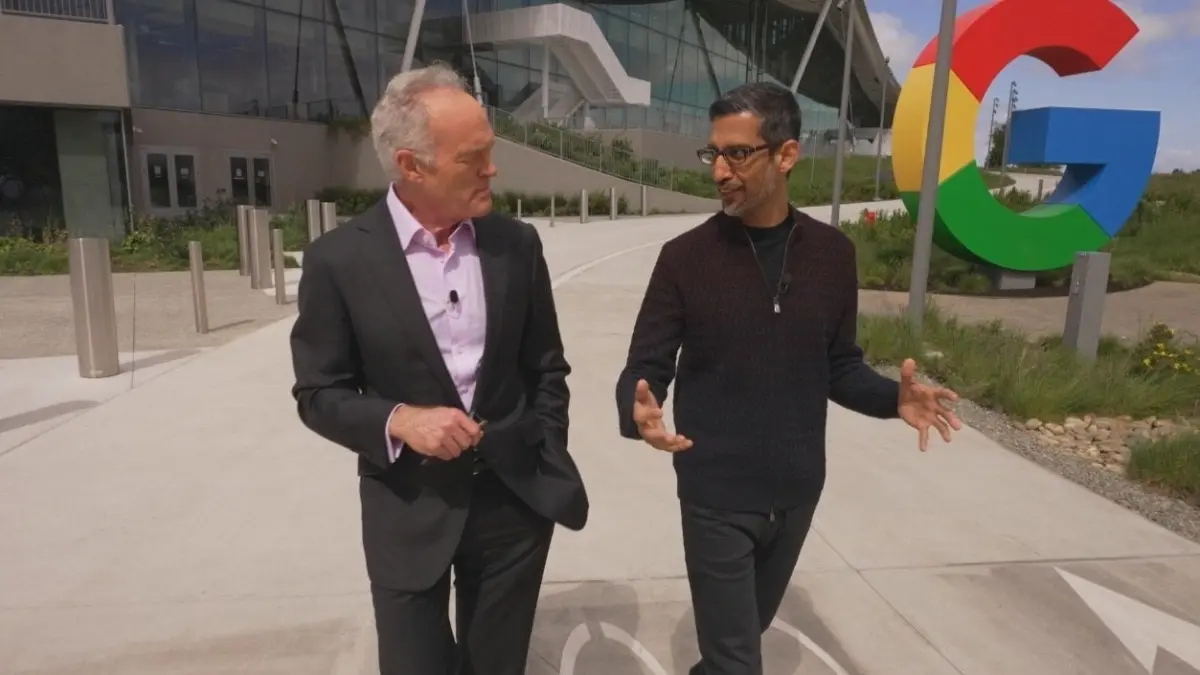
The narrative shifted dramatically when 60 Minutes aired its segment on artificial intelligence, hosted by veteran correspondent Scott Pelley. Seeking to explore both the promises and perils of the AI revolution, the program focused heavily on the opaque nature of modern neural networks.
Pelley informed millions of viewers that the most mysterious aspect of current AI research is "emergent properties"—a term used to describe instances where systems exhibit unexpected skills they were not explicitly programmed to perform. To illustrate this, the segment cut to footage of an unidentified Google AI program interacting with a user in Bengali. Pelley asserted that the software had "adapted on its own" after being prompted in Bengali, explicitly claiming it was a language the system "was not trained to know."
Reinforcing this narrative, James Manyika, Google’s Senior Vice President of Technology and Society, stated during the interview: "We discovered that with very few amounts of prompting in Bengali, it can now translate all of Bengali. So now, all of a sudden, we have a research effort where we’re now trying to get to a thousand languages."
The Immediate Backlash
Almost immediately after the broadcast concluded, the AI research community mobilized online. Within hours, prominent ethicists, linguists, and computer scientists dismantled the narrative presented by CBS and Google, pointing out glaring contradictions between the TV segment and Google’s own peer-reviewed research papers.
Supporting Context & Metrics: The Reality of Training Data
The central pillar of the 60 Minutes report—that PaLM taught itself Bengali without prior exposure—crumbled under the weight of basic algorithmic transparency.
What the Research Papers Say
When Google researchers initially published their technical paper detailing the architecture and training methodology of the PaLM model ("PaLM: Scaling Language Modeling with Pathways"), they meticulously documented the composition of the training dataset.
According to this foundational paper, the massive multilingual corpus used to train PaLM indeed included Bengali text. Specifically, Bengali data constituted approximately 0.026% of the model’s total training corpus. While 0.026% may sound minuscule to a layperson, in the realm of massive transformer models trained on petabytes of text, it represents millions of tokens and substantial exposure to the structural patterns, vocabulary, and grammar of the language.
How Prompting Actually Works
Margaret Mitchell, a leading AI researcher, ethicist at Hugging Face, and former co-lead of Google’s AI ethics team, took to Twitter to explain the mechanics at play.
"By prompting a model trained on Bengali with Bengali, it will quite easily slide into what it knows of Bengali: This is how prompting works," Mitchell tweeted.
She emphasized a fundamental truth of modern natural language processing: an AI model cannot output coherent, syntactically correct responses in a language if it has never had access to data points from that language during its training phase. The transition from basic text completion (predicting the next word in a sequence) to question-answering or translation is not a magical leap of consciousness; rather, it is the activation of latent cross-lingual representations learned during standard training phases.
Furthermore, linguist and University of Washington professor Emily M. Bender heavily criticized James Manyika’s assertion that PaLM could suddenly "translate all of Bengali."
"What does ‘all of Bengali’ actually mean?" Bender wrote on social media. "How was this tested?"
Bender pointed out that broad, unsubstantiated claims about translating entire linguistic traditions gloss over critical evaluation metrics, dialects, cultural contexts, and syntactic nuances, serving instead to manufacture an aura of omnipotence around the software.
Official Statements and Corporate Spin
As public criticism mounted, both Google and CBS faced mounting pressure to clarify their statements.
Google’s Defense: Dissecting "Emergent Capabilities"
When pressed for comment by tech journalists, Google spokesperson Jason Post attempted to thread the needle between the company’s marketing claims and the scientific reality of training data.
Post clarified that Google had never officially claimed the model was completely devoid of Bengali data in its foundational corpus. Instead, he framed the achievement around the concept of task-specific training versus generalized capability:
"While the PaLM model was trained on basic sentence completion in a wide variety of languages (including English and Bengali), it was not trained to know how to 1) translate between languages, 2) answer questions in Q&A format, or 3) translate information across languages while answering questions," Post stated. "It learned these emergent capabilities on its own, and that is an impressive achievement."
While industry insiders acknowledge that zero-shot and few-shot learning capabilities (where models perform tasks they weren’t explicitly fine-tuned for) are genuine and valuable advancements in machine learning, critics argue that conflating these technical milestones with "learning a language it has never seen" crosses the boundary from technical achievement into misleading PR.
CBS’s Silence
CBS News and correspondent Scott Pelley faced heavy criticism for failing to verify the claims against publicly available academic literature before broadcasting them to a mass audience. A CBS spokesperson declined to provide an on-the-record response to press inquiries regarding the segment, leaving the network’s editorial oversight under a cloud of scrutiny.
Industry Fallout and Ethical Implications
The incident has catalyzed a much larger conversation within the technology sector regarding the ethical responsibilities of media outlets and AI corporations.
Fueling the AGI Hype Cycle
Critics like Emily M. Bender have long warned against the careless use of terminology that anthropomorphizes artificial intelligence. Terms like "emergent properties," when sensationalized by mainstream media, often act as a psychological stepping stone toward the public belief in Artificial General Intelligence (AGI)—the hypothetical milestone where machines achieve human-level or superior cognitive reasoning across all domains.
Bender bluntly characterized the framing of the 60 Minutes segment:
"The term ’emergent properties’ seems to be the respectable way of saying AGI. It’s still bullshit."
The PR Playbook: Cultivating the Myth of "Magic"
For artificial intelligence startups and tech giants alike, maintaining a public perception of mysterious, near-magical capability carries immense financial incentives. It drives venture capital investment, inflates stock valuations, and secures regulatory leverage.
Margaret Mitchell captured the frustration of many domain experts regarding the symbiotic relationship between corporate marketing and uncritical journalism:
"Maintaining the belief in ‘magic’ properties, and amplifying it to millions (thanks for nothin @60Minutes!) serves Google’s PR goals. Unfortunately, it is disinformation."
Future Outlook: Navigating the Intersection of AI and Media
As generative AI tools become deeply embedded in society, the demand for accurate, sober, and scientifically grounded journalism has never been more critical. The fallout from the Google-CBS 60 Minutes controversy offers several key takeaways for the future:
- The Need for Technical Literacy in Journalism: Major news organizations must cultivate specialized reporting teams capable of critically evaluating vendor claims, reading underlying research papers, and consulting independent domain experts before airing extraordinary technical assertions.
- Accountability in Corporate Communications: Tech companies will face increasing scrutiny from the scientific community when marketing language outpaces technical reality. As regulatory frameworks (such as the European Union AI Act) begin to take shape, misleading claims about AI capabilities could soon face legal and compliance repercussions.
- Demystifying AI for the Public: To build a resilient society capable of navigating the AI era, the public must be educated on how models actually work—viewing them as sophisticated statistical pattern-matching engines rather than sentient, autonomous entities.
Ultimately, Google’s PaLM model is a formidable technological achievement that represents years of rigorous engineering and computational scaling. By wrapping these genuine accomplishments in sensationalized narratives of spontaneous, unprompted omniscience, both Google and CBS did a disservice to the scientists who built the technology and the public trying to understand it.