Executive Overview
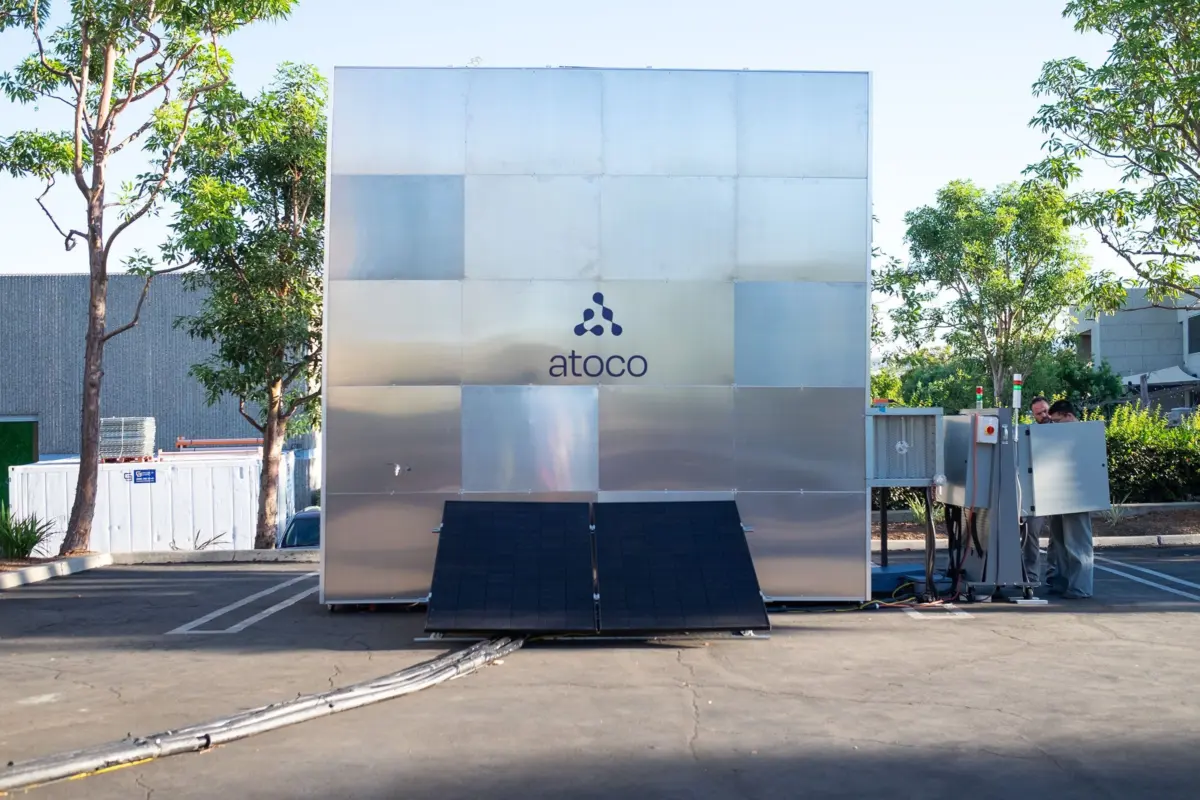
On a sweltering September morning in Irvine, California, the parking lot of the clean-tech startup Atoco resembles a sci-fi set straight out of Frank Herbert’s Dune. Beneath a relentless sun pushing temperatures past 80 degrees Fahrenheit, a 20-foot-tall, metal-clad machine hums quietly. Inside this monolith, engineers monitor an iPad displaying a steadily ascending line—a real-time visualization of water being harvested directly from thin air.
Atoco’s technology relies on a revolutionary class of materials known as metal-organic frameworks (MOFs). Developed by Atoco founder Omar Yaghi—whose pioneering work earned him the Nobel Prize in Chemistry—these materials act as molecular sponges, capturing atmospheric moisture at the microscopic level without requiring a drop of liquid water or a traditional electrical grid connection.
Even more remarkably, Atoco’s system solves a major paradox of the modern digital age: the massive amounts of waste heat and water consumption generated by artificial intelligence data centers. By harnessing low-grade industrial heat rather than electricity to "wring out" its molecular sponges, Atoco can convert a data center’s thermal pollution into thousands of liters of clean, distilled water. As tech giants like Microsoft, Google, and Amazon Web Services race to meet ambitious "water-positive" targets by 2030, innovations like Atoco’s MOF-based systems offer a tantalizing glimpse into a future where water scarcity can be met with atmospheric abundance.
Detailed Chronology: From Theoretical Chemistry to Real-World Innovation
The Roots of Scarcity
The journey toward Atoco’s atmospheric water generators began decades ago, shaped profoundly by the early life of its founder. Growing up as a Palestinian refugee in Jordan, Omar Yaghi experienced water scarcity firsthand. As a child, his daily responsibilities included filling as many containers as possible to sustain his household during the rare bi-weekly visits of municipal water delivery trucks.
"That makes you appreciate scarcity," Yaghi reflects. Decades later, that personal hardship fueled a lifelong scientific quest. When Yaghi was a PhD student, creating stable structures that could trap molecules inside engineered pores was considered "every chemist’s dream." Over the past 20 years, his research transformed theoretical chemistry into tangible reality, successfully bridging organic chemistry with metal ions to create highly stable, customizable molecular structures.
The Playground of Molecules
To understand how a MOF works, experts often use a familiar analogy. Seth Cohen, dean of the School of Physical Sciences at UC Irvine (who is independent of Atoco), describes the architecture of a MOF as looking "somewhat like a jungle gym on a playground."
These structures feature vast open spaces on a microscopic scale. Through careful chemical engineering, scientists can manipulate these interior dimensions to maximize surface area. "The footage of a gram of MOF could cover two football fields," Yaghi explains. "They can store hydrogen in there to make clean energy, or you could store $textCO_2$ in there to make clean air. Or, in this case, you can store water."
Refining the "Precision Material"
Atoco was founded to take these materials out of the academic laboratory and deploy them commercially. According to Atoco CEO Samer Taha and Vice President of R&D Benjie Limketkai, the company engineered "precision materials" tailored explicitly to pull water molecules from the air, hold them securely, and release them efficiently upon demand.

The chemical tuning must be exact: the material has to "like water, but not love it." If the bonds are too weak, it cannot capture moisture in dry conditions; if they are too strong, it requires too much energy to release the water. By dialing in the precise angle of every atom within the framework, Atoco’s scientists achieved a balance that allows the system to harvest moisture even when relative humidity drops into the teens.
The Irvine Demonstration
At Atoco’s Irvine facility, the culmination of this decades-long research stands in the parking lot. On test days, when ambient temperatures cross 90 degrees Fahrenheit, the system runs with remarkable discretion. Rather than relying on a nearby data center, the engineering team simulates industrial heat by piping in thermal energy at roughly 150 degrees Fahrenheit.
A small solar panel powers the system’s electronic monitoring tools, but the core water-harvesting operation remains eerily quiet—drowned out only by passing cars. When Taha pushes a button and turns a spigot, a clear, pristine stream of water tumbles out. While liability rules prevent visitors from drinking it directly from the nozzle, laboratory analysis confirms it is chemically equivalent to distilled water, as the MOF naturally filters out environmental pollutants.
Supporting Context & Metrics: The AI Data Center Nexus
The Waste Heat Problem
The modern AI boom has triggered an unprecedented construction wave of hyperscale data centers. These facilities house thousands of high-performance servers running complex machine learning algorithms, mathematical proofs, and generative AI systems. In doing so, they produce staggering amounts of waste heat.
A single modern AI data center can pump out as much heat as tens of thousands of homes. Operators are routinely forced to exhaust this thermal energy into the surrounding environment, contributing to urban heat islands and driving up cooling costs.
"Roughly 70 percent of industrial waste heat is low-grade, unutilized, thrown into oceans or into the air," says Taha. "If you convert that waste heat to clean water using our technology, you’re talking about trillions of liters of clean water."
Solving the Dual Crisis
Data center operators face a dual crisis: managing extreme heat and consuming millions of gallons of water daily for evaporative cooling towers. Traditional cooling methods deplete local water tables, drawing fierce criticism from local communities experiencing droughts.
Atoco’s technology directly addresses both challenges by turning a liability into an asset.

- The Energy Input: Unlike traditional atmospheric water generators that require energy-intensive refrigeration compressors or boiling cycles, Atoco’s MOFs release captured moisture using low-grade industrial heat starting at just 100 degrees Fahrenheit.
- The Paradigm Shift: "Data centers are investing a lot of money to get rid of waste heat," Taha notes. "We actually want it; we need it. We give you back water, the same product that is causing the issue."
Scaling Metrics and Economics
- Current Prototype Output: The Irvine parking lot monolith can generate up to 300 liters (approx. 80 gallons) of water per day, running on the thermal equivalent of a 20-kilowatt data center footprint.
- Next-Generation Commercial Units: Atoco is developing commercial units slated to produce up to 1,000 liters per day, designed to be stacked in modular grid arrays to match industrial demands.
- Levelized Cost: Atoco currently produces water at a levelized cost of $5 per metric ton, making it competitive with older desalination plants. However, the company aims to match newer desalination facilities that hit targets of $2 per ton or less within the next three to five years.
Official Statements and Industry Perspectives
Atoco Leadership on Commercialization
Atoco has already deployed five on-grid prototype trials with partners across the United States and within the Gulf Cooperation Council (GCC). The startup plans to begin taking commercial orders for its premier product line. While management has declined to name specific tech partners due to non-disclosure agreements, they confirm active discussions with major cloud providers regarding on-site pilot projects.
The market urgency is driven in large part by corporate sustainability pledges. Tech giants including Microsoft, Google, and Amazon Web Services have established binding commitments to become "water positive"—returning more water to local communities than they consume—by the year 2030.
Scientific Caution and Realistic Challenges
Despite the immense promise of metal-organic frameworks, independent experts urge a balanced perspective. Seth Cohen, who previously worked at DARPA on MOF initiatives spearheaded by Yaghi, cautions that the technology is not a universal silver bullet.
"MOFs have incredible promise, but they aren’t a silver bullet for water access everywhere," Cohen notes. Without an accessible external source of heat—such as industrial exhaust, solar thermal panels, or geothermal sites—even the most advanced MOFs require an energy source to release their trapped water. This presents logistical hurdles for deploying off-grid units in remote rural areas where both energy and water infrastructure are sparse.
Furthermore, deploying cutting-edge chemical materials at industrial scale involves inherent risks. While major tech companies frequently embrace high-risk, high-reward innovations to hit sustainability metrics, conservative municipal utilities move much slower. Proving durability, long-term cycling stability, and cost-competitiveness will take time.
Future Outlook: From Scarcity to Abundance
The intersection of artificial intelligence, climate change, and advanced materials science has positioned Atoco at the vanguard of a quiet industrial revolution. By transforming waste heat into life-sustaining water, the company’s MOF technology offers a scalable blueprint for mitigating two of the twenty-first century’s most pressing crises.
Whether deployed alongside hyperscale server farms in arid tech hubs or integrated into geothermal installations and industrial corridors, atmospheric water harvesting is transitioning from theoretical chemistry into commercial reality. For Omar Yaghi, who spent his childhood tracking water rations in a refugee camp, the realization of his life’s work represents a profound philosophical shift.
"Now," Yaghi says, "we’re talking about going from scarcity to abundance."