Executive Overview
In the rapidly evolving landscape of B2B go-to-market strategies, artificial intelligence has shifted from a novelty to the core operating system of modern sales. Yet, as the market is flooded with off-the-shelf AI outbound tools promising automated scale, a nuanced operational truth is emerging among top-tier organizations: generic automation hits a hard ceiling when it comes to depth, context, and proprietary data utilization.
Enter SaaStr AI. As aggressive users of AI outbound infrastructure, the organization relies heavily on established third-party vendors to drive approximately 90% of its volume-based outreach. Platforms such as Monaco, Artisan, Agentforce, and Qualified handle the heavy lifting of domain protection, deliverability infrastructure, sequencing, and reply handling—tasks that require years of engineering and thousands of customer implementations to master.
However, recognizing that traditional AI Sales Development Representatives (SDRs) only scratch the surface of a company’s internal data ecosystem, SaaStr took a hybrid approach. They recently engineered a proprietary prospecting tool natively inside their internal platform, 10K.
This custom engine does something third-party tools simply cannot do: it synthesizes scattered first-party data residing across at least six distinct company silos—ranging from deep Salesforce history and event attendance to newsletter engagement and past podcast archives—to write intensely hyper-personalized outbound pitches.
By marrying the volume capabilities of market-tested vendors with an internally built, data-rich "AI ABM" (Account-Based Marketing) engine for named accounts, SaaStr AI has mapped out a blueprint for modern sales organizations. The result is a system that bridges the gap between mass scalability and deep, contextual relevance.
Detailed Chronology: From Custom Renewal Decks to Automated Prospecting
To understand how SaaStr AI arrived at its current hybrid outbound architecture, one must examine the evolution of its internal engineering efforts, which began not with cold prospecting, but with customer renewals.
Phase 1: The Renewal Bottleneck
Historically, crafting highly tailored renewal presentations was a luxury reserved for the company’s highest-tier partners. Prior to the deployment of proprietary AI agents, the team could realistically build fully bespoke custom decks for only about five diamond sponsors. Every other account received a standard, templated follow-up sequence.
This created a distinct engagement disparity. While major enterprise accounts like Google Cloud received intense white-glove attention, smaller silver sponsors—who represented smaller financial commitments but historically suffered from lower renewal rates—frequently churned due to a lack of perceived individual attention.
Phase 2: Building the Renewal Agent
As detailed on Episode #013 of The Agents, engineer Amelia set out to solve this bottleneck. In roughly half a day, she built a dedicated renewal agent operating on top of the 10K platform.
The agent was designed to ingest data from both traditional CRM architectures and siloed external sources:
- The Salesforce Side: Contracts, historical lifetime value (LTV), email opens, Qualified chat logs, and Momentum call recordings.
- The External Side: WordPress activity, social footprints, podcast archives, and Bizzabo event lead counts.
Once ingested, the agent automatically compiled this data and generated a dynamic, fully custom slide deck through the Gamma API.
Phase 3: Unlocking Exponential Customization
The impact of the renewal agent was immediate and dramatic. Instead of limiting the team to five custom decks, the agent empowered them to output 20 to 30 custom decks effortlessly.
The business results defied conventional expectations. Silver sponsors—facing lower price points where a $25,000 sponsorship represents a major budgetary decision—responded at significantly higher rates than the diamond sponsors. The deployment of a custom deck signaled that SaaStr had tracked their event ROI and performance metrics just as meticulously as they would for a six-figure enterprise partner.
Phase 4: Scaling to New Logos via the Pitch Generator
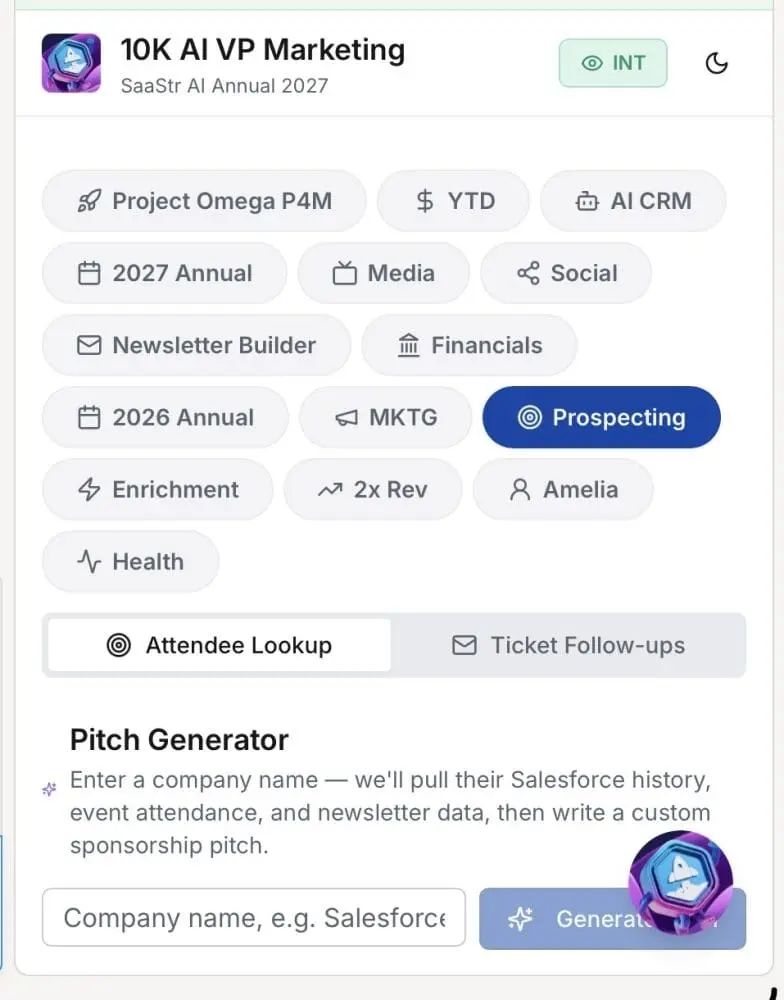
Buoyed by the success of the renewal agent, SaaStr AI translated the exact same architectural philosophy into new-logo acquisition, giving birth to the Pitch Generator inside 10K’s Prospecting tab.
Today, when targeting a prospective sponsor, a user simply inputs a company name. The 10K engine instantaneously queries Salesforce history, event attendance logs, and newsletter engagement metrics, stitching them together into a comprehensive, verifiable pitch. Rather than relying on generic boilerplate text, the tool generates hyper-specific narrative pillars that address the target company directly.
Supporting Context & Metrics: Why Off-the-Shelf Tools Fall Short
While the allure of a single, unified AI tool that handles all prospecting is strong, market realities dictate a more diversified strategy. SaaStr’s operational framework highlights the friction points between traditional vendor tools and custom internal infrastructure.
The Domain Infrastructure Trap
Mass outbound is fundamentally an infrastructure game. Operating a database comprising hundreds of thousands of contacts requires sophisticated engineering to maintain sender reputation, optimize inbox placement, handle complex multi-step sequencing, and execute automated meeting bookings.
Rebuilding deliverability infrastructure for a 450,000-contact database from scratch would be an egregious misallocation of engineering and sales resources. For volume motions, established vendors like Monaco, Artisan, Agentforce, and Qualified remain unmatched because they have spent years hardening their systems against filtering algorithms and spam traps.
The CRM Data Sילו Problem
Where traditional vendors inevitably hit a wall is data accessibility. A standard AI SDR connects to a CRM and reads a fractional slice of the database—typically active contacts, basic accounts, and superficial activity history.
At SaaStr, institutional knowledge regarding a single account is fragmented across at least six distinct operational systems. No third-party outbound vendor will organically wire into all of these disparate internal databases for a single customer.
Furthermore, economic pressures are compounding this limitation. As major CRM providers like Salesforce move toward metering agent API calls via systems like Flex Credits, deep, continuous CRM reads by third-party vendors will become increasingly cost-prohibitive. For instance, the 10K platform alone routinely executes approximately 35,000 Salesforce API calls daily—a volume that would trigger crippling cost structures if routed entirely through external software vendors.
The Power of Verifiable First-Party Data
The distinction between third-party prospecting and SaaStr’s internal pitch generator lies in the granularity of the data presented to the prospect.
- The Vendor Approach: A standard automated email generated by a third-party tool typically relies on generalized enrichment data: "Companies like yours sponsor SaaStr to reach B2B executives."
- The 10K Approach: SaaStr’s custom-generated pitch can state explicitly: "We noticed that 14 members of your executive team attended SaaStr Annual last year, your VP of Marketing is a weekly reader of our newsletter, and your previous sponsorship generated 312 qualified pipeline opportunities."
Every single data point utilized by the 10K engine is verifiable by the recipient. This transforms automated outbound from an annoying interruption into a compelling, data-backed account-based marketing (ABM) motion.
Official Statements & Operational Rules
The success of SaaStr AI’s hybrid outbound framework is governed by strict operational guardrails designed to prevent the pitfalls of unmonitored artificial intelligence. Through public breakdowns and commentary, leadership has outlined the core principles governing their internal tool development.
The Human-in-the-Loop Imperative
SaaStr maintains a strict mandate: An autonomous agent proposes a narrative, but a human must approve it before any asset is generated or deployed.
As an illustrative example, during the rollout of the renewal agent, the AI initially proposed a standard template narrative for a silver sponsor: "You are a silver sponsor; upgrade to gold." However, human oversight caught a critical context gap—that specific company had emerged from stealth right before the event and had experienced massive organizational growth.
An account manager stepped in, overrode the agent’s suggestion, and reframed the pitch to offer three tailored options, including a specialized media-plus-content tier. Fixing the strategic narrative at the proposal stage took a matter of minutes; attempting to edit a fully generated, rigid deck afterward would have required a total restart.
The Two-Touch Sequencing Rule
To optimize conversion rates, SaaStr enforces a strict communication cadence for named accounts:
- The Initial Touchpoint: The first email is intentionally short. It initiates contact without attaching heavy collateral or deep-dive decks. Data indicates that a concise opening message yields significantly higher response rates than front-loading dense informational assets.
- The Discovery Loop: Responses to this initial outreach provide qualitative feedback that dictates the content of the subsequent pitch.
- The Detailed Follow-Up: Once engagement is established, the AI-assisted, human-reviewed deep version of the pitch or custom deck is delivered.
Leadership Insights
Reflecting on the strategic necessity of building proprietary tools when the market falls short, Jason Lemkin emphasized the limitations of current software ecosystems:
"We couldn’t get that from third-party services," says Jason Lemkin. SaaStr wanted hyper-personalized outreach: the perfect email, the perfect deck. So they built it themselves. "It just can’t, today, it can’t be bought."
By refusing to compromise on depth for high-value named accounts, the organization achieved a striking benchmark: 17,000 conversations, 600 booked meetings, and a 2.1x increase in pipeline conversion efficiency.
Future Outlook: The Blueprint for Modern Sales Architecture
As the generative AI boom matures, the illusion that a single software category can solve every go-to-market challenge is fading. The future of B2B sales development does not belong exclusively to off-the-shelf mass automation, nor does it belong entirely to bespoke internal engineering. Instead, it belongs to the hybrid architecture pioneered by organizations like SaaStr AI.
The Definitive SaaStr Setup
For organizations looking to model their infrastructure on proven, high-performing paradigms, the recommended tech stack splits cleanly down operational lines:
- Volume Outbound & Deliverability: Rely on established market vendors (such as Monaco, Artisan, Agentforce, and Qualified) to handle the foundational mechanics of domain protection, list hygiene, sequencing, and mass outreach at scale.
- Proprietary Enrichment & Named Account ABM: Build or deploy internal micro-agents (such as SaaStr’s 10K platform) that sit on top of your fragmented first-party data silos—connecting CRM records, event registration systems, marketing automation platforms, and communication logs.
- Human Governance: Maintain strict human-in-the-loop validation checkpoints to verify strategic narratives, ensure brand alignment, and execute high-value follow-up interactions.
The Road Ahead
As CRM API metering becomes more aggressive and buyers grow increasingly numb to surface-level, AI-generated personalization, the competitive advantage will shift decisively toward companies that can leverage their own proprietary data.
Vendors will continue to optimize the plumbing of email delivery and sequencing, but the insights that close enterprise deals will increasingly come from within. By building internal tools to bridge the data gap, SaaStr AI has demonstrated that the most effective sales engine is one that combines the industrial scale of third-party vendors with the proprietary intelligence of your own data ecosystem.