Executive Overview
The sprawling, decentralized ecosystem of global cybercrime has suffered a severe blow following a synchronized international law enforcement crackdown on the prolific data theft and extortion syndicate known as ShinyHunters. At the center of this geopolitical and technical drama is the detention in Amman, Jordan, of a teenage hacker operating under the alias “Rey.” Identified by security researchers as Saif Al-din Khader, the young suspect is reportedly cooperating with the Federal Bureau of Investigation (FBI) to dismantle the remaining infrastructure of the hacking collective.
Rey’s apprehension occurred precisely as the syndicate was deep into an aggressive extortion campaign targeting a recently divested business unit of global aerospace giant Boeing. This particular operation triggered intense alarms within federal intelligence agencies, not only because of the sensitivity of the data involved—which posed potential operational aviation security risks—but also due to the suspect’s proximity to Royal Jordanian Airlines, where his father is reportedly employed.
Compounding the chaos in the cyber underground, Dutch law enforcement recently executed a high-profile raid resulting in the arrest of Pepijn van der Stap, a 24-year-old convicted cybercriminal who had ostensibly pivoted to a legitimate career as an "offensive security lead" at a Dutch cybersecurity firm. Beyond his alleged role in facilitating ShinyHunters data thefts, Van der Stap faces explosive allegations from Dutch investigators regarding a suspected plot to orchestrate multiple murders abroad.
Together, these events illustrate a profound transformation in the cybercrime landscape. The modern incarnation of ShinyHunters operates less like a cohesive brotherhood and more like a loose, franchise-based criminal enterprise—reminiscent of the fictional "Dread Pirate Roberts"—where identities are co-opted, brands are bought and sold, and reckless teenagers clash with seasoned ransomware syndicates in a high-stakes game of digital brinkmanship.

Detailed Chronology: From Oracle Zero-Days to Global Raids
The unraveling of the current ShinyHunters hierarchy traces back to a critical software vulnerability discovered in mid-2026. Understanding the timeline of these events reveals how a mix of zero-day exploitation, reckless public taunting, and international police coordination brought down key players.
June 2026: The Oracle PeopleSoft Zero-Day Campaign
In June 2026, threat actors associated with ShinyHunters began aggressively mass-exploiting a zero-day vulnerability, later cataloged as CVE-2026-35273, within Oracle PeopleSoft—a widely utilized software-as-a-service (SaaS) platform relied upon by global enterprises for human resources, payroll, and benefits management. While Oracle rushed out patches and cybersecurity firm Mandiant issued emergency web application firewall (WAF) rules, the hackers quickly engineered URL-encoding bypass tricks to circumvent these defenses.
According to communications with security media outlet BleepingComputer, the initial ambition behind the PeopleSoft campaign was brazen: the hackers intended to breach the FBI’s internal recruitment and personnel databases. While direct penetration of the FBI’s core PeopleSoft database proved elusive, the broader campaign succeeded in mass-harvesting proprietary data from dozens of enterprise systems across transportation, healthcare, technology, agriculture, higher education, and government sectors.
September 15, 2026: The Amsterdam Raid
On the evening of September 15, Dutch police executed a dramatic flash-bang raid on the residence of Pepijn van der Stap in Amsterdam. Van der Stap, who had recently completed a prison sentence for prior extortion offenses, had been publicly posing as a reformed hacker and working as an offensive security lead for Dutch cybersecurity firm Neo Security. Authorities, however, suspected him of secretly maintaining his ties to ShinyHunters by aiding in high-profile data thefts and corporate extortions.

Late September 2026: Rey Seizes the Brand and Taunts the FBI
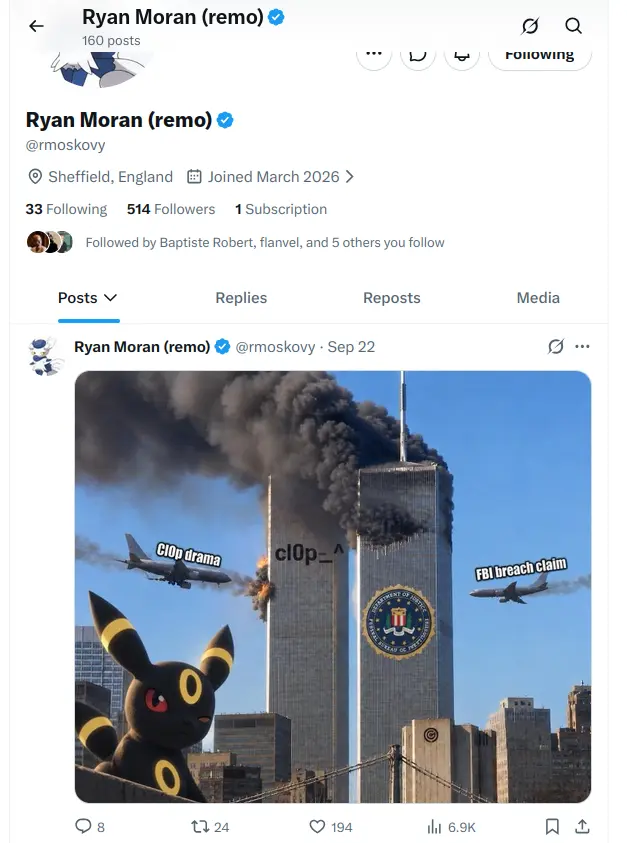
Immediately following Van der Stap’s arrest, Saif Al-din Khader ("Rey") seized control of the volatile ShinyHunters brand. Capitalizing on the vacuum left by the arrest of the Dutchman—whose former hacker alias was "Umbreon"—Rey publicly boasted about infiltrating FBI systems and extorting the notorious Cl0p ransomware group.
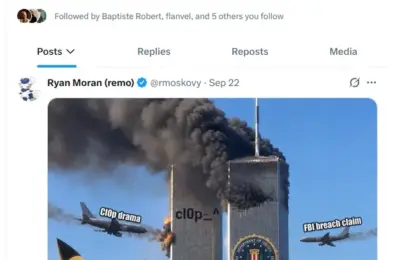
In an elaborate attempt to frame Van der Stap, Rey’s public posts on Twitter/X featured mocking memes juxtaposed with Umbreon’s distinct avatar. Simultaneously, Rey’s digital footprint revealed a deep obsession with the Cl0p syndicate; in March 2026, he had published an exhaustive investigation on a GitHub blog doxing two Russian men believed to be the core architects behind Cl0p.
However, Rey’s grandstanding quickly backfired. Threat intelligence trackers and rival cybercrime factions on Telegram launched a counter-campaign dubbed "The Battle," relentlessly doxing Rey, exposing his financial transactions, and ridiculing his tactical ineptitude.
September 30, 2026: The Darknet Website Goes Dark
As federal investigators closed in and a self-imposed FBI ultimatum expired, the primary darknet data-leak portal utilized by ShinyHunters suddenly went offline. The group’s infrastructure fractured as members scattered, and Rey began purging his social media footprint in a futile effort to evade detection.

October 3–6, 2026: Detentions and Contractor Fallout
- October 3, 2026: Reuters cited three unnamed intelligence sources confirming that a suspected ShinyHunters administrator in Amman, Jordan, named Saif Al-din Khader, had been detained by local authorities and was actively cooperating with the FBI.
- October 5, 2026: Investigative reports revealed that the FBI had terminated a contractor at Accenture following a damaging breach of the Bureau’s recruitment portal. The negligence—failing to apply patches to the PeopleSoft server—exposed sensitive personal identifiable information (PII) on more than 5,000 FBI personnel, including psychiatric records, medical histories, and specialized unit classifications.
Supporting Context & Metrics: The Anatomy of a Cybercrime Franchise
To fully grasp the mechanics of modern digital extortion, analysts must examine how groups like ShinyHunters have evolved from centralized cells into decentralized syndicates of independent contractors.
The Franchise Model of Extortion
Original iterations of ShinyHunters, largely composed of French nationals who have since faced arrest and imprisonment, established a notorious reputation for leaking massive volumes of corporate data. Yet, the brand survived its original founders. Much like the literary concept of the "Dread Pirate Roberts," the ShinyHunters moniker became a marketable franchise.
According to investigators, the modern incarnation relies on a network of freelance cybercriminals and affiliates who feed stolen credentials from SaaS platforms into a shared pool. These freelancers negotiate ransom demands with victim corporations, typically paying out a 25% to 30% cut to whoever controls the group’s alias and negotiation channels.
The Boeing and Jeppesen ForeFlight Connection
The urgency of the FBI’s investigation surged exponentially when ShinyHunters turned its crosshairs toward Jeppesen ForeFlight, a digital aviation and navigation business unit recently divested by Boeing. In November 2025, Boeing had sold Jeppesen ForeFlight to private equity firm Thoma Bravo for a staggering $10.55 billion.

The theft of sensitive navigation and flight operations data from this subsidiary introduced severe operational security risks, prompting rapid intelligence-sharing between aerospace executives and federal law enforcement. This corporate victimization carried an ironic personal dimension: Rey’s father is widely reported to be an employee of Royal Jordanian Airlines, a carrier largely controlled by the Jordanian government that operates its long-haul passenger fleet on Boeing aircraft. Password-stealing malware recovered from a shared family computer revealed that Rey’s father utilized identical credentials across multiple internal portals for Royal Jordanian personnel—providing investigators with a clear trail into the suspect’s immediate circle.
Official Statements and Institutional Responses
The fallout from the dual operations in Jordan and the Netherlands has forced targeted corporations, security vendors, and government bodies to issue public clarifications regarding their security postures.
- Boeing Corporate Communications: In a brief statement provided to security researchers, Boeing acknowledged the digital extortion attempts. "We are aware of claims by a threat actor regarding data allegedly associated with Boeing and our former subsidiary Jeppesen ForeFlight," a Boeing spokesperson stated. "We are actively reviewing the matter with the Jeppesen ForeFlight team."
- Jeppesen ForeFlight: Maintaining a calm posture, a company spokesperson emphasized that proactive internal safeguards insulated their core infrastructure. "Based on our investigation to date into this claim and proactive security posture, there was no impact to our operations or products."
- Neo Security and Benjamin Korper: Following the dramatic arrest of Pepijn van der Stap, his employer at Neo Security faced immediate intense scrutiny. Founder Benjamin Korper confirmed to journalists that an independent forensic firm was hired to audit Neo Security’s infrastructure. While investigators found no evidence that Van der Stap had compromised his employer or clients, the raid—featuring flash-bang grenades deployed by tactical police units—highlighted the violent volatility trailing modern cybercriminals.
- The Federal Bureau of Investigation: In its May 2026 Flash Notice (PSA260515), the FBI formally advised victims against paying ransoms to ShinyHunters, highlighting the group’s erratic harassment techniques, which historically included telephonic harassment, direct threats to victims’ families, and "swatting" campaigns. In response to the advisory, ShinyHunters representatives brazenly told tech publication The Register that hacking the FBI was fundamentally a public relations stunt designed to undermine the Bureau’s credibility and preserve their extortion revenue streams.
Future Outlook: The Death of a Brand and Lessons for Enterprise Security
The neutralization of Saif Al-din Khader in Amman and the ongoing prosecution of Pepijn van der Stap in the Netherlands signal a watershed moment for cybercrime enforcement. However, the dismantling of these specific individuals does not eradicate the underlying structural vulnerabilities that enabled their campaigns.
- The Vulnerability of Third-Party SaaS Platforms: The heavy reliance on enterprise software platforms like Oracle PeopleSoft demonstrates that corporate supply chains remain dangerously fragile. Malicious actors no longer need to breach hardened perimeters directly; they can exploit zero-day vulnerabilities in administrative utilities to slip undetected into thousands of global networks.
- The Perils of "Reformed" Hacker Integration: The Van der Stap case serves as an unsettling cautionary tale for the cybersecurity industry. As firms increasingly hire former cybercriminals to bolster "offensive security" teams, the lack of rigorous vetting and verifiable rehabilitation metrics creates severe internal trust vulnerabilities.
- The Erosion of Cybercrime Anonymity: Rey’s downfall underscores the persistent reality that youthful bravado, social media hubris, and personal ego inevitably override operational security. By engaging in public flame wars on Telegram, taunting law enforcement with custom memes, and entangling family credentials in compromised digital footprints, amateur operators invite their own undoing.
As international law enforcement continues to lean on cooperators like Khader to map out remaining affiliate networks, the "ShinyHunters" brand lies in ruins—its darknet portals offline, its leadership scattered or imprisoned, and its remaining freelancers warned that the cost of adopting a notorious moniker is ultimate accountability before the law.