Executive Overview
The promise of artificial intelligence in customer experience (CX) has long been fueled by vendor hype, glossy product demos, and idealized sandbox environments. But how well do AI agents actually perform when deployed in the chaotic, high-stakes trenches of live e-commerce?
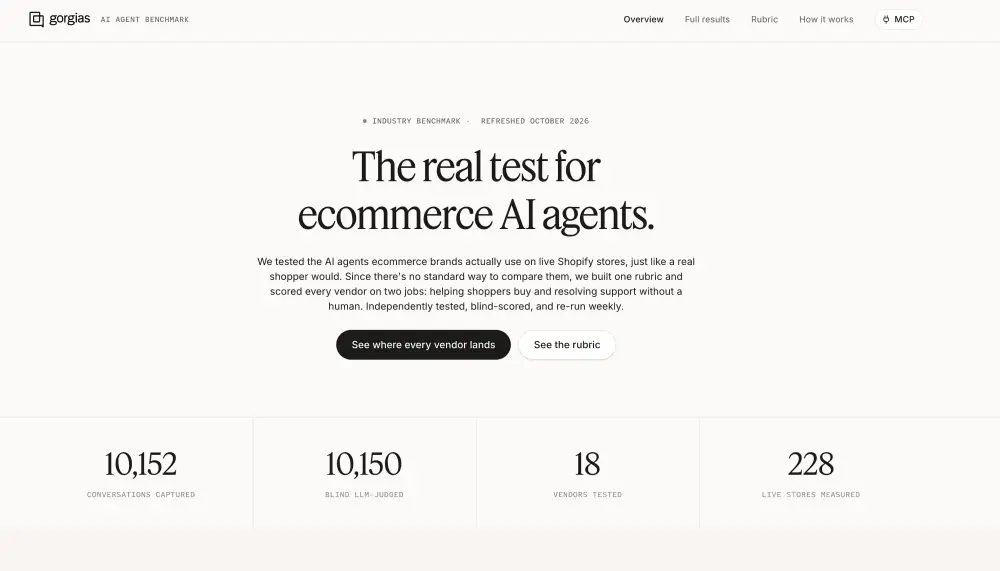
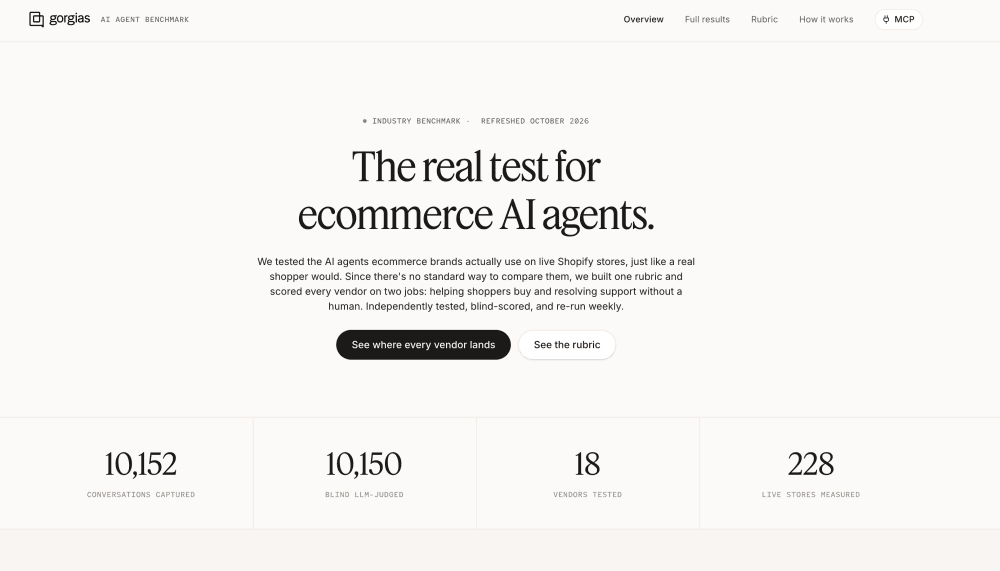
To answer this pressing question, Gorgias—a $100M ARR e-commerce CX leader backed by SaaStr Fund—has published a groundbreaking, independent public benchmark. Evaluating 13 distinct AI vendors across 212 live, mid-market e-commerce stores carrying real inventory, the study strips away synthetic catalogs and marketing spin. Every agent faced the same live customer messages, evaluated blindly by automated judges against 26 rigorous binary checks. Factual claims regarding pricing, store policies, and stock-keeping units (SKUs) were programmatically verified against live store data.
The findings deliver a sobering dose of reality to the software-as-a-service (SaaS) and e-commerce landscapes: the industry’s best AI agents fully resolve about 70% of customer conversations without human intervention. However, the typical vendor clears less than half.
Even more startlingly, legacy customer service titans and marketing giants—including Zendesk, Intercom, and Klaviyo—underperformed significantly, with none managing to resolve more than 42% of customer interactions in this rigorous assessment. As enterprises pour billions into automation to drive down operational costs, this new benchmark provides the first truly objective playbook for separating marketing illusions from operational utility.
Detailed Chronology and Testing Methodology
For years, procurement teams have relied on vendor-provided metrics that utilized highly optimistic definitions of "automation." Recognizing a massive transparency void in the market, the evaluation architecture was designed from the ground up to reflect genuine consumer experiences rather than laboratory ideals.
The Anatomy of the Evaluation
Unlike typical internal testing conducted in closed developer sandboxes, this benchmark engaged real-world operational friction.
- Live Environments: The evaluation tested agents on 212 active, mid-market e-commerce storefronts handling genuine customer traffic and active supply chains.
- Controlled Inputs: Every participating vendor’s agent received identical, unvarnished customer inquiries.
- Blind Judging & Programmatic Checks: Responses were scored blind to the vendor identity against a strict checklist of 26 binary parameters. Factual details—such as whether a stated return window matched store policy or if a product price was quoted correctly—were programmatically audited directly against the live databases of the respective merchant stores.
Redefining "Resolution"
The core discrepancy between vendor marketing claims and reality lies in the definition of a resolved ticket. In-product analytics deployed by vendors often utilize loose guardrails; for instance, counting an interaction as automated if the AI provides an answer and 72 hours pass without a human agent stepping in. Under these definitions, a frustrated customer who simply abandons the chat in disgust is logged as a "successful resolution."
The new benchmark rejects this obfuscation. A conversation was categorized as successfully automated only when the AI handled the query with absolute zero human touch. This meant:
- No handoff to a human representative.
- No defensive deflection out of the communication channel (e.g., forcing the customer to email, fill out a legacy contact form, or call a support hotline).
- No conversational dead-ends.
If an agent’s automated fallback strategy pushed a customer away from the chat interface, the interaction was immediately scored as an unresolved failure. Because the testing auditor never requested human assistance, every single handoff was treated as a direct decision and limitation of the autonomous agent itself.
Supporting Context and Metrics: Performance Breakdown
The data paints a fascinating, highly stratified picture of the current e-commerce AI vendor ecosystem. While a select few pioneers have built robust autonomous systems, the vast majority of the market lags behind.
Top Performers vs. The Median Field
When analyzing automation rates—defined as the share of engaged conversations successfully closed by the AI without human intervention over a rolling four-week observation window—the disparity is stark:
- The Top Five Vendors: Average a 70% automation rate (individual top performers range between 64% and 75%).
- The Median Vendor: Resolves just 48% of interactions.
- Volume-Weighted Average: Across the entire evaluated field, the aggregate automation rate sits at 46%.
Most concerning for enterprise buyers is the performance of bundled helpdesk solutions. Major platforms that brands already pay for—such as Zendesk, Intercom, and Klaviyo—all hovered at or below a 42% resolution rate. For brands relying on the built-in AI tools of their primary ticketing or email suites, the data suggests they are utilizing some of the weakest automation options available on the market.
Automation Rate vs. Quality Score
High automation alone can be a dangerous metric if the underlying answers are factually incorrect or unhelpful. When cross-referencing automation rates with blind quality scores (graded on a 0 to 100 scale), vendors generally fell into three distinct buckets:
- Strong on Both Metrics: Vendors like Yuma, Decagon, and Gorgias successfully cleared the bar for both high automation (>64%) and high quality (>65).
- High Automation, Weak Answers: Certain platforms aggressively close tickets, but sacrifice accuracy. For example, Ada successfully closes a high volume of conversations, but scored significantly lower on overall answer quality.
- Strong Answers, Low Automation: Conversely, vendors like Sierra achieved elite-tier quality scores matching industry leaders, yet failed to autonomously resolve even half of their inbound traffic.
The practical business case for weighting quality alongside speed and automation is clear: a ticket incorrectly marked as "resolved" because it provided a customer with the wrong return window inevitably spawns a secondary contact. Because resolving a second-touch complaint often costs significantly more than the initial interaction, low-quality AI agents actively generate their own future ticket volume.
The Slippery Slope: Widespread Performance Declines
One of the most concerning revelations from the four-week historical tracking data is that performance stability is far from guaranteed.
- Nine out of ten tracked vendors lost automation ground over the observation period.
- Quality metrics followed a similar downward trajectory, with nine out of ten vendors experiencing score drops (e.g., Ada dropping 17 points, Zendesk down 15, Sierra down 14, and Gorgias down 12).
Whether these fluctuations stem from quiet underlying model updates, merchant store configuration drift, or increasingly complex customer inquiries, the takeaway for enterprise leadership is absolute: the automation rate witnessed during a vendor pilot is rarely the rate sustained in production next month. Continuous monitoring and scheduled re-evaluations are mandatory.
Topic Vulnerability: Order Tracking vs. Policy Pages
The benchmark breaks down support quality by specific topic categories, revealing a massive variance in how agents handle different types of requests. The field experienced an average 28-point drop between its easiest conversation types and its hardest:
- Policy Pages (Highest Scores): Questions that can be answered directly from static documentation or return policies yield the highest success rates.
- System Lookups & Dynamic Queries (Lowest Scores): Questions requiring real-time enterprise system lookups, database queries, or nuanced judgment calls sit near the bottom of the capability list.
Critically, order tracking—historically the single largest ticket category for e-commerce brands—resides near the bottom of performance rankings. Across the board, only about a third of post-sale tracking inquiries reached a successful autonomous finish. Furthermore, the most common technical failures observed by judges were not hallucinated facts, but rather rigid authentication walls, endless loops demanding re-entered order numbers, and immediate, unnecessary escalations to human agents.
Official Statements and Industry Insights
Industry veterans and tech executives have been quick to weigh in on the implications of this transparency milestone.
"Exactly how many support and related issues can AI Agents really, truly resolve today? It’s a good test of just exactly where the latest models and agents are," notes tech analysts tracking the SaaS fund investments. By removing sandboxes and synthetic catalogs from the equation, the benchmark forces vendors to confront the messy reality of production-grade commerce.
The debate over pricing models is equally heated. Because "resolved conversations" frequently serve as the foundational billing unit for AI platforms—with solutions like the Gorgias AI Agent charging roughly $0.90 per resolved ticket—the definition of success directly impacts corporate P&Ls.
"Get each vendor’s exact definition of a billable resolution in writing before you sign any enterprise contract," industry advisors warn. If an agent artificially deflects users or relies on ambiguous closure metrics, businesses risk paying premium rates for inflated performance figures.
Future Outlook: Strategic Takeaways for E-Commerce Leaders
As artificial intelligence continues its rapid evolution, e-commerce brands must pivot away from superficial vendor promises toward rigorous, data-driven procurement strategies. Based on the insights of this benchmark, industry leaders recommend a six-point action plan for navigating the AI agent market:
- Build Realistic Financial Models: Base business cases on a conservative 65% to 70% resolution ceiling—and only when partnering with a proven, top-five tier vendor. For bundled helpdesk tools, expect realistic automation rates between 20% and 42%.
- Evaluate Automation and Quality Concurrently: Never select a vendor based on resolution volume alone. Insist on seeing verified quality scores evaluated against identical test corpuses.
- Weight Results Against Your Specific Ticket Mix: If the majority of inbound customer volume consists of complex order tracking, delivery exceptions, or damaged items rather than static policy inquiries, the benchmark averages will overstate expected performance.
- Conduct Cold Reference Testing: Do not rely on vendor demos. Take 30 real support tickets from the previous month, open fresh incognito sessions on the live websites of the vendor’s current customers, and independently audit their full resolution capabilities.
- Establish Routine Re-Testing Protocols: Because the vast majority of vendors experienced performance degradation over recent four-week monitoring periods, treat AI agent deployment as an ongoing operational asset requiring continuous monthly audits and prompt optimization.
- Scrutinize Onboarding and Configuration: The benchmark highlights that the same foundational AI model can score brilliantly on one merchant store and fail completely on another. Guardrails, identity authentication flows, and escalation logic—which are configured directly by the brand—account for the vast performance gap between mediocre deployments and market-leading successes.
Ultimately, while current AI agents have proven capable of handling routine policy inquiries with impressive efficiency, the journey toward fully autonomous e-commerce customer service remains an ongoing engineering challenge. Transparency initiatives like this public benchmark provide the necessary roadmap to navigate the hype and build genuinely resilient customer support operations.