Executive Overview
The modern go-to-market (GTM) technology stack is undergoing a structural bifurcation. For years, organizations have chased the elusive "silver bullet"—a single, monolithic platform that promises to automate the entirety of marketing, sales prospecting, and customer success. However, as artificial intelligence matures from experimental chatbots to autonomous agents capable of complex reasoning and multi-system execution, leading-edge teams are adopting a more nuanced architecture.
SaaStr AI, a recognized testing ground for cutting-edge sales technology, offers a clear lens into this evolution. Rather than relying entirely on third-party AI software or building an unmanageable proprietary infrastructure from scratch, SaaStr AI has pioneered a hybrid model. The organization utilizes a suite of external commercial vendors—including Monaco, Artisan, Agentforce, and Qualified—to manage high-volume outbound campaigns, win-back strategies, and real-time inbound conversion. Yet, for its highest-value named accounts and complex renewal pipelines, the team relies on an internally developed AI agent named "10K."
This strategic division of labor highlights a growing limitation in commercial AI sales tools: siloed data. While third-party platforms excel at horizontal execution—managing deliverability, sequencing, and domain protection across hundreds of thousands of contacts—they typically lack deep visibility into the proprietary, fragmented first-party data that defines an enterprise’s institutional knowledge. By combining the infrastructure scale of commercial vendors with the contextual depth of a bespoke, internal prospecting and renewal engine, SaaStr AI has unlocked unprecedented engagement metrics, including a 2.1x increase in tailored output efficiency and exceptional response rates from historically difficult-to-convert cohorts.
Detailed Chronology: The Evolution of SaaStr AI’s Outbound Architecture
The implementation of SaaStr AI’s current GTM apparatus did not happen overnight; it evolved through a series of tactical deployments, capability gaps, and iterative internal builds.
Phase 1: Heavy Reliance on Commercial Outbound Tools
In the early stages of scaling its AI-driven revenue operations, SaaStr AI deployed a specialized roster of external vendors to establish volume and velocity. Monaco was brought in to handle cold outbound prospecting, injecting baseline momentum into unmapped markets. Artisan was tasked with managing warm outbound motions, capitalizing on existing brand awareness. Simultaneously, Salesforce’s Agentforce was deployed to execute automated win-back campaigns targeting churned or stalled pipeline, a move that quickly yielded an impressive 72% open rate. On the inbound front, Qualified integrated an AI agent capable of capturing high-intent web traffic, which successfully closed over $2 million in pipeline over a twelve-month period.
These tools proved indispensable for foundational scale. However, as the organization’s database expanded to roughly 450,000 contacts, the leadership team realized that relying solely on out-of-the-box software created a glass ceiling regarding personalization and data synthesis.
Phase 2: The Data Silo Bottleneck
As outbound operations accelerated, the team confronted a fundamental architectural constraint: commercial vendors only see a fraction of an enterprise’s total data footprint. A typical AI Sales Development Representative (SDR) connects to a customer relationship management (CRM) platform, reading surface-level metrics such as contact details, account names, and basic activity histories.
At SaaStr, critical intelligence regarding client behavior is distributed across at least six distinct, non-integrated systems. These include event attendance logs, podcast and media archives, newsletter readership data, historical custom-contract records, and engagement telemetry from proprietary platforms. No commercial outbound vendor is willing or able to custom-wire their infrastructure into all of these disparate data silos for a single customer. Furthermore, as major CRM providers like Salesforce introduce metering for agent API calls via Flex Credits—with internal tools like 10K already executing approximately 35,000 Salesforce API calls daily—deep, continuous CRM reads by third-party vendors threaten to become cost-prohibitive.
Phase 3: The Birth of the Internal Renewal Agent
Recognizing that standard vendors could generate grammatically correct emails but lacked the context required for high-stakes enterprise relationships, the team engineered a breakthrough on Episode #013 of The Agents. Utilizing their internal AI framework, 10K, the team built a specialized renewal agent in roughly half a day.
This renewal agent ingested data from both traditional CRM structures (contracts, historical lifetime value, email opens, live chat histories, and sales call transcripts) and external repositories that had never touched Salesforce (WordPress metrics, social sentiment, podcast download archives, and event registration headcounts). Powered by the Gamma API, the agent automatically generated fully customized renewal decks. Previously, the bandwith required to build bespoke decks limited this level of personalization to the top five diamond-tier sponsors; everyone else received standardized templates. With the agent operational, the volume of custom decks surged from 5 to between 20 and 30 per cycle.
Phase 4: Expanding the Framework to New Logo Prospecting
Buoyed by the success of the renewal agent—particularly among silver-tier sponsors, who historically represented lower renewal rates but responded at unprecedented frequencies when shown granular proof of their past performance—the team applied the exact same architecture to new logo prospecting.
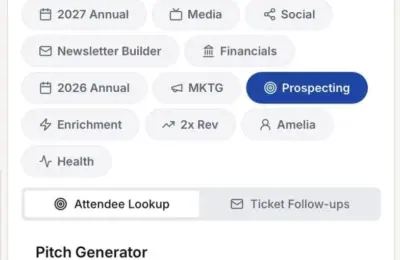
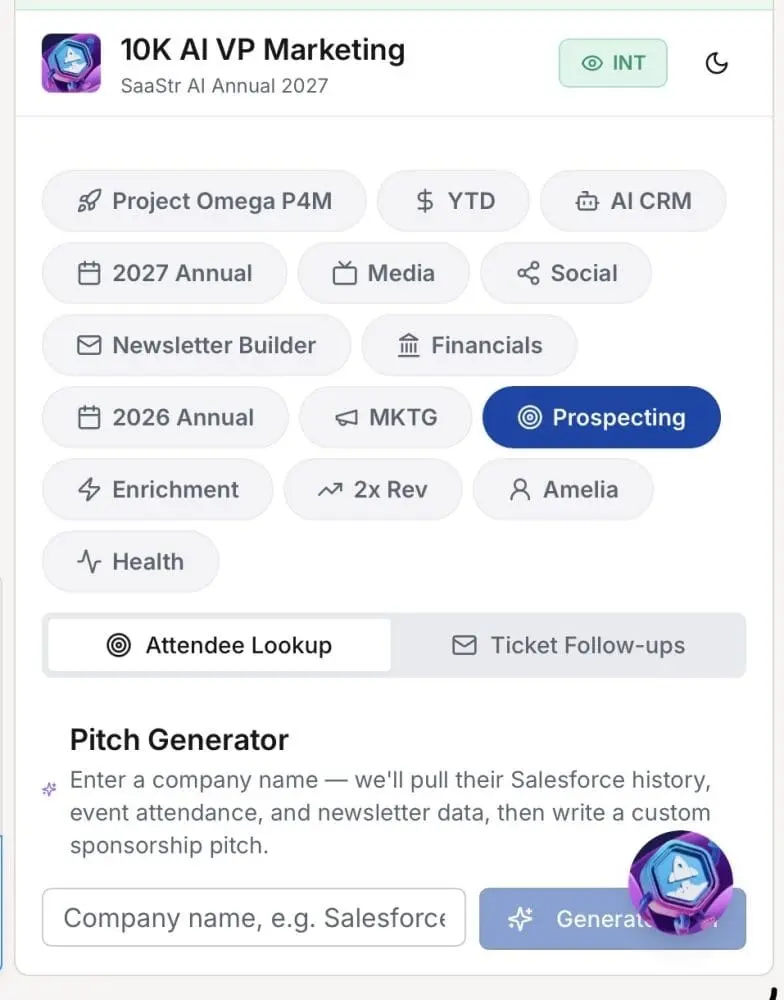
By integrating the Attendee Lookup, Ticket Follow-ups, and an advanced Pitch Generator directly into the Prospecting tab of 10K, the organization effectively birthed an automated Account-Based Marketing (ABM) engine. Today, 10K functions as the team’s virtual Vice President of Marketing, utilizing several of these integrated tools more frequently than any human staff member.
Supporting Context & Metrics: Why Volume and Precision Require Different Engines
The core thesis underpinning SaaStr AI’s GTM strategy is straightforward: 90% of outbound volume should run through proven external vendors, while high-value named accounts require bespoke internal tooling.
+-------------------------------------------------------------------+
|                        SAFASTR AI GTM STACK                       |
+---------------------------------+---------------------------------+
|      VOLUME & SCALE (90%)       |      PRECISION & CONTEXT (10%)  |
+---------------------------------+---------------------------------+
| • Monaco (Cold Outbound)        | • Internal Tool: "10K"          |
| • Artisan (Warm Outbound)       | • Pitch Generator & ABM         |
| • Agentforce (Win-Backs)        | • Automated Custom Decks        |
| • Qualified (Inbound Conversion)| • Cross-System Data Synthesis   |
+---------------------------------+---------------------------------+
The Infrastructure Reality of Outbound at Scale
Outbound operations at scale are fundamentally an engineering and data hygiene challenge. Success relies heavily on domain reputation management, deliverability optimization, multi-touch sequencing, automated reply handling, meeting booking protocols, and rigorous list hygiene. Monaco, Artisan, Agentforce, and Qualified have spent years engineering infrastructure to solve these exact problems across thousands of enterprise customers.
Rebuilding deliverability infrastructure for a 450,000-contact database internally would represent an inefficient allocation of engineering and human capital. Consequently, whenever SaaStr AI executes a high-volume motion, commercial vendors remain the definitive choice.
The Power of Granular, First-Party Data Integration
Where third-party platforms generate generalized pitches—such as "companies like yours sponsor SaaStr to reach B2B executives"—SaaStr AI’s internal Pitch Generator utilizes multi-system data to construct verifiable, hyper-targeted narratives.
When a user inputs a target company name into 10K, the tool queries Salesforce history alongside event attendance logs and newsletter engagement metrics. The resulting output can state with absolute precision:
- Exactly how many professionals from the target organization attended the SaaStr Annual event in the previous year.
- Which specific executives within the target hierarchy actively read the SaaStr newsletter.
- Detailed performance and lead-generation outcomes from the company’s previous sponsorship iterations.
This approach transforms cold outreach into an evidence-based conversation. Because every cited fact is verifiable, the prospect immediately recognizes that the outreach is backed by genuine data tracking rather than generic template generation.
Official Statements & Core Governance Rules
The deployment of autonomous agents for revenue generation introduces operational risks if human oversight is entirely removed. To mitigate these risks and ensure message quality, SaaStr AI established strict governance protocols during the development of its internal prospecting tools.
Jason Lemkin on the Limits of Commercial Software
Reflecting on the rationale behind building proprietary tools when the market is saturated with SaaS alternatives, executive leadership emphasized the necessity of self-reliance for hyper-personalized motions.
"We couldn’t get that from third-party services," notes Jason Lemkin. SaaStr wanted hyper-personalized outreach: the perfect email, the perfect deck. So they built it themselves. "It just can’t, today, it can’t be bought."
With documented milestones including over 17,000 processed conversations, 600 secured meetings, and a 2.1x increase in efficiency metrics, the decision to bridge commercial software with internal engineering has proven quantitatively sound.
The Two Golden Rules of Agent-Assisted Prospecting
To maintain brand integrity and prevent automated missteps, SaaStr AI enforces two non-negotiable operational rules derived from its early renewal agent experiments:
- Human-in-the-Loop Narrative Approval: Autonomous agents are permitted to propose strategic narratives, but a human operator must review and approve them before any collateral is generated. For example, during a silver-tier renewal cycle, the agent initially proposed a standard upsell script. Recognizing that the target company had recently emerged from stealth and scaled rapidly, a human team member redirected the narrative into a tiered media-plus-content proposal. Fixing the strategic narrative at the prompt stage takes minutes; editing a fully generated, multi-page deck takes hours.
- Asymmetrical Communication Depth: The initial outreach must be concise and conversational. When the renewal agent led with a massive, pre-built deck attached to the first email, engagement lagged. When the team shifted to a short, text-based introductory email, response rates spiked significantly. Furthermore, replies to that initial touch provided qualitative feedback indicating precisely what data and assets should be included in the follow-up. The agent initiates the conversation; human specialists deliver the deep, customized follow-up packages.
Future Outlook: The Next Phase of AI-Driven GTM Architecture
As the enterprise software market absorbs the lessons of the AI agent wave, the division between horizontal SaaS vendors and bespoke internal applications is expected to sharpen.
For the broader B2B SaaS ecosystem, SaaStr AI’s hybrid model serves as a preview of where revenue operations are heading. The era of buying a single platform to handle every aspect of sales and marketing is giving way to a modular architecture. Organizations will increasingly license robust infrastructure layers—such as deliverability networks, conversational bots, and sequencing engines—from specialized external vendors, while investing in lightweight, proprietary internal codebases to ingest, clean, and activate their unique first-party data assets.
As CRM APIs become more strictly metered and generic AI copy floods buyer inboxes, generic personalization will rapidly lose its efficacy. The future belongs to organizations capable of synthesizing deep, cross-functional data histories into verifiable, high-context business cases. By maintaining commercial engines for volume while engineering proprietary agents for precision, SaaStr AI has mapped out a sustainable blueprint for navigating the next generation of sales technology.