Executive Overview
In the rapidly evolving landscape of artificial intelligence-driven sales development, organizations are confronted with a critical strategic dilemma: should they rely entirely on specialized third-party outbound vendors, or should they engineer proprietary internal tooling to leverage deep, proprietary data?
For SaaStr AI, the answer is not an absolute binary, but a highly calculated hybrid model. While approximately 90% of the company’s daily outbound volume—encompassing deliverability management, sequencing, reply handling, meeting booking, and list hygiene—continues to run through established external platforms like Monaco, Artisan, Agentforce, and Qualified, a quiet revolution has taken place internally.
SaaStr AI has constructed a proprietary prospecting engine embedded within its proprietary platform, 10K. This internal tool is designed to solve a fundamental limitation of commercial AI Sales Development Representative (SDR) software: the inability to ingest and synthesize deep, multi-source first-party data that never touches a traditional CRM. By merging historical Salesforce data with fragmented touchpoints—ranging from event attendance records and newsletter readership metrics to past sponsorship performance and proprietary communication archives—SaaStr AI has pioneered a hyper-targeted Account-Based Marketing (ABM) motion.
This investigative report examines SaaStr AI’s dual-track outbound strategy, exploring why commercial vendors remain essential for scale, why proprietary internal tools are required for high-value strategic accounts, and the vital operational guardrails—such as human-in-the-loop narrative approval and tiered messaging—that prevent automation from turning into impersonal noise.
Detailed Chronology: From Custom Deck Bottlenecks to Automated ABM
The Pre-Agent Era: Manual Customization at Scale
Historically, hyper-personalized sales outreach suffered from an intractable economic constraint: it did not scale. At SaaStr AI, creating truly bespoke pitch decks and data-driven proposals was a luxury reserved exclusively for the organization’s elite tier of "diamond" sponsors—roughly five accounts per year that commanded the highest contract values.
For the remaining ecosystem of silver and gold sponsors, the reality was starkly different. While their financial contributions were vital, resource constraints dictated that they received standardized, heavily templated follow-up communications and generic renewal packets. This created an operational ceiling, locking out mid-tier accounts from experiencing the white-glove treatment typically reserved for enterprise giants.
The Turning Point: Building the Renewal Agent in Half a Day
The genesis of SaaStr AI’s internal prospecting engine began not with new customer acquisition, but with customer retention. As detailed on Episode #013 of The Agents, team member Amelia engineered a dedicated renewal agent built directly on top of the 10K platform in approximately half a day.
This renewal agent was designed to break down organizational data silos. It ingested structured data from Salesforce—including contracts, historical lifetime value (LTV), email open rates, Qualified chat logs, and Momentum call transcripts—while simultaneously pulling unstructured and disparate data that had never lived inside the CRM:
- WordPress engagement metrics
- Social media interactions
- The extensive SaaStr podcast archive
- Bizzabo event lead counts
By integrating this information through the Gamma API, the agent automatically generated fully custom, data-rich renewal decks.
The Shift in Output and Engagement
The operational impact of deploying the renewal agent was immediate and dramatic. Where SaaStr AI had previously managed to produce customized decks for only 5 major accounts, the automated renewal agent successfully generated and dispatched 20 to 30 custom decks to a much broader cohort of clients.
The qualitative and quantitative results challenged conventional B2B sales assumptions. Silver sponsors—companies writing smaller checks that historically suffered from the lowest renewal rates—replied at a significantly higher rate than the diamond sponsors. For a smaller company, a $25,000 sponsorship represents a major budgetary decision, often carrying more internal scrutiny than a $300,000 allocation from an enterprise giant like Google Cloud. By delivering a custom deck that meticulously tracked their specific event ROI and engagement metrics, SaaStr AI proved that mid-tier accounts valued granular, data-backed attention just as much as tier-one enterprises.
Buoyed by the success of the renewal agent, SaaStr AI leadership realized that the underlying architecture could be redeployed to solve a parallel challenge: new logo acquisition. Thus, the proprietary prospecting tool within 10K was born.
Supporting Context & Metrics: The Anatomy of a Hybrid Stack
Why 90% of Outbound Still Runs Through Vendors
Despite possessing sophisticated internal engineering capabilities, SaaStr AI remains heavily reliant on established third-party outbound vendors. To understand this balance, one must examine the operational complexities of modern high-volume prospecting.
Outbound at scale is governed by infrastructure challenges that require years of dedicated engineering and massive customer-base feedback loops to solve. These include:
- Deliverability Protection: Ensuring emails land in the primary inbox rather than the spam folder across shifting domain reputation algorithms.
- Advanced Sequencing: Managing multi-channel touchpoints over weeks without triggering provider blocks.
- Reply Handling & Sentiment Analysis: Parsing incoming prospect responses to categorize objections, out-of-office notices, and positive interest.
- Meeting Booking & List Hygiene: Automating calendar scheduling while continuously scrubbing bounce rates and outdated contact details.
Platforms like Monaco, Artisan, Agentforce, and Qualified have invested years solving these exact engineering hurdles. Furthermore, SaaStr AI maintains a database comprising approximately 450,000 contacts. Attempting to rebuild core deliverability infrastructure, mailbox warm-up protocols, and inbox rotation networks for a database of this size would represent an inefficient allocation of engineering resources. Therefore, for any motion driven primarily by sheer volume, commercial vendors remain the undisputed choice.
The CRM Data Bottleneck
Where standard AI SDR vendors invariably hit a wall is the breadth of data they can access. A typical commercial AI SDR connects to a company’s CRM and reads a predictable, restricted subset of information: basic contacts, account fields, and occasional activity histories.
At SaaStr AI, institutional knowledge regarding an account is radically decentralized, living across at least six distinct, disconnected silos:
- The core Salesforce CRM instance
- Proprietary event attendance databases (tracking physical and virtual participation)
- Comprehensive newsletter readership and engagement logs
- Podcast archive consumption tracking
- Content management platforms (WordPress)
- Customer communication channels (Qualified chats, Momentum calls)
No commercial outbound vendor is configured to wire into all of these disparate data repositories for a single customer. Compounding this structural limitation is the shifting economic landscape of CRM data consumption. Major enterprise software providers, including Salesforce, have introduced metered pricing models for agent API calls—such as Flex Credits. With internal platforms like 10K already executing approximately 35,000 Salesforce API calls daily, forcing external vendors to perform deep, multi-system CRM reads on every single prospect would introduce prohibitive cost structures over time.
Inside the 10K Pitch Generator: Account-Based Marketing at Scale
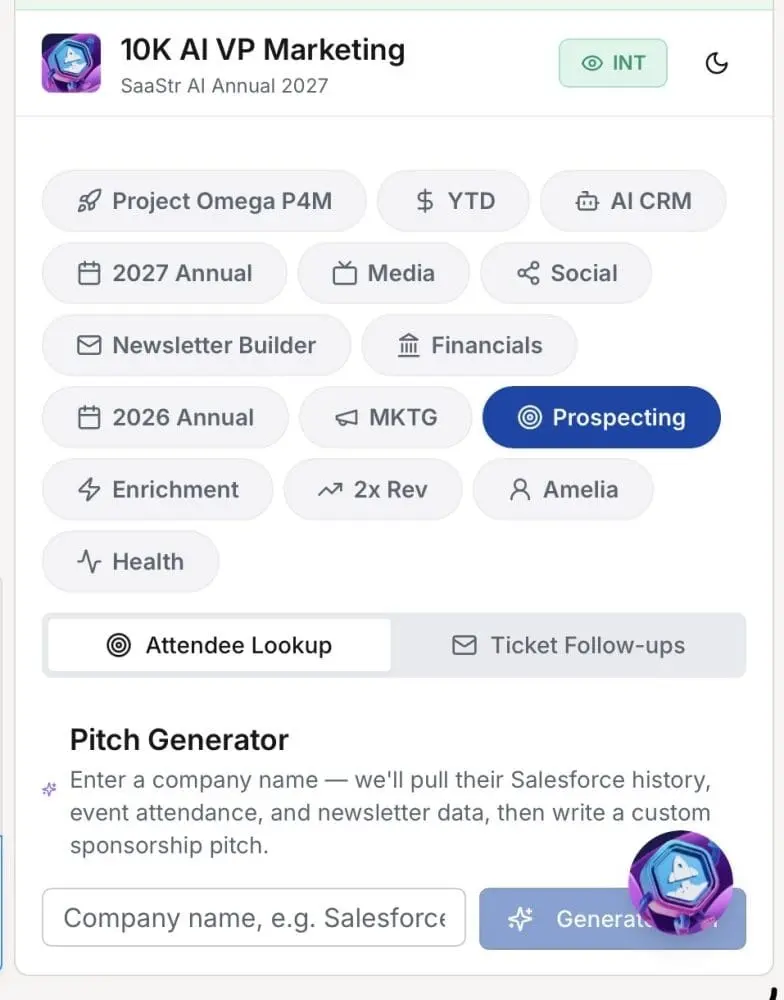
To bridge this data divide, SaaStr AI developed the Prospecting tab inside 10K, featuring dedicated modules for Attendee Lookup, Ticket Follow-ups, and the flagship Pitch Generator.
When an operator inputs a target company name into the tool, the engine executes a multi-point data retrieval operation:
- It queries Salesforce for historical interactions and past deal stages.
- It scans event attendance logs to identify physical delegates from that organization.
- It cross-references newsletter engagement to flag specific leaders who consume SaaStr content.
Instead of a generic commercial pitch—such as "Companies like yours sponsor SaaStr to reach B2B executives"—the 10K pitch generator crafts hyper-personalized messaging grounded in verifiable facts:
"We noticed that 14 members of your executive team attended SaaStr Annual last year, and your VP of Marketing regularly reads our weekly newsletter. Furthermore, based on your team’s lead generation metrics from your previous sponsorship tier, your prospective pipeline return for an expanded presence is projected at…"
Every single data point cited in the pitch is about the target company, allowing prospects to easily verify the accuracy of the outreach. SaaStr AI characterizes this methodology not as traditional cold emailing, but as "AI ABM"—Account-Based Marketing where an autonomous agent executes the laborious, multi-source research that human SDRs simply do not have time to perform.
Official Statements & Operational Guardrails
Guardrail One: Human-in-the-Loop Narrative Approval
The integration of generative AI into high-stakes revenue workflows introduces significant brand and messaging risks. To mitigate these risks, SaaStr AI instituted strict operational guardrails derived directly from the lessons learned during the deployment of its renewal agent.
Rule Number One: The agent proposes a narrative, but a human operator must explicitly approve it before any collateral is generated.
During the initial deployment of the renewal agent, the AI reviewed a silver sponsor’s profile and automatically proposed the narrative: "You are a silver sponsor; you should upgrade to gold." However, a human review by Amelia revealed vital contextual nuance: the target company had emerged from stealth mode immediately prior to the previous event and had experienced explosive headcount and revenue growth since.
Recognizing that a simple upgrade pitch was misaligned with the account’s trajectory, the human operator modified the narrative to offer three tailored options, including a specialized media-plus-content tier. Correcting the strategic narrative upfront took a matter of minutes. Attempting to edit a fully generated, rigid slide deck after the fact would have required a complete reconstruction of the asset.
Guardrail Two: Tiered Communication Architecture
Rule Number Two: The initial outreach email must remain concise, reserving deep-dive personalized content for subsequent follow-ups.
Through iterative testing on renewal campaigns, SaaStr AI discovered that sending an initial email without an attached or linked pitch deck consistently generated higher response rates than leading with heavy collateral. Furthermore, the qualitative nature of the replies to those brief opening emails provided valuable buying signals that informed what content should be emphasized in the deeper pitch.
Consequently, the operational workflow dictates that the AI agent executes the initial touchpoint, while a human team member takes over to deliver the detailed, data-rich follow-up.
Future Outlook: The Definitive B2B Go-To-Market Stack
SaaStr AI’s dual-track outbound architecture offers a compelling blueprint for the future of B2B go-to-market strategies. As commercial AI tools become increasingly commoditized, competitive advantage will no longer stem from the mere ability to automate email sending at scale. Instead, differentiation will be defined by an organization’s ability to seamlessly harness proprietary, first-party operational data that external software cannot access.
Reflecting on the empirical results of this hybrid model—yielding over 17,000 conversations, 600 qualified meetings, and a 2.1x increase in pipeline velocity—CEO Jason Lemkin summarized the core thesis during a recent public briefing:
"We couldn’t get that from third-party services. SaaStr wanted hyper-personalized outreach: the perfect email, the perfect deck. So we built it ourselves. It just can’t, today, it can’t be bought."
Summary of the SaaStr AI Setup
To replicate or adapt this proven architecture, revenue leaders must segment their outbound motion into distinct operational tiers:
- Volume Outbound (Vendors): Retain commercial platforms (such as Monaco, Artisan, Agentforce, and Qualified) to manage high-volume email sequencing, domain protection, list hygiene, and initial prospect engagement.
- Strategic ABM (Internal Tooling): Engineer proprietary internal applications (such as the 10K Prospecting and Pitch Generation modules) to mine decentralized first-party data across CRM, event, content, and communication silos.
- Hybrid Execution (Human-in-the-Loop): Utilize autonomous agents to aggregate research and propose strategic narratives, but mandate human validation for narrative selection and second-touch deep engagement.
As data privacy regulations tighten, API costs rise, and buyer fatigue toward generic AI-generated spam reaches an all-time high, the future belongs to companies that can successfully blend the automated scale of commercial vendors with the profound, bespoke relevance of internal intelligence engines.