Executive Overview
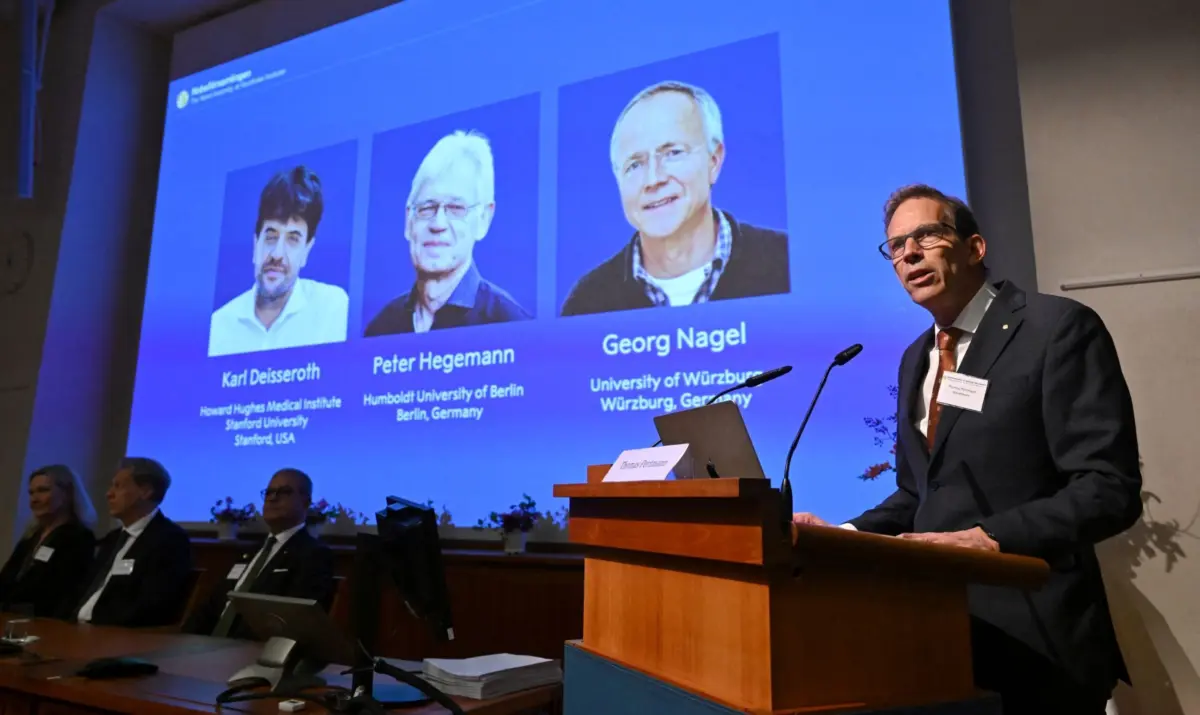
In a landmark decision that bridges the once-distant worlds of microbiology and neurobiology, the Karolinska Institute has awarded the 2026 Nobel Prize in Physiology or Medicine to three pioneering researchers: Karl Deisseroth of Stanford University, Peter Hegemann of Humboldt University in Berlin, and Georg Nagel of the University of Würzburg.
This trio of scientists unlocked a capability that previous generations of neuroscientists could only imagine: the ability to control individual nerve cells with pulses of light. Their breakthrough birthed optogenetics, a revolutionary technique that has fundamentally transformed our understanding of the living brain.
By merging microbial genetics with optical engineering, optogenetics allows researchers to toggle specific neurons on or off with millisecond precision. According to Per Svenningsson, chair of the Nobel Committee for Medicine, the technique provides "opportunities for mapping the brain in a way that we could once only dream of."
No other methodology offers such granular, targeted insight into the nervous system. Beyond its profound academic value, optogenetics is accelerating our comprehension of complex neurological and psychiatric disorders—including depression, schizophrenia, and post-traumatic stress disorder (PTSD)—while opening transformative pathways in clinical medicine, such as the restoration of sight in the visually impaired.
Detailed Chronology: From Algae to Neural Circuits
The path to optogenetics is a masterclass in serendipity, cross-disciplinary collaboration, and relentless scientific inquiry. It began not in a mammalian neuroscience laboratory, but in the study of a humble, single-celled pond organism.
1. The Algal Origins: Peter Hegemann’s Early Inquiries
At the close of the 20th century, Peter Hegemann set out to answer a fundamental biological question: How does the single-celled alga Chlamydomonas detect and react to light?
For decades, biologists had known that Chlamydomonas possessed an "eye spot"—a tiny, orange-pigmented dot on its cellular surface containing a light-sensing molecule called retinal. However, the precise mechanics of how this structure translated light into movement remained elusive.
Using microscopic electrodes, Hegemann began measuring the electrical signals generated by the alga upon light exposure. His findings were astonishing: the organism produced an electrical impulse a mere 0.5 milliseconds after receiving a photon of light. This response time is roughly 20 times faster than that of the human eye, whose photoreception process takes at least 10 milliseconds.
Hegemann hypothesized that light detection in Chlamydomonas relied on a dramatically simpler mechanism than the complex biochemical cascades found in human eyes. In the early 1990s, he proposed a radical theory: the algal eye spot contained a specialized protein that functioned simultaneously as a light sensor and an ion channel, opening directly upon illumination to allow charged particles to flood the cell.
At the time, the hypothesis sparked fierce skepticism. While thousands of ion channels had been documented, none were known to be directly responsive to light without intermediary signaling molecules.
2. Genetic Sequencing and Georg Nagel’s Breakthrough
To validate his theory, Hegemann attempted to isolate the light-sensitive proteins directly from the algal eye spot. Yet, once removed from their native cellular membrane, the proteins destabilized and lost their function.
The impasse broke when an independent group of Japanese researchers successfully sequenced the complete genome of Chlamydomonas. Armed with this genetic blueprint, Hegemann’s team identified two candidate genes that theoretically encoded proteins with the properties of a light-gated ion channel.
Enter Georg Nagel, who took the critical next step of functional verification. Nagel isolated the newly identified genes and introduced copies of them separately into unfertilized frog oocytes (eggs). The frog eggs successfully synthesized the corresponding proteins, embedding them into their outer cell membranes.
When Nagel illuminated the eggs, the proteins functioned precisely as predicted: they acted as light-gated ion channels. Nagel named the genes channelrhodopsin-1 and channelrhodopsin-2 (ChR2).
Further biophysical analysis revealed that the protein produced by ChR2 operated with blistering speed, permitting a massive influx of ions in a mere 0.2 milliseconds. This biological velocity accounted for the extraordinary photosensitivity and reaction times originally observed in Chlamydomonas.
3. Crossing the Kingdom Barrier: Karl Deisseroth and Mammalian Integration
While Nagel and Hegemann had mapped the molecular machinery of algal light perception, the broader scientific community quickly realized its potential. If these foreign, light-sensitive proteins could be introduced into mammalian cells—which do not naturally respond to light—researchers could theoretically control animal cellular activity using fiber optics.
This realization drew the attention of Karl Deisseroth, a bioengineer, psychiatrist, and neuroscientist at Stanford University. Deisseroth was searching for a tool that could selectively manipulate the firing patterns of individual neurons within a living, behaving mammalian brain. Traditional methods, such as electrical stimulation or pharmacological intervention, lacked spatial and temporal precision, affecting thousands of unrelated cells simultaneously.
In 2005, Deisseroth contacted Nagel to obtain the DNA sequence for ChR2. He then packaged the gene into a harmless viral vector and introduced it into mammalian neurons growing in laboratory dishes.
The results were electrifying. When exposed to pulses of blue light, the engineered neurons immediately fired electrical impulses, propagating signals to neighboring cells. By harnessing a gene harvested from pond algae, Deisseroth had achieved optical control over mammalian neural tissue.
Supporting Context & Metrics: The Mechanics and Impact of Optogenetics
To fully appreciate the magnitude of the 2026 Nobel Prize, one must examine the precise neurobiological principles that make optogenetics uniquely powerful, alongside the quantitative leaps it has provided to researchers.
The Neurobiological Foundation
The human brain is a staggeringly complex network comprising approximately 86 billion neurons, communicating via trillions of synaptic connections. This internal chatter is mediated by electrical impulses—action potentials—driven by the controlled flow of ions (such as sodium, potassium, calcium, and chloride) across neuronal membranes.
- Excitation vs. Inhibition: By deploying different microbial opsins, researchers can either excite or inhibit target neurons. For instance, channelrhodopsin allows positively charged ions to flow into the cell when illuminated with blue light, triggering an action potential (turning the neuron on). Conversely, proteins like halorhodopsin pump negatively charged chloride ions into the cell upon yellow-light illumination, hyperpolarizing the membrane and silencing electrical activity (turning the neuron off).
- Cell-Type Specificity: By placing the opsin genes under the control of specific genetic promoters (molecular "switches" active only in certain cell types), scientists can target exclusively dopaminergic neurons, GABAergic interneurons, or pain-sensing nociceptors, leaving neighboring cells completely unaffected.
Key Comparative Metrics
- 0.2 milliseconds: The lightning-fast activation time of ChR2-mediated ion flow, allowing scientists to mimic natural neural firing patterns.
- 20x Speed Advantage: Algal channelrhodopsin responds to light roughly 20 times faster than human retinal photoreceptor cells.
- Single-Cell Resolution: Unlike deep-brain electrical stimulation (DBS)—which bathes entire brain regions in electrical current—optogenetics can target micro-circuits consisting of just a handful of cells.
- 10+ Years of Refinement: Following the foundational 2005 experiments, collaborative efforts between Deisseroth, Hegemann, and Nagel expanded the "optogenetic toolkit" to include proteins responsive to green, yellow, and red wavelengths of light, enabling multi-color, simultaneous control of distinct neural pathways.
Official Statements and Global Recognition
The announcement of the 2026 Nobel Prize was met with universal acclaim across the international scientific community, highlighting the profound synergy between fundamental microbiology and applied clinical research.
"Optogenetics provides opportunities for mapping the brain in a way that we could once only dream of. No other technique allows for such precise study of a living brain, helping researchers better understand the functions of our nervous systems as well as various neurological diseases and disorders."
— Per Svenningsson, Chair of the Nobel Committee for Medicine
The Nobel Assembly at the Karolinska Institute elaborated on the broader implications of the prize in its official press release:
"This prize is not just a celebration of neuroscience. It also serves as a triumphant example of what can happen when different disciplines of biology converge, as the findings that served as the basis for the development of optogenetics emerged from research in microbiology… Using optogenetics, researchers have been able to reveal neural circuits governing specific memories, feelings, and behaviors relevant for neurological and psychiatric disorders. In clinical medicine, researchers are using the method in attempts to restore sight in people with visual impairment."
Reflecting on the collaborative evolution of the field, the laureates emphasized that optogenetics stands as a monument to open scientific exchange. What began as an academic curiosity regarding how green algae navigate sunlight has blossomed into a ubiquitous pillar of modern biomedical research, uniting physicists, geneticists, behavioral neuroscientists, and clinicians.
Future Outlook: Translating Light into Cures
As optogenetics enters its third decade since its mammalian inception, the horizon of clinical and experimental applications is expanding at a breathtaking pace.
1. Dissecting Psychiatric and Neurodegenerative Diseases
For decades, neuropsychiatric conditions such as major depressive disorder, anxiety, schizophrenia, and addiction have eluded targeted treatments due to the brain’s staggering complexity. Optogenetics has fundamentally changed this landscape. By isolating specific neural circuits responsible for aberrant behaviors, anhedonia, or fear conditioning in animal models, researchers are identifying precise therapeutic targets. Pharmaceutical companies and academic labs are now utilizing these insights to design next-generation therapeutics that mimic or modulate these exact circuits without the need for genetic modification in humans.
2. Restoring Vision in the Blind
One of the most exciting clinical frontiers for optogenetics lies in ophthalmology. Diseases such as retinitis pigmentosa and age-related macular degeneration destroy the light-sensitive photoreceptor cells in the retina, leading to blindness, while leaving the underlying retinal ganglion cells intact.
Clinical researchers are currently conducting human trials using viral vectors to deliver light-sensitive opsin genes directly into these surviving retinal cells. By bypassing damaged photoreceptors, patients fitted with specialized digital cameras and projection goggles can potentially translate visual scenes into light pulses that stimulate the newly sensitive retinal cells, effectively restoring functional vision.
3. Precision Neuromodulation and Beyond
Looking forward, bioengineers are working to integrate optogenetic interfaces with wireless, implantable micro-LED devices. These biocompatible implants will allow researchers and clinicians to deliver localized light stimulation deep within targeted tissue structures with minimal invasiveness.
As the boundaries between optics, genetics, and neurology continue to dissolve, the 2026 Nobel Prize honors a triumph of human ingenuity: proving that by turning a beam of light onto the innermost workings of life, we can illuminate the deepest mysteries of the mind.