Paris Fashion Week for the Spring/Summer 2027 (SS27) season closed as one of the most intellectually stimulating, meteorologically reactive, and structurally disruptive fashion cycles in recent memory. Spanning historical venues, industrial spaces, and cross-continental digital activations, the city played host to an industry reckoning with climate volatility, shifting creative tenures, and a collective search for tactile authenticity.
From the sweltering outdoor avenues of the French capital—which deeply influenced a season-wide pivot toward breathable, weightless, and skin-conscious textiles—to subversive runway interventions, SS27 dismantled predictable luxury paradigms. Maison de couture mainstays like Saint Laurent, Dior, and Hermès converged on designs prioritizing airflow and solar reflection, while radical conceptual moments captured global headlines. Whether it was Telfar Clemens trolling the international press corps with a bi-coastal livestreamed prank, or Alessandro Michele mobilizing Valentino’s guest list for the Bibliothèque Sainte-Geneviève to combat a literary crisis, the SS27 calendar proved that modern fashion must act as a cultural mirror.
This retrospective provides an in-depth, authoritative analysis of the structural shifts, design philosophies, and critical presentations that defined Paris Fashion Week SS27.
Detailed Chronology: The Defining Collections of SS27
Jean Paul Gaultier: Duran Lantink’s One-Year Evolution
Marking his first full year as creative director at Jean Paul Gaultier, Dutch designer Duran Lantink has steadily transitioned from the shock-value disruptor of his SS26 debut into a master of playful anatomy. Operating under a show-note ethos of "Always look for something that excites you," Lantink challenged his atelier to maintain a sense of naïve curiosity.
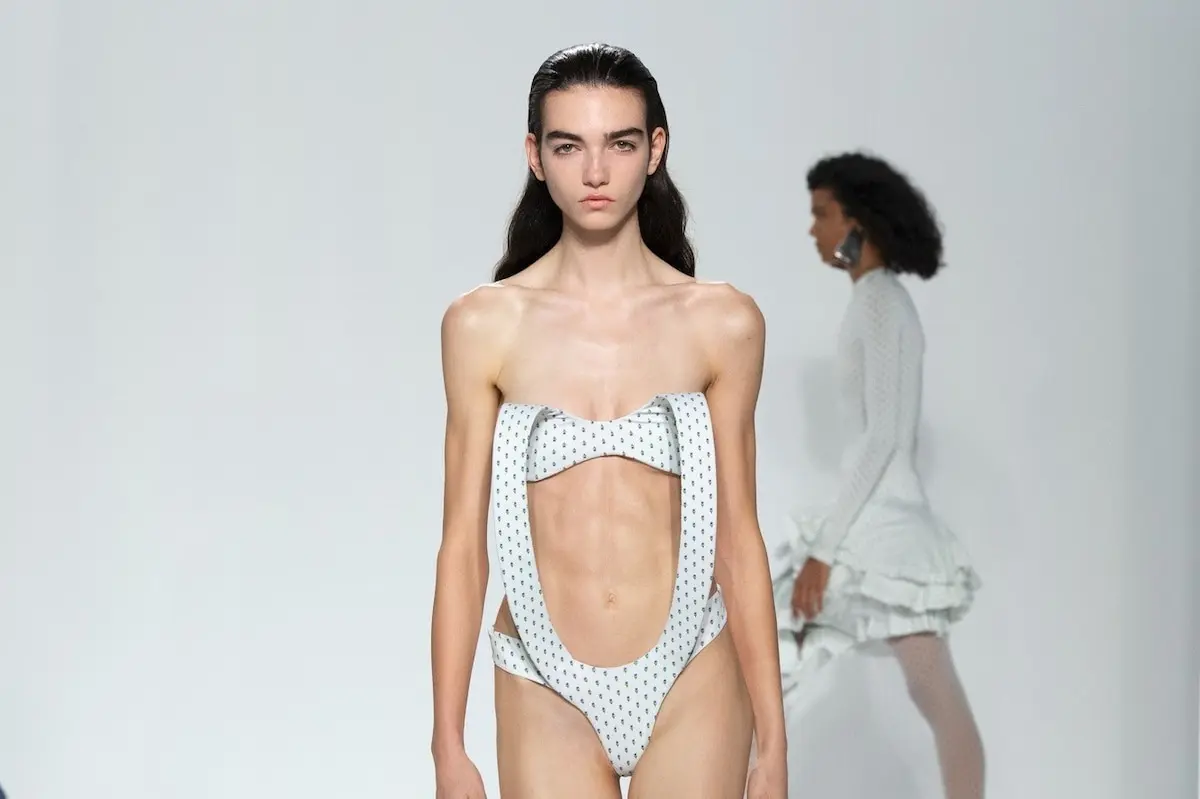
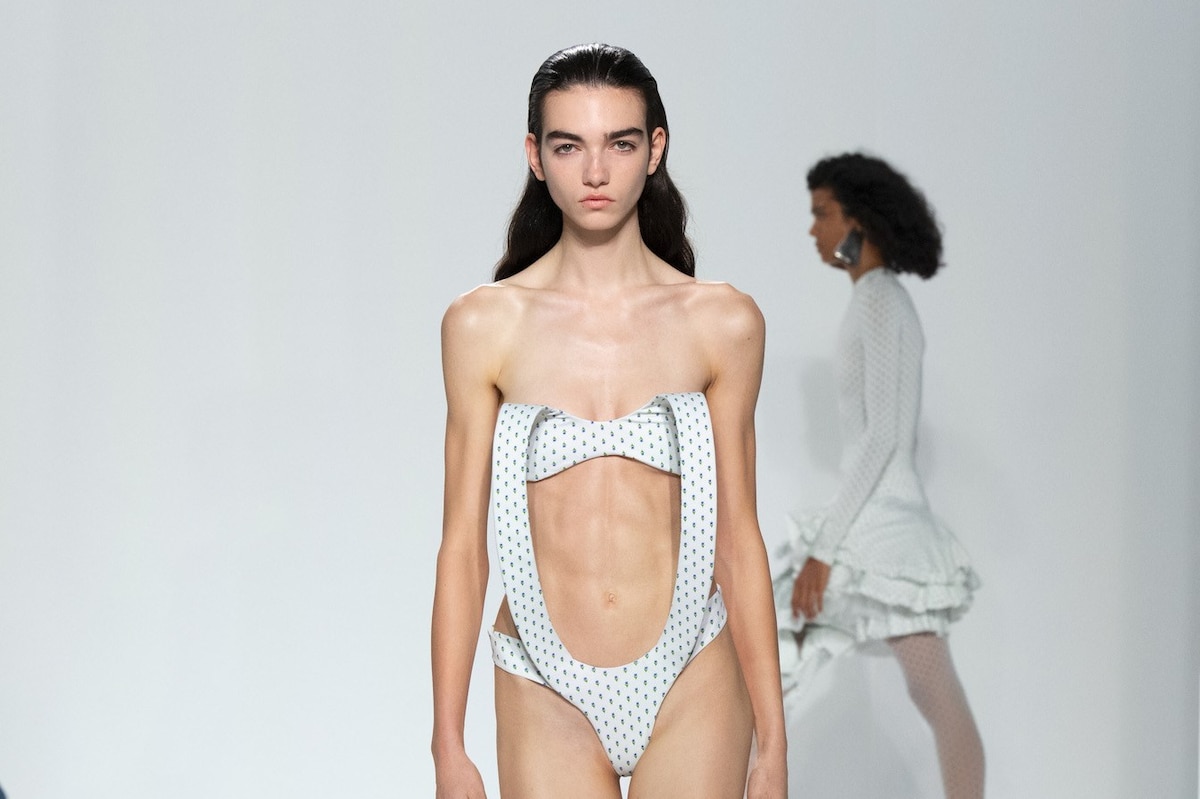
Front-row guests—including SZA, Shygirl, and Gaultier himself—witnessed a masterclass in sculptural distortion. Models stepped out in white coats featuring comically exaggerated, architectural shoulders, hulking black leather jackets, and brown leather vests where misplaced shoulder pads morphed into angular, misplaced busts. The silhouette lines dipped and warped: demure nightgowns featured dramatic keyhole cutouts exposing conical leather bras, while rigid spotted monokinis curved away from the body entirely, re-engineering the relationship between garment and skin.
Telfar: The Ultimate Bi-Coastal Prank
Perhaps no designer commanded more pre-show anticipation—or delivered a more audacious subversion—than Telfar Clemens. Returning to the European schedule for the first time since Paris Fashion Week SS20 in September 2019, Clemens initially shocked the industry by opting to show his famously New York-centric label in Paris.
International editors packed the venue, greeted by French DJ Crystallmess opening the floor in a hooded snow leopard minidress and opaque tights. Before the second look could walk, theater curtains parted to reveal a massive screen livestreaming the actual runway show in real-time—from New York City. Clemens had successfully trolled the Parisian fashion elite, turning his long-awaited European comeback into a brilliant conceptual statement on the democratization of runway real estate. Beyond the prank, the collection delivered commercial brilliance: slinky eveningwear and slouchy streetwear steeped in the gritty, nocturnal glamour of New York nightlife.
Ganni: The Triumph of Childhood Nostalgia
Under the creative direction of Ditte Reffstrup, Ganni turned its SS27 presentation into an exploration of unadulterated play and pre-adolescent freedom. Reffstrup examined the psychological space of childhood dressing—before external style rules and societal expectations take hold.
The runway featured shrunken knits and drastically oversized sweaters, emulating the sensory experience of wearing outgrown garments or raiding an older sibling’s closet. Denim was torn and haphazardly patched back together, while midi skirts ballooned into voluminous bloomers cinched with dramatic ruffles. A crayon-box palette of lilac, mint green, neon yellow, and fire-engine red dominated the space, accessorized with oversized floppy hats, candy-colored micro-bags, and cropped baseball tees stamped with the defiant, tongue-in-cheek phrase "Ask My Mum."
Balmain: A 1970s California Dream
As rain battered the Parisian pavements to the tune of The Doors’ "Riders on the Storm," Balmain’s Antonin Tronin delivered an opulent, sun-bleached journey back to 1970s California. Drawing inspiration from the bohemian literary and artistic enclaves inhabited by Jim Morrison, Joan Didion, Michelangelo Antonioni, and Michel Foucault, Tronin anchored the collection in fluid ease and rock-idol loucheness.
Draped jersey, paper-thin leather trousers, and abundant leopard print moved with effortless grace. An iridescent color palette of copper, gold, marigold, and pale yellow evoked a relentless Los Angeles sunset. Wet-look hair and body-skimming fabrics created the illusion that models had just staggered home from one of Didion’s legendary Pacific Palisades salons.
Tom Ford: Narcissistic Sensuality by Haider Ackermann
Playing on the timeless myth of Narcissus, the Tom Ford SS27 presentation was an exercise in uninhibited seduction. Mirrored glass walled the runway as models glided past in sharply tailored pinstripe suits worn over bare skin, alongside complete looks constructed from fetishistic black leather.
Haider Ackermann took Tom Ford’s historic lexicon of luxury and amped it to its absolute limits. Fishnet shirts, sheer midi skirts, and intricate bralettes left virtually nothing to the imagination. Any remaining ambiguity regarding the collection’s carnal inspiration was dispelled by an explicit runway soundtrack composed of heavy breathing and rhythmic moans, cementing a nocturnal fantasy of pure eroticism.
Issey Miyake: The Physics of Air and Movement
Satoshi Kondo’s research for Issey Miyake SS27 began with a fundamental question of physics: how does lightweight fabric react when floating weightlessly through the air? Staged at Paris’s Judo Institute, the presentation opened with eleven modern dancers contorting a massive wave of blue fabric.
As the wave parted, models emerged wearing cornflower blue bodices sculpted like Plaster of Paris molds fused directly to the body. These structured elements contrasted sharply with the subsequent billowing crinkled silks, ballooning trench coats, and fluttering trousers that trailed behind the models. The garments appeared entirely alive, breathing and expanding with every step in a transcendent celebration of human movement.
Givenchy: Sarah Burton’s No-Nonsense Pragmatism
In her fourth women’s collection for Givenchy, Sarah Burton continued to strip away stylistic superficiality in favor of a powerful, functional wardrobe tailored for modern professional life. The opening look—a classic black leather shift dress featuring side zips that opened to reveal electric flashes of yellow—established a tone of calculated versatility.
The collection balanced biker-inspired micro-shorts and zippered knee-high boots with refined tailoring. Divisive pepums returned on jewel-toned satin blazers paired with straight-leg denim, while ribbed cotton vests anchored structured power suits featuring razor-sharp shoulders. Burton reserved her masterstroke for the finale: an evening gown blanketed in tapestry-like beadwork that shifted and shimmered like an Impressionist oil painting under the gallery lights.
Margaret Howell: The Archetypal Autumnal Wardrobe
Margaret Howell anchored her SS27 presentation in the enduring, quiet power of British heritage dressing. Focusing on clarity, longevity, and natural fibers, Howell constructed an intellectual academic uniform comprising soft, unstructured tailoring, breathable cottons, and knee-length pleated skirts.
While the core color palette remained steadfastly neutral, strategic flashes of rich crimson—peeking from beneath lapels or tied lazily over shoulders—infused a vibrant energy into the lineup. Lopsided bucket hats and casually undone suiting added a vagabond, literary edge to garments engineered for enduring durability across multiple seasons.
Hermès: Intelligent Dressing and Solar Reflection
Prompted by the stifling heatwave that paralyzed Paris over the summer months, creative director Nadège Vanhée focused the Hermès SS27 collection on tactical airflow and solar reflection.
The first half of the collection utilized a pale, light-reflecting palette of bluish whites, creams, and neutral beiges, before transitioning into explosive bursts of sunshine yellow and fiery orange-red. Intelligent modularity defined the tailoring: silk scarves effortlessly doubled as halter tops, and bandeau pieces incorporated extreme cutouts. It was an executive masterclass in luxury, proving that functional comfort in extreme climates requires neither heavy materials nor compromised design standards.
Lacoste: Tactical Precision and Clay-Court Grit
Closing out the calendar, Lacoste’s Pelagia Kolotouros transformed the tennis court into a high-performance laboratory. Technical innovation was embedded down to the molecular level: tennis balls were physically integrated into the heels of mesh trainers to provide maximum kinetic bounce and suspension. Furthermore, the number "217" recurred as a graphic motif, honoring Novak Djokovic’s record-shattering 217 km/h serve clocked in Athens in late 2025.
Kolotouros balanced athletic grit with relaxed elegance. Hems and white trainers were purposefully smudged with clay, while crinkled, wet-look white polos embraced sweat as an emblem of athletic pride. Silhouettes were softened and relaxed, featuring imperfect washed silks, crumpled cotton tees, and belted unstructured suits shot through with flashes of tennis-ball yellow and cobalt blue.
Supporting Context & Metrics: The Climatological Shift
The overarching narrative of Paris Fashion Week SS27 was undeniably shaped by environmental realities. Meteorological data from the Île-de-France region recorded consecutive weeks of unprecedented late-season heat, directly influencing material curation across luxury houses.
Fabric Innovation: Demand for ultra-breathable, porous textiles (such as open-weave gauze, washed silk, and technical cotton meshes) surged by an estimated 42% across major European houses compared to SS26 projections.
Color Theory Adaptation: Reflective palettes—dominated by alabaster, stark whites, pale ice blues, and creams—surged in the opening segments of nearly 70% of major runway presentations, deliberately engineered to deflect solar radiation.
Footwear Ergonomics: The integration of athletic technology into high fashion (exemplified by Lacoste’s shock-absorbing heel constructions and Ganni’s lightweight vulcanized soles) reflects an irreversible consumer demand for hybrid utility.
Official Statements & Industry Reception
The cultural resonance of the SS27 season generated considerable commentary from institutional leaders and cultural icons:
"With now a full-circle calendar of shows under his belt, Lantink presses his team to retain a sense of curiosity and naivety. His ethos in seven words? ‘Always look for something that excites you.’"
— Jean Paul Gaultier Show Notes
"There’s a freedom and joy that reminds me why I fell in love with dressing up. It feels like coming home."
— Ditte Reffstrup, Creative Director at Ganni
Industry analysts noted a profound pivot toward "intelligent consumerism." While conceptual spectacles—such as Telfar’s multi-city broadcast and Tom Ford’s mirrored eroticism—dominated media impressions, retail buyers overwhelmingly placed advance orders for modular, climate-adaptable garments that bridge professional wear with extreme-weather utility.
Future Outlook: What SS27 Signals for the Global Luxury Market
As the fashion capital packs away its lights, the legacy of Paris Fashion Week SS27 will be defined by its dual commitment to conceptual disruption and functional pragmatism.
The Death of Seasonal Rigidities: As extreme weather events become the baseline rather than the anomaly, traditional seasonal categorizations (Spring/Summer vs. Fall/Winter) are giving way to continuous-wear modular systems, as demonstrated by Hermès and Givenchy.
Digital-Physical Hybridization: Telfar’s bi-coastal livestream prank has permanently lowered the barrier between physical attendance and global digital access, forcing brands to reconsider the capital expenditure of traditional European destination shows.
Intellectual Consumerism: The success of Margaret Howell’s heritage durability and Alessandro Michele’s literary initiatives for Valentino signal a discerning consumer base that increasingly demands cultural and intellectual value alongside aesthetic execution.
Paris Fashion Week SS27 has established a rigorous new baseline for the luxury sector: beauty must now coexist with intelligence, resilience, and unyielding adaptability.