Executive Overview
In the fast-evolving landscape of B2B go-to-market strategies, modern revenue teams face a persistent dichotomy: scale versus hyper-personalization. On one hand, automated outbound software promises high-volume prospecting through automated sequencing, multi-channel touches, and domain protection infrastructure. On the other hand, high-value enterprise accounts demand a level of bespoke insight—drawing from granular, cross-platform historical data—that off-the-shelf software tools rarely capture.
SaaStr AI, a leading voice and platform in the software-as-a-service community, has operationalized a hybrid model to resolve this tension. While the organization continues to route approximately 90% of its day-to-day outbound volume through established vendor platforms like Monaco, Artisan, Agentforce, and Qualified, it has built a proprietary prospecting tool directly into its internal "10K" ecosystem.
This custom agent solves a critical blind spot in standard AI sales development representative (SDR) platforms: the inability to seamlessly ingest and act upon disparate, first-party data sources that exist outside the basic CRM architecture. By bridging Salesforce histories, event attendance metrics, newsletter engagement data, and community interactions, SaaStr’s custom pitch generator transforms standard account-based marketing (ABM) into a scalable, data-dense narrative engine.
The results have redefined the organization’s approach to both customer retention and net-new acquisition, yielding exponential increases in custom pitch deployment—jumping from a handful of manual decks to dozens of hyper-tailored proposals—and proving that when it comes to enterprise-grade outreach, a hybrid approach combining vendor infrastructure with internal intelligence yields superior engagement.
Detailed Chronology: From Manual Bottlenecks to Automated ABM
The genesis of SaaStr AI’s internal prospecting tool did not begin with net-new logo acquisition; rather, it was born out of a stark operational bottleneck in customer renewals.
The Renewal Agent Breakthrough
As detailed in Episode #013 of the media series The Agents, SaaStr team member Amelia set out to solve a perennial scaling issue within the business: the creation of custom renewal decks for event sponsors. Historically, the bandwidth required to pull performance metrics, attendee counts, and historical engagement data meant that truly bespoke, highly detailed renewal decks could only be generated for the top tier of sponsors—typically the elite diamond accounts. The remaining silver and gold sponsors received largely templated, standardized follow-ups.
To break this bottleneck, Amelia constructed a dedicated renewal agent built on top of the 10K platform in roughly half a day. The engineering logic was straightforward yet comprehensive. The agent was programmed to ingest standard data from the Salesforce ecosystem—including contracts, lifetime value (LTV), email opens, Qualified chat logs, and Momentum call recordings. Crucially, it was also configured to draw from operational data that had historically lived in silos outside Salesforce, such as WordPress activity, social footprints, podcast archives, and Bizzabo lead-acquisition counts.
Once synthesized, this unified data payload was routed through the Gamma API to automatically construct fully realized, visually polished custom presentation decks.
Scaling Personalization to the Long Tail
The deployment of the renewal agent fundamentally altered SaaStr’s renewal economics. Instead of producing just five custom decks for diamond sponsors, the automated agent enabled the team to generate and dispatch 20 to 30 fully custom decks for a much broader swathe of accounts.
The downstream impact on conversion and engagement metrics was immediate and counterintuitive. Silver sponsors—companies writing smaller checks and historically experiencing the lowest renewal rates—registered reply rates that surpassed those of the high-end diamond accounts. For a smaller company, a $25,000 sponsorship investment represents a significant budget allocation compared to a $300,000 commitment from a tech giant like Google Cloud. Receiving a deeply customized deck that demonstrated a granular understanding of their specific lead generation and engagement outcomes signaled to smaller sponsors that SaaStr valued their partnership with the same analytical rigor applied to enterprise titans.
Translating Renewal Success to New Logo Prospecting
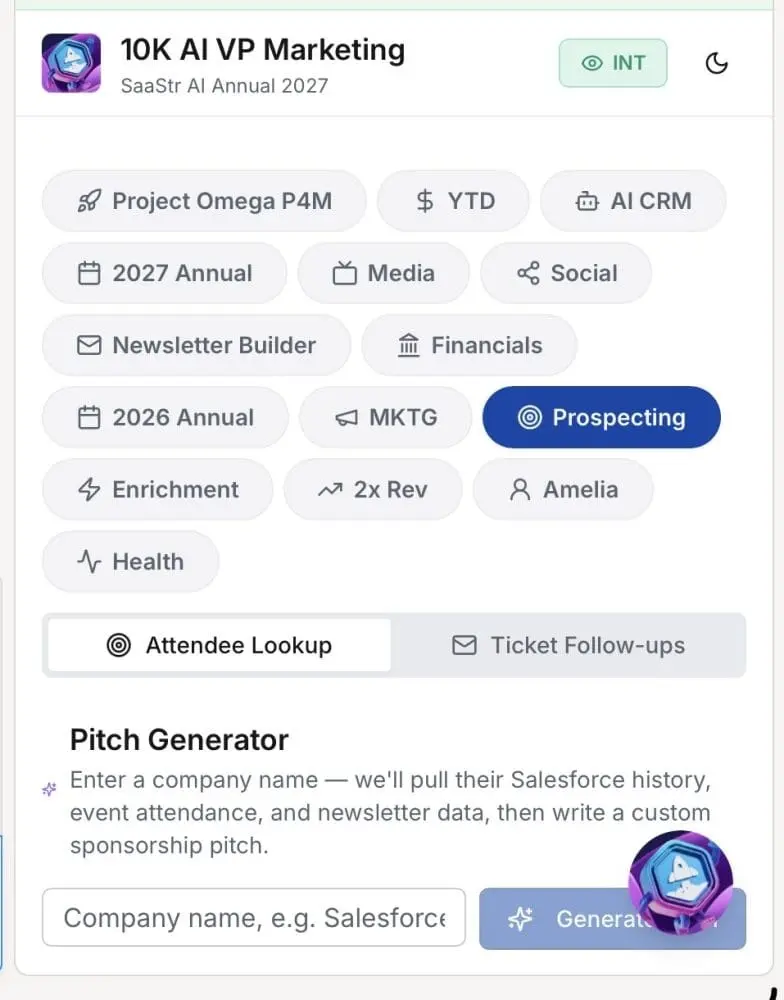
Encouraged by the efficacy of the renewal agent, the engineering and sales teams at SaaStr AI elected to apply the exact same underlying philosophy to net-new prospecting. Recognizing that standard third-party AI outbound tools suffer from data poverty—often limited to basic contact records and surface-level CRM activity histories—the team integrated the pitch generator directly into the Prospecting tab of the internal 10K platform.
Today, when sales representatives target a high-priority named account, the agent executes deep automated research. By fusing event history, past participation in major gatherings like SaaStr Annual, and digital consumption patterns (such as executive newsletter readership), the tool crafts hyper-contextualized introductory pitches that move far beyond generic value propositions.
Supporting Context & Metrics: Why Off-the-Shelf Tools Fall Short
To understand why SaaStr AI chose to build an internal tool rather than rely solely on market-leading outbound platforms, one must examine the architecture of modern sales infrastructure and the limitations of CRM data synchronization.
The Vendor Ecosystem for Volume
SaaStr AI remains an aggressive consumer of commercial AI outbound tools. According to leadership, approximately 90% of the organization’s outbound volume continues to run through established vendors.
Maintaining a massive outbound engine requires solving complex technical hurdles that span multiple domains:
- Deliverability Infrastructure: Protecting domain reputation across hundreds of thousands of contacts.
- Sequencing and Cadence: Managing timing, multi-channel touchpoints, and automated follow-ups.
- Reply Handling and Intent Recognition: Parsing incoming responses to gauge sentiment and intent.
- List Hygiene: Scrubbing bounce rates and ensuring contact accuracy.
Organizations like Monaco, Artisan, Agentforce, and Qualified have dedicated years of dedicated engineering and millions of dollars to solve these foundational infrastructure problems. Rebuilding this plumbing for SaaStr’s database of 450,000 contacts would represent an inefficient allocation of internal engineering resources. Consequently, for high-volume motions, third-party vendor platforms remain the default and correct choice.
The First-Party Data Gap
The limitation of commercial AI SDR platforms lies not in their ability to write persuasive copy, but in their restricted field of vision. A typical AI outbound tool connects to a company’s CRM and reads a fractional subset of data: basic contact fields, account names, and rudimentary activity logs.
At an organization like SaaStr, valuable operational and behavioral intelligence is distributed across at least six distinct systems, including email marketing engines, event management databases, content management systems, customer success platforms, and community forums. No off-the-shelf outbound vendor will natively wire into all of these disparate repositories for a single customer.
Furthermore, economic realities are compounding this data access problem. Major CRM providers—most notably Salesforce—have introduced metering models, such as Flex Credits, for agent API calls. Internal systems like SaaStr’s 10K platform already generate roughly 35,000 Salesforce API calls per day. As CRMs move toward consumption-based pricing for automated agents, deep, continuous CRM reads by third-party vendors will become increasingly cost-prohibitive.
Comparative Metrics of the Hybrid Model
By deploying a hybrid model—utilizing four commercial vendors for high-volume sweeps and one proprietary internal tool for strategic named accounts—SaaStr AI has established a balanced go-to-market funnel:
| Outbound Motion | Primary Engine | Target Audience | Data Sources Utilized | Output Format |
|---|---|---|---|---|
| High-Volume Outbound | Commercial Vendors (Monaco, Artisan, Agentforce, Qualified) | Broad market segments, mass cold outreach | Standard CRM fields, basic contact history | Automated multi-channel sequences & emails |
| Strategic ABM Prospecting | Internal 10K Pitch Generator | High-value named accounts, target sponsors | Salesforce history, event attendance, newsletter data, custom engagement metrics | Hyper-personalized pitches & custom collateral |
| Customer Renewals | Custom Renewal Agent (Gamma API integration) | Existing sponsors (Silver, Gold, Diamond tiers) | LTV, contract history, WordPress, social, podcast archives, Bizzabo lead counts | Fully custom review & renewal decks |
Official Statements and Strategic Rules
The operational framework governing SaaStr AI’s hybrid prospecting model is anchored by strict governance protocols designed to prevent the pitfalls common to fully autonomous AI agents.
The Human-in-the-Loop Imperative
In public discussions and internal case studies, leadership has emphasized that AI agents should propose narratives, but human operators must approve them before any collateral is generated or dispatched.
To illustrate this rule, the team points to an early deployment of the renewal agent. For a specific silver-tier renewal, the agent initially proposed a standard narrative framework: "You are a silver sponsor, consider upgrading to a gold package." However, human oversight caught a crucial contextual nuance: that specific company had emerged from stealth right before the previous event and had experienced massive organizational and financial growth since.
A human operator—Amelia—intervened and rewrote the pitch to offer three distinct, tailored options, including a specialized media-plus-content tier. Rectifying the strategic narrative prior to automated generation required only a few minutes of human intervention; attempting to manually edit a fully generated, flawed deck would have proven vastly more time-consuming.
The Two-Tiered Communication Rule
In tandem with human-in-the-loop approval, SaaStr enforces a strict structural protocol regarding outreach sequencing:
- The Initial Touch is Concise: The first outreach email generated by the system is deliberately short. Data across SaaStr’s campaigns demonstrates that an initial email lacking an attached deck consistently achieves higher response rates than emails leading with heavy collateral. Furthermore, the replies to these brief introductory notes provide actionable intelligence regarding what the prospect actually cares about.
- The Deep Dive Follows Engagement: Once a prospect responds, the comprehensive, deeply researched pitch or custom asset is deployed by a human representative.
Leadership Insights
Reflecting on the rationale behind building a proprietary tool rather than attempting to buy one off the shelf, Jason Lemkin noted:
"We couldn’t get that from third-party services… It just can’t, today, it can’t be bought."
Seeking hyper-personalized outreach that bridges the gap between the perfect email and the perfect deck, SaaStr’s internal deployment generated significant pipeline impact, logging over 17,000 conversations and 600 qualified meetings while driving a 2.1x increase in engagement efficiency across targeted campaigns.
Future Outlook: The Next Phase of AI-Driven Go-To-Market
As the market matures, the dividing line between standard sales automation and true account-based intelligence will only sharpen. SaaStr AI’s trajectory offers a compelling blueprint for B2B organizations navigating the next generation of go-to-market technology.
The Commoditization of Volume
As more companies adopt commercial AI outbound tools, the marginal effectiveness of generic, high-volume cold outreach will inevitably decline. Inboxes are increasingly saturated by AI-generated sequences that rely on superficial personalization markers—such as referencing a prospect’s recent LinkedIn post or university alma mater. While these touches outperform traditional spray-and-pray emails, buyers are quickly learning to identify and filter out formulaic AI SDR outreach.
The Rise of Proprietary Data Moats
The true competitive advantage in outbound sales is shifting away from software features and toward proprietary data moats. Companies that possess unique first-party data—such as event attendance records, community engagement histories, proprietary usage metrics, and niche content consumption patterns—will increasingly find that off-the-shelf software cannot adequately leverage their unique assets.
Consequently, the architecture pioneered by SaaStr—maintaining vendor stacks for baseline operational volume while investing in lightweight, internal agentic workflows built on top of proprietary databases—is likely to become the gold standard for sophisticated enterprise sales teams.
What Lies Ahead for 10K and SaaStr AI
SaaStr AI has signaled that its internal tool evolution is ongoing. Having already proven the efficacy of the renewal agent and the net-new prospecting pitch generator, the engineering team is actively exploring replacing portions of their existing vendor stack with native capabilities built directly into the 10K platform.
By continuing to tighten the feedback loop between CRM intelligence, first-party digital behavior, and automated generation APIs (such as Gamma and custom LLM wrappers), SaaStr aims to push the boundaries of what is possible in AI-assisted account-based marketing. For B2B leaders watching from the sidelines, the message is clear: while third-party vendors remain essential for keeping the engines of scale running, true enterprise differentiation will belong to those who build systems capable of listening to their own internal data.