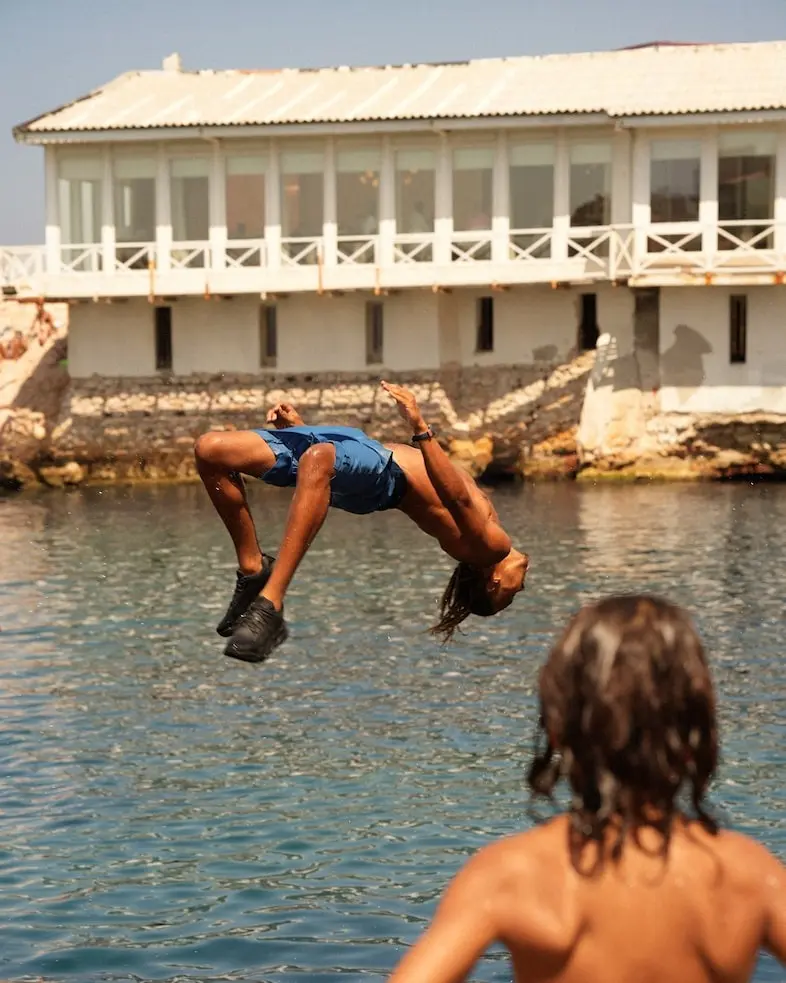
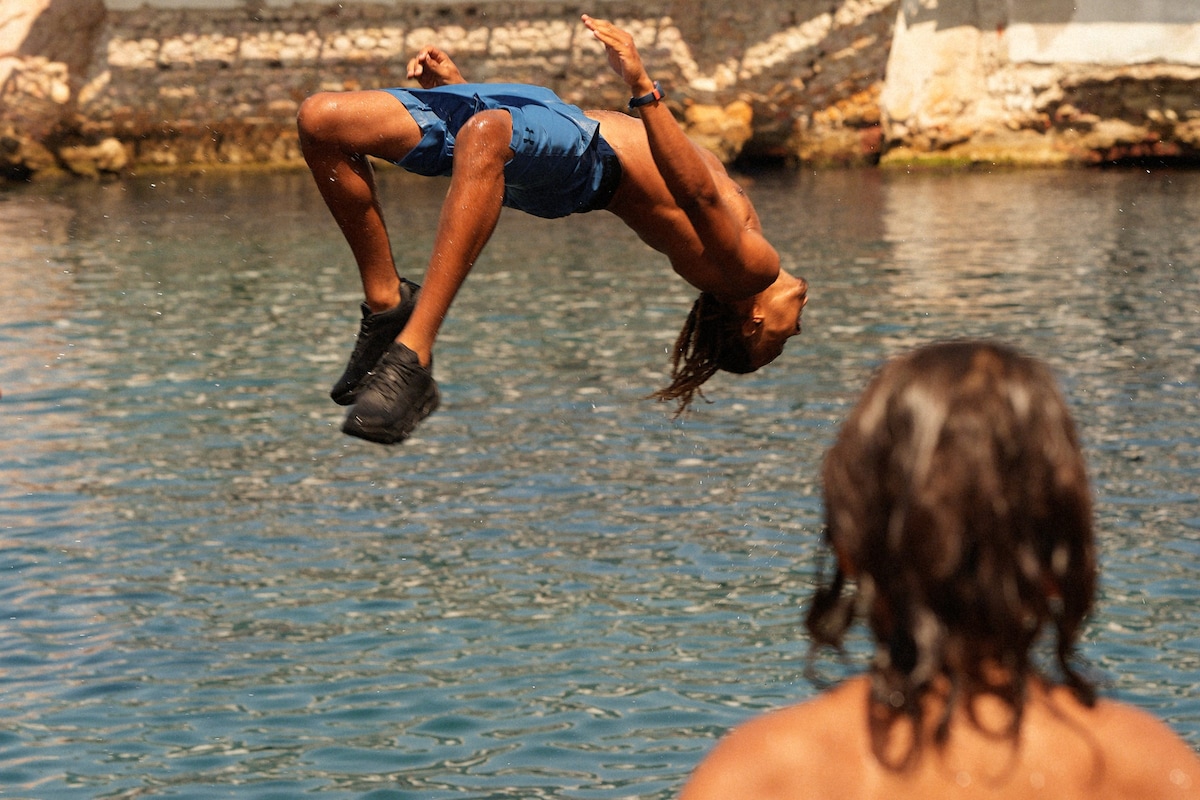
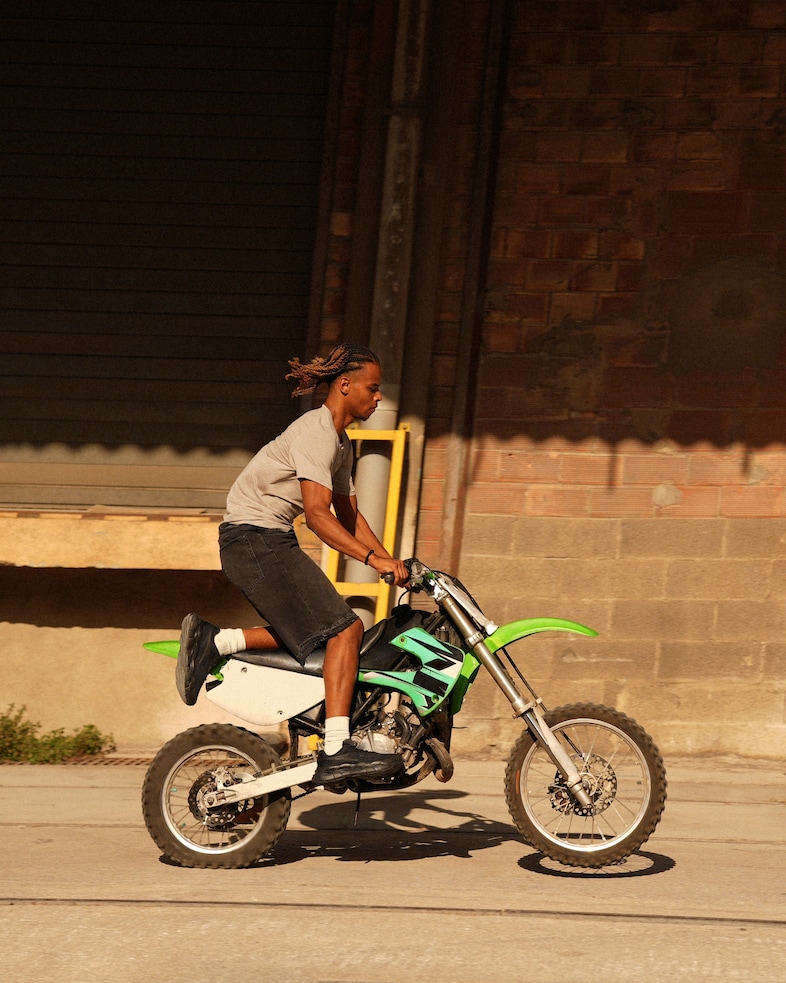
MARSEILLE, FRANCE — A green dirt bike revs down a sunbaked, palm-lined city street, kicking up a trail of dust before cutting an engine against the rhythmic percussion of the Mediterranean tide. A few blocks away, a tight-knit group of friends skates down toward the coastline, laughing as the afternoon heat bounces off the concrete. Without missing a beat, one of them launches into a fluid backflip, plunging headfirst into the glittering, cerulean waves.
It is the kind of cinematic, sun-drenched vignette designed to trigger a sharp pang of envy as you tap mindlessly through your Instagram stories. For most, these images represent an idealized, curated fantasy of youth—a digital postcard consumed through a screen. But for Ismael (widely known as Bako), Fares, Mohamed, and Sheri, this is not a highlight reel designed for public consumption. This is simply Tuesday.
Hailing from a remarkably diverse mosaic of social, economic, and cultural backgrounds, these young men call Marseille their shared home. Yet, in an era defined by hyper-individualism, digital isolation, and the relentless curation of personal brands, their bond represents something increasingly rare: a modern brotherhood forged not out of convenience, shared privilege, or neighborhood pedigree, but out of absolute solidarity.
This deep-rooted kinship, captured as part of Under Armour’s Rest Less series—a campaign spotlighting collectives that manifest their restless energy in real life (IRL)—offers a profound blueprint for community. Eschewing the superficiality of modern networking, Bako and his friends have built an oasis of authentic connection against the gritty, beautiful backdrop of southern France.
Executive Overview
In contemporary urban sociology, the phenomenon of the modern affinity group is often studied through the lens of fragmentation. Modern cities—even vibrant, multicultural hubs like Marseille—frequently function as vectors of division, segregating populations along lines of class, ethnicity, and geography. Against this socio-economic backdrop, the formation of resilient, cross-cultural collectives is an anomaly.
The Marseille collective bridges these divides organically. Bound by a shared passion for movement, street culture, and mutual survival, Bako, Fares, Mohamed, and Sheri have constructed an infrastructure of emotional and physical support that operates entirely outside traditional institutional frameworks. Their story is a compelling case study in urban resilience, demonstrating how marginalized or diverse youth can leverage their immediate environment to create systems of collective care.
This feature explores the genesis of their brotherhood, the city that serves as their crucible, the foundational ethos that governs their daily lives, and the broader cultural implications of what it means to live "restlessly" in an age of algorithm-driven alienation.
Detailed Chronology: From Strangers to Chosen Family
The genesis of any profound relationship is inherently accidental—a roll of the dice in the vast probability matrix of urban life. You never quite know when a fleeting glance with a stranger across a crowded skate park or a dusty beach path will pivot into a lifelong alliance. For Bako and his peers, this was precisely the mechanism of their unification.
Phase 1: The Incubation Period (The Chance Encounters)
Long before they shared meals, motorcycle rides, or medical crises, the members of the collective were simply disparate figures orbiting the same municipal landmarks. Marseille’s public spaces—its concrete skate parks, sun-bleached promenades, and bustling neighborhood corners—acted as the primary staging grounds.
"The start of a friendship can be spontaneous," reflects Bako, looking back on the early days before the group solidified. "None of us planned this. We were just crossing paths as strangers at the skate park, down by the beach, and hanging around the neighborhood."
In these initial encounters, social strata were instantly flattened. On a skateboard ramp or a stretch of sand, ancestral background, financial status, and family history hold no currency. What mattered instead was an unspoken mutual respect—a shared cadence of movement and an openness to the unknown. Over months, these transient hellos evolved into lingering conversations, which gradually deepened into regular hangouts until, almost imperceptibly, the group crossed the threshold from acquaintanceship into kinship.
Phase 2: Testing the Metal (The Crucible of Crisis)
A brotherhood built solely on fair-weather recreation is brittle; true community is revealed only when tested by adversity. For this Marseille collective, the ultimate test arrived when Bako faced a severe, prolonged health crisis.
For many young adults, chronic illness or medical emergencies can induce profound isolation, as peer groups often scatter when confronted with vulnerability and heavy emotional labor. The opposite occurred here. Throughout Bako’s ordeal, the group doubled down on their commitment to one another.
"They never stopped being there for me throughout that difficult time," Bako recalls, his voice carrying a quiet, immense weight. "When you go through something like that, you find out who is standing next to you. Today, I am just happy and grateful to be surrounded by them."
This period cemented the group’s foundational philosophy: their bond was not merely an aesthetic lifestyle choice for social media, but an unshakeable support network designed to absorb life’s heaviest shocks.
Supporting Context & Metrics: The Sociological Landscape of Marseille
To fully understand the resonance of the group’s dynamic, one must examine the unique urban ecosystem of Marseille itself. As France’s second-largest city and its oldest port, Marseille has historically functioned as a historic gateway between Europe, North Africa, and the broader Mediterranean world. It is a city defined by intense contrasts—a place of breathtaking coastal beauty juxtaposed with pockets of profound economic deprivation, social tension, and systemic integration challenges.
| Sociological Factor | Marseille Context | Impact on the Collective |
|---|---|---|
| Demographic Diversity | High concentration of immigrant communities and diverse cultural diasporas. | Acts as a natural crucible, bringing together individuals from vastly different walks of life. |
| Urban Geography | Dense neighborhoods intersecting with expansive public coastlines and open-air recreational spaces. | Provides free, accessible "third places" (skate parks, beaches) essential for organic community formation. |
| Economic Pressures | Elevated youth unemployment rates compared to national French averages. | Fosters a "community-first" resource-sharing mentality (the 5-5 rule) to buffer against systemic precarity. |
"Marseille has influenced our relationship as a group because the city allowed all of us to meet even though our lives are all very different," Bako explains. "It’s like a checkpoint that brings people together, no matter where they come from."
In urban planning, sociologists often reference Ray Oldenburg’s concept of "third places"—environments separate from the home (first place) and the workplace/school (second place) where people gather simply to exist and connect. In Marseille, the streets, the seawall, and the skate parks operate as vital third places. They are democratic spaces where the city’s multicultural youth can negotiate identities, build trust, and circumvent the socio-economic barriers that institutional structures often reinforce.
Bako’s Code: Five Rules for Modern Kinship
During interviews detailing their inclusion in Under Armour’s Rest Less initiative, the collective articulated a remarkably structured ethical framework. Far from living impulsively, the group operates under a strict internal code designed to safeguard their unity against external pressures.
Below are the five core pillars that govern Bako, Fares, Mohamed, and Sheri’s brotherhood:
1. Never Lie
"We’re a family, and we trust each other. As we say: ‘A lie takes the elevator, and the truth takes the stairs.’"
Trust is the non-negotiable currency of the collective. In an environment where the outside world can be unpredictable and unforgiving, absolute internal transparency ensures that psychological safety is maintained. Lies, no matter how small, introduce friction into a machine that relies on seamless coordination.
2. Always Stick Together
"Despite the ups and downs, we stay in the same car, and nobody jumps out while we’re on the road."
This vehicular metaphor speaks directly to loyalty through turbulence. Life in a vibrant, fast-paced port city inevitably brings vocational, financial, and personal detours. The rule dictates abandonment is not an option; if one member stalls, the others pull over to help fix the engine.
3. Laughter as a Baseline
"Honestly, when we’re together, we do not even have to try."
While the group handles serious burdens—from health scares to socio-economic hurdles—joy is treated as a vital nutrient rather than a luxury. The effortless nature of their collective laughter serves as an emotional pressure-release valve, neutralizing stress and sustaining their collective momentum.
4. Move Forward Together
"For us, we like to lift each other up so that we can move forward together and see each other grow."
This principle rejects zero-sum individualism. In competitive modern societies, peer groups often fracture as individuals prioritize personal advancement at the expense of others. For this collective, individual success is meaningless if achieved in isolation; growth must be communal, participatory, and shared.
5. Sharing (The 5-5 Mentality)
"This is the most important one. The 5-5 mentality. It means that if I have something and you don’t, we have it. If you have something and I don’t, we have it. And if neither of us has it, we figure it out. In our family, when one person eats, everyone eats. And it applies to everything. We make sure that nobody is missing anything."
Perhaps the most radical tenet of Bako’s code, the "5-5 mentality" is an operational model of absolute resource pooling. Whether it is material support, emotional bandwidth, or financial assistance, scarcity is met with collective abundance. It is an ethos that echoes traditional indigenous and working-class solidarity models, modernized for a generation navigating the pressures of the 21st century.
Official Statements & Cultural Philosophy
The partnership with Under Armour’s Rest Less campaign frames these localized dynamics within a global conversation about youth culture, authenticity, and physical expression. The initiative seeks to dismantle the polished, sterile perfection championed by mainstream social media algorithms, favoring instead the raw, unscripted friction of real-world communities.
For the collective, fulfillment is explicitly decoupled from traditional metrics of capitalist achievement—such as solitary career milestones, digital clout, or material accumulation. Instead, fulfillment is found in the richness of a shared life: the tactile thrill of a motorcycle ride, the salt air of the Mediterranean, the physical exhaustion of a day spent skating, and the deep, abiding comfort of knowing that someone will answer the phone when the existential or literal storms roll in.
"It’s about embracing an abundance mindset, making room for each other’s self-expression, and feeding each other’s momentum, no matter what," notes the collective statement accompanying the campaign. Driven by a community-first mindset that prioritizes care, openness, and mutual elevation, they project a rare sense of intimacy. As the old adage goes: if you know, you know. And for those outside this circle, the message is clear—hope you can find your own version of it, because this is what life is truly about.
Future Outlook: Reclaiming the Physical Public Realm
As we look toward the future, the implications of Bako and his friends’ lifestyle extend far beyond the sun-baked avenues of Marseille. We are currently living through what public health officials have diagnosed as a global loneliness epidemic. Young adults globally are spending unprecedented hours tethered to digital interfaces, witnessing life through glowing rectangles while experiencing record lows in meaningful face-to-face community engagement.
The Marseille collective serves as a vital counter-narrative. Their existence proves that the physical public realm—when actively reclaimed through movement, play, and radical empathy—still holds the power to heal, unite, and transform strangers into kin.
In the years ahead, as urban spaces continue to commercialize and privatize communal zones, the preservation of "third places" like Marseille’s skate parks and beaches will be paramount. Collectives like Bako’s remind us that human resilience does not stem from algorithms, optimization software, or isolated self-reliance. It stems from the simple, radical act of sharing your path with others, keeping your hands on the handlebars, and making sure that when one person eats, everyone eats.