Executive Overview
For most travelers, a road trip is defined by the miles checked off the odometer, the blur of asphalt vanishing in the rearview mirror, and the final arrival at a destination. Once the engine is killed, the hours spent navigating winding backroads, battling sudden downpours, or discovering off-the-beaten-path diners often fade into a monolithic blur of time. The journey itself—the very essence of travel—is routinely overshadowed by the destination.
Enter Milepost, a standout new entry in the independent app ecosystem that seeks to fundamentally rewrite how we interact with our drives. Featured as part of the Indie App Spotlight series, Milepost is designed to transform mundane commutes and cross-country expeditions alike into rich, interactive, and deeply personal digital journals. By seamlessly blending automated data capture with qualitative journaling, Apple ecosystem integration, and a social network built specifically for vehicle enthusiasts, Milepost bridges the gap between raw GPS telemetry and meaningful human memory.
As independent developers continue to push the boundaries of what is possible within Apple’s software frameworks, Milepost distinguishes itself not merely as a utility tool, but as a lifestyle companion. Available across iOS, iPadOS, macOS, and watchOS with robust CarPlay integration, the application utilizes modern hardware capabilities to document routes, track weather patterns, catalog musical backdrops, and foster a community of drivers who view their vehicles as extensions of their personal stories.
Detailed Chronology: The Evolution of Journey-Tracking Software
The Pre-Digital Era of Navigation and Logging
To understand the significance of what Milepost achieves, it is helpful to look backward at the evolution of road trip documentation. For decades, capturing a journey meant relying on physical road atlases with highlighted routes, disposable cameras tucked into glove compartments, and paper journals where drivers scribbled mileage notes at gas stations. These analog logs were charming, but they were cumbersome to maintain, prone to loss or damage, and disconnected from the real-time data of the vehicle.
The Rise of Fitness and Fitness-Adjacent Trackers
When smartphones equipped with GPS arrived, the software landscape quickly adapted to track movement—primarily through the lens of fitness. Applications like Strava, Nike Run Club, and various cycling computers revolutionized how runners and cyclists documented their paths, transforming every jog into a quantifiable dataset complete with elevation profiles, splits, and maps.
However, a distinct gap remained in the market for drivers. While mapping applications like Apple Maps and Google Maps excelled at getting users from Point A to Point B via the most efficient route, they treated the journey as a problem to be solved rather than an experience to be savored. Once a navigation session ended, all historical context vanished, leaving behind no record of the spontaneous roadside stops, the changing atmospheric conditions, or the soundtrack that accompanied a twilight drive through mountain passes.
The Conceptualization and Launch of Milepost
Recognizing this void, the creators of Milepost set out to build an ecosystem tailored specifically to the psychology of driving. Rather than focusing purely on navigation, the application was engineered to act as an archival assistant. By running quietly in the background—or interfacing directly via CarPlay—Milepost began logging the invisible metadata of a drive: exact distances, peak and average speeds, duration, and localized weather data.
Over subsequent development iterations, the application evolved from a simple telemetry logger into a comprehensive journaling platform. The introduction of "Roadbooks"—multimedia galleries combining user notes, photography, and track data—elevated Milepost from a nerdy data-collection tool into an emotionally resonant digital scrapbook. The recent rollout of deep Apple ecosystem compatibility, including Shortcuts, Siri support, and an innovative Model Context Protocol (MCP) server integration, has positioned Milepost at the cutting edge of consumer software design.
Supporting Context & Metrics: Under the Hood of Milepost
To appreciate the scope of Milepost, one must examine its multifaceted feature set, designed to cater simultaneously to data-driven technophiles and memory-keeping sentimentalists.
Comprehensive Telemetry and "Roadbooks"
At its core, Milepost answers the question: Where did I actually go, and what was it like? Every recorded drive preserves critical data points:

- Route Mapping: High-resolution GPS tracking mapping the exact trajectory taken.
- Environmental Metrics: Automatically logged weather conditions, providing context to whether a drive was under clear blue skies or through a torrential downpour.
- Dynamic Statistics: Precise breakdowns of total distance covered, elapsed time behind the wheel, and speed metrics.
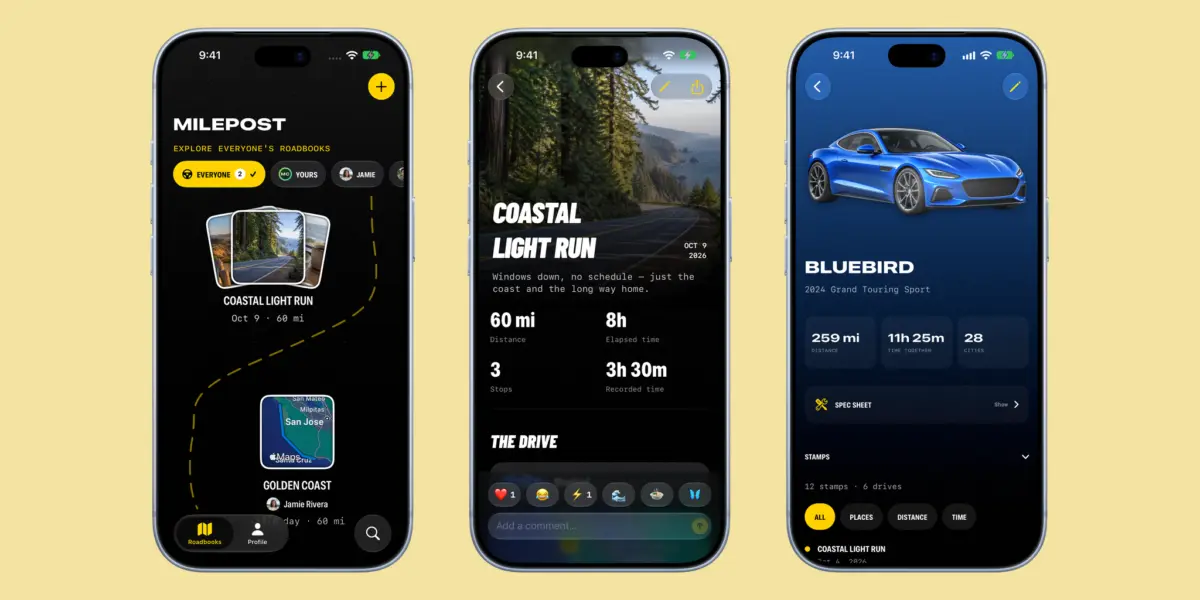
However, data points alone do not make a memory. Milepost allows users to inject narrative into their telemetry through Roadbooks. A Roadbook functions as a chronological timeline of a specific trip. Drivers can append high-resolution photographs, write personal journal entries about hidden gems discovered along the highway, and even integrate with Apple Music. By syncing with Apple Music history, the app creates a permanent audio fingerprint of the drive—revealing precisely which album or playlist was playing when the user crossed state lines or navigated a coastal highway at sunset.
Social Connectivity and the Virtual Garage
Driving has historically been an isolating experience, yet road-tripping is deeply communal. Milepost bridges this divide by incorporating a dedicated social network tailored to drivers. Users can selectively share their journeys with friends and fellow enthusiasts, who can then leave comments, react to milestones, and follow along with live updates.
Complementing the social feed is the Garage feature. Designed for car lovers, this dedicated space allows users to showcase their vehicles, cataloging the make, model, year, and modifications of the cars that carry them on their adventures. It transforms the app from a personal diary into a community-driven hub for automotive culture.
Cutting-Edge Ecosystem Integration
Milepost distinguishes itself through deep integration with the Apple hardware and software stack:
- CarPlay: Offers a streamlined interface to manage trip recording safely from the dashboard without interacting with a handheld smartphone.
- Siri & Shortcuts: Enables hands-free control, allowing drivers to initiate logging, add voice notes, or query trip statistics using natural language commands.
- macOS Support: Provides a larger, desktop-optimized canvas for users who wish to meticulously review, organize, and edit their roadbooks on a high-resolution Mac display.
- MCP Server Support: A forward-thinking feature that introduces an Model Context Protocol server. This allows users to interface their historical driving data with AI agents, making it possible to plan future travel itineraries based on past preferences, favorite routes, and historical driving habits.
Pricing, Accessibility, and Tiered Offerings
Milepost operates on a freemium business model designed to make the core journey-recording experience accessible to all users while offering advanced archival and customization tools for power users.

- Free Tier: Available immediately on the App Store, the free version grants users access to the fundamental drive-recording capabilities, allowing anyone to start capturing their daily commutes and weekend excursions without financial commitment.
- Milepost Pro: For enthusiasts seeking to unlock the full potential of the platform, the Pro subscription unlocks complete, unrestricted drive history, advanced design layouts for sharing, alternative app icons to customize the home screen, and deep driving insights.
- Subscription Pricing Structure:
- Monthly: $4.99 per month
- Annual: $29.99 per year
- Lifetime License: $199.00 flat fee for permanent access
- Trial Offer: All Pro tiers are available with a 7-day free trial, allowing users to evaluate the expanded feature set before committing financially.
Future Outlook: The Next Horizon for Indie Software and Travel Tech
As the software industry increasingly trends toward subscription-heavy, enterprise-focused, or AI-hyped utilities, applications like Milepost represent a refreshing counter-narrative. They demonstrate that independent developers can leverage advanced technologies—such as localized AI protocols, complex API integrations with Apple Music and Maps, and rich telemetry engines—to solve niche, highly human problems.
The inclusion of the MCP server, in particular, points toward a fascinating future for personal data management. As generative artificial intelligence and personal agents become more deeply embedded in daily life, the ability for an AI to access a structured, secure repository of one’s real-world travel history opens up unprecedented possibilities for automated, hyper-personalized travel planning. Future iterations of Milepost could dynamically suggest weekend getaways based on past weather preferences, optimal driving times, and favorite musical genres logged during previous excursions.
Moreover, as automotive displays become more software-defined and open to third-party developers via platforms like Apple’s next-generation CarPlay, applications like Milepost are uniquely positioned to transition from companion smartphone apps into native dashboard experiences.
For now, Milepost succeeds in its immediate mission: reminding us that the spaces between departure and arrival are worth remembering. Whether navigating the monotonous daily commute or embarking on a cross-country odyssey, the application ensures that every mile logged leaves a lasting mark.