Executive Overview
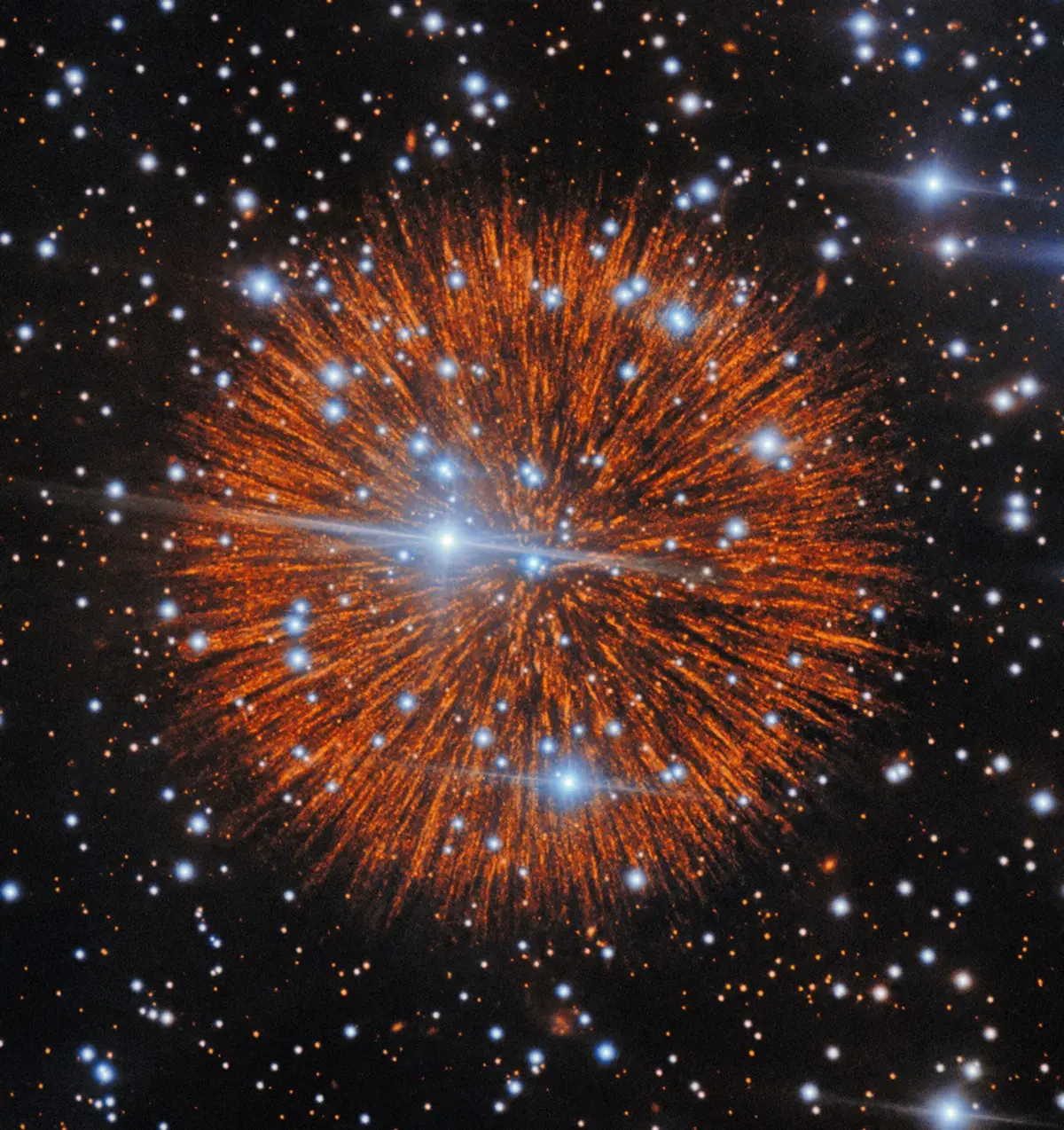
In the relentless pursuit of understanding the universe’s most violent origins, astronomers have reached a monumental milestone. Utilizing the cutting-edge capabilities of the Gemini North telescope in Hawaii, an international team of researchers has captured the most detailed, high-resolution image to date of the Pa 30 nebula. This intricate celestial object represents the expanding debris field of a historic supernova—one that lit up Earth’s night skies during the Middle Ages, meticulously recorded by medieval astronomers and chroniclers.
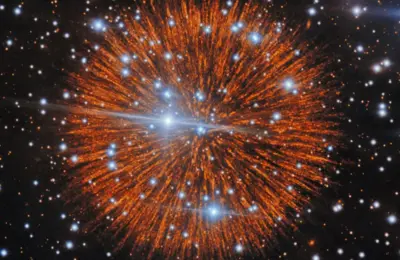
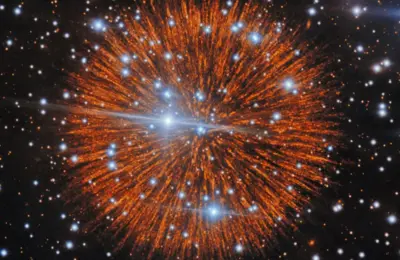
For years, the Pa 30 nebula has captivated astrophysicists due to its striking resemblance to a cosmic dandelion or an exploding firework frozen in time. However, this newly published imagery, detailed in The Astrophysical Journal, transcends previous observational limits. The data reveals an astronomical bounty previously hidden from view: approximately ten times more structural detail than any prior survey of the remnant.
Most astonishingly, the new observations shatter the long-held assumption that the nebula’s iconic expanding filaments of matter are continuous streams. Instead, high-resolution analysis shows that these strands are segmented, resembling beads strung along a thread. These "cosmic pearls"—massive, pearl-like knots of gas of startlingly uniform size—defy standard theoretical models of stellar death. Each individual knot spans an astonishing four light-days in diameter, a gargantuan scale capable of housing our entire solar system’s planetary region roughly ten times over with room to spare.
This unexpected geometric regularity in the chaotic aftermath of a stellar explosion provides a brand-new lens through which scientists can examine the mechanics of thermonuclear destruction. As researchers scramble to update their simulation models to account for this eerie order, Pa 30 stands as a testament to the fact that the universe still holds breathtaking surprises, bridging the gap between ancient human history and state-of-the-art astrophysics.
Detailed Chronology: From Medieval Stargazers to Modern Telescopes
To fully appreciate the significance of the Gemini North observations, one must trace the timeline of Pa 30—a journey that spans nearly a millennium of human observation, technological evolution, and theoretical breakthroughs.
The Middle Ages: A Guest Star in the Heavens
The story of Pa 30 begins not in a modern laboratory, but under the dark, unpolluted skies of the medieval world. Between the late 11th and early 12th centuries—specifically around the year 1181 AD—astronomers in China and Japan recorded the sudden appearance of a "guest star." According to historical texts, this mysterious luminous entity shone brightly in the night sky for roughly six months, rivaling the brilliance of Saturn before slowly fading into obscurity.
For centuries, this transient event remained a historical footnote, preserved only in ancient archives. It wasn’t until modern astrophysics developed the tools to look backward and outward that researchers began connecting historical records with high-energy remnants in the modern sky. Pa 30 is now widely recognized as the historical remnant of this very event, designated scientifically as SN 1181. It stands as one of only a handful of historical supernovae recorded before the invention of the telescope, placing it in an elite category alongside famed events like the Crab Nebula (SN 1054).
The Modern Era: Discovery and the Dandelion Phase
As radio and optical astronomy advanced through the late 20th and early 21st centuries, astronomers systematically hunted for the ghosts of historical supernovae. Pa 30 was eventually identified as a faint, expanding bubble of gas centered on a rare, ultra-hot progenitor star (often referred to as a "zombie star" formed by the merger of two white dwarfs).
Initial deep-space imaging revealed a delicate, spherical web of long, filamentary strands of matter radiating outward from the central engine. To terrestrial and orbital observers alike, the expanding ejecta bore an unmistakable likeness to a dandelion seed head caught in the wind or a frozen fireworks display. Yet, despite the aesthetic beauty of these early images, technical limitations restricted the clarity of the observations. The filaments appeared smooth and continuous, blending into a hazy wash of gas and dust that prevented scientists from examining the true fine-scale architecture of the explosion.
The Breakthrough: Gemini North and the Revelation of the Pearls
The turning point arrived when researchers turned the Gemini Multi-Object Spectrograph on the Gemini North telescope—part of the International Gemini Observatory, operated by NOIRLab—toward the northern constellation of Cassiopeia, where Pa 30 resides.
By leveraging advanced adaptive optics and high-resolution spectroscopic imaging, the research team pierced through the observational veil. The resulting data yielded an explosion in detail: roughly ten times the structural clarity of any past campaign. As the processed images were finalized, the continuous filaments dissolved into distinct, bead-like formations. The "cosmic pearls" were brought to light, marking a profound shift in our empirical understanding of SN 1181 and launching a new phase of theoretical investigation.
Supporting Context & Metrics: Decoding the Scale of Pa 30
The physical properties of the Pa 30 nebula, as quantified by the recent study in The Astrophysical Journal, challenge our intuition regarding the behavior of matter in the wake of a catastrophic stellar explosion.
Scale and Dimensions
To understand the sheer magnitude of the newly discovered "cosmic pearls," one must translate astronomical units into relatable terrestrial terms.
- Diameter of Individual Knots: Each individual gas knot measures approximately four light-days across. To put this in perspective, light travels from the Sun to Earth in about 8 minutes and 20 seconds; it takes roughly 5.5 hours to reach Pluto. A span of four light-days is exponentially larger, stretching far beyond the outer boundary of the Kuiper Belt.
- Volumetric Comparison: As noted by co-author Ilaria Caiazzo, the planetary region of our solar system could comfortably fit inside a single one of these pearl-like knots approximately ten times, with ample space left over.
- Macroscopic Structure: The nebula as a whole spans a massive volume of expanding space, with the filaments stretching outward from the central white dwarf remnant at velocities exceeding thousands of kilometers per second.
The Progenitor Mystery
Pa 30 is not the remnant of a standard core-collapse supernova, which occurs when a massive star runs out of fuel and implodes. Instead, it is classified as a rare type of thermonuclear supernova—specifically, one originating from a double-degenerate merger. In this scenario, two white dwarfs (the dense, collapsed cores of dead, sun-like stars) spiraled inward and collided.

This violent merger, known scientifically as a Type Iax supernova, failed to completely obliterate the stellar material, instead leaving behind a rapidly spinning, ultra-luminous zombie star surrounded by rapidly expanding ejecta. The interaction between the high-velocity wind from this central remnant and the surrounding shell of matter is believed to drive the formation of the intricate filaments observed today.
The Enigma of Uniformity
The most perplexing metric associated with these cosmic pearls is their uniformity. In standard fluid dynamics and explosion modeling, the chaotic collision of stellar matter produces turbulent, asymmetrical, and highly irregular clumps of debris. Gas ejected at relativistic and sub-relativistic speeds encounters varying densities of interstellar medium, resulting in a chaotic distribution of sizes and shapes.
Yet, the knots in Pa 30 display a striking regularity. Not only are they remarkably similar in physical volume and mass, but they are also evenly spaced along the linear filaments like beads on a necklace. This geometric perfection is unprecedented in supernova remnant research, forcing astrophysicists to rethink how instabilities propagate through expanding plasma.
Official Statements and Expert Perspectives
The publication of these findings has sent ripples through the astrophysical community, eliciting excitement and analytical caution from leading researchers involved in the study.
In an institutional press release from the Institute of Science and Technology Austria (ISTA), co-author Ilaria Caiazzo emphasized the baffling nature of the discovery:
"The planetary region of our solar system could fit in each knot about 10 times with room to spare. The knots are quite strikingly uniform. We are excited to try to model them."
The visual and structural symmetry has prompted theorists to re-evaluate computer simulations of thermonuclear explosions. Traditional models have long focused on bulk mixing and Rayleigh-Taylor instabilities—the fingers and plumes of hot gas that push into cooler surrounding material during an explosion. However, the beads-on-a-string morphology suggests that secondary physical mechanisms, such as magnetic field interactions, periodic thermal instabilities, or acoustic waves rippling through the ejecta, may play a dominant role in shaping the remnants of Type Iax supernovae.
Dr. Robert Smith, a theoretical astrophysicist not directly involved with the Gemini North study, noted the broader implications for stellar archaeology:
"When historical records meet modern high-resolution imaging, we are given a rare calibration point for stellar evolution. We know the exact age of Pa 30—roughly 840 years. Seeing structures of this scale and uniformity forces us to admit that our hydrodynamic models of white dwarf mergers are missing a crucial, highly organized physical parameter. These ‘cosmic pearls’ are telling us that nature has mechanisms for imposing order on chaos that we are only just beginning to decode."
Future Outlook: The Road Ahead for Supernova Remnant Research
The revelation of the Pa 30 cosmic pearls marks the beginning of a new chapter in observational astronomy, rather than the conclusion of a mystery. Armed with the unprecedented data from Gemini North, the scientific community is already charting the next steps in research and observation.
Advanced Hydrodynamic Modeling
The immediate priority for theorists is the development of three-dimensional hydrodynamic simulations capable of replicating the bead-like structures observed in Pa 30. Researchers must determine whether these knots form during the initial explosion itself or if they condense later as the ejecta cools and interacts with the circumstellar medium. Simulating a volume equivalent to four light-days per knot while maintaining high enough resolution to capture the fine filamentary alignments will push the limits of modern supercomputing.
Multi-Wavelength Campaigns
While optical imaging from Gemini North has revealed the spatial distribution of the gas knots, a complete understanding requires multi-wavelength observations. Astronomers plan to target Pa 30 with space-based observatories across the electromagnetic spectrum:
- X-ray Telescopes (such as Chandra and XMM-Newton): To probe the ultra-hot shocked gas and measure the high-energy emissions generated by the interaction between the central zombie star and the expanding shell.
- Infrared and Radio Facilities (such as JWST and the Atacama Large Millimeter/submillimeter Array): To analyze dust formation, chemical composition, and the density profiles within the individual pearls.
Expanding the Search to Other Remnants
Perhaps the most exciting prospect is the possibility that Pa 30 is not a cosmic anomaly. If bead-like, uniform gas knots are a standard feature of Type Iax supernovae or specific types of white dwarf mergers, astronomers may find similar structures in other, less accessible remnants scattered throughout the Milky Way. Surveying other historical and non-historical remnants with next-generation telescopes will reveal whether the "cosmic pearls" of Pa 30 are a rare quirk of a single star system or a universal signature of a specific pathway to stellar death.
As humanity continues to gaze outward with ever-sharper eyes, the ghost of the 1181 AD guest star reminds us that the universe is infinitely more complex, geometric, and wondrous than our ancestors could have ever imagined—and that the echoes of ancient cosmic violence continue to write poetry across the night sky.